
Written by Arthur Simitian | PartsAdvisory
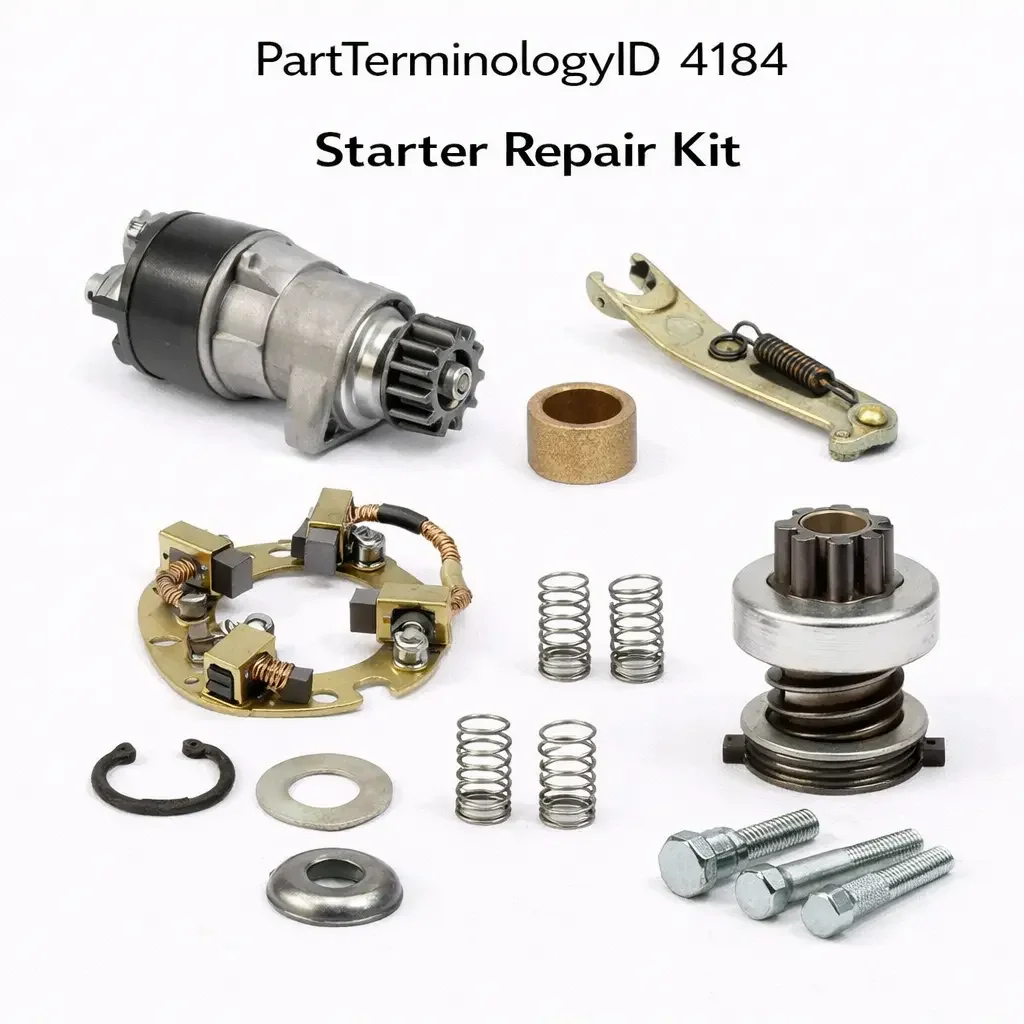
PartTerminologyID 4184, Starter Repair Kit, is the collection of replacement components packaged together to restore a failed or degraded starter motor to serviceable condition without replacing the complete starter assembly, typically including some combination of brushes, brush springs, brush holder components, solenoid contacts, overrunning drive hardware, bushings, and associated seals or washers that are the statistically most likely wear and failure components in the starter motor over its service life. That definition covers the starter repair kit function correctly and leaves unresolved what specific components are included in this particular kit versus a different kit for the same motor application, whether the kit is designed for a complete overhaul of all serviceable wear components or for a targeted repair of one specific failure mode such as brush replacement only or solenoid contact replacement only, whether the kit components are OEM specification replacements that match the original material composition and dimensional tolerances or are aftermarket equivalents that may differ in brush compound formulation, spring force, or contact material, whether the kit includes the tools or installation aids required to complete the repair such as bushing drivers, snap ring pliers, or spring compressors, and whether completing the repair with this kit requires starter motor removal from the vehicle or can be performed with the motor in situ on some accessible mounting positions.
For sellers, PartTerminologyID 4184 is the starter repair kit where kit contents completeness is the most return-generating attribute, because a buyer who receives a kit that does not include a component they believed was covered by the kit must either order an additional part to complete the repair or discover the missing component only after disassembling the motor and finding the component in a condition that requires replacement. Both outcomes generate a return of the incomplete kit. The kit contents list is the single most important attribute for this PartTerminologyID because it determines whether the buyer can complete the intended repair with only the parts in the kit, and incomplete or ambiguous contents listings generate returns from buyers who discovered the omission after beginning the disassembly.
What the Starter Repair Kit Does
Complete overhaul kit versus targeted repair kit and the scope of restoration
Complete starter overhaul kits contain all wear components that have a defined service life shorter than the starter motor housing and armature assembly, including brushes, brush springs, brush holder insulation components, solenoid main contacts, solenoid plunger tip, front and rear bushings, drive retainer hardware, and any seals or anti-corrosion washers in the assembly. A complete overhaul kit applied to a motor with adequate armature and housing condition restores all wear surfaces to new specification and allows the motor to achieve a second full service life without component replacement.
Targeted repair kits cover a specific failure mode or a subset of wear components. A brush kit contains only brushes and possibly springs. A solenoid contact kit contains the main contact disc and terminal studs. A bushing kit contains the front and rear bushings. Targeted kits are appropriate when the failure mode is confirmed as a single component and other wear components have been inspected and confirmed serviceable. They produce a lower-cost repair than a complete overhaul kit when the broader component inspection confirms serviceable condition of all non-kit components.
The distinction between complete overhaul and targeted kit determines the buyer's expectation about what the repair will accomplish. A buyer who orders a kit described only as a "starter repair kit" without clear contents disclosure may expect a complete overhaul kit and receive a targeted brush kit, generating a return when they find the solenoid contacts or bushings are not included.
Solenoid contact set and the welded contact failure mode
The solenoid main contact set is one of the most commonly failed components in high-cycle starters on vehicles with stop-start systems, frequent short-trip driving patterns, or high-ambient-temperature operation. The main contacts carry the full battery-to-motor current during every cranking event. Each closure of the main contacts produces an arc as the contact gap closes, depositing arc erosion products on the contact surfaces over time. The contact surfaces eventually develop pitting that increases contact resistance, reducing voltage delivery to the motor and increasing contact heating.
A contact set that has developed severe pitting or a contact disc that has welded to the terminal stud from a high-current arc event produces either high contact resistance with reduced cranking torque or a welded-closed condition where the starter motor runs continuously after the ignition key is released. The welded contact condition is the most urgent failure mode because it can drain the battery completely if the vehicle is left unattended, and it can overheat the starter motor windings from sustained full-current operation.
Contact set replacement without identifying the root cause of accelerated contact wear is the most common solenoid contact repair error. A contact set replaced in a motor that is experiencing high current from a failing battery, an undersized battery cable, or an engine with elevated cranking resistance from carbon buildup will produce the same accelerated contact pitting on the replacement contacts. The kit listing must include a root cause check for the conditions that accelerate contact wear.
Brush and brush spring specification and the kit-to-motor matching requirement
The brushes included in a starter repair kit must match the starter motor's brush holder cavity dimensions, shunt lead length, and composition grade. A brush that is narrower than the holder cavity will rock in the holder and produce arcing. A brush with a shunt lead shorter than required will not reach the holder terminal and will prevent correct electrical connection. A brush composition grade formulated for low-current interior motor applications will overheat in a high-current starter application.
Brush springs must match the spring type and force specification for the holder positions in the motor. A spring with lower force than specified will allow brush bounce at operating speed. A spring with higher force will accelerate brush and commutator wear from excessive contact friction. Kit listings that specify brush dimensions and spring force values allow buyers to verify compatibility before installation.
Bushing pre-soak and installation guidance within the kit context
Sintered bronze bushings included in a starter repair kit require the same oil pre-soak procedure as individually ordered bushings. A buyer who installs bushings from a repair kit without pre-soaking them in oil will experience dry-installation seizure on the first cranking cycle, destroying the new bushing and requiring another kit or individual bushing replacement. The oil pre-soak requirement must be stated in the kit instructions and in the listing to prevent this outcome.
Bushing installation also requires a correctly sized driver that matches the bushing outside diameter to prevent distortion during pressing. A repair kit that includes bushings but does not include or reference a bushing driver tool leaves the buyer to improvise an installation method that risks bushing distortion and inside diameter reduction below the shaft running clearance.
Why This Part Generates Returns
Buyers return starter repair kits because the kit contents do not cover a component the buyer believed was included and the repair cannot be completed without an additional order, the brush dimensions in the kit do not match the brush holder cavity in this motor application from a production variant difference, the solenoid contacts included in the kit do not fit the solenoid terminal geometry on this specific solenoid variant, the bushings were installed dry without oil pre-soaking and seized on the first cranking cycle, the repair kit was applied to a motor whose armature or housing requires replacement and the kit components do not restore adequate performance, the root cause of the solenoid contact failure was not addressed and the replacement contacts experience the same accelerated wear as the originals, and the kit was ordered for the wrong motor variant on an application where multiple motor specifications are cataloged under the same vehicle year and model.
Status in New Databases
PartTerminologyID 4184 is cataloged in PIES/PCdb as Starter Repair Kit. Under PIES 8.0 and PCdb 2.0 there is no change to the terminology or classification for this PartTerminologyID.
Top Return Scenarios
Scenario 1: "Kit contents incomplete for intended repair, buyer discovers missing component after disassembly"
The buyer orders a starter repair kit expecting it to include solenoid contacts based on the generic kit description. The kit contains brushes, springs, and bushings but does not include the solenoid contact set. After disassembling the motor the buyer finds the solenoid contacts are the primary failed component. The kit cannot complete the repair without the solenoid contacts. The buyer returns the kit as incomplete for the intended repair.
Prevention language: "Kit contents: This kit includes the following components: [list each component explicitly with quantity]. Solenoid contacts are not included in this kit. If the solenoid contacts are the failed component on your motor, order the solenoid contact set separately or confirm the complete overhaul kit that covers all wear components before disassembling the motor."
Scenario 2: "Brush dimensions in kit do not match holder cavity on this motor variant"
The starter motor application has two production variants with different brush holder cavity dimensions. The kit is cataloged for the standard variant. The buyer's motor is the high-output variant with a larger brush cavity. The brushes in the kit are 2mm narrower than the buyer's motor requires. The buyer discovers the mismatch after removing the original brushes and comparing them to the kit brushes. The kit is returned as incorrectly specified.
Prevention language: "Motor variant verification: Confirm the brush dimensions in this kit match the brush holder cavity dimensions in your specific motor before disassembling the motor. Multiple production variants may exist for this application with different brush specifications. Measure the original brushes before removal and confirm the kit brush dimensions match within 0.2mm in all three dimensions."
Scenario 3: "Solenoid contact disc geometry incorrect for solenoid terminal stud spacing on this solenoid variant"
The solenoid on this motor application was revised mid-production with a different terminal stud spacing. The contact disc in the kit is designed for the original stud spacing. The replacement disc does not seat correctly on the revised stud spacing and the main contacts do not close correctly when the solenoid is activated. The buyer returns the kit as including the wrong contact disc.
Prevention language: "Solenoid variant check: The solenoid contact disc in this kit is designed for the terminal stud spacing of the [year/production] solenoid variant. If your solenoid was produced after [year/production change], confirm the stud spacing matches the kit contact disc before installation. Measure the center-to-center distance between the main terminal studs and compare to the kit contact disc hole spacing before disassembling the solenoid."
Scenario 4: "Bushings installed dry, seize on first cranking cycle, kit returned as defective"
The buyer installs the sintered bronze bushings from the repair kit without reading the instructions and without oil pre-soaking. The bushings seize on the armature shaft on the first cranking cycle after reassembly. The buyer returns the kit as defective when the dry installation was the cause.
Prevention language: "Bushing installation: Sintered bronze bushings in this kit must be pre-soaked in clean motor oil for a minimum of 30 minutes before installation. Do not use solvent to clean the bushings. Dry installation without oil pre-soaking will cause bushing seizure on the first cranking cycle. Pre-soak all bushings in the kit before beginning motor reassembly."
Scenario 5: "Solenoid contact root cause not addressed, replacement contacts develop same pitting within weeks"
The buyer replaces the solenoid contacts from the kit after finding pitted main contacts. The replacement contacts are installed without checking the battery cranking capacity. The battery is producing 18 amperes above the normal cranking current demand from a partially seized engine from carbon buildup. The elevated cranking current produces above-normal arc energy at the new contacts. The replacement contacts develop the same pitting as the originals within several hundred start cycles. The buyer returns the kit as producing defective contacts.
Prevention language: "Solenoid contact root cause check: Before installing the replacement solenoid contacts, confirm the cranking current is within the normal range for this motor application by measuring battery current draw during cranking. Above-normal current from a battery that collapses under load, elevated circuit resistance, or increased engine cranking resistance will accelerate contact erosion on the replacement contacts identically to the originals. Address any cranking current faults before installing the replacement contact set."
Scenario 6: "Kit applied to motor with armature winding fault, repair does not restore full cranking torque"
The starter motor has an armature winding short from a previous over-current event. The buyer applies the complete overhaul kit to the motor, replacing all wear components. The armature winding short remains. The motor cranks at reduced torque from the winding fault. The buyer returns the kit as insufficient to restore full cranking performance.
Prevention language: "Armature and housing condition pre-check: Before ordering a repair kit, test the armature for winding shorts by performing a growler test or measuring armature winding resistance across commutator segments. A winding short will reduce motor torque regardless of wear component condition. If the armature has a winding fault, complete starter assembly replacement is more appropriate than a repair kit service. A repair kit is effective only when the armature, housing, and field components are confirmed serviceable."
Listing Requirements
PartTerminologyID: 4184
Kit scope: complete overhaul or targeted repair (mandatory)
Complete contents list with component identity and quantity per item (mandatory)
Brush dimensions: width, height, depth (mandatory)
Brush spring force specification (mandatory)
Solenoid contact disc geometry where included (mandatory)
Bushing material and pre-soak requirement where included (mandatory)
Compatible motor variants and production range (mandatory)
Motor variant verification note (mandatory)
Armature pre-check note (mandatory)
Solenoid contact root cause check note (mandatory)
Bushing oil pre-soak note where applicable (mandatory)
OEM part number cross-reference (mandatory)
Catalog Checklist for ACES/PIES Teams
PartTerminologyID = 4184
Require kit scope: complete overhaul or targeted (mandatory)
Require complete itemized contents list (mandatory)
Require brush dimension specification (mandatory)
Require bushing pre-soak note where bushings are included (mandatory)
Require armature pre-check note (mandatory)
Prevent incomplete contents return: every component in the kit must be listed by name and quantity; generic kit descriptions that do not itemize contents generate returns from buyers who discover omissions after disassembly
Prevent motor variant brush mismatch: brush dimensions must be listed and motor variant verification must be required before disassembly
Prevent solenoid contact variant mismatch: contact disc geometry and stud spacing must be confirmed against solenoid variant before installation
Prevent dry bushing seizure return: oil pre-soak requirement must be prominent in listing for all kits containing sintered bronze bushings
Prevent root cause repeat failure: cranking current check and armature pre-check must precede kit application to prevent repeat wear on replacement contacts and confirm kit application is appropriate
FAQ (Buyer Language)
How do I know if I need a complete overhaul kit or a targeted repair kit?
Disassemble the motor or have it tested before ordering. A complete overhaul kit is appropriate when the motor has high mileage and multiple wear components are at or near the end of their service life, making it cost-effective to replace all wear items at once. A targeted repair kit is appropriate when diagnosis has confirmed a specific failed component and all other wear components have been inspected and confirmed serviceable. Ordering a targeted kit for a motor with multiple worn components will require a second service when the remaining worn components reach end of life.
What should I check on the armature before applying a repair kit?
Test the armature for winding shorts using a growler or by measuring resistance between adjacent commutator segments with a low-range ohmmeter. All segments should show similar resistance within a few percent of each other. A segment pair with significantly lower resistance than the others has a winding short. Also measure insulation resistance from commutator segments to the armature shaft with a megohmmeter. A reading below 500,000 ohms indicates winding insulation breakdown. Either fault requires armature or complete starter replacement rather than a repair kit.
How do I confirm the brush dimensions in the kit match my motor before disassembling it?
If the motor is accessible with the brush holder visible, remove the brush holder access cover and measure the holder cavity dimensions directly. If the motor must be removed for service, measure the original brushes before removing them from the holder and compare to the kit brush dimensions. Confirm all three dimensions match within 0.2mm before completing disassembly.
Why do solenoid contacts fail prematurely after replacement?
Solenoid contacts fail prematurely when the cranking current is above the normal operating range from a battery that collapses under load, excessive circuit resistance, or an engine with elevated cranking resistance from carbon deposits or bearing wear. The elevated current increases arc energy at contact closure and accelerates contact surface erosion. Measure battery cranking voltage under load and confirm it holds above 9.6 volts. Measure cranking current and compare to the normal specification for this motor. Address any faults before installing replacement contacts.
Can I apply a repair kit to a motor that has been overheated from a welded solenoid contact event?
A motor that ran continuously from a welded solenoid contact should have the armature tested for winding insulation damage before a repair kit is applied. Sustained over-current from a welded contact can degrade winding insulation through the thermal buildup in the armature slots. A winding insulation test with a megohmmeter before kit application confirms whether the armature is serviceable. A motor with winding insulation failure from a welded contact event requires complete replacement rather than a repair kit.
What tools do I need to complete the repair kit installation?
Most repair kits require a set of snap ring pliers for the drive retainer snap ring, an inside micrometer or bore gauge for housing bore measurement, an outside micrometer for shaft and pin diameter measurement, a bushing driver matched to the bushing outside diameter for press installation, and a spring scale for spring force verification. A growler or low-range ohmmeter is required for armature testing before kit application. Confirm the tools are available before beginning disassembly.
What Sellers Get Wrong About PartTerminologyID 4184
The most common error by a significant margin is omitting the complete itemized contents list. A starter repair kit listing that describes the kit as a "starter overhaul kit" or "starter repair kit" without listing each included component by name and quantity produces the highest return rate of any listing pattern under this PartTerminologyID. Buyers who order based on the generic description and then discover a specific component is not included after disassembly have no recourse except to return the kit and order an additional part separately or together. The itemized contents list is the one attribute that more than any other determines whether buyers receive what they expected. Every component must be named and quantified. Every component that is not included must be identified as not included if the buyer might reasonably expect it to be in a "complete" kit.
The second error is omitting the armature pre-check note. Repair kits are the correct repair path only when the armature, housing, and field assembly are confirmed serviceable. A kit applied to a motor with a winding fault, commutator wear beyond the minimum diameter, or field winding failure will not restore the motor to full performance regardless of how complete the kit is. Without the pre-check note buyers apply kits to motors that require complete replacement and return the kits as insufficient when the motor condition was the limiting factor.
The third error is omitting the solenoid contact root cause check. Solenoid contacts that were prematurely worn from above-normal cranking current will wear the replacement contacts at the same rate. Without the root cause check note buyers replace contacts and return the kit within weeks when the replacement contacts show the same pitting as the originals. The root cause check note converts this repeat failure into a correct upstream fault diagnosis before the contacts are installed.
The fourth error is omitting the motor variant verification note. Brush dimensions, solenoid contact disc geometry, and bushing diameter specifications vary across production variants of the same motor application. A kit cataloged for one variant will not fit all variants under the same application number. Without the variant verification note buyers disassemble the motor and discover the mismatch after the point of no return in the repair process, generating a return that could have been avoided by a pre-disassembly component comparison.
The fifth error is omitting the bushing oil pre-soak note where the kit includes sintered bronze bushings. This note is required on every kit that includes bushings. Dry bushing installation seizure is the single most common immediate post-repair failure under this PartTerminologyID when bushings are part of the kit. One sentence in the listing and in the kit instructions prevents this return entirely.
Cross-Sell Logic
Starter (PartTerminologyID 4152): for buyers where the armature pre-check reveals winding shorts, commutator wear beyond minimum diameter, or field winding failure that makes complete starter replacement more appropriate than a repair kit service.
Starter Solenoid: for buyers where the solenoid housing, pull-in coil, or hold-in coil is the failed component rather than the contact set, requiring solenoid replacement rather than contact set replacement from a repair kit.
Battery: for buyers where the root cause check reveals a battery that collapses under cranking load, contributing to above-normal cranking current that accelerates solenoid contact wear.
Battery Cables: for buyers where the cranking current check reveals above-normal circuit resistance from corroded cable connections that elevates cranking current and accelerates solenoid contact pitting.
Starter Drive (PartTerminologyID 4172): for buyers where the overrunning clutch failure is confirmed as the fault and a drive-specific repair is needed rather than a comprehensive kit that includes components not requiring replacement.
Bushing Driver Tool Set: as a complementary tool recommendation for buyers installing a kit with sintered bronze bushings, ensuring correct press-fit installation without bushing distortion.
Why Catalog Data Quality Matters for PartTerminologyID 4184
Starter repair kit returns cluster around five scenarios that are fully preventable with listing language: incomplete contents disclosure, armature condition mismatch, solenoid contact root cause repeat failure, motor variant component mismatch, and dry bushing installation. These five scenarios account for the substantial majority of returns under this PartTerminologyID and every one of them reflects missing listing information rather than a product defect.
The complete itemized contents list is the highest-priority single attribute for this PartTerminologyID. More returns originate from contents disclosure failures than from any other cause. A complete, explicit, itemized list of every component in the kit by name and quantity, with explicit identification of what is not included when a buyer might reasonably expect it, prevents the largest single return category before the order is placed.
The armature pre-check note and the solenoid contact root cause note together address the two scenarios where the repair kit is correctly specified but is applied to a motor or circuit condition that limits the effectiveness of the replacement components. Both notes redirect buyers to upstream conditions that must be confirmed before the kit can deliver its designed result.
The motor variant verification note and the bushing oil pre-soak note address two scenarios that are specific to the component level and both are entirely preventable with information that is available in the listing. Variant component mismatch is prevented by requiring a pre-disassembly component comparison. Dry bushing seizure is prevented by a single sentence.
All five notes together make every listing under this PartTerminologyID complete and convert the majority of return scenarios into either correct upstream diagnoses, correct pre-order verification steps, or correct installation practices before any component is damaged.
Application Range and Fitment Guidance for PartTerminologyID 4184
Starter repair kit applications are concentrated in vehicles and equipment platforms where the starter motor is accessible for in-vehicle service, the starter motor has a design that separates major wear components for individual replacement, and the cost of component-level repair is substantially below the cost of complete starter assembly replacement. These conditions are most commonly met on commercial vehicles, fleet vehicles, agricultural equipment, marine applications, and high-usage light trucks where starter replacement frequency is high enough to justify the labor investment in component-level repair.
Passenger car starter repair kits are most practical on platforms where the starter is easily accessible and where the starter motor design accommodates disassembly with common tools. European luxury vehicle starters with high component costs and long disassembly procedures generate stronger repair kit demand than domestic passenger car starters where complete replacement is often cost-competitive with component repair.
Gear reduction starter repair kits must address the planetary gear components in addition to the brush and solenoid components, making complete overhaul kits for gear reduction designs more comprehensive than those for direct drive starters. Planetary gear wear produces a whining noise during cranking that increases with motor speed and is distinct from the grinding of pinion-to-ring-gear contact noise. Including planetary gear components in a complete overhaul kit for gear reduction starters ensures the kit addresses all wear mechanisms rather than only the brush and contact wear that dominates direct drive starter kits.
Final Take for PartTerminologyID 4184
Starter Repair Kit (PartTerminologyID 4184) is the multi-component restoration package where complete itemized contents disclosure, armature pre-check guidance, solenoid contact root cause validation, motor variant verification, and bushing oil pre-soak requirement are the five attributes that prevent the five most common return scenarios. Every listing without itemized contents disclosure generates returns from buyers who discovered missing components after disassembly. Every listing without armature pre-check guidance generates returns from kits applied to motors with conditions that limit repair effectiveness. Every listing without solenoid contact root cause validation generates repeat contact pitting returns within weeks of installation. Every listing without motor variant verification generates component dimension mismatch returns after disassembly. Every listing without bushing oil pre-soak guidance generates immediate seizure returns from dry installation.
The itemized contents list is the single highest-impact attribute for this PartTerminologyID and delivers more return prevention per word than any other content in the listing. Together with the four supporting notes, these five attributes make every listing under this PartTerminologyID complete and give every buyer the information needed to confirm the kit is appropriate for their motor, to prepare the motor correctly before kit installation, and to install each kit component correctly to achieve the designed service life.