
Written by Arthur Simitian | PartsAdvisory
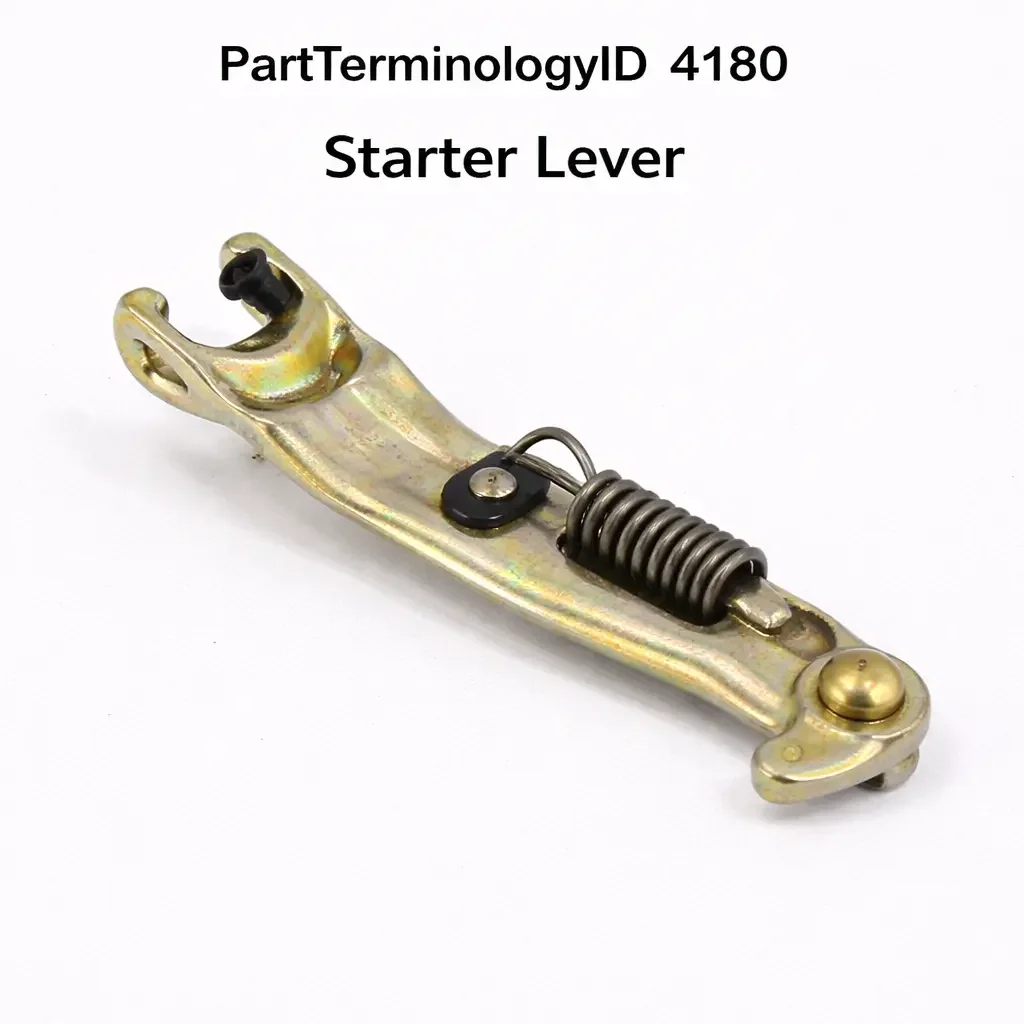
PartTerminologyID 4180, Starter Lever, is the mechanical shift fork or engagement lever within the starter motor assembly that transfers the linear stroke of the solenoid plunger into axial movement of the starter drive assembly along the armature shaft, sliding the pinion gear toward the ring gear for engagement before the solenoid main contacts close and the motor circuit is energized. That definition covers the starter lever function correctly and leaves unresolved whether the lever is a forked shift fork that straddles the drive collar and contacts the drive on both sides of the collar groove simultaneously, a single-arm engagement lever that contacts only one side of the drive collar through a single pivot point, whether the lever material is stamped steel, cast iron, or a polymer composite on some applications where weight reduction is prioritized over maximum durability, the pivot pin or pivot boss diameter and the lever bore clearance that determines the pivot wear rate, whether the lever engages a roller collar, a groove in the drive body, or the drive collar directly, and whether lever failure produces a no-engagement condition from a broken or disconnected lever, an incomplete-engagement condition from a worn pivot that reduces effective lever stroke, or a delayed-engagement condition from a lever that is binding on its pivot.
For sellers, PartTerminologyID 4180 is the starter lever where pivot wear producing incomplete drive engagement is the most return-generating attribute, because a lever with a worn pivot bore increases the pivot clearance beyond the design tolerance, reducing the effective stroke delivered to the drive collar for a given solenoid plunger stroke. The reduced effective stroke may be sufficient to begin engaging the drive but insufficient to fully mesh the pinion with the ring gear, producing a partial engagement condition where the pinion contacts the ring gear face at an angle rather than full mesh. This partial engagement produces a grinding noise and ring gear tooth damage without completing engine cranking, and the buyer may attribute the symptom to the solenoid, the ring gear, or the drive rather than identifying the lever pivot as the fault source.
What the Starter Lever Does
Shift fork geometry and mechanical advantage
The shift fork is designed with a specific arm length ratio between the solenoid plunger connection point and the drive collar contact points. This ratio determines the mechanical advantage the lever provides: a longer arm on the drive side multiplies the solenoid plunger stroke into a larger drive collar movement, while a shorter arm on the drive side reduces the stroke multiplication. The designed ratio ensures the drive collar travels the full distance from the retracted position to the fully meshed position within the solenoid plunger's stroke range.
A lever that is bent from impact or heat distortion changes the arm length ratio and the effective stroke multiplication. A lever bent toward the drive side of the pivot increases the drive stroke beyond the designed maximum, potentially driving the pinion too deeply into mesh or jamming the drive against the stop. A lever bent away from the drive side reduces the stroke below the minimum required for full mesh, producing the partial engagement condition described above.
Pivot pin condition and the wear-induced stroke reduction
The starter lever pivots on a pin or boss that is integral to the starter front housing. The lever bore that rides on this pivot must maintain a running clearance that allows lever rotation without lateral play that changes the effective pivot radius. As the pivot bore wears, the lever can rock laterally on the pivot, reducing the effective moment arm and the stroke delivered to the drive collar.
Measuring the pivot pin diameter and the lever bore diameter confirms whether the clearance is within the specification that maintains correct stroke delivery. A clearance above the maximum specification requires lever replacement. If the pivot pin is also worn, the housing assembly requires replacement or pin replacement before a new lever will maintain correct clearance with the new pin.
Why This Part Generates Returns
Buyers return starter levers because the pivot wear was not identified and the housing pivot pin is also worn, requiring pin replacement alongside the lever for correct clearance, the lever fork engagement groove or roller collar contact points are worn and the new lever does not engage the drive collar correctly on the first application, the solenoid plunger stroke is outside specification and even a correct new lever cannot deliver full drive engagement from an insufficient plunger stroke, and the lever is bent from impact during installation with an incorrect tool and the buyer returns it as having incorrect geometry.
Status in New Databases
PartTerminologyID 4180 is cataloged in PIES/PCdb as Starter Lever. Under PIES 8.0 and PCdb 2.0 there is no change to the terminology or classification for this PartTerminologyID.
Top Return Scenarios
Scenario 1: "Housing pivot pin also worn, new lever on worn pin returns to same clearance quickly"
The buyer replaces the starter lever after confirming the pivot bore is worn beyond specification. The housing pivot pin is also worn below the minimum diameter specification from the same wear cycle. The new lever bore clearance with the worn pin is immediately above the specification maximum. The lever returns to the same partial-engagement symptom within a short period. The buyer returns the lever as failing prematurely.
Prevention language: "Pivot pin inspection: Before installing the replacement lever, measure the housing pivot pin diameter and confirm it is within the specification that produces correct clearance with the new lever bore. A worn pivot pin that is below minimum diameter will produce above-specification clearance with a new lever bore immediately after installation, returning the motor to the partial engagement condition. Replace or restore the pivot pin before installing the new lever."
Scenario 2: "Solenoid plunger stroke insufficient, new lever cannot deliver full drive engagement"
The starter solenoid plunger stroke is below specification from a worn solenoid return spring or a solenoid plunger with internal stop wear. The replacement lever is geometrically correct but the solenoid delivers only 80 percent of the designed plunger stroke. The lever transmits 80 percent of the designed drive collar stroke, which is insufficient for full pinion mesh. The buyer returns the lever as producing incomplete engagement when the solenoid stroke is the fault source.
Prevention language: "Solenoid plunger stroke validation: Before replacing the lever, confirm the solenoid plunger stroke is within the specification that produces complete drive engagement through the lever geometry. A solenoid with a worn return spring or worn plunger stop delivers a reduced stroke that limits lever effectiveness regardless of lever condition. Measure plunger stroke with a dial indicator at the plunger tip during solenoid activation before diagnosing the lever."
Scenario 3: "Lever bent during installation, geometry incorrect, incomplete engagement on first start"
The buyer installs the replacement lever using pliers that contact the lever arm rather than the pivot boss area. The lever is bent 3 degrees during installation from the uneven clamping force. The bent lever reduces the effective drive stroke below the minimum required for full mesh. Partial engagement produces grinding on the first crank attempt. The buyer returns the lever as having incorrect geometry.
Prevention language: "Installation handling: Install the starter lever by handling only the pivot boss area and the solenoid connection end. Do not apply force to the lever arms or fork tines during installation as this will bend the lever and alter the stroke geometry. Verify the lever seats flat on its pivot and moves freely through its full rotation range before installing the solenoid."
Listing Requirements
PartTerminologyID: 4180
Lever type: shift fork or single-arm engagement lever (mandatory)
Lever material: stamped steel, cast iron, or polymer (mandatory)
Pivot bore diameter and tolerance (mandatory)
Compatible pivot pin diameter specification (mandatory)
Pivot wear inspection note (mandatory)
Solenoid plunger stroke validation note (mandatory)
Installation handling note (mandatory)
OEM part number cross-reference (mandatory)
Catalog Checklist for ACES/PIES Teams
PartTerminologyID = 4180
Require lever type (mandatory)
Require pivot bore diameter specification (mandatory)
Require compatible pivot pin diameter (mandatory)
Prevent pivot pin wear follow-on return: housing pivot pin must be measured before new lever installation; worn pin requires replacement alongside lever
Prevent solenoid stroke fault lever return: solenoid plunger stroke must be confirmed before lever is diagnosed as the incomplete engagement cause
Prevent installation bend return: lever handling guidance must specify contact points to prevent arm bending during installation
FAQ (Buyer Language)
How do I check if the starter lever pivot is worn?
Measure the lever pivot bore diameter with an inside micrometer or pin gauge. Compare to the specification. Also measure the housing pivot pin diameter with an outside micrometer. Calculate the running clearance as the bore diameter minus the pin diameter. If the clearance exceeds the maximum specified value, the lever, the pin, or both require replacement.
How do I confirm the solenoid stroke is sufficient before blaming the lever?
Remove the lever from the housing with the solenoid accessible. Attach a dial indicator to measure movement at the solenoid plunger tip. Activate the solenoid with battery voltage at the pull-in terminal while grounding the hold-in terminal. Read the plunger stroke from the indicator. Compare to the minimum stroke specification for full engagement through the lever geometry.
Can I bend the lever back if I accidentally bent it during installation?
No. Attempting to straighten a bent starter lever risks work-hardening the metal at the bend and cracking the lever at the corrected position. A bent lever requires replacement rather than correction.
What Sellers Get Wrong About PartTerminologyID 4180
The most common error is omitting the pivot pin inspection note. A worn housing pivot pin produces insufficient clearance improvement with a new lever bore, returning the motor to partial engagement within a short period. Without the pin inspection note buyers replace the lever and find the symptom returns quickly from the worn pin that was never measured.
The second error is omitting the solenoid stroke validation note. An insufficient solenoid stroke limits lever effectiveness regardless of lever condition. Without the validation note buyers replace the lever when the solenoid is the fault source and return the lever when engagement remains incomplete.
Cross-Sell Logic
Starter Solenoid: for buyers where solenoid plunger stroke measurement confirms insufficient stroke that limits lever-delivered drive engagement regardless of lever condition.
Starter (PartTerminologyID 4152): for buyers where the housing pivot pin is worn beyond individual replacement and the housing assembly requires complete starter replacement.
Starter Drive (PartTerminologyID 4172): for buyers where lever and pivot inspection confirms the lever is delivering correct stroke but the drive collar groove or drive body is worn and not accepting the lever engagement correctly.
Final Take for PartTerminologyID 4180
Starter Lever (PartTerminologyID 4180) is the mechanical stroke conversion component where pivot pin inspection, solenoid stroke validation, and installation handling guidance are the three attributes that prevent the three most common return scenarios. Every listing without pivot pin inspection generates premature return-to-symptom from a worn pin that was not replaced alongside the lever. Every listing without solenoid stroke validation generates lever returns from a solenoid-fault partial engagement that lever replacement cannot address. Every listing without installation handling guidance generates bent-lever returns from incorrect installation contact points.
Together these three attributes make every listing under this PartTerminologyID complete.