
Written by Arthur Simitian | PartsAdvisory
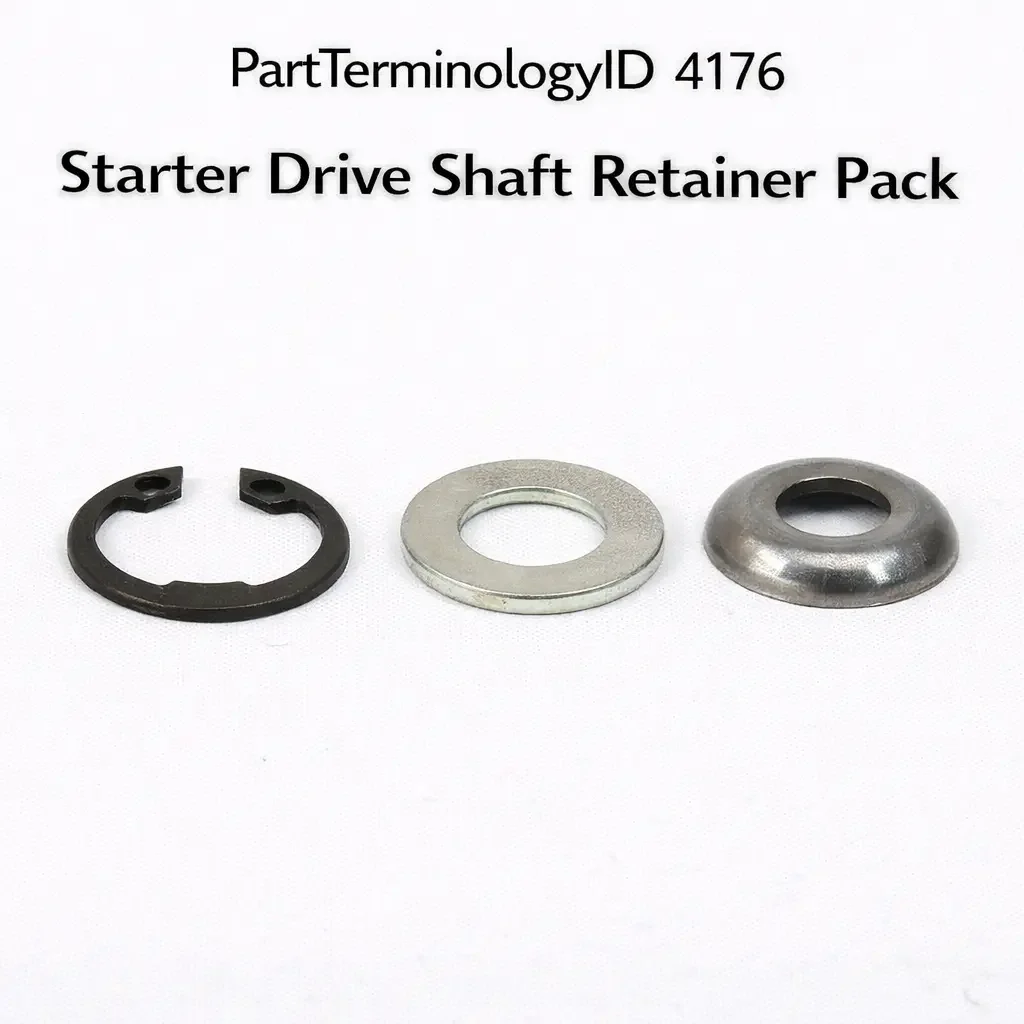
PartTerminologyID 4176, Starter Drive Shaft Retainer Pack, is the hardware kit that retains the starter drive assembly on the armature shaft, preventing axial movement of the drive beyond the designed travel limits during pinion engagement and disengagement and preventing the drive from drifting off the shaft end during the period between start cycles when the pinion must remain in the retracted position clear of the ring gear. That definition covers the starter drive retainer function correctly and leaves unresolved whether the pack contains a snap ring and thrust washer combination that seats in a groove machined in the armature shaft, a roll pin that passes through both the drive body and the shaft to prevent axial travel beyond a defined point, a retainer collar and clip combination that seats on the drive shaft outside the main drive body, a fiber or rubber anti-drift washer that provides light friction resistance to prevent drive creep toward the ring gear between start cycles, and whether the retainer pack covers a single retainer position or both the inner and outer retainer positions required to constrain the drive within its designed axial travel limits on both the engagement and retraction sides.
For sellers, PartTerminologyID 4176 is the starter drive shaft retainer pack where anti-drift washer function is the most return-generating attribute, because the anti-drift washer is frequently omitted during starter service because its function is not understood, producing a drive that slowly migrates toward the ring gear between start cycles and contacts the ring gear at engine idle speed with a grinding or ticking sound that the driver attributes to an engine noise rather than a starter drive contact fault. The anti-drift component is small, easily lost during disassembly, and its absence does not prevent the motor from starting, making it the most commonly overlooked component in the retainer pack installation.
What the Starter Drive Shaft Retainer Pack Does
Snap ring and thrust washer function and the axial travel limit
The snap ring retainer seats in a machined groove on the armature shaft at the inner limit of the drive's designed axial travel range. When the drive moves toward the ring gear during engagement, the drive body contacts the thrust washer which transfers the stop force to the snap ring and the shaft groove. Without the snap ring, the drive can travel beyond the designed mesh depth, driving the pinion too deep into the ring gear and causing binding or ring gear damage. Without the thrust washer between the drive body and the snap ring, the snap ring is subjected to direct impact loads from the drive body that accelerate groove wear and snap ring fatigue.
The snap ring must be fully seated in the groove with both ends engaged in the groove before installation is complete. A partially seated snap ring that contacts only one side of the groove will be ejected from the groove under the first engagement load, allowing the drive to travel unrestricted beyond the engagement stop. After installation, verify the snap ring is fully seated by attempting to rotate it in the groove. A correctly seated snap ring resists rotation.
Anti-drift washer and the between-cycle position maintenance
The anti-drift washer provides light friction resistance that prevents the drive from creeping toward the ring gear under gravity or vibration between start cycles. The drive on a solenoid-shifted starter is retracted from the ring gear by the return spring after each start cycle. The anti-drift washer maintains this retracted position by providing enough resistance to gravity and vibration-induced movement to keep the drive from contacting the ring gear at engine idle.
A drive without the anti-drift washer installed will migrate toward the ring gear over time and at some point begin to contact the ring gear face during engine idle, producing a ticking or grinding sound that increases with engine speed. This contact wears both the pinion face and the ring gear face and eventually produces impact damage to the ring gear teeth from the rotating pinion contact. The sound is frequently misdiagnosed as a valvetrain noise or a flywheel bearing noise before the starter drive contact is identified as the source.
Why This Part Generates Returns
Buyers return starter drive shaft retainer packs because the snap ring size is incorrect for the armature shaft groove diameter, the anti-drift washer is omitted during installation and the grinding noise from drive contact with the ring gear leads the buyer to return the retainer pack as incorrect, the pack does not include the thrust washer and the buyer assumed it was included, and the snap ring is installed incorrectly and ejected on the first engagement, causing the buyer to return the pack as defective.
Status in New Databases
PartTerminologyID 4176 is cataloged in PIES/PCdb as Starter Drive Shaft Retainer Pack. Under PIES 8.0 and PCdb 2.0 there is no change to the terminology or classification for this PartTerminologyID.
Top Return Scenarios
Scenario 1: "Anti-drift washer omitted, drive contacts ring gear at idle, returned as incorrect retainer"
The buyer installs the snap ring and thrust washer but loses the anti-drift washer during disassembly and does not notice its absence during assembly. The drive migrates toward the ring gear within several hundred idle cycles. A ticking noise develops at engine idle. The buyer attributes the noise to the retainer pack and returns it.
Prevention language: "Anti-drift washer: The anti-drift washer in this pack is required to prevent the starter drive from migrating toward the ring gear between start cycles. Install the anti-drift washer in its designed position between the drive body and the retainer collar. Omitting this component will result in pinion contact with the ring gear at engine idle speed and a grinding or ticking noise that increases with engine RPM."
Scenario 2: "Snap ring not fully seated, ejected on first engagement, drive travels unrestricted"
The snap ring is installed with one end not fully engaged in the shaft groove. On the first engagement cycle the drive impact force ejects the snap ring from the groove. The drive travels beyond the designed mesh depth on subsequent cranking attempts. The buyer returns the pack as defective when the installation fault was the cause.
Prevention language: "Snap ring seating verification: After installing the snap ring in the shaft groove, verify it is fully seated by attempting to rotate the ring in the groove. A correctly seated snap ring resists rotation. A snap ring that rotates freely or that can be displaced axially is not fully seated and will be ejected under engagement load. Reinstall the snap ring until it fully resists rotation in all directions."
Listing Requirements
PartTerminologyID: 4176
Pack contents: snap ring, thrust washer, anti-drift washer, retainer collar (mandatory)
Snap ring inside diameter and wire diameter (mandatory)
Anti-drift washer function note (mandatory)
Snap ring seating verification note (mandatory)
Compatible armature shaft groove specification (mandatory)
OEM part number cross-reference (mandatory)
FAQ (Buyer Language)
What is the anti-drift washer for and where does it go?
The anti-drift washer provides light friction resistance that keeps the starter drive in the retracted position between start cycles. Without it the drive creeps toward the ring gear and contacts the ring gear at idle speed, producing a ticking or grinding noise. Install it between the drive body and the retainer collar in the position indicated by the original component layout before disassembly.
How do I confirm the snap ring is correctly seated after installation?
After seating the snap ring in the groove, try to rotate it circumferentially in the groove. A correctly seated snap ring resists rotation because both ends are engaged in the groove. Also attempt to displace it axially. A correctly seated snap ring resists axial displacement. If the snap ring rotates freely or displaces axially, it is not fully seated.
What Sellers Get Wrong About PartTerminologyID 4176
The most common error is omitting the anti-drift washer function note. The anti-drift washer is the component most commonly lost during disassembly and most commonly omitted during reassembly because its function is not understood. Without the function note buyers assemble the motor without it, the drive contacts the ring gear at idle, and the resulting noise leads to a return of the retainer pack as incorrect when the omission was the cause.
The second error is omitting the pack contents list. A pack that does not clearly list each component allows buyers to proceed with assembly not knowing a component is missing until the motor produces the symptom of the missing part.
Cross-Sell Logic
Starter Drive (PartTerminologyID 4172): for buyers where the drive itself is worn or the overrunning clutch has failed in addition to the retainer hardware requiring replacement.
Starter (PartTerminologyID 4152): for buyers performing a complete starter rebuild where the retainer pack is one of several hardware components replaced as part of a comprehensive service.
Final Take for PartTerminologyID 4176
Starter Drive Shaft Retainer Pack (PartTerminologyID 4176) is the axial retention hardware whose most commonly overlooked component is the anti-drift washer. Anti-drift washer function disclosure, snap ring seating verification, and complete pack contents listing are the three attributes that prevent the three most common return scenarios. Every listing without the anti-drift washer function note generates ring gear contact noise returns from assemblies where the washer was omitted. Every listing without snap ring seating verification generates ejected snap ring returns from incorrectly installed rings. Every listing without a complete contents list leaves buyers assembling incomplete kits without knowing a component is missing.
Together these three attributes make every listing under this PartTerminologyID complete.