
Written by Arthur Simitian | PartsAdvisory
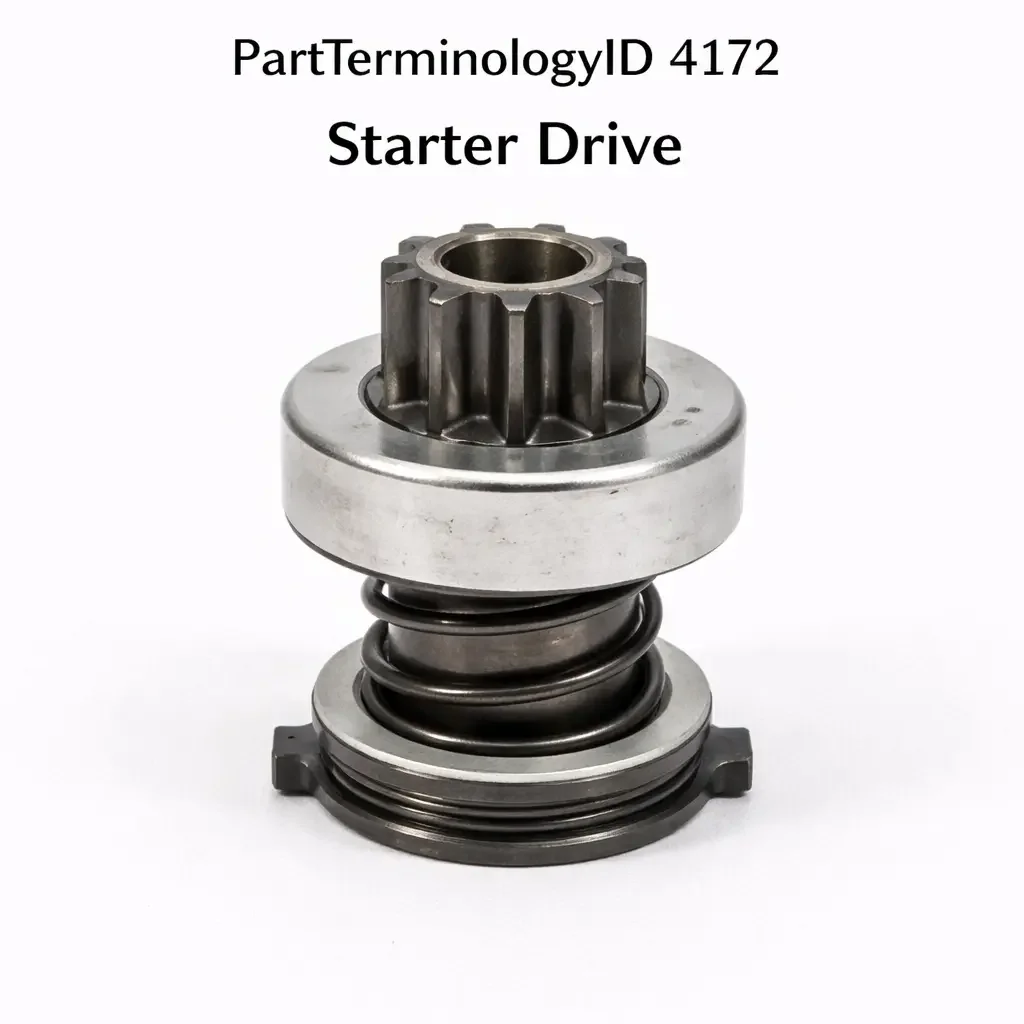
PartTerminologyID 4172, Starter Drive, is the assembly that transmits cranking torque from the starter motor armature shaft to the engine flywheel or flexplate ring gear during engine cranking, and then automatically disengages from the ring gear when the engine fires and ring gear speed exceeds starter motor speed, preventing the engine from back-driving and over-speeding the starter motor armature. That definition covers the starter drive function correctly and leaves unresolved whether the drive is a pre-engaged Bendix-style inertia drive that uses the motor's acceleration to drive the pinion into mesh through a helical spline, a solenoid-shifted pre-engaged drive that uses the starter solenoid's mechanical shift fork to positively slide the pinion into mesh before the motor circuit closes, whether the overrunning clutch mechanism uses a roller clutch, a sprag clutch, or a wrap-spring clutch to transmit torque in the drive direction while freewheeling in the over-run direction, the pinion tooth count and module pitch that must match the ring gear on the engine, the helical spline pitch and hand of the drive shaft engagement feature on inertia drive applications, and whether the drive assembly is supplied as a discrete replaceable component that mounts to the armature shaft or is integrated into the starter motor assembly in a way that requires full motor disassembly or replacement to service.
For sellers, PartTerminologyID 4172 is the starter drive where overrunning clutch failure mode identification is the most return-generating attribute, because the overrunning clutch within the starter drive fails in two distinct modes that produce opposite symptoms and are both attributed to a failed starter drive without identifying which failure mode has occurred. A clutch that fails to transmit torque in the drive direction produces no cranking, which the buyer attributes to the starter drive and replaces it. A clutch that fails to freewheel in the over-run direction allows the engine to back-drive the starter motor armature after the engine fires, over-speeding the armature to destruction. Both failures result in a starter drive return or a subsequent starter motor armature return, and the listing must identify both failure modes so buyers can confirm which mode is present before ordering the replacement.
What the Starter Drive Does
Overrunning clutch torque transmission and freewheeling function
The overrunning clutch within the starter drive transmits cranking torque from the drive body to the pinion in one rotational direction and freewheels without transmitting torque in the opposite direction. During engine cranking the clutch locks and transfers the starter motor torque to the pinion and ring gear. When the engine fires and the ring gear accelerates beyond the starter motor speed, the clutch transitions to freewheel mode and the ring gear drives the pinion at over-run speed without transmitting that speed back to the armature.
A roller clutch uses a set of rollers in a ramp cage that wedge between the inner and outer races in the drive direction and roll to the wide end of the ramps in the freewheel direction. A failed roller clutch that slips in the drive direction allows the motor to spin without transmitting torque to the pinion, producing a characteristic spinning sound without cranking engagement. A failed roller clutch that locks in both directions transmits ring gear over-run speed back to the armature, which reaches destructive speed within a fraction of a second after the engine fires.
A sprag clutch uses asymmetric sprags that tilt to lock in the drive direction and tilt the other way to release in the freewheel direction. Sprag clutch failure modes are similar to roller clutch modes: slipping in drive produces no torque transmission, locking in both directions produces armature over-speed after engine fire.
Inertia drive versus solenoid-shifted drive engagement mechanisms
Inertia drive starters use the motor's acceleration to screw the pinion into mesh through a helical spline. As the armature accelerates, the pinion lags behind due to inertia and the relative rotation between the drive body and the pinion drives the pinion along the helical spline until it contacts the ring gear. If the ring gear is not in a position to accept the pinion tooth, the pinion contacts the ring gear face and the drive's spring-loaded engagement feature cushions the impact until the ring gear rotates enough for the teeth to mesh.
The helical spline on inertia drives must match the drive shaft in both pitch and hand. A replacement drive with the wrong spline pitch will not engage the drive shaft. A drive with the correct pitch but wrong hand will apply the pinion force in the wrong axial direction, driving the pinion away from the ring gear rather than into mesh. Both mismatches produce a no-mesh condition that the buyer attributes to a defective drive when the specification mismatch is the actual fault.
Solenoid-shifted drives are positively shifted into mesh by the solenoid plunger before the main motor circuit closes. The shift fork on the solenoid engages a groove in the drive body and slides the drive assembly along the armature shaft toward the ring gear. The pinion meshes before the motor current flows, ensuring clean engagement. A solenoid-shifted drive with a failed shift fork groove will not be positively driven into mesh and the drive body will not advance to ring gear engagement distance, producing no engagement despite a functioning motor circuit.
Why This Part Generates Returns
Buyers return starter drives because the overrunning clutch failure mode was not identified before the drive was ordered and the replacement does not address the actual fault, the ring gear has damaged teeth from repeated pinion impact caused by a different fault and the replacement drive engages the same damaged ring gear and fails immediately, the pinion tooth count or spline specification does not match the application from a production variant difference, the overrunning clutch correctly freewheeled but the armature is the over-speed damaged component requiring armature replacement rather than drive replacement, and the drive is supplied without the anti-drift spring or collar hardware that is required for correct installation on this application.
Status in New Databases
PartTerminologyID 4172 is cataloged in PIES/PCdb as Starter Drive. Under PIES 8.0 and PCdb 2.0 there is no change to the terminology or classification for this PartTerminologyID.
Top Return Scenarios
Scenario 1: "Clutch slips in drive direction, no cranking torque, drive replaced, clutch condition not confirmed as fault"
The starter motor spins freely when the start circuit is activated. No cranking torque reaches the ring gear. The spinning sound without engagement is characteristic of a drive-direction clutch slip. The buyer replaces the starter drive. The replacement drive engages correctly. The fault was correctly identified and the replacement resolves the symptom.
However, if the cranking circuit was not validated before the drive was replaced, and the no-cranking symptom was actually from insufficient battery voltage causing the motor to spin but produce inadequate torque to overcome the clutch lock-up threshold, the drive may be returned as non-functional when the battery was the actual fault.
Prevention language: "Clutch slip versus battery fault distinction: A starter drive clutch that slips in the drive direction produces a free-spinning motor sound with no cranking. Confirm battery voltage is adequate under cranking load before attributing a free-spin symptom to the drive clutch. A battery with insufficient cranking capacity may produce motor rotation without adequate torque to lock the overrunning clutch, mimicking a drive clutch slip."
Scenario 2: "Clutch locks in over-run direction, armature over-speeded after engine fire, armature destroyed, drive returned"
The starter drive overrunning clutch has failed in the locked position. When the engine fires and the ring gear accelerates, the clutch transmits ring gear speed to the armature rather than freewheeling. The armature reaches destructive speed within a fraction of a second. The armature winding conductors separate from the commutator slots from centrifugal force. The buyer hears a high-pitched whine from the over-speeding motor immediately after engine fire. The buyer replaces the starter drive. The replacement drive has a functional overrunning clutch and the symptom does not recur.
The original armature may also be damaged from the over-speed event. Inspecting the armature for separated commutator conductors and testing for armature shorts before reinstalling the motor prevents a follow-on armature failure from an undetected over-speed injury.
Prevention language: "Armature over-speed inspection: If the starter drive overrunning clutch was locked in the over-run direction, inspect the armature for separated commutator conductors and test for armature winding shorts before reinstalling the starter motor. An armature that was briefly over-speeded may have sustained winding damage that produces a partial short and reduced cranking torque even after drive replacement."
Scenario 3: "Ring gear teeth damaged from previous no-mesh impacts, new drive pinion damaged immediately on installation"
The ring gear has chipped or broken teeth from repeated hard impact of the starter drive pinion from a previous engagement fault. The replacement drive pinion engages the damaged ring gear and is damaged by impact with the broken tooth positions on the first few cranking cycles. The buyer returns the replacement drive as defective on arrival when the ring gear condition caused the damage.
Prevention language: "Ring gear condition inspection: Before installing the replacement starter drive, inspect the ring gear teeth through the starter mounting opening for chipped, broken, or significantly worn teeth. A ring gear with damaged teeth will damage the replacement pinion on the first engagement cycle. Replace the flywheel or flexplate ring gear before installing a new starter drive when ring gear damage is confirmed."
Listing Requirements
PartTerminologyID: 4172
Drive type: inertia or solenoid-shifted (mandatory)
Overrunning clutch type: roller, sprag, or wrap-spring (mandatory)
Pinion tooth count (mandatory)
Pinion module pitch (mandatory)
Spline specification for inertia drive: pitch and hand (mandatory)
Drive shaft bore diameter (mandatory)
Clutch failure mode identification: slip versus lock (mandatory)
Ring gear condition inspection note (mandatory)
Armature over-speed inspection note (mandatory)
Hardware included: anti-drift spring, collar, or retaining clip (mandatory)
OEM part number cross-reference (mandatory)
Catalog Checklist for ACES/PIES Teams
PartTerminologyID = 4172
Require drive type: inertia or solenoid-shifted (mandatory)
Require clutch type (mandatory)
Require pinion tooth count and module pitch (mandatory)
Require spline specification for inertia drives (mandatory)
Prevent battery fault drive return: battery cranking capacity must be confirmed before clutch slip diagnosis
Prevent armature over-speed secondary failure: armature inspection must follow locked clutch replacement to prevent follow-on damage
Prevent ring gear damage drive return: ring gear inspection must precede drive installation to prevent immediate pinion damage
FAQ (Buyer Language)
My starter spins when I turn the key but the engine does not crank. Is it the starter drive?
A free-spinning starter with no cranking engagement is characteristic of a starter drive overrunning clutch that is slipping in the drive direction. Before ordering a replacement drive, confirm the battery can deliver adequate cranking voltage under load. Insufficient battery voltage can prevent the clutch from developing the friction needed to lock in the drive direction, producing a spin-without-crank symptom that mimics a drive clutch slip.
I heard a high-pitched whine from the starter immediately after the engine started. What happened?
A high-pitched whine immediately after engine fire indicates the starter drive overrunning clutch failed to freewheel when the engine speed exceeded starter speed. The clutch locked in the over-run direction and the ring gear drove the armature to over-speed. Replace the starter drive and inspect the armature for winding damage before reinstalling the motor.
How do I check the ring gear before installing a new starter drive?
With the starter removed, use a flashlight to inspect the ring gear teeth through the starter mounting opening while slowly rotating the crankshaft. Look for chipped, cracked, or missing teeth at any position around the ring gear circumference. Rotate the crankshaft a full revolution to inspect all tooth positions. Any damaged teeth require ring gear replacement before a new drive is installed.
What is the difference between inertia drive and solenoid-shifted drive?
An inertia drive uses the motor's acceleration to screw the pinion into mesh through a helical spline. A solenoid-shifted drive uses the starter solenoid's mechanical shift fork to positively slide the pinion into mesh before the motor circuit closes. Solenoid-shifted drives provide more reliable engagement under cold conditions and are the dominant design on current gear reduction starters. Inertia drives are common on older direct-drive starters and some light-duty applications.
What Sellers Get Wrong About PartTerminologyID 4172
The most common error is omitting both overrunning clutch failure mode descriptions. The two failure modes produce opposite symptoms and require different diagnostic steps to confirm. Without both failure mode descriptions buyers may replace the drive without confirming whether the clutch is slipping or locking, miss an armature over-speed injury when the clutch was locking, or attribute a battery-fault spin-without-crank symptom to the drive clutch.
The second error is omitting the ring gear condition inspection note. A damaged ring gear that caused the original drive failure will immediately damage the replacement pinion on the first engagement cycle. Without the inspection note buyers install the replacement into a ring gear that will produce the same drive damage within the first few start cycles.
The third error is omitting the pinion tooth count and module pitch specification. A replacement drive with the wrong pinion specification will either ratchet against the ring gear without meshing or mesh with interference that chips both the pinion and ring gear teeth. Without the specification buyers cannot confirm compatibility beyond vehicle year and model, which does not account for ring gear specification differences from engine or transmission variants.
Cross-Sell Logic
Flywheel or Flexplate Ring Gear: for buyers where ring gear inspection confirms chipped or broken teeth that will damage the replacement drive pinion, requiring ring gear replacement before drive installation.
Starter (PartTerminologyID 4152): for buyers where the armature has been over-speeded by a locked overrunning clutch and shows winding damage or commutator conductor separation requiring complete starter replacement rather than drive-only service.
Starter Solenoid: for buyers on solenoid-shifted applications where the shift fork engagement groove in the drive body is confirmed intact and the fault traces to a solenoid plunger that is not completing the shift stroke, indicating the solenoid rather than the drive requires replacement.
Final Take for PartTerminologyID 4172
Starter Drive (PartTerminologyID 4172) is the torque transmission and over-run protection component where overrunning clutch failure mode identification, ring gear condition inspection, armature over-speed inspection, and pinion specification confirmation are the four attributes that prevent the four most common return scenarios. Every listing without failure mode identification leaves buyers without the diagnostic differentiation needed to confirm which clutch fault is present. Every listing without ring gear inspection guidance generates immediate pinion damage on the replacement from an unaddressed ring gear fault. Every listing without armature inspection guidance risks a follow-on armature failure from an over-speed injury that was not detected at drive replacement. Every listing without pinion specification generates mesh incompatibility returns from ring gear specification differences.
Together these four attributes make every listing under this PartTerminologyID complete.