
Written by Arthur Simitian | PartsAdvisory
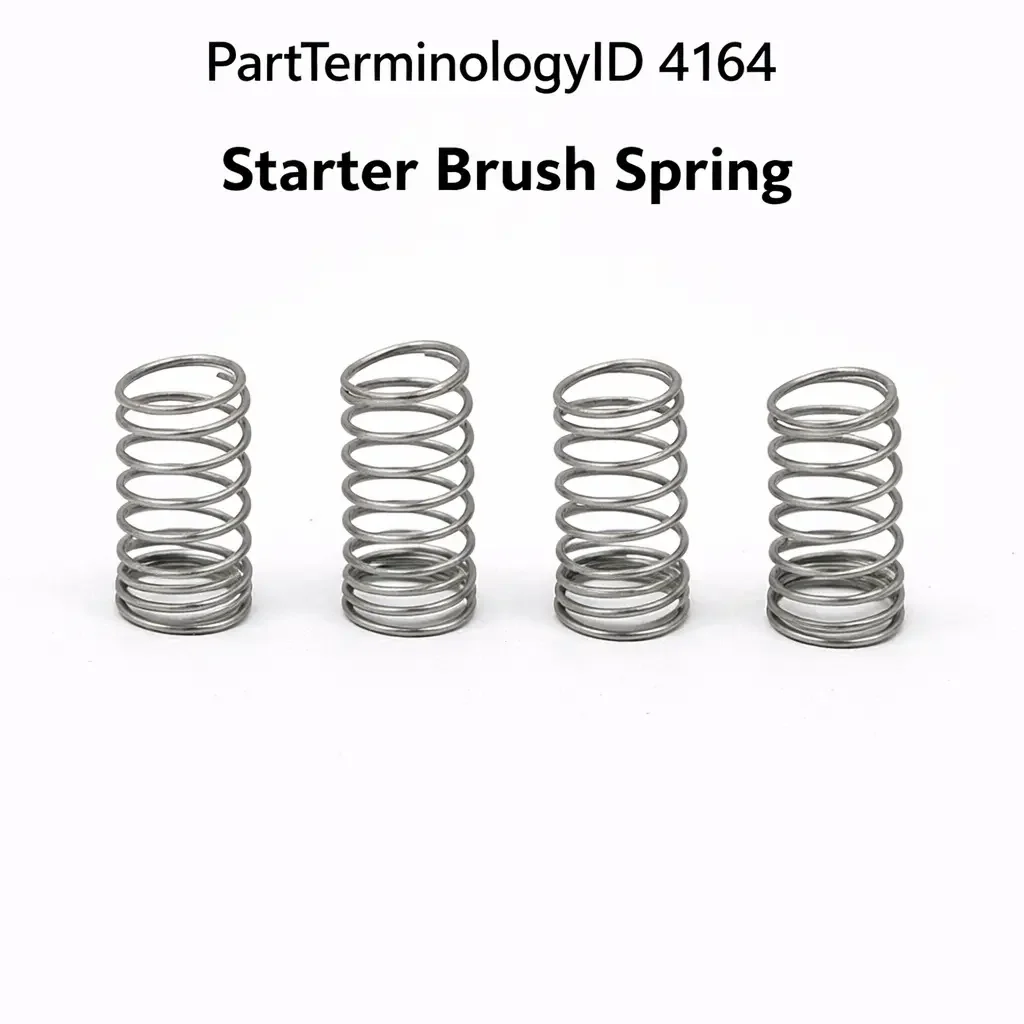
PartTerminologyID 4164, Starter Brush Spring, is the spring element within the starter motor brush holder that maintains consistent contact pressure between the brush face and the commutator surface throughout the operating life of the brush, ensuring adequate current transfer from the stationary brush holder circuit to the rotating commutator segments across the full brush wear range from new to minimum serviceable depth. That definition covers the brush spring function correctly and leaves unresolved whether the spring is a coil compression spring, a leaf spring, or a constant-force clock spring, the specified contact force in grams or Newtons that the spring must deliver at the new brush position and at the minimum brush depth position, whether the spring is sold individually or as a set covering all brush holder positions in the motor, whether the spring engages the back face of the brush body directly or acts through a brush holder pivot arm that multiplies the spring force before applying it to the brush, and whether spring replacement alone is the correct repair when worn brushes have been confirmed as the fault source rather than spring tension loss.
For sellers, PartTerminologyID 4164 is the brush spring where spring force specification matching is the most return-generating attribute, because a replacement spring with a different force specification than the original alters the brush contact pressure and produces either under-pressure conditions that allow brush bounce and arcing, or over-pressure conditions that accelerate brush and commutator wear from excessive friction. Both conditions produce shortened brush and commutator service life that the buyer attributes to the replacement spring quality rather than the force specification mismatch.
What the Starter Brush Spring Does
Contact force range and the bounce threshold
The brush spring must maintain contact pressure above the minimum threshold required to prevent brush bounce at the armature's operating speed throughout the full wear range of the brush. At new brush length the spring is compressed to its working position and delivers a defined force. As the brush wears and the spring extends toward its free length, the delivered force decreases. At minimum brush length the spring must still deliver the minimum force required to prevent bounce at the maximum armature speed.
A spring that has lost tension from heat exposure may deliver adequate force when the brush is new but fall below the bounce threshold before the brush reaches its minimum serviceable depth, effectively reducing the usable brush service life and producing arcing damage to the commutator during the latter portion of the brush wear cycle. Testing spring force with a spring scale at both the new brush position and the minimum brush position confirms whether the spring is within specification throughout the full wear range.
Spring replacement as a standalone repair versus complete brush and spring replacement
Spring replacement as a standalone repair is appropriate when the brushes are confirmed to be within minimum depth specification but the spring force has been verified below the required threshold. A worn spring with serviceable brushes produces brush bounce and arcing that damages the commutator without the brushes being the primary fault. Replacing the spring alone restores correct brush contact without the cost of a full brush set replacement.
More commonly, spring and brush replacement are performed together as part of a starter motor rebuild because the service life of both components is similar and the labor cost of accessing the brush holder assembly makes individual replacement less economical than replacing both at the same service interval.
Why This Part Generates Returns
Buyers return starter brush springs because the replacement spring force specification does not match the original and produces brush bounce or excessive friction, the spring is sold individually and the buyer needs a complete set for all holder positions, the spring type does not match the holder geometry and does not engage the brush correctly, and the brushes are the actual worn component and spring replacement alone does not resolve the reduced cranking torque.
Status in New Databases
PartTerminologyID 4164 is cataloged in PIES/PCdb as Starter Brush Spring. Under PIES 8.0 and PCdb 2.0 there is no change to the terminology or classification for this PartTerminologyID.
Top Return Scenarios
Scenario 1: "Spring force specification too low, brush bounces at operating speed, arcing damages commutator"
The replacement spring has a lower force specification than the original. The brush bounces against the commutator at armature operating speed. Arcing at the contact face damages the commutator segments and the brush face within a short period. The buyer returns the spring as defective.
Prevention language: "Spring force specification: Confirm the replacement spring force specification matches the original in grams or Newtons at both the new brush position and the minimum brush depth position. A spring with lower force than specified will allow brush bounce at armature operating speed, producing arcing that damages both the commutator and brush face. Measure original spring force with a spring scale before ordering if the specification is not available in the service manual."
Scenario 2: "Individual spring ordered for four-position motor, three positions unaddressed"
The buyer orders one replacement spring for a four-brush motor. Three holder positions remain with their original springs, which show the same tension loss as the returned spring. Cranking performance remains below specification from the three remaining underpowered springs.
Prevention language: "Spring set coverage: Confirm the quantity ordered covers all brush holder positions in the motor. A four-brush motor requires four springs. Ordering individual springs for a multi-position motor leaves the remaining positions with original worn springs that will produce the same brush bounce condition."
Listing Requirements
PartTerminologyID: 4164
Spring type: coil, leaf, or constant-force (mandatory)
Spring force at new brush position (mandatory)
Spring force at minimum brush depth (mandatory)
Quantity: individual or set (mandatory)
Compatible brush holder and motor reference (mandatory)
Spring force specification verification note (mandatory)
Set coverage confirmation note (mandatory)
OEM part number cross-reference (mandatory)
FAQ (Buyer Language)
How do I test if my brush spring has lost tension?
Use a spring scale to measure the force the spring delivers with the brush holder at the new brush position. Compare the reading to the specification in the service manual. Also measure with the holder at the minimum brush position. A reading below the minimum specified force at either position indicates the spring requires replacement.
Should I replace just the spring or the brushes and spring together?
If the brushes are within the minimum depth specification and the spring force is confirmed below threshold, spring replacement alone is the correct repair. If the brushes are also worn, replace both at the same time to avoid a repeat disassembly when the brushes reach minimum depth shortly after spring replacement.
What Sellers Get Wrong About PartTerminologyID 4164
The most common error is omitting the spring force specification. A spring listed by dimensions only without a force specification gives the buyer no basis for confirming the replacement delivers the required contact pressure. Without the force specification buyers install an undersized spring and return it when brush bounce produces arcing and commutator damage.
The second error is omitting the set coverage disclosure. A spring sold individually for a multi-position motor leaves the buyer with an incomplete repair. Specifying the quantity and confirming whether the listing covers a complete set for the motor design prevents incomplete repair returns.
Cross-Sell Logic
Starter Brush Set (PartTerminologyID 4156): for buyers performing a complete brush holder service where both the brushes and springs are replaced at the same service interval for cost-effective preventive maintenance.
Starter Brush Holder Assembly (PartTerminologyID 4160): for buyers where the brush holder pivot arm or insulation plate is also degraded, making complete holder assembly replacement more appropriate than individual spring replacement.
Final Take for PartTerminologyID 4164
Starter Brush Spring (PartTerminologyID 4164) is the contact pressure maintenance component where spring force specification matching and complete set coverage are the two attributes that prevent the two most common return scenarios. Every listing without force specification generates arcing returns from under-pressure springs. Every listing without set coverage disclosure generates incomplete repair returns from single-spring orders on multi-position motors.
Together these two attributes make every listing under this PartTerminologyID complete.