
Written by Arthur Simitian | PartsAdvisory
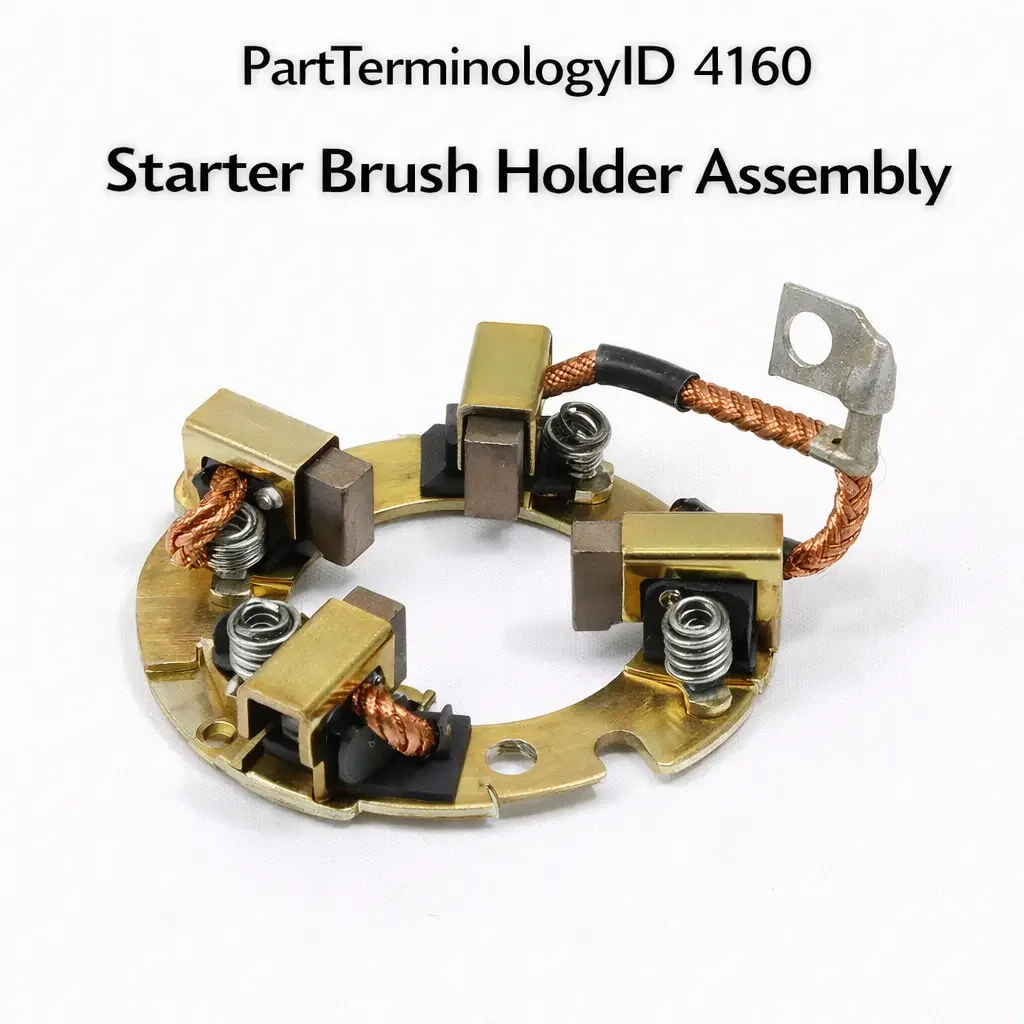
PartTerminologyID 4160, Starter Brush Holder Assembly, is the component that houses the individual brush elements and their associated springs, positioning each brush against the commutator of the starter motor armature at the correct contact angle and spring pressure while maintaining electrical insulation between the positive brush holders and the starter motor housing ground. That definition covers the brush holder assembly function correctly and leaves unresolved whether the assembly is an end-frame integrated design where the brush holders are molded directly into the rear end cap of the starter motor housing, a separate plate-style assembly that bolts to the rear of the motor housing and can be replaced independently of the end cap, whether the assembly holds two brush positions or four brush positions in a paired arrangement of positive and negative holders, whether the insulation separating the positive brush holders from the assembly mounting plate is a phenolic resin, a nylon polymer, or a fiberglass composite that determines the thermal and chemical resistance of the insulation under repeated heat cycling in the starter environment, the spring type used in each holder position including a coil spring, a leaf spring, or a constant-force clock spring, and whether the assembly includes the brushes pre-installed or is supplied as the holder structure only requiring the buyer to transfer the original brushes or install separately ordered brushes.
For sellers, PartTerminologyID 4160 is the starter brush holder assembly where insulation breakdown between positive holders and ground is the most critical fault attribute, because a brush holder assembly with failed insulation between a positive brush holder and the motor housing shorts the positive brush circuit to ground through the motor case, producing a direct battery short through the starter relay when the start circuit is activated. This fault produces immediate relay contact damage, potential wiring harness damage from the uncontrolled current, and a no-crank condition that presents as a failed relay or failed starter rather than a failed brush holder assembly insulation fault. A buyer who replaces the relay and then the starter without testing the brush holder assembly insulation will return both components when the insulation fault remains.
What the Starter Brush Holder Assembly Does
Positive holder insulation and the ground fault failure mode
The starter motor operates as a series-wound or permanent magnet motor with current flowing from the battery positive terminal through the solenoid main contacts to the brush holder positive terminals, through the positive brushes to the commutator, through the armature windings, back through the commutator to the negative brushes, and to ground through the motor housing. The positive brush holders must be electrically isolated from the motor housing and the negative brush holders to prevent short-circuit current paths that bypass the armature windings.
Insulation breakdown in the positive brush holder mounting boss or the insulation plate between the holder and the assembly frame allows current to flow from the positive brush directly to the motor housing ground without passing through the armature. The resulting short circuit draws current from the battery through the solenoid main contacts and the positive wiring at the full available battery current, which is limited only by the battery's internal resistance rather than the armature winding resistance. This fault produces catastrophic current flow that welds the solenoid main contacts in the closed position, blows fuses or fusible links in the battery positive circuit, and can damage wiring harness sections.
Insulation integrity testing with an ohmmeter or megohmmeter between the positive brush holder terminal and the motor housing before any other diagnosis confirms or excludes the brush holder assembly as the fault source. A resistance reading below 100,000 ohms between a positive holder and the housing indicates insulation breakdown that requires assembly replacement before the motor is reinstalled.
Spring type and the brush pressure maintenance function
The spring in each brush holder position maintains consistent contact pressure between the brush face and the commutator throughout the service life of the brush as the brush material wears away. The spring must maintain adequate contact force over the full wear range of the brush from new to the minimum serviceable brush depth.
Coil springs maintain relatively consistent force throughout their compression range and are the most common type in starter brush holder applications. Leaf springs provide high initial contact force that decreases as the brush wears and the spring deflection decreases, which can produce insufficient brush pressure late in brush service life. Constant-force clock springs maintain nearly uniform force throughout the full brush wear range and are used on applications where consistent commutator contact pressure through the complete brush service life is a design priority.
A brush holder assembly replacement that uses a spring type with different force characteristics than the original will produce different brush wear rates and commutator contact quality than the original design. Confirming the spring type matches the original is a relevant attribute for applications where the spring type is a known design specification.
Why This Part Generates Returns
Buyers return starter brush holder assemblies because the original fault is a commutator condition or armature fault that a brush holder replacement does not address, the insulation fault that caused the original brush holder failure was not identified and the replacement assembly is installed into the same fault condition that destroyed the original, the assembly is supplied without brushes and the buyer expected brushes to be included, the spring type produces different brush contact pressure than the original resulting in inconsistent cranking performance, and the assembly mounting orientation is incorrect for the specific starter motor variant and the brush positions do not align with the commutator segments.
Status in New Databases
PartTerminologyID 4160 is cataloged in PIES/PCdb as Starter Brush Holder Assembly. Under PIES 8.0 and PCdb 2.0 there is no change to the terminology or classification for this PartTerminologyID.
Top Return Scenarios
Scenario 1: "Insulation fault in original assembly caused relay contact welding, relay replaced without identifying brush holder as source"
The starter solenoid main contacts are welded from a direct battery short through a failed brush holder insulation. The buyer replaces the solenoid and then the complete starter without identifying the brush holder assembly insulation fault as the source of the short. The replacement starter is installed with a new brush holder assembly that has correct insulation. The fault does not recur because the replacement assembly has intact insulation. However, if a buyer had installed the replacement starter assembly without replacing the brush holder, the insulation fault would remain and immediately weld the new solenoid contacts.
Prevention language: "Insulation integrity test: Before installing the replacement brush holder assembly or reinstalling the starter, test insulation resistance between each positive brush holder terminal and the motor housing with an ohmmeter. Acceptable insulation resistance is above 100,000 ohms between each positive holder and the housing. A reading below this threshold indicates insulation breakdown that will produce a direct battery short through the solenoid main contacts when the start circuit is activated. Do not reinstall a motor with a failed brush holder insulation."
Scenario 2: "Assembly supplied without brushes, buyer expected brushes included, returns assembly as incomplete"
The buyer orders a starter brush holder assembly expecting the replacement brushes to be pre-installed in the holder. The assembly is supplied as the holder structure only, requiring the buyer to separately order or transfer brushes. The buyer returns the assembly as incomplete.
Prevention language: "Brushes included or not included: Confirm whether this assembly includes brushes installed in the holder positions or is supplied as the holder structure only. If brushes are not included, order the compatible brush set separately or confirm the original brushes are within serviceable limits for transfer to the new holder."
Scenario 3: "Commutator condition not addressed, new brush holder assembly installed, premature wear returns within weeks"
The buyer replaces the brush holder assembly after confirming the holder insulation has failed. The commutator surface has wear grooves from the original worn brushes that were accelerated by the insulation fault arcing. The new assembly is installed with new brushes against the grooved commutator. The brushes seat improperly against the grooved surface and wear prematurely. The buyer returns the assembly as failing.
Prevention language: "Commutator inspection: Inspect and resurface the commutator before installing the replacement brush holder assembly. A commutator with wear grooves or surface contamination from the previous insulation fault will cause new brushes to seat incorrectly and wear at an accelerated rate. Resurfacing the commutator before assembly installation ensures the new brushes seat correctly and achieve their designed service life."
Scenario 4: "Assembly mounting orientation incorrect, brush positions misaligned with commutator segments, motor produces reduced torque"
The replacement brush holder assembly fits the motor housing dimensionally but has a rotation index that positions the brush holders at a different angular position relative to the commutator neutral plane than the original. The brushes make contact on the commutator segments at positions that are slightly off the commutator neutral plane, reducing motor efficiency and cranking torque. The engine cranks slowly from the misaligned brush timing.
Prevention language: "Assembly orientation: Confirm the brush holder assembly mounting orientation positions the brush holders at the correct angular position relative to the commutator neutral plane. Many brush holder assemblies have a single correct installation orientation indicated by an alignment tab, a notch, or a marked position on the assembly. Installing the assembly in an incorrect orientation shifts the brush contact position off the commutator neutral plane and reduces motor torque output."
Listing Requirements
PartTerminologyID: 4160
Holder configuration: two-brush or four-brush positions (mandatory)
Insulation material type (mandatory)
Spring type: coil, leaf, or constant-force (mandatory)
Brushes included: yes or no (mandatory)
Assembly mounting type: end-frame integrated or separate plate (mandatory)
Compatible starter motor reference (mandatory)
Insulation integrity test note (mandatory)
Commutator inspection note (mandatory)
Assembly orientation note (mandatory)
Brushes-included clarification note (mandatory)
OEM part number cross-reference (mandatory)
Catalog Checklist for ACES/PIES Teams
PartTerminologyID = 4160
Require holder configuration: two or four positions (mandatory)
Require spring type (mandatory)
Require brushes-included disclosure (mandatory)
Require assembly mounting type (mandatory)
Prevent insulation fault relay damage: insulation integrity test must precede any reinstallation; positive holder to housing resistance must exceed 100,000 ohms
Prevent commutator condition return: commutator must be inspected and resurfaced before assembly installation
Prevent orientation mismatch: assembly alignment feature must be identified and correct orientation must be confirmed at installation
FAQ (Buyer Language)
How do I test the brush holder assembly insulation before installation?
Set a multimeter to the resistance range. Touch one probe to a positive brush holder terminal and the other probe to the motor housing body. A reading above 100,000 ohms indicates acceptable insulation. A reading below this value indicates insulation breakdown and the assembly requires replacement. Test all positive holder positions individually.
Does this assembly come with brushes installed?
Confirm from the listing whether brushes are pre-installed in the holder positions. If brushes are not included, order the correct brush set for this motor application separately. If the original brushes are within serviceable limits, they may be transferred to the new holder if they fit the new holder cavity dimensions.
How do I confirm the correct installation orientation?
Inspect the brush holder assembly and the motor end cap for alignment features including tabs, notches, or marked positions. The assembly should install in only one orientation that aligns the alignment feature with the corresponding feature on the motor housing. If no alignment feature is present, confirm the brush holder positions align with the commutator segment positions by rotating the armature while observing the brush contact points before closing the motor housing.
Why is commutator inspection required when I am replacing the brush holder, not the brushes?
The brushes that will be installed in the new holder, whether new brushes or transferred original brushes, must seat correctly against the commutator surface. A commutator with wear grooves or surface damage will cause the new brushes to seat incorrectly regardless of the holder condition, producing premature brush wear that the buyer attributes to the replacement assembly.
What Sellers Get Wrong About PartTerminologyID 4160
The most common error is omitting the insulation integrity test note. A brush holder assembly insulation fault is the specific condition that justifies replacement of the assembly rather than just the brushes, and confirming the fault is in the insulation rather than the commutator or armature is the diagnostic step that leads to the correct component order. Without the test note buyers may replace the assembly when the fault is actually in the commutator or armature, or may overlook the insulation fault and install a new assembly into a condition that destroys the new assembly from the same fault.
The second error is omitting the brushes-included clarification. Whether brushes are included is the most practically important specification for a buyer ordering this assembly and its absence generates immediate returns from buyers who expected a complete assembly with brushes.
The third error is omitting the commutator inspection note. The commutator surface condition determines whether new brushes installed in the new holder will achieve their designed service life. Without the commutator inspection note buyers install the new assembly on a grooved commutator and return the assembly when the brushes wear prematurely.
Cross-Sell Logic
Starter Brush Set (PartTerminologyID 4156): for buyers ordering a holder assembly that does not include brushes, requiring a compatible brush set to complete the motor rebuild.
Starter (PartTerminologyID 4152): for buyers where commutator wear exceeds the minimum diameter specification or where armature testing reveals additional faults beyond the brush holder assembly, indicating complete starter replacement is more appropriate than component rebuild.
Solenoid: for buyers where brush holder insulation failure has welded the solenoid main contacts, requiring solenoid replacement alongside the brush holder assembly.
Final Take for PartTerminologyID 4160
Starter Brush Holder Assembly (PartTerminologyID 4160) is the current distribution and brush positioning component where insulation integrity testing, commutator condition inspection, brushes-included disclosure, and assembly orientation confirmation are the four attributes that prevent the four most common return scenarios. Every listing without insulation test guidance risks relay contact welding from a missed insulation fault. Every listing without commutator inspection guidance generates premature brush wear returns. Every listing without brushes-included disclosure generates incomplete-assembly returns. Every listing without orientation guidance generates misaligned brush timing and reduced torque returns.
Together these four attributes make every listing under this PartTerminologyID complete.