
Starter Brush (PartTerminologyID 4156): Where Commutator Condition and Brush Grade Prevent Premature Brush Replacement
Written by Arthur Simitian | PartsAdvisory
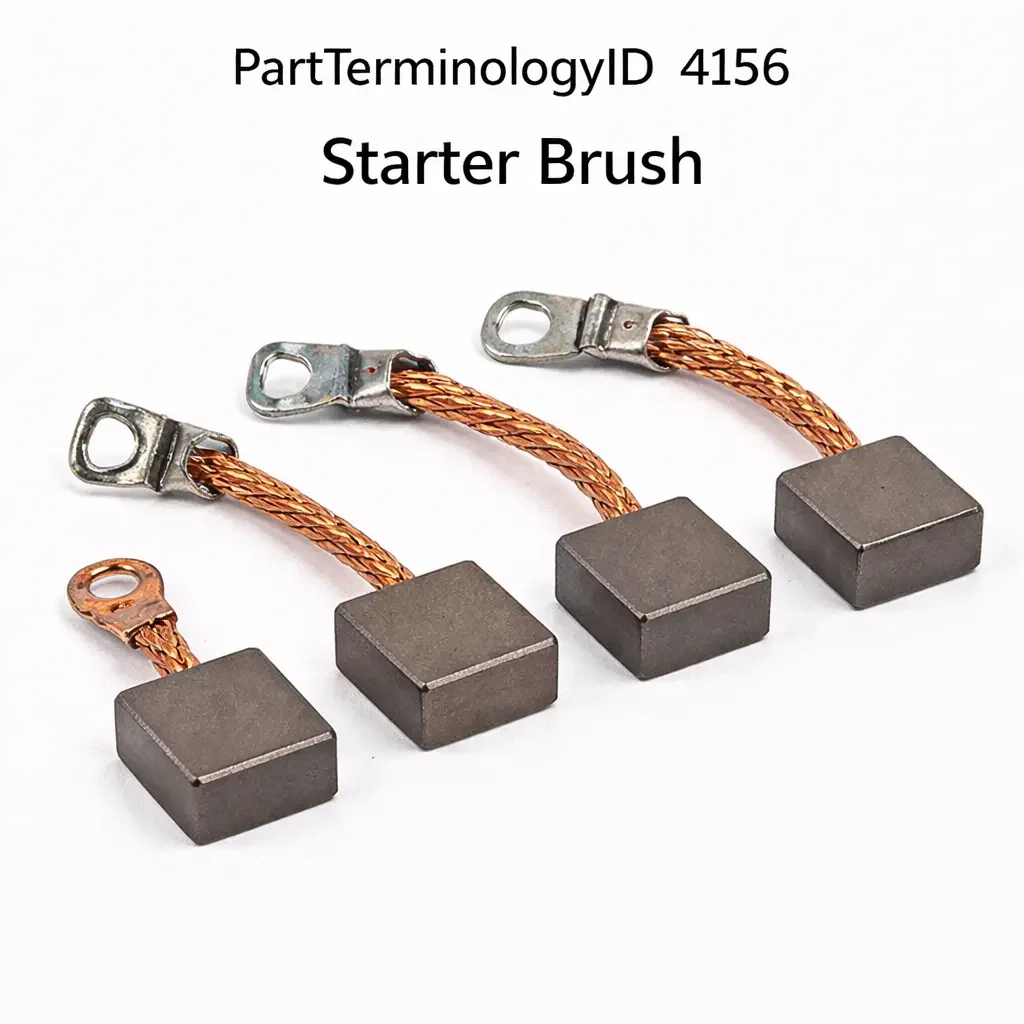
PartTerminologyID 4156, Starter Brush, is the carbon or carbon-composite contact element that presses against the rotating commutator segments of the starter motor armature to deliver current from the brush holder assembly to the armature windings, enabling the motor to develop the rotating magnetic field that produces cranking torque. That definition covers the starter brush function correctly and leaves unresolved whether the brush is a pure carbon composition, a copper-graphite composite formulated for high-current starter motor applications, or a silver-graphite composite on premium starter designs, the brush dimensions including width, height, and depth that must match the brush holder cavity dimensions precisely to ensure correct brush seating and spring pressure, whether the brush includes a shunt lead wire crimped to the brush body that connects to the brush holder terminal or is a bare brush body that relies on spring contact alone on some older designs, whether the brushes are sold individually or as a set of four that covers all brush positions in the starter motor, and whether the starter brush is compatible with the commutator surface condition on this specific motor or requires commutator resurfacing before the new brush will seat correctly.
For sellers, PartTerminologyID 4156 is the starter brush where commutator surface condition is the most return-generating attribute, because a new brush installed on a commutator with worn grooves, glazed contact surfaces, or eccentric runout will not seat correctly against the commutator segments, will wear irregularly, and will fail to deliver the current required for full cranking torque within a short period of installation. A buyer who installs new brushes without inspecting and conditioning the commutator surface will return the brushes as failing prematurely when the commutator was the root cause throughout.
What the Starter Brush Does
Carbon composition and current delivery function
The starter brush maintains continuous sliding electrical contact between the stationary brush holder assembly and the rotating commutator of the armature. The brush is held against the commutator by a spring that maintains consistent contact pressure as the brush wears down through its service life. Current flows from the brush holder terminal through the shunt lead into the brush body and across the brush-to-commutator contact face into the commutator segment that is aligned with that brush position.
Copper-graphite composite brushes are standard on most gear reduction starter applications because the copper content reduces electrical resistance compared to pure carbon brushes, allowing higher current density through a smaller brush cross-section. This higher current delivery capability is required in compact gear reduction starters where space constraints limit brush size. Pure carbon brushes are more common on older direct-drive starter applications where brush cross-sectional area is larger and current density per unit area is lower.
The brush spring pressure must be within a defined range to maintain adequate contact force without excessive friction against the commutator. A spring that has lost tension from heat exposure allows the brush to bounce against the commutator at high armature speeds, interrupting current flow intermittently and producing arcing at the contact face that accelerates commutator and brush wear. Brush replacement without spring inspection and replacement where needed returns the motor to the same premature wear condition that degraded the original brushes.
Commutator surface condition and new brush seating
A new brush is machined to a flat face that must conform to the curved surface of the commutator before full contact area is achieved. The initial seating period during which the flat new brush wears to match the commutator radius is called the run-in period. During run-in the contact area between the brush and commutator is smaller than the full brush face area, producing higher current density at the contact points and accelerated wear at the contact edges until the brush face radius matches the commutator.
A commutator with deep wear grooves cut by the original worn brushes presents an uneven surface that a new brush cannot conform to without extended run-in or commutator resurfacing. The new brush contacts only the raised ridges between the grooves, further concentrating current density and accelerating the brush wear rate. A commutator with a glazed surface from overheating or oil contamination prevents the slight abrasive action of the brush that is required to maintain a clean contact surface, resulting in high contact resistance and reduced current delivery.
Commutator resurfacing on a lathe removes grooves and eccentricity, restoring the round uniform surface that new brushes seat against correctly. On applications where commutator resurfacing is practical, performing this step before installing new brushes significantly extends the service life of the replacement brushes. On applications where the commutator wear depth exceeds the minimum diameter specification, commutator replacement or starter assembly replacement is required rather than brush and commutator resurfacing.
Why This Part Generates Returns
Buyers return starter brushes because new brushes are installed on a worn or grooved commutator that prevents correct seating and the brushes fail prematurely, the brush dimensions do not match the brush holder cavity precisely and the brush rocks or binds in the holder rather than maintaining flat contact with the commutator, the brush shunt lead length is incorrect for the holder geometry and the lead contacts the armature or interferes with rotation, the brush spring has lost tension and the new brush bounces against the commutator at operating speed, and the brush set covers only some positions in a four-brush motor because the buyer ordered an individual brush rather than the correct four-brush set.
Status in New Databases
PartTerminologyID 4156 is cataloged in PIES/PCdb as Starter Brush. Under PIES 8.0 and PCdb 2.0 there is no change to the terminology or classification for this PartTerminologyID.
Top Return Scenarios
Scenario 1: "Worn grooved commutator, new brushes seat poorly, premature wear within weeks"
The buyer replaces the starter brushes without inspecting the commutator surface. The commutator has deep wear grooves from the original worn brushes. The new brushes contact only the raised ridges between the grooves and wear irregularly from the concentrated contact pressure. The brush face does not conform to the commutator radius. Current delivery is below specification. The starter cranks slowly. The buyer returns the brushes as defective within weeks of installation.
Prevention language: "Commutator inspection before brush installation: Inspect the commutator surface before installing replacement brushes. A commutator with wear grooves, glazing, or surface contamination will cause new brushes to seat incorrectly and wear prematurely. Lightly resurface the commutator on a lathe to remove grooves and restore a uniform round surface before installing new brushes. If commutator wear depth exceeds the minimum diameter specification, replace the starter assembly rather than brushes alone."
Scenario 2: "Brush dimensions incorrect, brush rocks in holder, intermittent contact produces arcing"
The replacement brush set has a width that is 0.5mm narrower than the brush holder cavity. The brush rocks laterally in the holder under the contact spring force, producing a contact face that alternates between the leading and trailing edges rather than the full flat face. The arcing at the contact edges pits the commutator segments and damages the replacement brush face within the first few hundred start cycles. The buyer returns the brushes as causing commutator damage.
Prevention language: "Brush dimension verification: Confirm the replacement brush dimensions match the brush holder cavity precisely. A brush that is narrower or shorter than the holder cavity will rock or tilt under spring pressure, concentrating contact at the edges rather than the full face and producing arcing that damages both the brush and the commutator. Measure the original brush dimensions and confirm the replacement matches within 0.2mm in all dimensions."
Scenario 3: "Brush spring tension lost, new brush bounces at operating speed, intermittent torque"
The starter motor brush springs have lost tension from heat exposure over the service life of the original brushes. The buyer replaces the brushes but does not inspect or replace the springs. The new brushes bounce against the commutator at the armature's high operating speed. The intermittent contact produces arcing and current interruption that reduces average cranking torque below the required threshold. The engine cranks slowly and inconsistently. The buyer returns the brushes as producing inadequate cranking.
Prevention language: "Brush spring inspection: Inspect the brush holder springs before installing replacement brushes. A spring that does not return the brush holder firmly to the brush stop position or that shows visible deformation from heat exposure has lost tension and should be replaced along with the brushes. New brushes installed with worn springs will bounce against the commutator at operating speed, producing arcing and intermittent torque regardless of brush quality."
Scenario 4: "Four-brush motor, two-brush set ordered, two positions unaddressed, motor produces reduced torque"
The starter motor has four brush positions. The buyer orders a set of two brushes believing the motor is a two-brush design based on the part description. The replacement covers only two of the four positions. The two unaddressed positions still have the original worn brushes. The motor produces approximately half of its rated cranking torque from the two new brushes while the two worn brushes deliver reduced current from their degraded contact. The engine cranks slowly. The buyer returns the two new brushes as failing to restore cranking performance.
Prevention language: "Brush count per motor: Confirm the number of brush positions in the starter motor before ordering. Most gear reduction starters use four brush positions arranged in two positive and two negative pairs. An individual brush or a two-brush set does not cover all positions in a four-brush motor. Order the complete brush set that covers all positions in the motor to ensure uniform current delivery and consistent brush wear across all positions."
Listing Requirements
PartTerminologyID: 4156
Brush composition: carbon, copper-graphite, or silver-graphite (mandatory)
Brush dimensions: width, height, depth in millimeters (mandatory)
Shunt lead length and terminal type (mandatory)
Quantity per set: individual or four-brush set (mandatory)
Compatible starter motor make and model reference (mandatory)
Commutator inspection pre-installation note (mandatory)
Brush dimension verification note (mandatory)
Spring inspection note (mandatory)
Brush count confirmation note (mandatory)
OEM part number cross-reference (mandatory)
Catalog Checklist for ACES/PIES Teams
PartTerminologyID = 4156
Require brush composition (mandatory)
Require brush dimensions: width, height, depth (mandatory)
Require shunt lead specification (mandatory)
Require quantity: individual or set (mandatory)
Prevent commutator condition return: grooved commutator causes premature new brush failure; commutator inspection is mandatory pre-installation step
Prevent dimension mismatch return: brush must match holder cavity dimensions within 0.2mm; dimension verification must precede installation
Prevent spring tension return: worn springs cause new brush bounce and arcing; spring inspection must accompany brush replacement
Prevent incomplete set return: brush count must match all positions in motor; set coverage must be confirmed per motor design
FAQ (Buyer Language)
How do I inspect the commutator before installing new brushes?
With the starter disassembled, visually inspect the commutator surface for wear grooves, glazing, and discoloration from arcing. Run a fingernail across the commutator surface: a smooth surface with no ridges is acceptable for new brush installation. Visible grooves or roughness indicate resurfacing is needed. Measure the commutator diameter and compare to the minimum specification in the service manual. A commutator below minimum diameter requires starter replacement.
How do I measure my original brushes to confirm the correct replacement size?
Remove the original brushes from the holder and measure width, height, and depth using a caliper. Record all three dimensions. The replacement brush must match all three within 0.2mm. Also measure the shunt lead length from the brush body to the terminal and confirm the replacement shunt is the same length to prevent lead interference with the armature.
How do I check if the brush springs are still serviceable?
With the brush removed from the holder, observe whether the spring returns the brush holder firmly to the stop position. A spring with adequate tension will snap the holder closed without hesitation. A spring that moves slowly or stops before the holder reaches the stop has lost tension and requires replacement. Also inspect for visible deformation of the spring coils from heat exposure.
Does it matter if I replace only the worn brushes and leave the others?
On a four-brush motor, replacing fewer than all four brushes results in uneven current delivery because the new and old brushes are at different wear stages and contact areas. The new brushes will carry more current than the worn brushes until all brushes are at similar wear levels. Replacing all brushes as a complete set ensures uniform current delivery and predictable wear rate across all positions.
What Sellers Get Wrong About PartTerminologyID 4156
The most common error is omitting the commutator inspection note. New brushes installed on a worn or grooved commutator will fail prematurely from the same cause that wore the original brushes. Without the inspection note buyers install new brushes without addressing the commutator condition and return the brushes as failing within weeks of installation. The commutator inspection note converts this return into either a correct resurfacing step before installation or a correct starter assembly replacement decision when the commutator is beyond the minimum diameter.
The second error is omitting the brush dimension specification. A brush that does not precisely match the holder cavity dimensions rocks in the holder and produces arcing that damages both the brush and commutator. Without the dimension specification buyers cannot confirm compatibility from the listing description alone. The dimension listing converts this return into a correct pre-order measurement step.
The third error is omitting the spring inspection note. New brushes with worn springs produce the same bounce-and-arc pattern that degraded the original brushes. Without the spring note buyers replace only the brushes and return them when cranking performance does not improve from the same spring tension fault.
Cross-Sell Logic
Starter (PartTerminologyID 4152): for buyers where commutator wear depth exceeds the minimum diameter specification, indicating the starter assembly requires replacement rather than brush and commutator resurfacing.
Brush Spring Set: for buyers where spring inspection confirms tension loss or visible heat deformation, indicating the springs require replacement alongside the brushes for correct brush contact pressure.
Commutator Resurfacing Service or Lathe Tool: as a service recommendation for buyers performing brush replacement, where light commutator resurfacing before new brush installation significantly extends brush service life.
Final Take for PartTerminologyID 4156
Starter Brush (PartTerminologyID 4156) is the current delivery component whose service life is determined as much by commutator surface condition and spring tension as by the brush material itself. Commutator inspection guidance, brush dimension verification, spring inspection, and brush count confirmation are the four attributes that prevent the four most common return scenarios. Every listing without commutator inspection guidance generates premature brush returns from grooved commutators. Every listing without dimension specification generates arcing returns from imprecise brush-to-holder fit. Every listing without spring inspection generates bounce-and-arc returns from worn springs. Every listing without brush count guidance generates reduced-torque returns from incomplete set replacement.
Together these four attributes make every listing under this PartTerminologyID complete.