
Written by Arthur Simitian | PartsAdvisory
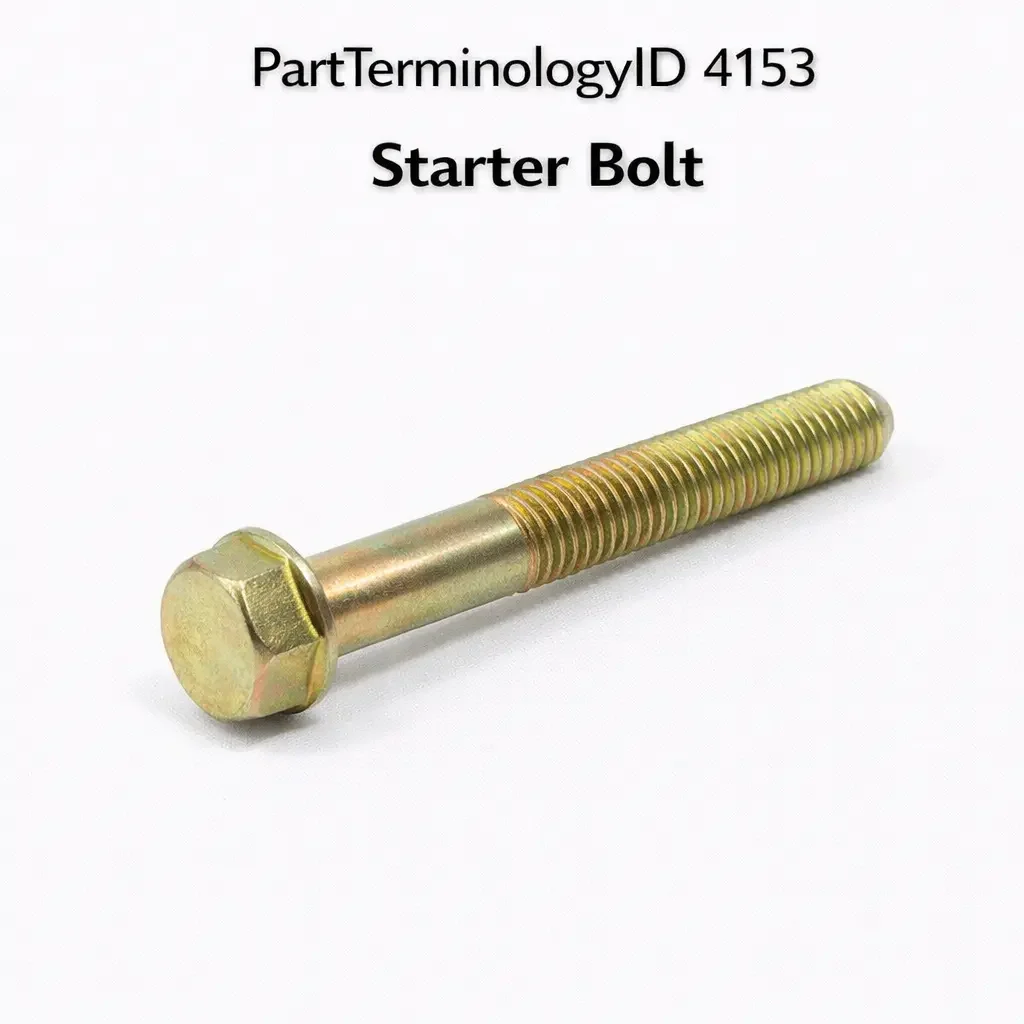
PartTerminologyID 4153, Starter Bolt, is the fastener that secures the starter motor assembly to the engine block starter mounting pad, maintaining the precise positional relationship between the starter nose housing and the flywheel or flexplate ring gear required for correct pinion mesh depth, transmission of cranking torque without bolt fatigue, and vibration resistance throughout the engine's operating range. That definition covers the starter bolt function correctly and leaves unresolved whether the bolt is a standard hex head cap screw, a flanged hex head bolt that distributes clamping load across the mounting flange without a separate washer, a stud-and-nut configuration on some heavy-duty and European applications where the starter slides onto fixed studs rather than accepting through-bolts, whether the thread specification is metric or SAE unified and the specific diameter, pitch, and length that the engine block mounting boss is designed for, the grade or property class of the bolt which determines the proof load and tensile strength available for the starter mounting application, whether the starter requires two bolts, three bolts, or a single bolt plus an alignment dowel depending on the mounting flange design, whether the mounting bolt holes in the engine block are blind tapped holes or through holes with nuts on the back side of the block boss, and whether the starter mounting application is a high-vibration environment that requires thread locking compound or specific torque retention features to prevent bolt loosening during engine operation.
For sellers, PartTerminologyID 4153 is the starter bolt where thread specification mismatch is the most return-generating attribute, because a starter bolt that appears correct in head size and overall length but has the wrong thread diameter or pitch will either cross-thread into the engine block mounting boss on installation, stripping the aluminum or cast iron threads, or will bottom out in the blind hole before generating adequate clamping force, leaving the starter improperly secured. Either outcome produces a starter that vibrates loose during operation, damaging the ring gear from repeated pinion mis-engagement, or an engine block with stripped mounting threads that requires helicoil repair before any correct bolt can be installed. The thread specification must be confirmed against the engine block mounting boss thread, not assumed from the vehicle make, model, and year.
What the Starter Bolt Does
Clamping force and pinion mesh depth maintenance
The starter bolt serves a more precise mechanical function than a standard fastener. The starter nose housing must be positioned relative to the ring gear within a defined mesh depth tolerance to ensure the pinion teeth engage correctly with the ring gear teeth during cranking. Too little mesh depth, from a loose bolt or an undersized flange, allows the pinion to ratchet across the ring gear teeth rather than engaging fully, producing rapid ring gear and pinion tooth wear. Too much mesh depth, from a starter mounting pad that positions the nose too close to the ring gear, causes the pinion to bind in the ring gear during engagement, stalling the starter motor and overloading the ring gear teeth.
The correct bolt torque applied to the correct thread specification delivers the clamping force that holds the starter nose housing in the precise position established by the mounting pad design. A bolt that is under-torqued from incorrect torque specification or from a fastener with a lower strength grade than required allows the starter to shift position under vibration, gradually changing the mesh depth relationship and accelerating ring gear wear. A bolt that is over-torqued from an incorrect torque value or a higher-grade bolt substitution may stretch beyond its proof load, reducing clamping force below the design value and allowing loosening under thermal cycling.
Thread form, diameter, pitch, and length specification
Starter bolt thread specifications vary by engine manufacturer, engine family, and production year across domestic, European, and Asian applications. Domestic V8 engine applications from the 1960s through the 1980s predominantly used SAE unified coarse thread specifications in 3/8-16, 7/16-14, and 1/2-13 sizes depending on the engine and starter design. Metric engine applications from the 1980s onward use M8, M10, and M12 metric coarse thread specifications at pitches of 1.25mm and 1.5mm depending on the engine family.
Thread length is a critical dimension on blind tapped hole applications. A bolt that is too long for the blind hole bottoms out before the starter flange is clamped, leaving the starter loose despite the appearance of a tightened bolt. A bolt that is too short for the application engages fewer thread turns than the design requires, reducing the thread engagement length below the minimum needed for the required clamping force at the specified torque. Both conditions produce a starter that is not correctly secured despite an installation that appears complete.
The washer face diameter on flanged hex head starters bolts distributes clamping load across the starter mounting flange. A standard hex head bolt without a flange used on an application designed for a flanged bolt concentrates clamping load at a smaller contact area, which can deform aluminum mounting flanges on some starter designs under the required installation torque. Confirming whether the application requires a standard hex head or flanged hex head bolt is a mandatory fitment attribute.
Blind tapped hole versus through-hole and the depth stop condition
Starter mounting bosses on most domestic cast iron engine blocks use blind tapped holes that terminate at a defined depth within the block. The usable thread depth in the boss determines the maximum bolt engagement length and the minimum required thread engagement for the specified clamping force. Most blind tapped starter mounting holes provide 18 to 25mm of usable thread engagement for M10 and M12 metric bolts and equivalent engagement for SAE thread sizes.
Aluminum engine blocks use thread inserts or thread-forming processes with tighter bolt length tolerances than cast iron applications because aluminum threads have lower shear strength than the bolt material and require more thread turns for equivalent pullout resistance. A bolt that is 5mm too long in a cast iron application may simply bottom out with no immediate damage. The same 5mm overlong bolt in an aluminum block application may cause thread galling or stripping at the insert interface under the installation torque before the bolt visibly bottoms out.
Through-hole mounting configurations on some European and heavy-duty applications use a stud protruding from the engine block with a nut securing the starter flange from the starter side. These applications do not use a bolt under PartTerminologyID 4153 in the conventional sense but may catalog the stud or the nut under related PartTerminologyIDs. Fitment claims must identify whether the application uses a through-bolt, a blind tapped bolt, or a stud-and-nut to prevent ordering a bolt for a stud-and-nut application.
Why This Part Generates Returns
Buyers return starter bolts because the thread specification does not match the engine block mounting boss thread and the bolt either cross-threads or does not engage, the bolt length is incorrect for the blind hole depth and the bolt bottoms out before generating clamping force, the bolt head type is incorrect for the application and the correct installation torque cannot be achieved with the available tool clearance, the application uses a stud-and-nut configuration and a bolt under this PartTerminologyID does not apply, the replacement bolt grade is lower than required and the bolt stretches under installation torque without achieving the required clamping force, and the thread locking compound requirement was not identified and the replacement bolt loosens under engine vibration within a short period.
Status in New Databases
PartTerminologyID 4153 is cataloged in PIES/PCdb as Starter Bolt. Under PIES 8.0 and PCdb 2.0 there is no change to the terminology or classification for this PartTerminologyID.
Top Return Scenarios
Scenario 1: "Wrong thread pitch, bolt cross-threads in block boss, engine block thread damaged"
The buyer orders a replacement starter bolt based on head size and overall length. The bolt has the correct thread diameter but the wrong pitch, metric 1.25mm instead of the required 1.5mm. The buyer installs the bolt and it initially threads in before binding and cross-threading in the block boss. The block boss threads are damaged. The buyer returns the bolt as defective when the thread pitch mismatch was the fault.
Prevention language: "Thread specification verification: Before ordering the replacement bolt, confirm both the thread diameter and thread pitch against the original bolt or the engine block mounting boss thread specification. A bolt with the correct diameter but incorrect pitch will cross-thread in the mounting boss and damage block threads. Use a thread pitch gauge or compare the replacement bolt thread directly against the original before installation. Thread pitch mismatch cannot be detected by head size or overall length alone."
Scenario 2: "Bolt too long for blind hole, bottoms out before clamping starter, starter vibrates loose"
The replacement bolt is 8mm longer than required for the blind tapped mounting hole. The bolt threads in correctly until it bottoms out at the base of the blind hole. The installer torques the bolt to specification but the starter flange has not been clamped because the bolt contacted the bottom of the hole before the flange was compressed. The starter vibrates loose during the first engine start cycle. The buyer returns the bolt as causing a loose starter when the bolt length was the fault.
Prevention language: "Bolt length verification: Confirm the replacement bolt length matches the original. On blind tapped hole applications a bolt that is longer than the usable thread depth in the boss will bottom out before clamping the starter flange. Measure the original bolt and confirm the replacement matches within 2mm before installation. A bolt that contacts the bottom of the blind hole before the flange is clamped will not secure the starter regardless of the torque applied."
Scenario 3: "Lower grade bolt substituted, bolt stretches under torque, clamping force inadequate, starter loosens"
The original starter bolt is a Grade 10.9 metric flanged hex head bolt. The buyer replaces it with a Grade 8.8 bolt of the same thread specification. The Grade 8.8 bolt's proof load is below the installation torque specified for the Grade 10.9 original. The bolt stretches elastically and then yields slightly during installation, reducing its clamping force below the design value. The starter loosens over several thousand engine start cycles. The buyer returns the bolt as failing to hold the starter secure.
Prevention language: "Bolt grade requirement: Confirm the replacement bolt matches the property class or grade of the original bolt. A lower-grade bolt substituted at the original torque specification will stretch beyond its proof load during installation, reducing clamping force below the design value. Starter mounting bolts on high-vibration applications typically require Grade 10.9 metric or Grade 8 SAE fasteners. Installing a lower-grade bolt at the original torque specification will result in a bolt that loosens prematurely under engine vibration."
Scenario 4: "Thread locking compound required, not applied, bolt loosens within weeks of installation"
The starter mounting application on this engine is designed for a thread locking compound applied to the bolt threads at installation. The original bolt has dried thread locking compound residue on the threads from the factory application. The buyer installs the replacement bolt without applying thread locking compound. The bolt loosens from engine vibration within a few weeks. The buyer returns the bolt as unable to maintain torque when the missing thread locking compound was the installation requirement.
Prevention language: "Thread locking compound: On this application the starter mounting bolts require medium-strength thread locking compound applied to the threads before installation. Clean the mounting boss threads of any old compound residue before applying fresh compound to the replacement bolt threads. Without thread locking compound the bolt will loosen from engine vibration despite being installed at the correct torque."
Scenario 5: "Stud-and-nut application, bolt ordered, no installation point exists"
The vehicle uses a stud-and-nut starter mounting configuration where the stud is pressed into the engine block and the starter slides onto the stud with a nut securing it from the front. The buyer orders a replacement bolt under PartTerminologyID 4153. No threaded hole accepts the bolt on this application. The buyer returns the bolt as incorrect.
Prevention language: "Mounting configuration check: Confirm the starter mounting configuration before ordering. Some applications use studs pressed into the engine block with nuts securing the starter rather than bolts threading into the block. On stud-and-nut applications this PartTerminologyID does not apply. The correct parts for stud-and-nut applications are the mounting stud and the retaining nut rather than a bolt."
Listing Requirements
PartTerminologyID: 4153
Thread form: metric or SAE unified (mandatory)
Thread diameter and pitch (mandatory)
Thread length and bolt overall length (mandatory)
Property class or grade (mandatory)
Head type: standard hex, flanged hex, or other (mandatory)
Quantity: single bolt or set (mandatory)
Mounting configuration: blind tapped, through-hole, or stud-and-nut (mandatory)
Thread locking compound requirement where applicable (mandatory)
Torque specification (mandatory)
Thread specification verification note (mandatory)
Bolt length verification note (mandatory)
Grade requirement note (mandatory)
OEM part number cross-reference (mandatory)
Catalog Checklist for ACES/PIES Teams
PartTerminologyID = 4153
Require thread form: metric or SAE (mandatory)
Require thread diameter and pitch (mandatory)
Require bolt length (mandatory)
Require property class or grade (mandatory)
Require head type (mandatory)
Require mounting configuration (mandatory)
Require torque specification (mandatory)
Prevent thread pitch mismatch return: diameter alone does not confirm thread compatibility; pitch must be specified and verified
Prevent blind hole bottoming return: bolt length must match blind hole usable depth; length verification must precede installation
Prevent lower grade substitution return: property class must match original; lower grade at original torque yields bolt and reduces clamping force
Prevent thread locking compound omission: thread locking compound requirement must be listed where applicable; omission produces premature loosening
FAQ (Buyer Language)
How do I confirm the correct thread specification for my starter bolt?
Remove the original bolt and measure the thread diameter with a caliper. Determine whether the threads are metric or SAE by comparing the thread pitch to a pitch gauge. For metric bolts confirm whether the pitch is 1.0, 1.25, or 1.5mm for the measured diameter. For SAE bolts confirm the threads-per-inch count. Both diameter and pitch must match the replacement bolt. Do not rely on overall length or head size alone to confirm thread specification.
Why is bolt length important for starter mounting?
Most starter mounting holes are blind tapped holes that terminate at a fixed depth in the engine block. A bolt longer than the usable thread depth in the hole will bottom out before clamping the starter flange, leaving the starter improperly secured despite the bolt appearing fully tightened. Measure the original bolt length and confirm the replacement matches within 2mm before installation.
What happens if I use a lower grade bolt than the original?
A lower-grade bolt installed at the torque specified for the original higher-grade bolt will stretch beyond its elastic limit during installation, permanently deforming the bolt shank and reducing its clamping force below the design value. The bolt will appear installed correctly but the starter will loosen under engine vibration because the reduced clamping force is insufficient to resist the vibration loads. Always match or exceed the original bolt property class or grade.
Do starter bolts require thread locking compound?
Some applications require thread locking compound and others do not. If the original bolt has residue of a red, blue, or green thread locking compound on the threads, apply fresh medium-strength compound to the replacement bolt. Clean the mounting boss threads of old compound before applying fresh compound. If no compound residue is visible on the original bolt and the application does not have a service manual specification for compound use, thread locking compound is generally not required.
What is the correct torque for starter mounting bolts?
Torque specifications vary by engine application. Common domestic V8 applications typically specify 25 to 35 foot-pounds for 3/8-inch SAE bolts and 40 to 55 foot-pounds for 7/16-inch bolts. Common metric applications specify 20 to 30 Newton-meters for M8 bolts and 40 to 55 Newton-meters for M10 bolts. Always confirm the torque specification in the engine service manual or the replacement part documentation rather than estimating from bolt diameter alone.
Can I reuse the original starter bolts when installing a replacement starter?
Original starter bolts can typically be reused if they are not visibly damaged, do not show signs of thread galling, and have not been stretched beyond their elastic limit from previous over-torquing. Inspect the bolt threads for damage and confirm the bolt is not visibly necked down at any point along the shank. If there is any uncertainty about the condition of the original bolts, replacement is the correct choice.
What Sellers Get Wrong About PartTerminologyID 4153
The most common error is omitting the thread pitch specification. A starter bolt listing that specifies thread diameter without pitch leaves buyers unable to confirm the single most important compatibility attribute for the fastener. A bolt with M10 diameter but 1.25mm pitch is not interchangeable with an M10 1.5mm pitch bolt and will cross-thread in a boss designed for the other pitch. Without the pitch specification in the listing the buyer has no basis for confirming compatibility before installation and the cross-threading return is the predictable outcome.
The second error is omitting the bolt length specification. Blind tapped mounting hole applications have a maximum usable bolt length that is determined by the hole depth. A bolt length specification in the listing allows the buyer to confirm compatibility with the blind hole depth before installation. Without the length specification buyers receive a bolt that may be correct in thread specification but wrong in length and discover the mismatch only after cross-threading is attempted or the starter is found loose after installation.
The third error is omitting the property class or grade specification. A buyer who substitutes a lower-grade bolt for a high-grade original on the assumption that a fastener of the correct thread specification is equivalent regardless of grade will find the replacement bolt yielding under the installation torque and the starter loosening prematurely. The grade specification in the listing gives the buyer the information needed to select a correct replacement or to confirm the original bolt is suitable for reuse.
The fourth error is omitting the thread locking compound note where applicable. Applications where the OEM design requires thread locking compound will experience premature bolt loosening without it, regardless of correct torque application. The compound requirement cannot be inferred from the bolt specification alone and must be identified in the listing.
Cross-Sell Logic
Starter (PartTerminologyID 4152): for buyers replacing the complete starter assembly where the mounting bolts should be inspected and replaced at the same service interval to ensure the new starter is secured with fasteners of confirmed grade and length.
Helicoil Thread Repair Kit: for buyers where stripped engine block mounting threads from a cross-threaded or broken bolt require thread insert repair before a replacement bolt can be installed.
Thread Locking Compound: for buyers on applications where the mounting bolt specification requires medium-strength thread locking compound at installation to prevent vibration loosening.
Torque Wrench: as a complementary tool recommendation for buyers who may not have access to a calibrated torque wrench, noting that starter bolt torque specification compliance is required to achieve the correct clamping force without bolt yielding.
Why Catalog Data Quality Matters for PartTerminologyID 4153
Starter bolt returns cluster around four scenarios that are all preventable with listing language: thread pitch mismatch, incorrect bolt length, lower-grade substitution, and missing thread locking compound guidance. The thread pitch mismatch generates returns with potential consequential damage to engine block threads that converts a minor fastener replacement into a thread repair. The bolt length error generates returns of bolts that appear correct but fail to secure the starter from blind hole bottoming. The grade substitution generates repeat loosening returns when the lower-grade bolt yields under the original torque. The thread locking compound omission generates loosening returns within weeks of installation on applications that require compound.
Thread specification completeness, bolt length specification, property class disclosure, and compound requirement identification together address all four scenarios. Each attribute requires one line in the listing. All four are absent in most aftermarket listings for this PartTerminologyID, which typically list only head size and overall length without thread pitch, property class, or installation notes.
Application Range and Fitment Guidance for PartTerminologyID 4153
Starter bolt applications span every vehicle with a bolt-mounted starter from the early electric starter era through the present. Domestic V8 and V6 engine applications from the 1960s through the 1980s used SAE unified thread specifications predominantly in 3/8-16 and 7/16-14 sizes with hex head cap screws. The transition to metric fasteners on domestic engines began in the early 1980s and was complete by approximately 1990 on most platforms, with M10 and M12 metric flanged hex head bolts becoming the dominant specification through the present.
European vehicles used metric fasteners exclusively from the beginning of the application range, with M8, M10, and M12 specifications common across German, French, and Italian engine applications depending on engine displacement and starter mounting design.
Japanese and Korean engine applications use metric specifications consistent with JIS and ISO standards, with M10 1.25mm pitch being the most common starter mounting bolt specification across a broad range of four-cylinder and V6 engine applications.
Heavy-duty diesel truck applications use larger diameter SAE or metric fasteners than passenger car applications, with 1/2-13 SAE and M14 metric specifications appearing on Class 5 through Class 8 applications depending on engine manufacturer. These applications have higher torque specifications and typically require Grade 8 SAE or Grade 10.9 metric fasteners.
Final Take for PartTerminologyID 4153
Starter Bolt (PartTerminologyID 4153) is the precision fastener whose function extends beyond simple retention to include maintaining the starter nose housing in the exact position required for correct pinion mesh depth and vibration-resistant cranking torque transmission. Thread pitch specification, bolt length, property class, and thread locking compound guidance are the four attributes that prevent the four most common return scenarios. Every listing without thread pitch generates cross-threading returns from buyers who confirmed diameter but not pitch. Every listing without bolt length generates blind hole bottoming returns. Every listing without property class generates premature loosening returns from lower-grade substitution at the original torque. Every listing without thread locking compound guidance generates loosening returns on applications where the OEM design requires compound.
Together these four attributes make every listing under this PartTerminologyID complete and give every installer the specification information needed to confirm compatibility and achieve the design clamping force before the first thread turn is engaged.