
Written by Arthur Simitian | PartsAdvisory
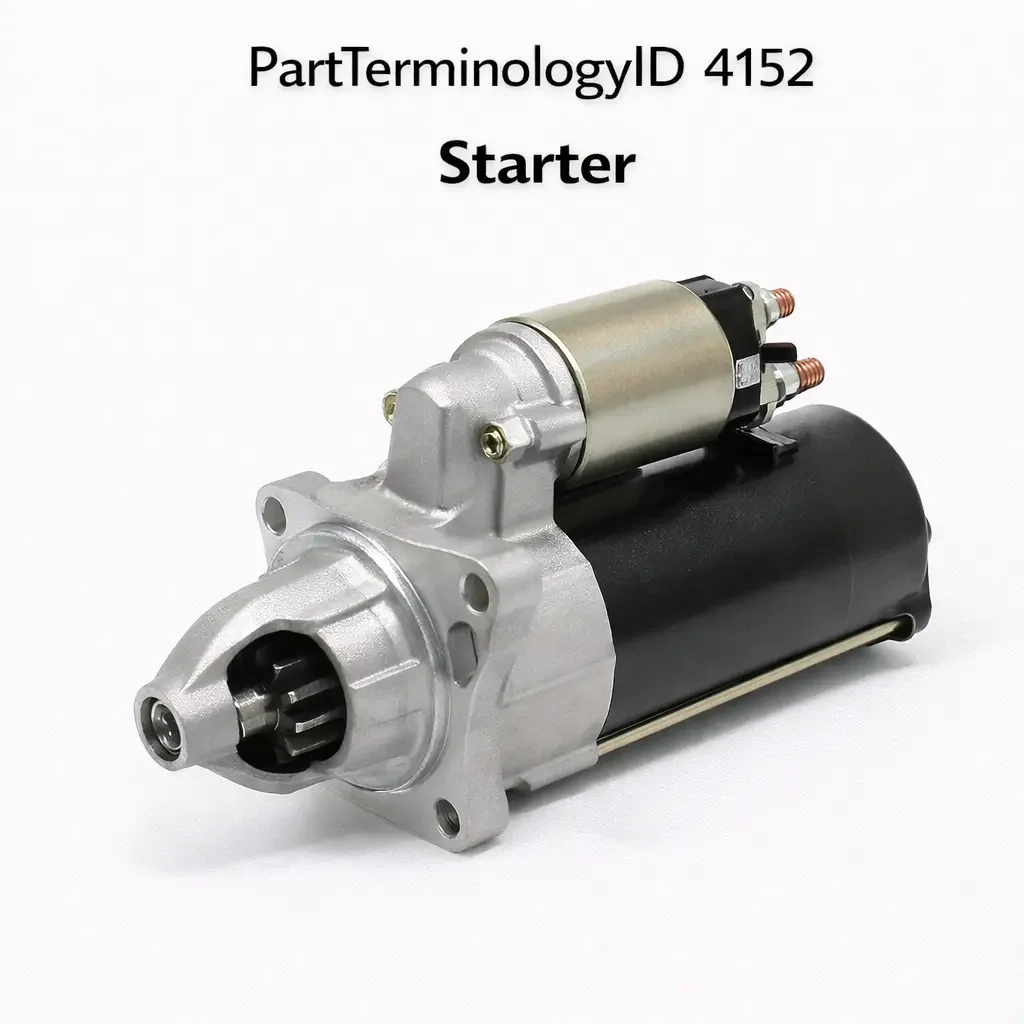
PartTerminologyID 4152, Starter, is the electric motor assembly that cranks the engine by engaging the starter pinion gear with the engine flywheel or flexplate ring gear and spinning the crankshaft to the minimum speed required for combustion initiation, receiving high-current switched power from the battery through the starter relay and ignition switch circuit when the driver turns the ignition key to the start position or activates the push-button start system. That definition covers the starter function correctly and leaves unresolved whether the starter is a conventional gear-reduction starter that uses a permanent magnet motor and planetary gear reduction to deliver high torque at lower motor speed, a direct-drive starter that uses a series-wound motor to engage the ring gear directly without gear reduction, a pre-engaged starter that uses a solenoid-mounted shift fork to slide the pinion into mesh before the motor circuit closes versus an inertia-drive starter that uses the motor's acceleration to drive the pinion into mesh, the ring gear tooth count and pitch that must match the replacement starter pinion specification, whether the starter solenoid is integrated into the starter assembly as a cap-mounted unit or is a remote solenoid mounted separately on the firewall or inner fender with wiring to the starter motor, whether the starter mounting flange bolt pattern and starter nose housing diameter match the engine block starter pocket, whether the engine uses a manual transmission flywheel with a ring gear or an automatic transmission flexplate with a ring gear and whether the flexplate ring gear tooth count differs from the flywheel ring gear count on the same engine application, and whether the starter includes a heat shield required on applications where exhaust manifold proximity causes thermal degradation of the starter solenoid winding insulation without shielding.
For sellers, PartTerminologyID 4152 is the starter where the cranking circuit validation chain is the most return-generating attribute, because the starter is the last component in a multi-stage activation chain that includes the battery, battery cables, ignition switch, starter relay, solenoid control circuit, and main power feed, and a fault at any earlier stage in the chain produces a no-crank symptom that is indistinguishable from a failed starter at the symptom level. A buyer whose vehicle does not crank and who replaces the starter without validating the cranking circuit will return the starter when no change occurs if the battery was discharged, the battery cable connection was corroded, the starter relay had failed, or the starter solenoid control circuit had an open circuit fault. The majority of no-crank returns under this PartTerminologyID are starters that were functional and that were installed into a vehicle whose actual fault was in the cranking circuit rather than the starter itself.
What the Starter Does
Gear reduction starter versus direct drive starter and the torque delivery difference
Gear reduction starters use a permanent magnet motor rotating at higher speed than the output shaft, with planetary or helical gear reduction between the motor and the output pinion. The gear reduction multiplies torque while reducing output speed to the ring gear engagement range. Gear reduction starters are physically smaller and lighter than direct drive starters of equivalent cranking torque, and they are the dominant architecture on vehicles produced after approximately 1990 on most platforms.
Direct drive starters use a series-wound motor whose output shaft is the starter pinion drive shaft, with the motor and pinion rotating at the same speed. Direct drive starters require higher motor current to develop the same cranking torque as a gear reduction unit and are more common on heavy-duty truck and diesel applications where the larger physical packaging is acceptable and the simpler mechanical design is preferred for service durability. A direct drive starter replacement installed on a gear reduction starter application will not fit the nose housing diameter or bolt pattern in most cases, making this an unlikely cross-application error, but listings must specify the starter type to confirm application-specific architecture compatibility.
Starter solenoid function and the two-step engagement sequence
The starter solenoid on pre-engaged starters serves two functions simultaneously: it acts as the high-current switch that closes the main battery-to-motor circuit, and it mechanically shifts the pinion gear into mesh with the ring gear before the motor circuit closes. The solenoid contains two coil windings: a pull-in coil that generates the magnetic force to shift the plunger and close the main contacts, and a hold-in coil that maintains the plunger position against the spring return force after the main contacts close. The pull-in coil is grounded through the motor when the main contacts are open and disconnects from the circuit when the contacts close, reducing current draw from the pull-in coil winding after engagement.
A starter solenoid with a failed pull-in coil produces no pinion movement and no motor rotation when the start circuit is activated, presenting as a completely dead starter. A solenoid with a failed hold-in coil produces initial pinion engagement and motor rotation that drops out immediately as the solenoid plunger bounces back under spring pressure when the pull-in coil loses its ground through the motor contacts. This rapid engagement-dropout behavior produces a chattering or clicking from the starter that buyers may describe as a clicking noise rather than a no-crank, and they may attribute the clicking to the battery rather than the starter solenoid.
A failed main contact set in the solenoid produces a solenoid that engages and shifts the pinion into mesh but delivers no current to the motor, resulting in a mechanical clunk from pinion engagement without any motor rotation. This symptom confirms the solenoid plunger and shift mechanism are functional while the main contacts are the specific fault.
Ring gear tooth count and the pinion mesh compatibility requirement
The starter pinion must mesh correctly with the engine flywheel or flexplate ring gear. The ring gear tooth count and module pitch determine which starter pinion is compatible. A starter pinion with the wrong tooth pitch or the wrong tooth count will either not engage the ring gear at all, producing a ratcheting noise and no cranking, or will engage the ring gear with interference that damages both the pinion teeth and the ring gear teeth within the first few start cycles.
Domestic V8 and V6 engines from the 1960s through the 1990s used a variety of ring gear specifications that differ across engine families, transmission types, and production year revisions. A starter replacement that is cataloged for the vehicle make and model but does not specify the ring gear tooth count may be correct for the standard application but incorrect for an engine that has been replaced with a different year or displacement, a transmission that has been swapped from automatic to manual with a different flywheel, or a high-performance ring gear that has been installed as part of an engine rebuild. The listing must specify the ring gear tooth count the starter pinion is designed for as a mandatory compatibility attribute.
Heat shield requirement and the solenoid thermal protection
Starters mounted in close proximity to the exhaust manifold or catalytic converter on vehicles with tight underhood packaging are exposed to sustained radiant heat that can damage the solenoid winding insulation and degrade the main contact material over repeated heat soak cycles. Factory heat shields on these applications protect the solenoid from direct radiant exposure and are required for the starter to achieve its designed service life.
A buyer who replaces the starter without reinstalling the OEM heat shield, or who installs a replacement starter that does not include a heat shield on an application that requires one, will find the replacement starter failing prematurely from the same thermal degradation mechanism that destroyed the original. The listing must identify heat shield requirement where applicable and confirm whether the replacement starter includes the shield or requires the OEM shield to be transferred from the original.
Cranking Circuit Validation Chain
The cranking circuit validation chain is the diagnostic sequence that separates a starter fault from a supply circuit fault before any component is removed or ordered. The chain proceeds from the battery through each component in the activation path to the starter motor terminals. A fault found at any stage in the chain indicates the component at that stage rather than the starter.
The battery is the primary fault source on no-crank complaints across all vehicle applications and age ranges. A battery with insufficient reserve capacity to deliver cranking current under load will present as a slow crank or no-crank that a buyer attributes to the starter. A battery voltage measurement with no load applied that shows 12.6 volts does not confirm adequate cranking capacity. The battery must be load-tested to confirm it can deliver the required cranking amps at the engine's minimum temperature without voltage dropping below 9.6 volts. A battery that passes a no-load voltage test but fails a load test is discharged or sulfated and produces a no-crank from insufficient current delivery rather than a starter fault.
The battery cables are the second most common fault source on no-crank complaints. A positive cable with a corroded terminal at the battery post or a corroded connection at the starter solenoid feed terminal introduces resistance that reduces voltage delivery to the starter under the high-current cranking demand. Voltage drop across a corroded positive cable during cranking can reduce starter motor terminal voltage from the battery's 12-volt output to below 9 volts, which reduces motor torque to below the cranking threshold. A cable voltage drop test during cranking that shows more than 0.5 volts across the positive cable confirms a cable resistance fault rather than a starter fault.
The ground path from the engine block to the battery negative terminal is the third most commonly overlooked fault in the cranking circuit. The engine-to-chassis ground strap and the battery negative cable must carry the full cranking current return path without significant resistance. A corroded engine ground strap connection at the engine block or chassis attachment point introduces voltage drop in the return path that reduces motor terminal voltage identically to a corroded positive cable. Ground path integrity is confirmed by a voltage drop test from the battery negative post to the engine block during cranking.
The starter relay is the switched high-current component that connects the battery positive to the starter solenoid feed terminal when the ignition switch or BCM activates the relay coil. A failed starter relay produces no voltage at the starter solenoid feed terminal during cranking attempts. Confirming the presence or absence of battery voltage at the solenoid feed terminal during a key-to-start event separates a relay fault from a starter fault in one measurement. No voltage at the solenoid feed with the key held in start indicates a relay, ignition switch, or BCM fault rather than a starter fault.
The solenoid control circuit carries the low-current signal from the ignition switch or BCM to the starter relay coil or directly to the starter solenoid pull-in coil on some applications. A fault in the solenoid control circuit wiring, such as a corroded connector at the neutral safety switch or a failed neutral safety switch that does not allow the start circuit to complete in park or neutral, produces no relay activation and no cranking regardless of starter condition.
Why This Part Generates Returns
Buyers return starters because the battery is discharged or has insufficient cranking capacity and the cranking circuit was not load-tested before the starter was ordered, the battery cable connections are corroded and voltage drop in the cable circuit prevents adequate current delivery to the starter, the starter relay has failed and no supply voltage reaches the starter solenoid feed terminal during start attempts, the neutral safety switch or clutch switch has failed and the start circuit cannot be completed in any gear or clutch position, the ignition switch start contact has failed and no control signal reaches the relay or solenoid, the engine is seized or hydrolocked and the starter cannot crank the engine regardless of starter condition, the replacement starter does not match the ring gear tooth count on this specific engine or transmission combination, and the replacement starter is thermally damaged because the heat shield was not reinstalled on a heat-critical application.
Status in New Databases
PartTerminologyID 4152 is cataloged in PIES/PCdb as Starter. Under PIES 8.0 and PCdb 2.0 there is no change to the terminology or classification for this PartTerminologyID.
Top Return Scenarios
Scenario 1: "Failed battery under load, no-crank attributed to starter, starter replaced with no change"
The vehicle does not crank when the ignition is turned to start. The battery shows 12.4 volts no-load but collapses to 7.8 volts under cranking demand from a sulfated cell. The starter motor receives insufficient voltage to develop cranking torque. The buyer attributes the slow-to-no-crank to the starter and replaces it. The battery fault remains. The replacement starter also fails to crank from the same insufficient battery voltage.
Prevention language: "Battery load test first: Before replacing the starter, have the battery load-tested to confirm it can deliver the required cranking amps without voltage dropping below 9.6 volts. A battery that shows adequate no-load voltage may fail under cranking current demand from sulfation or cell damage. A battery failing under load produces the same no-crank symptom as a failed starter and replacing the starter on a failed battery produces no change."
Scenario 2: "Corroded positive battery cable, voltage drop prevents cranking torque, starter replaced with no change"
The vehicle cranks slowly and eventually stops cranking entirely. The positive battery cable has a corroded terminal at the battery post that introduces 1.8 volts of resistance drop under cranking current. The starter motor receives 10.2 volts instead of the battery's 12.0 volts and cannot develop adequate torque to crank the engine at the required speed. The buyer replaces the starter. The cable resistance fault remains. The replacement starter also cranks slowly from the same voltage drop.
Prevention language: "Battery cable voltage drop test: With the engine cranking, measure voltage drop from the battery positive post to the starter solenoid main feed terminal. A reading above 0.5 volts indicates excessive resistance in the positive cable circuit. Also measure from the battery negative post to the engine block. A reading above 0.3 volts indicates a ground path resistance fault. Both faults produce slow or no-crank identically to a failed starter. Correct cable and connection faults before replacing the starter."
Scenario 3: "Failed starter relay, no voltage at solenoid feed, starter replaced with no change"
The vehicle produces no crank and no click when the ignition is turned to start. The starter relay has failed open. No battery voltage is present at the starter solenoid feed terminal during start attempts. The buyer replaces the starter. The relay fault remains. The replacement starter also receives no supply voltage.
Prevention language: "Starter relay validation: With the ignition key held in the start position, probe the starter solenoid large feed terminal for battery voltage with a test light or multimeter. No voltage at the solenoid feed terminal indicates a failed starter relay, a failed ignition switch start contact, a failed neutral safety switch, or a wiring fault in the control circuit rather than a starter fault. A starter that receives no supply voltage is functioning correctly."
Scenario 4: "Failed neutral safety switch, start circuit cannot complete in any shifter position, starter replaced with no change"
The vehicle does not crank from any shifter position. The neutral safety switch has an open-circuit fault that prevents the start circuit from completing regardless of shifter position. No control signal reaches the starter relay. No voltage is present at the relay coil terminal during key-to-start events. The buyer replaces the starter. The neutral safety switch fault remains. No change.
Prevention language: "Neutral safety switch validation: Confirm the neutral safety switch or clutch switch is allowing the start circuit to complete. On automatic transmission vehicles confirm the start circuit activates in both park and neutral positions. On manual transmission vehicles confirm the clutch pedal switch activates the circuit when the clutch is fully depressed. A neutral safety switch or clutch switch that does not allow start circuit completion in any position prevents starter activation regardless of starter condition."
Scenario 5: "Seized engine, hydrolocked cylinder, starter cannot crank engine, buyer attributes no-crank to starter"
The vehicle does not crank after sitting overnight. The engine has a hydrolocked cylinder from a failed head gasket that allowed coolant to enter the combustion chamber. The starter motor activates and the solenoid engages but the starter stalls immediately from the mechanical resistance of the incompressible coolant preventing piston movement. The buyer hears the solenoid click without any engine rotation and attributes the symptom to a failed starter. The buyer replaces the starter. The replacement starter also stalls from the same hydrolocked cylinder.
Prevention language: "Engine mechanical check: Before replacing the starter, attempt to rotate the engine manually using a breaker bar on the crankshaft pulley bolt. If the engine cannot be rotated by hand with all spark plugs removed, the engine has a mechanical seizure or hydraulic lock condition that prevents cranking regardless of starter condition. A starter that stalls under excessive mechanical load is functioning correctly. Address the engine mechanical condition before installing a replacement starter."
Scenario 6: "Wrong ring gear tooth count, pinion does not mesh correctly, ratcheting noise on crank attempt"
The buyer installs a replacement starter that is cataloged for the vehicle make and model but has a pinion designed for the standard flywheel ring gear. The vehicle has had the engine replaced with a later-production unit that uses a different ring gear tooth count. The pinion does not mesh with the ring gear and the starter ratchets against the ring gear teeth without engaging. The buyer returns the starter as defective.
Prevention language: "Ring gear tooth count verification: Confirm the ring gear tooth count on the flywheel or flexplate before ordering a replacement starter. A starter pinion must match the ring gear tooth count and module pitch for correct engagement. Starter cataloging by vehicle make, model, and year may not account for engine replacements, transmission swaps, or production changes within a model year that result in a different ring gear specification. Count the ring gear teeth or confirm the ring gear part number before the order is placed."
Scenario 7: "Heat shield not reinstalled, replacement starter solenoid fails from thermal exposure within months"
The buyer installs a replacement starter on a V8 engine where the starter is mounted below the exhaust manifold. The OEM heat shield is not reinstalled. The replacement solenoid winding insulation degrades from radiant heat during engine operation. The solenoid develops an intermittent main contact fault within three months of installation. The buyer returns the starter as prematurely failed.
Prevention language: "Heat shield reinstallation: On this application the starter is mounted in proximity to the exhaust manifold and requires the heat shield for thermal protection of the solenoid winding insulation. Reinstall the OEM heat shield when installing the replacement starter. A replacement starter installed without the heat shield on a heat-critical application will experience premature solenoid insulation degradation from radiant heat exposure."
Listing Requirements
PartTerminologyID: 4152
Starter type: gear reduction or direct drive (mandatory)
Solenoid type: integrated cap-mounted or remote firewall-mounted (mandatory)
Ring gear tooth count compatibility (mandatory)
Mounting bolt pattern and nose housing diameter (mandatory)
Transmission type compatibility: automatic flexplate or manual flywheel (mandatory)
Heat shield: included, required OEM transfer, or not required (mandatory)
Rotation direction: clockwise or counterclockwise viewed from drive end (mandatory)
Battery load test note (mandatory)
Battery cable voltage drop test note (mandatory)
Starter relay validation note (mandatory)
Neutral safety switch validation note (mandatory)
Engine mechanical check note (mandatory)
Ring gear tooth count verification note (mandatory)
Heat shield reinstallation note where applicable (mandatory)
OEM part number cross-reference (mandatory)
Catalog Checklist for ACES/PIES Teams
PartTerminologyID = 4152
Require starter type: gear reduction or direct drive (mandatory)
Require ring gear tooth count compatibility (mandatory)
Require mounting bolt pattern and nose housing (mandatory)
Require transmission type compatibility (mandatory)
Require heat shield specification (mandatory)
Require rotation direction (mandatory)
Prevent battery fault starter return: battery load test must precede starter diagnosis; voltage-only battery test does not confirm cranking capacity
Prevent cable voltage drop starter return: cable voltage drop test during cranking must precede starter replacement on slow-crank complaints
Prevent relay fault starter return: solenoid feed terminal voltage must be confirmed before starter is diagnosed
Prevent neutral safety switch starter return: start circuit completion in park and neutral must be confirmed before starter is diagnosed
Prevent engine mechanical starter return: manual crankshaft rotation check must confirm engine rotates freely before starter is replaced
Prevent ring gear mismatch starter return: ring gear tooth count must be confirmed as a fitment attribute not assumed from vehicle year and model
Prevent heat shield omission starter return: heat shield reinstallation is mandatory on heat-critical applications; heat shield requirement must be listed
FAQ (Buyer Language)
My car makes a clicking noise but does not crank. Is the starter bad?
A clicking noise when the ignition is turned to start is most commonly a battery or battery cable fault rather than a starter fault. A rapid clicking series indicates the battery is unable to deliver cranking current and the solenoid is chattering from insufficient voltage to hold the contacts closed. A single loud click without engine rotation may indicate a seized engine or a starter main contact fault. Have the battery load-tested and check the battery cable connections before concluding the starter has failed.
My car produces no sound at all when I turn the key to start. Is it the starter?
No response to the start position, with no click and no motor sound, indicates no activation signal is reaching the starter solenoid. Check the starter relay, ignition switch start contact, neutral safety switch, and solenoid control circuit wiring before replacing the starter. A starter that receives no activation signal cannot indicate whether it is functional or not.
How do I confirm the starter relay is working?
With a helper holding the ignition key in the start position, probe the large terminal on the starter solenoid with a test light. The test light should illuminate brightly, confirming the relay is delivering battery voltage to the solenoid. No illumination with the key in start indicates the relay is not closing. Test the relay coil terminal for the activation signal from the ignition circuit to separate a relay fault from a coil control fault.
How do I do a battery cable voltage drop test?
Connect a multimeter in DC voltage mode across the positive cable from the battery positive post to the starter solenoid feed stud. Crank the engine for a few seconds while reading the voltage. A reading above 0.5 volts indicates excessive resistance in the positive cable circuit. Repeat from the battery negative post to the engine block for the ground path. A reading above 0.3 volts at the ground path indicates a ground strap or cable resistance fault.
How do I know if my engine is hydrolocked before replacing the starter?
Remove all spark plugs to relieve cylinder compression. Attempt to rotate the crankshaft manually using a 1/2-inch drive breaker bar and socket on the crankshaft harmonic balancer center bolt. An engine that rotates freely with all plugs removed is not mechanically seized and the starter is the diagnostic focus. An engine that cannot be rotated with the plugs removed has a mechanical obstruction or hydraulic lock that prevents cranking regardless of starter condition.
What ring gear tooth count does my starter need?
The ring gear tooth count is stamped or cast into the ring gear face or can be counted directly with the engine visible. Common domestic V8 applications use 168-tooth or 153-tooth ring gears depending on transmission type and production year. Confirming the tooth count directly is more reliable than assuming the standard fitment based on vehicle year and model, particularly on vehicles with non-original engines or transmissions.
My new starter cranks the engine but makes a grinding noise. What is wrong?
A grinding noise during cranking indicates the starter pinion is not meshing cleanly with the ring gear. The most common causes are a ring gear tooth count mismatch between the starter pinion and the installed ring gear, worn or damaged ring gear teeth that prevent clean mesh, or incorrect starter mounting that positions the pinion outside the correct mesh depth with the ring gear. Confirm the ring gear tooth count and inspect the ring gear teeth before assuming the starter is defective.
Does the replacement starter need a heat shield?
On applications where the original starter had a heat shield, reinstall it on the replacement. The heat shield protects the solenoid winding insulation from radiant heat from the exhaust manifold. An application that required a heat shield originally requires it on the replacement for the same reason. If the OEM heat shield is damaged or missing, a universal aftermarket heat shield of appropriate size can be used as a substitute.
What Sellers Get Wrong About PartTerminologyID 4152
The most common error is omitting the battery load test note. The battery is the single most common cause of no-crank complaints that result in starter replacement across all vehicle applications and age ranges. A battery that shows adequate no-load voltage but fails under cranking current demand produces the same no-crank symptom as a failed starter. Without the load test note buyers replace starters on battery faults and return them when the replacement also fails to crank from the same insufficient battery. The battery load test note is the highest-impact single attribute for this PartTerminologyID because it prevents the largest single category of unnecessary starter replacements.
The second error is omitting the cable voltage drop test note. Corroded battery cable connections are the second most common cause of no-crank or slow-crank complaints after battery failure. The voltage drop test is a specific measurement with a defined pass-fail threshold that buyers can perform with a standard multimeter before any part is removed. Without the test guidance buyers replace starters on cable faults and find the replacement also cranks slowly from the same cable resistance.
The third error is omitting the relay validation note. Confirming battery voltage at the starter solenoid feed terminal during a key-to-start event is the single measurement that separates a starter fault from all upstream circuit faults simultaneously. If voltage is present at the solenoid feed terminal and the starter does not respond, the starter is the fault source. If no voltage is present, the fault is upstream. Without this note buyers have no practical validation step between observing no-crank and ordering a starter.
The fourth error is omitting the neutral safety switch validation note. A neutral safety switch fault produces no-start that is completely indistinguishable from a starter fault at the symptom level. On automatic transmission vehicles a neutral safety switch stuck in the fault position will not allow start circuit completion in any gear, and buyers who try park, neutral, and drive without finding start circuit activation conclude the starter has failed. Without the neutral safety validation note buyers replace the starter and find no change.
The fifth error is omitting the ring gear tooth count specification. A starter replacement cataloged by vehicle year, make, and model assumes the standard ring gear specification for that application. Engines replaced with different years or displacements, transmissions swapped between automatic and manual, and production changes within a model year can all result in a ring gear specification that differs from the standard fitment. Without the tooth count specification buyers cannot confirm compatibility beyond vehicle identification and the return from a pinion-to-ring-gear mismatch is inevitable on non-standard applications.
Cross-Sell Logic
Battery: for buyers where the battery fails a load test during the cranking circuit validation, indicating the battery is the no-crank cause rather than the starter and battery replacement restores cranking without starter replacement.
Battery Cables: for buyers where the voltage drop test during cranking exceeds 0.5 volts on the positive cable or 0.3 volts on the ground path, indicating cable resistance is the slow-crank or no-crank cause and cable replacement or connection cleaning restores cranking.
Starter Relay: for buyers where no battery voltage is present at the starter solenoid feed terminal during key-to-start events and the fault traces to a failed relay contact rather than an ignition switch or neutral safety switch fault.
Neutral Safety Switch: for buyers where no relay activation signal is present at the relay coil terminal during key-to-start events and the fault traces to a failed neutral safety switch that is not completing the start circuit in park or neutral.
Ignition Switch: for buyers where the starter relay receives no activation signal from the ignition circuit during key-to-start events and the neutral safety switch is confirmed functioning, indicating an ignition switch start contact fault.
Flywheel or Flexplate Ring Gear: for buyers whose replacement starter makes a grinding noise during cranking, indicating worn or damaged ring gear teeth that prevent clean pinion mesh and require ring gear replacement alongside the starter.
Heat Shield: for buyers on heat-critical applications where the OEM heat shield is damaged or missing and the replacement starter requires thermal protection for the solenoid winding.
Why Catalog Data Quality Matters for PartTerminologyID 4152
Starter returns cluster around six scenarios that are fully preventable with listing language: battery fault misdiagnosis, cable voltage drop misdiagnosis, relay fault misdiagnosis, neutral safety switch misdiagnosis, ring gear mismatch, and heat shield omission. Together these six scenarios account for the majority of starter returns under this PartTerminologyID and none of them reflect a defective product.
The battery load test note and the cable voltage drop test note together address the two highest-volume return scenarios. Battery and cable faults are more common causes of no-crank and slow-crank than actual starter failure across the entire installed vehicle population, and buyers who proceed directly from a no-crank symptom to a starter order without battery and cable validation are the dominant return source. Both notes require one paragraph of guidance and both are absent in most aftermarket listings for this PartTerminologyID.
The relay validation note addresses the diagnostic step that most efficiently separates a starter fault from all upstream circuit faults in a single measurement. Without it buyers cannot confirm whether the starter is receiving supply before they remove and replace it.
The neutral safety switch note and the ring gear tooth count note address two scenarios that are specific to vehicle condition and configuration rather than universal circuit faults. Both are present in a significant share of returns and both require one sentence to address.
The heat shield note addresses the premature failure scenario that generates returns months after installation on applications where the solenoid winding is exposed to radiant heat without thermal protection.
All six notes together make every listing under this PartTerminologyID complete and give every buyer the validation sequence needed to confirm a genuine starter fault before the order is placed.
Application Range and Fitment Guidance for PartTerminologyID 4152
Starter applications span every vehicle with an internal combustion engine from the early 1900s when electric starters replaced hand cranking through the present. The gear reduction starter became the dominant architecture on domestic passenger cars and light trucks from approximately 1990 onward, replacing the heavier direct drive starters that were standard equipment through the 1980s. Direct drive starters remain common on heavy-duty diesel trucks, commercial vehicles, marine applications, and older vehicles in the service population.
Ring gear tooth count specifications vary by engine family, engine displacement, production year, and transmission type. The most common domestic V8 ring gear specifications are 168 teeth for standard automatic transmission applications and 153 teeth for high-performance and some manual transmission applications. V6 engine ring gear counts vary across manufacturers and engine families. Four-cylinder engines from European and Asian manufacturers use a wide range of ring gear specifications that must be confirmed per engine code rather than per vehicle model.
Remote solenoid applications are concentrated in older domestic vehicles from the 1960s and 1970s where the starter motor is a separate component from the solenoid. The solenoid is mounted on the inner fender or firewall and connected to the starter motor by a heavy cable. Replacement starters for these applications cover only the motor assembly and do not include the solenoid. Fitment claims must distinguish remote solenoid from integrated solenoid applications to prevent a solenoid-included starter being ordered for a remote solenoid application where the solenoid is not needed.
Starter rotation direction varies by engine and transmission combination. Most applications use a clockwise rotation viewed from the drive end, but counterclockwise applications exist on some European and specialty vehicles. Installing a clockwise starter on a counterclockwise application drives the pinion in the wrong direction and prevents ring gear engagement. Rotation direction is a mandatory fitment attribute for all starter applications.
Diesel engine starters require significantly higher cranking torque than gasoline engine starters due to higher compression ratios and the absence of spark assist during cold starts. Diesel starter applications require higher-rated gear reduction units with larger motor assemblies than comparable displacement gasoline applications. Fitment claims must confirm diesel versus gasoline engine application to prevent an undersized gasoline engine starter being applied to a diesel engine.
High-compression performance engine applications require starters with higher torque ratings than the standard engine application to crank the engine against elevated compression resistance. A standard replacement starter for a high-compression engine may crank the engine but at below-specification speed, resulting in hard starts or no-starts under cold conditions. Performance engine starters with high-torque gear reduction are the correct specification for these applications.
Final Take for PartTerminologyID 4152
Starter (PartTerminologyID 4152) is the engine cranking component where battery load test guidance, cable voltage drop validation, relay supply confirmation, neutral safety switch validation, ring gear tooth count specification, and heat shield reinstallation guidance are the six attributes that prevent the six most common return scenarios. Every listing without battery load test guidance sends buyers through a starter replacement that changes nothing because the battery was the fault source. Every listing without cable voltage drop validation sends buyers through a starter replacement on a cable fault. Every listing without relay supply confirmation sends buyers through a starter replacement when the relay or upstream circuit was the fault. Every listing without neutral safety switch validation sends buyers through a starter replacement when the start circuit was not completing from a switch fault. Every listing without ring gear tooth count specification risks a pinion mismatch on non-standard engine or transmission configurations. Every listing without heat shield guidance risks premature solenoid failure on heat-critical applications.
The battery load test note and the relay supply confirmation note together address the two scenarios that generate the largest share of no-change starter returns. Battery fault misdiagnosis generates the largest absolute volume of unnecessary starter replacements of any component in the entire aftermarket catalog. Relay fault misdiagnosis generates the same no-crank-after-replacement outcome from a different upstream fault source. Adding both notes to the listing converts both scenarios into correct upstream diagnoses that prevent the starter order entirely in most cases.
Cable voltage drop validation, neutral safety switch confirmation, ring gear specification, and heat shield guidance complete the set of attributes that ensure every buyer under this PartTerminologyID identifies the correct fault source before the starter is removed and every installer receives the guidance needed to achieve the full designed service life of the replacement.
Together these six attributes make every listing under this PartTerminologyID complete.