
Written by Arthur Simitian | PartsAdvisory
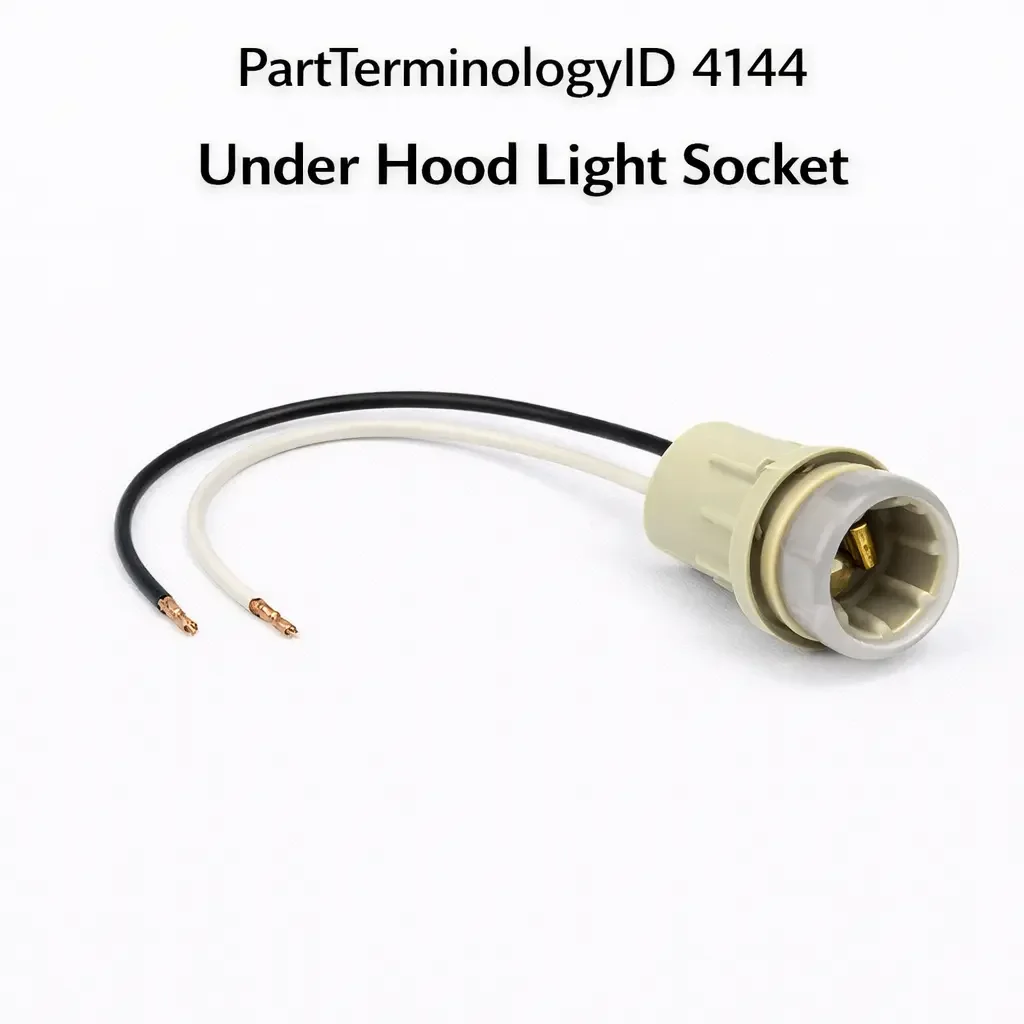
PartTerminologyID 4144, Under Hood Light Socket, is the bulb socket that provides illumination inside the engine compartment when the hood is opened, receiving switched power from the hood switch circuit when the hood latch releases and the hood is raised to allow the driver or technician to see the engine compartment in low-light conditions. That definition covers the under hood light socket function correctly and leaves unresolved whether the socket is activated by a plunger switch mounted in the hood latch mechanism that releases when the hood opens, a magnetic switch that activates when the hood magnet separates from the switch body at the cowl or fender area, or a manual pull switch on the lamp housing itself that allows the driver to activate the under hood light without opening the hood fully, whether the under hood light circuit is always-on and draws directly from the battery through a fuse regardless of ignition state, whether the socket is mounted in the engine compartment strut tower area, the firewall, the underside of the hood panel, or in a separate under hood lamp assembly mounted at the front of the engine bay, whether the socket and its supply wiring are exposed to engine heat, oil mist, fuel vapor, vibration, and the full range of underhood environmental conditions that accelerate socket housing degradation and terminal corrosion beyond any other socket application, and whether the socket is a discrete replaceable component or is integrated into a sealed under hood lamp assembly.
For sellers, PartTerminologyID 4144 is the under hood light socket where the underhood thermal and chemical environment is the most return-generating attribute, because the under hood light socket operates in the most hostile environment of any bulb socket on the vehicle. Engine heat cycles, oil mist deposition, vibration from the engine and road, and occasional contact with fluids and cleaning agents combine to degrade the socket housing and terminal contacts faster than any other socket category. A buyer who replaces the under hood light socket without addressing the root cause of the original socket failure will find the replacement degraded by the same environmental conditions within one to three years rather than the five to ten year service life a correctly installed socket in a protected position would achieve.
What the Under Hood Light Socket Does
Hood switch activation and the always-on circuit
The under hood light circuit is almost universally always-on, drawing power directly from the battery through a dedicated fuse regardless of ignition state. This architecture allows the under hood light to illuminate whenever the hood is opened including during jump-start procedures, battery service, and roadside breakdown scenarios where the ignition is off. The hood switch is the only control in the circuit.
A plunger-type hood switch mounted in the hood latch mechanism is the most common activation design on domestic vehicles. The plunger is compressed by the closed hood and extends when the hood is raised, closing the circuit and activating the socket. A plunger switch with a broken spring or a corroded plunger body may not extend reliably when the hood is opened, producing intermittent activation that the buyer attributes to an intermittent socket contact rather than an intermittent switch.
A manual pull switch integrated into some under hood lamp housings allows the driver to activate the lamp without triggering the hood switch, useful when the lamp is needed without fully opening the hood. On these applications the socket may have two activation paths: the hood switch circuit and the manual switch circuit. A fault in the hood switch path leaves the manual switch functional, and a buyer who tests only the hood switch path may find no activation while the manual switch path remains operational.
Underhood environmental degradation and socket service life
The under hood light socket is exposed to sustained radiant heat from the engine block and exhaust components, cyclical thermal expansion and contraction as the engine heats and cools, oil mist from the valve cover and breather circuits that deposits on the socket housing and terminal contacts, vibration transmitted through the body structure from the engine and road, and chemical exposure from battery outgassing, coolant residue, and brake fluid vapor in the underhood space.
These conditions combine to degrade socket terminal contacts through oxidation accelerated by heat and chemical exposure, to embrittle the socket housing plastic leading to cracking at the retaining clip or twist-lock position, and to degrade the insulation on the supply wiring between the fuse and the socket. A socket that has failed from thermal embrittlement and chemical oxidation in the underhood environment requires attention to the surrounding wiring and mounting condition at replacement, not only the socket body itself.
The replacement socket must be rated for the underhood thermal environment. A general-purpose interior socket with a polypropylene housing rated to 85 degrees Celsius installed in an underhood position where sustained temperatures may reach 120 to 150 degrees Celsius near the engine will embrittle and crack within one to two heat cycles. Confirming the replacement socket housing material is rated for the underhood temperature range is a mandatory pre-installation step.
Why This Part Generates Returns
Buyers return under hood light sockets because the hood switch has failed and the circuit is not activated when the hood is raised, the under hood light fuse has blown from a wiring insulation fault caused by heat damage to the supply wiring, the under hood light bulb has failed and the socket is undamaged, the replacement socket housing is not rated for the underhood thermal environment and cracks within one to two heat cycles, and the replacement socket terminal contacts oxidize from the same oil mist and chemical exposure as the original because the mounting area was not cleaned before installation.
Status in New Databases
PartTerminologyID 4144 is cataloged in PIES/PCdb as Under Hood Light Socket. Under PIES 8.0 and PCdb 2.0 there is no change to the terminology or classification for this PartTerminologyID.
Top Return Scenarios
Scenario 1: "Failed hood switch, no activation when hood opened, socket replaced with no change"
The under hood light does not illuminate when the hood is raised. The hood latch plunger switch has a broken spring. The plunger does not extend when the hood opens. No supply voltage reaches the socket. The buyer replaces the socket. The switch fault remains. No change in under hood light behavior.
Prevention language: "Hood switch validation: Confirm supply voltage is present at the under hood light socket terminal with the hood raised before replacing the socket. No voltage with the hood open indicates a failed hood switch or a blown under hood light fuse rather than a socket fault. Manually press and release the hood switch plunger and confirm the circuit activates before diagnosing the socket."
Scenario 2: "Heat-damaged supply wiring, insulation cracked, fuse blown, socket receives no power"
The under hood light does not illuminate. The supply wiring between the fuse and the socket has cracked insulation from sustained underhood heat exposure. The bare conductor has contacted a grounded surface and blown the under hood light fuse. The socket is undamaged but receives no supply voltage. The buyer replaces the socket. The blown fuse and damaged wiring remain. No change.
Prevention language: "Fuse and supply wiring check: Before replacing the socket, locate the under hood light fuse and confirm it is intact. If the fuse has blown, inspect the supply wiring from the fuse to the socket for cracked or damaged insulation caused by engine heat. Repair any damaged wiring before replacing the fuse and socket. A fuse that blows again after replacement indicates a wiring insulation fault that must be corrected."
Scenario 3: "Failed under hood light bulb, socket intact, socket returned after bulb replacement resolves dark light"
The under hood light does not illuminate when the hood is raised. Supply voltage is confirmed at the socket terminal with the hood open. The socket housing is undamaged. The bulb has a failed filament. The buyer replaces the socket. The light illuminates. The buyer returns the original socket as defective when the bulb was the failed component.
Prevention language: "Bulb pre-check: Confirm supply voltage is present at the socket terminal with the hood open. If supply voltage is present but the light does not illuminate, inspect the bulb filament before replacing the socket. Under hood light bulbs are exposed to the same thermal environment as the socket and may fail more frequently than the socket housing. Replace the bulb before ordering a socket."
Scenario 4: "Replacement socket housing not rated for underhood temperature, cracks within weeks of installation"
The buyer installs a general-purpose replacement socket with a standard polypropylene housing. The socket is mounted adjacent to the valve cover in a position where sustained underhood temperatures reach 130 degrees Celsius. The socket housing embrittles and cracks at the retaining clip within two heat cycles. The buyer returns the socket as defective on arrival.
Prevention language: "Temperature rating: Confirm the replacement socket housing is rated for the underhood operating temperature at the specific mounting position. General-purpose interior lamp sockets with standard polypropylene housings are not rated for sustained temperatures above 85 degrees Celsius. Underhood positions adjacent to the engine, exhaust manifold, or turbocharger require a socket with a high-temperature housing material rated to at least 125 degrees Celsius. Installing a standard-rated socket in a high-temperature underhood position will result in housing embrittlement and cracking within one to two heat cycles."
Listing Requirements
PartTerminologyID: 4144
Hood switch type: plunger, magnetic, or manual pull (mandatory)
Socket mounting position: strut tower, firewall, hood underside, or front engine bay (mandatory)
Housing temperature rating for underhood environment (mandatory)
Bulb base type and wattage specification (mandatory)
Socket architecture: discrete replaceable or integrated assembly (mandatory)
Hood switch validation note (mandatory)
Fuse and supply wiring inspection note (mandatory)
Bulb pre-check note (mandatory)
Temperature rating pre-installation check note (mandatory)
OEM part number cross-reference (mandatory)
Catalog Checklist for ACES/PIES Teams
PartTerminologyID = 4144
Require hood switch type (mandatory)
Require mounting position (mandatory)
Require housing temperature rating (mandatory)
Require bulb base type and specification (mandatory)
Prevent hood switch socket return: failed switch produces no activation identically to failed socket; switch circuit validation must precede socket diagnosis
Prevent heat-damaged wiring socket return: fuse and supply wiring must be inspected before socket replacement; a blown fuse from heat-damaged wiring recurs if wiring is not repaired
Prevent temperature-rated housing return: standard interior socket housing embrittles in underhood heat; temperature rating must be confirmed before installation
FAQ (Buyer Language)
Why does my under hood light not come on when I open the hood?
Confirm supply voltage is reaching the socket by probing the socket terminal with the hood open. If no voltage is present, check the under hood light fuse and manually press the hood switch plunger to confirm it is completing the circuit before replacing the socket. The hood switch is the most common fault source on a no-activation under hood light complaint.
How do I check if the hood switch is working?
Locate the plunger switch in the hood latch area. With the hood open the plunger should extend fully. Press the plunger manually and confirm the under hood light activates and deactivates with plunger movement. If the light does not respond to manual plunger movement with confirmed supply voltage at the socket, the socket or bulb is the fault source.
My under hood light fuse keeps blowing. What is causing it?
A recurring blown under hood light fuse indicates a wiring insulation fault in the supply circuit. Engine heat damages the insulation on the supply wiring over time, eventually exposing the conductor and causing a short to ground. Inspect the supply wiring from the fuse to the socket for cracked, melted, or abraded insulation and repair any damaged sections before replacing the fuse again.
How do I know if my replacement socket is rated for the underhood environment?
Confirm the socket housing material and temperature rating in the product specifications. A socket rated for underhood use should specify a housing temperature rating of at least 125 degrees Celsius. If the product does not specify a temperature rating or specifies a rating below 100 degrees Celsius, it is a general-purpose interior socket and is not suitable for an underhood mounting position adjacent to the engine.
Can I replace just the bulb without replacing the socket?
Yes on applications where the bulb is separately removable from the socket. Remove the socket from its mounting position, pull the bulb from the socket, and replace it with the correct base type and wattage. Under hood light bulbs are exposed to high thermal cycling and may fail more frequently than the socket housing on some applications.
What Sellers Get Wrong About PartTerminologyID 4144
The most common error is omitting the temperature rating note. The under hood light socket operates in the most thermally aggressive environment of any bulb socket on the vehicle and a replacement socket that is not rated for the underhood temperature at the specific mounting position will fail within weeks. Without the temperature rating note buyers install general-purpose sockets that crack and embrittle from the first heat cycle and return them as defective on arrival. The temperature rating note converts this return into a correct material specification check before installation.
The second error is omitting the hood switch validation note. The hood switch is the primary fault source on no-activation under hood light complaints and the socket is rarely the failed component. Without the switch validation note buyers replace sockets on switch faults and return them when no change occurs.
The third error is omitting the fuse and supply wiring inspection note. Heat-damaged supply wiring that blows the fuse is a sequential fault that recurs if the wiring is not repaired before the fuse and socket are replaced. Without the wiring inspection note buyers replace the socket into a still-damaged wiring circuit, the fuse blows again, and the socket is returned as non-functional when the wiring was the fault source throughout.
Cross-Sell Logic
Under Hood Light Bulb: for buyers where the socket is confirmed functional and supply voltage is present at the terminal with the hood open, but the light does not illuminate, indicating a failed bulb filament.
Hood Switch: for buyers where no supply voltage is present at the socket terminal with the hood open and manual plunger testing confirms the switch is not completing the circuit, indicating a failed hood switch rather than a socket fault.
Under Hood Light Fuse: for buyers where no supply voltage is present at the socket terminal and the fault traces to a blown under hood light fuse, and for buyers where the fuse recurs due to heat-damaged supply wiring requiring wiring repair before fuse replacement.
Under Hood Lamp Assembly: for buyers on sealed assembly applications where no discrete replaceable socket exists and a failed under hood light requires complete lamp assembly replacement.
Final Take for PartTerminologyID 4144
Under Hood Light Socket (PartTerminologyID 4144) is the engine compartment illumination component where hood switch validation, temperature rating confirmation, fuse and wiring inspection, and bulb pre-check are the four attributes that prevent the four most common return scenarios. Every listing without hood switch validation sends buyers through a socket replacement that changes nothing because the switch fault remains. Every listing without temperature rating guidance generates returns from buyers who installed a standard-rated socket in a high-temperature underhood position. Every listing without fuse and wiring inspection generates returns from buyers whose replacement socket receives no power from a still-blown fuse on still-damaged wiring. Every listing without bulb pre-check generates returns from buyers who replaced a functional socket when a bulb was the correct repair.
Together these four attributes make every listing under this PartTerminologyID complete.