
Written by Arthur Simitian | PartsAdvisory
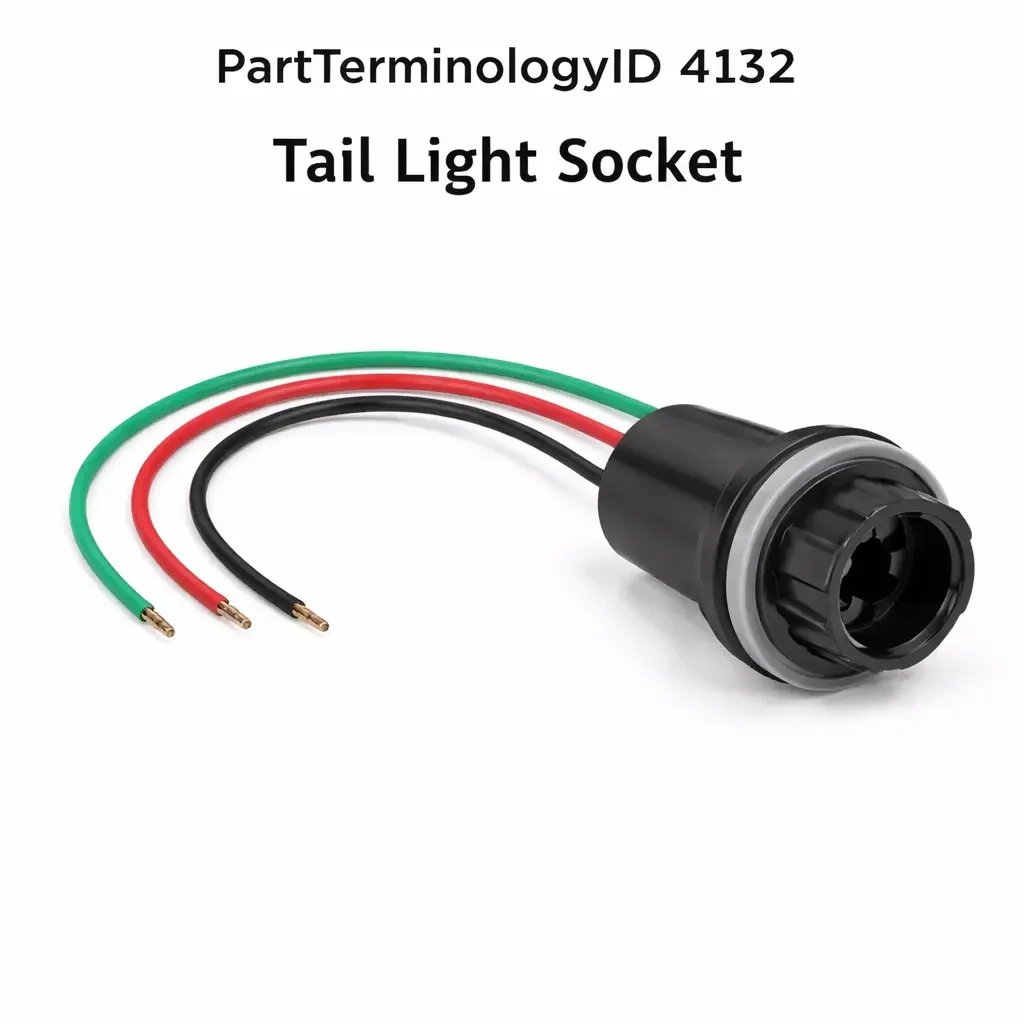
PartTerminologyID 4132, Tail Light Socket, is the bulb socket that holds the tail light bulb in the rear lamp assembly, receiving switched power from the tail light circuit when the parking lamps or headlamps are activated to provide continuous rear illumination indicating vehicle presence to following traffic during low-light conditions. That definition covers the tail light socket function correctly and leaves unresolved whether the socket holds a single-filament bulb dedicated to tail light illumination only, a dual-filament bulb that combines the tail light function with the stop light or turn signal function in a single bulb at the same position, a triple-function bulb on some applications that combines tail, stop, and turn signal in a single element, the bulb base type the socket accepts including single-contact bayonet, dual-contact bayonet, or wedge, whether the tail light circuit is a direct branch of the parking lamp switch output or a BCM-commanded output that the BCM activates in response to the headlamp switch input, whether the socket is exposed to road spray and weather in a rear lamp position that accelerates terminal corrosion compared to interior or front-mounted sockets, whether the tail lamp assembly uses a single socket per lamp position or a multi-socket circuit board assembly where the tail, stop, and turn signal functions each occupy separate socket positions in a single housing, and whether a failed tail light socket generates a BCM outage warning on vehicles with tail lamp circuit current monitoring.
For sellers, PartTerminologyID 4132 is the tail light socket where the dual-filament combined stop and tail architecture is the most return-generating attribute, because the 1157 dual-contact bayonet socket is the dominant tail light socket type across decades of domestic vehicle production and its dual-filament architecture produces symptom patterns that buyers frequently misinterpret. A tail light socket with a failed tail filament contact produces a dark tail light with a functioning stop light from the same position, which buyers may attribute to a tail lamp fuse fault or a headlamp switch fault rather than a socket contact failure. A tail light socket with a failed stop filament contact produces a functioning tail light with a dark stop light from the same position, which buyers may attribute to a brake switch fault rather than a socket contact. Understanding these dual-filament fault patterns and identifying them in the listing converts the majority of multi-symptom brake and tail circuit complaints from diagnostic dead ends into confirmed socket contact faults.
What the Tail Light Socket Does
Single-filament versus dual-filament versus multi-socket assembly architecture
Single-filament tail light sockets hold a bulb whose only function is continuous tail illumination. The socket has two terminals: one for switched tail light supply and one for ground. A failed socket contact produces a dark tail light only and does not affect stop, turn signal, or any other lighting function. Diagnosis is straightforward: confirmed tail light supply voltage at the socket terminal with the parking lamps active and a confirmed functional bulb that does not illuminate points to a failed socket contact.
Dual-filament combined stop and tail sockets are the dominant tail light architecture across domestic vehicles from the 1960s through the mid-2000s. The 1157 single-contact bayonet base and 3157 wedge base are the most common dual-filament socket types in this category. The socket body has three terminals: tail supply, stop supply, and shared ground. The low-intensity tail filament illuminates continuously with the parking lamps. The high-intensity stop filament illuminates when the brake pedal is depressed. A failed tail supply terminal produces a dark tail light with a functioning stop light. A failed stop supply terminal produces a functioning tail light with a dark stop light. A failed ground terminal produces simultaneous loss of both functions.
Multi-socket tail lamp assembly circuit boards on current-generation vehicles use separate socket positions for each lighting function within a single lamp assembly housing. The tail socket, stop socket, and turn signal socket are discrete positions on a shared circuit board that plugs into the back of the lamp assembly as a single unit. A fault at the tail socket position on a multi-socket board produces a dark tail light while all other positions on the same board continue functioning. The correct repair is the specific socket position or the complete circuit board depending on whether individual positions are separately replaceable.
Tail light circuit supply architecture and BCM-commanded outputs
On older vehicles the tail light circuit receives its supply directly from the headlamp switch output through a fuse. When the headlamp switch is turned to the parking lamp or headlamp position the tail light supply energizes and all tail light sockets receive voltage. A failed headlamp switch internal tail light contact, a blown tail light fuse, or a failed socket contact all produce a dark tail light. Isolating the fault requires confirming fuse condition, headlamp switch output voltage, and socket supply terminal voltage in sequence.
On BCM-commanded applications the headlamp switch sends an input signal to the BCM which activates the tail light supply through a BCM output driver or a tail light relay. A BCM output driver fault produces no tail light activation from any position simultaneously, which is distinguishable from a single socket fault that affects only one lamp position. A buyer who finds all tail light positions dark simultaneously has a supply circuit fault rather than an individual socket fault in most cases.
BCM outage monitoring and the LED retrofit false outage
Vehicles equipped with a BCM tail lamp outage monitoring circuit compare the measured tail lamp circuit current to a calibrated incandescent bulb threshold. A tail light socket position that fails open reduces circuit current and triggers an outage warning. An LED replacement bulb installed in the tail light socket draws less current than the incandescent threshold and triggers the same outage warning from a functioning socket. A buyer who receives a tail lamp outage warning after installing an LED bulb in the tail light socket and replaces the socket will find the replacement also triggers the outage warning from the same LED bulb. The listing must identify the LED outage warning condition to prevent a socket return on an LED current incompatibility.
Why This Part Generates Returns
Buyers return tail light sockets because the dual-filament fault pattern is misidentified and the buyer attributes the dark tail light or dark stop light to a fuse or switch fault rather than a socket contact fault, the tail light bulb has a failed filament and the socket is undamaged so the correct repair is a bulb replacement, the tail light fuse has blown and all tail light positions are dark simultaneously rather than a single socket fault, the BCM tail lamp outage warning is triggered by an LED replacement bulb drawing below the incandescent current threshold rather than a socket fault, the socket is exposed to rear bumper area weather and road spray that has corroded the terminal contacts producing elevated resistance before complete contact failure, and the multi-socket tail lamp circuit board requires full board replacement rather than an individual socket on the board.
Status in New Databases
PartTerminologyID 4132 is cataloged in PIES/PCdb as Tail Light Socket. Under PIES 8.0 and PCdb 2.0 there is no change to the terminology or classification for this PartTerminologyID.
Top Return Scenarios
Scenario 1: "Dark tail light with functioning stop light from same position, misdiagnosed as fuse fault"
The left rear tail light is dark when the parking lamps are active. The left rear stop light from the same position illuminates correctly when the brake pedal is depressed. The dual-filament socket has a failed tail supply terminal contact. The buyer checks the tail light fuse, finds it intact, and concludes the fuse is not the cause. The buyer checks the headlamp switch and finds parking lamp supply is present at the fuse panel. The buyer does not proceed to check the socket supply terminal and instead replaces the headlamp switch. No change. The socket tail supply terminal fault remains.
Prevention language: "Dual-filament fault pattern: A dark tail light with a functioning stop light from the same lamp position indicates a failed tail supply terminal contact in the dual-filament socket at that position. A fuse fault affects both the tail and stop functions simultaneously from all positions on the same fuse. A single-position dark tail with functioning stop at the same position confirms a socket terminal fault. Probe the tail supply terminal at the socket with the parking lamps active before diagnosing the headlamp switch or fuse."
Scenario 2: "Dark stop light with functioning tail light from same position, misdiagnosed as brake switch fault"
The right rear stop light is dark when the brake pedal is depressed. The right rear tail light from the same position illuminates correctly when the parking lamps are active. The dual-filament socket has a failed stop supply terminal contact. The buyer attributes the dark stop light to a failed brake switch, which would affect all stop light positions simultaneously. The buyer replaces the brake switch. The right rear stop light remains dark because the socket stop terminal contact is the actual fault at one position only.
Prevention language: "Single-position stop light fault: A dark stop light from one position with functioning stop lights at all other positions is a socket contact fault at the specific dark position rather than a brake switch fault. A brake switch fault produces no stop light activation at any position simultaneously. Confirm whether stop lights are functioning at other positions before diagnosing the brake switch. A single-position dark stop with all other stops functioning confirms a socket terminal contact fault."
Scenario 3: "Failed tail light bulb, socket intact, socket returned after bulb replacement resolves dark tail"
The left rear tail light is dark. The socket is undamaged and the tail supply terminal contact is intact. The dual-filament bulb has a failed low-intensity tail filament while the high-intensity stop filament remains intact. The parking lamp is dark but the stop light from the same position illuminates when the brake is depressed. The buyer replaces the socket. The new socket with the same dual-filament bulb having a failed tail filament still produces a dark tail light and a functioning stop light.
Prevention language: "Dual-filament bulb pre-check: A dark tail light with a functioning stop light from the same position may reflect a failed tail filament in the dual-filament bulb rather than a socket terminal fault. Remove the bulb and inspect both filaments visually, or apply supply voltage to the tail terminal directly and confirm the tail filament illuminates. A failed tail filament with an intact stop filament confirms a bulb replacement is the correct repair rather than a socket replacement."
Scenario 4: "Tail light fuse blown, all tail positions dark, socket replaced at one position without fuse check"
All tail light positions are dark when the parking lamps are activated. The tail light fuse has blown. The buyer notices the left rear tail light most prominently and replaces the left rear tail light socket. The fuse remains blown. All positions remain dark after socket installation including the newly replaced position.
Prevention language: "Fuse check first: If all tail light positions are dark simultaneously when the parking lamps are activated, check the tail light fuse before replacing any socket. A blown tail light fuse disables all tail light positions on the shared supply simultaneously. A socket fault affects only one position. Replace the fuse first and confirm whether all tail lights restore before diagnosing individual sockets."
Scenario 5: "LED tail light bulb installed, BCM outage warning triggered, socket replaced with no change"
The buyer installed LED tail light replacement bulbs and the BCM tail lamp outage warning illuminates on the dashboard. The BCM outage monitoring circuit detects the reduced LED current draw as a below-threshold condition and generates the warning. The buyer replaces the tail light socket. The LED bulb remains in the replacement socket. The outage warning persists because the LED current draw remains below the incandescent calibration threshold.
Prevention language: "LED outage warning: LED tail light bulbs draw significantly less current than the incandescent bulbs the BCM outage monitoring circuit is calibrated for. The reduced LED current triggers the outage warning from a correctly functioning socket. Socket replacement does not resolve an LED-induced outage warning. Install a load resistor in parallel with each LED bulb to simulate incandescent current draw, or replace the LED bulbs with the original incandescent specification."
Scenario 6: "Corroded tail socket terminals, intermittent tail light, replacement socket corrodes within one season"
The left rear tail light illuminates intermittently. The socket terminals have green oxidation from road spray exposure at the rear bumper area. The buyer replaces the socket but does not clean the lamp housing socket recess of salt and moisture residue. The replacement socket develops the same terminal corrosion within one winter season. The buyer returns the replacement as defective.
Prevention language: "Corrosion pre-treatment: Before installing the replacement tail light socket, clean the tail lamp housing socket recess of road salt, moisture residue, and corrosion deposits. Apply dielectric grease to the replacement socket terminal contacts and the socket body seating surface. The rear lamp position receives direct road spray and the replacement socket will corrode at the same rate as the original without pre-treatment."
Listing Requirements
PartTerminologyID: 4132
Filament type: single-filament dedicated tail or dual-filament combined stop and tail (mandatory)
Bulb base type: single-contact bayonet, dual-contact bayonet, or wedge (mandatory)
Bulb voltage and wattage specification (mandatory)
Circuit supply: direct headlamp switch branch or BCM-commanded output (mandatory)
Dual-filament fault pattern note: dark tail with functioning stop confirms tail terminal fault (mandatory)
Single-position stop fault note: dark stop at one position confirms socket terminal fault not brake switch fault (mandatory)
Fuse check note (mandatory)
LED outage warning note where applicable (mandatory)
Corrosion pre-treatment note (mandatory)
Dual-filament bulb pre-check note (mandatory)
Multi-socket circuit board note where applicable (mandatory)
Socket architecture: discrete replaceable or integrated circuit board (mandatory)
OEM part number cross-reference (mandatory)
Catalog Checklist for ACES/PIES Teams
PartTerminologyID = 4132
Require filament type: single or dual-filament (mandatory)
Require bulb base type and specification (mandatory)
Require circuit supply type (mandatory)
Require dual-filament fault pattern note (mandatory)
Require fuse check note (mandatory)
Require corrosion pre-treatment note (mandatory)
Prevent dark-tail-functioning-stop headlamp switch replacement: single-position dual-filament tail terminal fault produces this pattern; socket terminal probe must precede headlamp switch diagnosis
Prevent dark-stop-functioning-tail brake switch replacement: single-position dual-filament stop terminal fault produces this pattern; all-positions stop check must precede brake switch diagnosis
Prevent LED outage warning socket return: LED current below outage threshold is not a socket fault; load resistor or incandescent restoration is the correct solution
Prevent corrosion repeat return: housing cleaning and dielectric grease are mandatory installation steps for rear-mounted sockets
Prevent fuse fault single-socket return: all-positions-dark condition is a fuse fault; fuse check must precede any socket diagnosis
FAQ (Buyer Language)
My left rear tail light is dark but the stop light at that position works. Is it the socket?
A dark tail light with a functioning stop light from the same dual-filament bulb position is the characteristic symptom of a failed tail supply terminal contact in the socket at that position. Check the tail supply terminal at that specific socket with a test light while the parking lamps are active. No voltage at the tail terminal with confirmed fuse integrity and parking lamp supply confirms the socket tail terminal contact has failed. Replace the socket at that position.
My right rear stop light is dark but the tail light at that position works. Is it the brake switch?
A brake switch fault produces no stop light illumination at any position simultaneously. If the stop lights are functioning at all other positions and only the right rear is dark, the fault is the stop supply terminal contact in the socket at the right rear position rather than the brake switch. Replace the socket at the right rear position.
All my tail lights are dark at the same time. What is the fault?
All tail light positions dark simultaneously when the parking lamps are activated points to the tail light fuse or the tail light supply circuit rather than any individual socket. Check the tail light fuse first. If the fuse is intact, probe the headlamp switch tail light output or the BCM tail light output for supply voltage before diagnosing any socket.
My tail lamp outage warning came on after I installed LED bulbs. Is the socket bad?
LED tail light bulbs draw less current than the incandescent bulbs the BCM outage sensor is calibrated for. The reduced LED current triggers the outage warning from a functioning socket. Socket replacement will not clear an LED-induced outage warning. Install a load resistor in parallel with each LED bulb to simulate incandescent current draw and satisfy the outage sensor threshold.
How do I check the dual-filament tail light bulb before replacing the socket?
Remove the socket from the lamp housing. Inspect both filaments visually through the bulb glass. The tail filament is the lower-wattage filament and the stop filament is the higher-wattage filament. Apply supply voltage to the tail supply terminal and confirm the tail filament illuminates. Apply supply voltage to the stop terminal and confirm the stop filament illuminates. A filament that does not illuminate when powered directly has failed and bulb replacement resolves the dark function without socket replacement.
My tail light flickers or is intermittent. What is causing it?
Intermittent tail light operation most commonly reflects corroded terminal contacts at the socket producing variable resistance rather than a completely failed contact. Remove the socket and inspect the terminal surfaces for green oxidation. Clean the terminals with electrical contact cleaner and apply dielectric grease before reinstalling. If the intermittent symptom persists after cleaning, the terminal erosion is beyond recovery and socket replacement is required.
Can a loose socket in its housing cause intermittent tail light issues?
Yes. A socket that is not fully retained in its twist-lock or clip position in the lamp housing will lose contact when the assembly vibrates over road irregularities. Confirm the socket is fully seated and locked in its housing position before concluding the socket contact has failed. A socket that rotates or pulls from the housing with minimal effort has a failed retaining feature that allows intermittent contact.
What Sellers Get Wrong About PartTerminologyID 4132
The most common error is omitting the dual-filament fault pattern notes. The 1157 dual-filament socket is the single highest-volume tail light socket type in the aftermarket catalog and its two-terminal architecture produces two distinct single-function fault patterns that buyers frequently misattribute to upstream circuit components. A dark tail light with a functioning stop light is the most commonly misdiagnosed symptom under this PartTerminologyID and generates both headlamp switch returns and socket returns from buyers who replaced the wrong component. The dual-filament fault pattern note converts this symptom from a multi-component diagnostic chase into a confirmed socket terminal fault in one sentence.
The second common error is omitting the single-position stop fault note. A dark stop light at one position with functioning stop lights at all other positions is a socket stop terminal contact fault at that specific position. Without the note buyers replace brake switches on this symptom pattern and return both the brake switch and eventually the socket after the switch replacement produces no change. The single-position stop fault note ends this diagnostic chain at the correct component in one observation.
The third error is omitting the tail light fuse check note. An all-positions-dark tail light condition is a fuse fault in most cases. Without the fuse check note buyers replace individual sockets on what is a fuse fault, find the other positions are also restored when the fuse is eventually found and replaced, and return the socket as unnecessary.
The fourth error is omitting the LED outage warning note. LED tail light retrofits are increasingly common and the outage warning they generate on BCM-monitored circuits is predictable. Without the LED outage note buyers replace sockets that are functioning correctly while the LED current draw remains the warning trigger throughout.
The fifth error is omitting the corrosion pre-treatment note. Rear lamp positions at the bumper level receive direct road spray and salt accumulation that corrodes socket terminals faster than any other body-mounted socket position except the license plate and step light sockets. Without the pre-treatment note buyers return replacement sockets within one to two seasons from the same corrosion that destroyed the original.
Cross-Sell Logic
Tail Light Bulb: for buyers where dual-filament bulb inspection confirms a failed tail or stop filament in an undamaged socket, indicating a bulb replacement resolves the dark function without socket replacement.
Tail Light Fuse: for buyers where all tail light positions are dark simultaneously when the parking lamps are activated, indicating a blown tail light fuse rather than any individual socket fault.
Headlamp Switch: for buyers where the tail light supply is absent at all socket positions and the fuse is confirmed intact, tracing the supply fault to the headlamp switch tail light output contact.
BCM: for buyers where the tail light relay or BCM output for the tail light circuit is confirmed receiving no activation from the BCM despite confirmed headlamp switch input, indicating a BCM output driver fault.
Brake Pedal Switch: for buyers where the stop light is dark at all tail light positions simultaneously rather than one specific position, confirming a brake switch fault rather than individual socket contact faults.
Tail Lamp Outage Sensor: for buyers where the BCM outage warning persists after confirmed socket and incandescent bulb replacement, indicating a tail lamp outage sensor calibration fault rather than a socket fault.
LED Load Resistor: for buyers who have installed LED tail light bulbs and receive a BCM outage warning, indicating a load resistor in parallel with each LED bulb simulates incandescent current draw and resolves the warning without socket replacement.
Why Catalog Data Quality Matters for PartTerminologyID 4132
Tail light socket returns cluster around five scenarios that are all preventable with listing language: the dual-filament fault pattern misdiagnosis generating headlamp switch and brake switch returns, the tail light fuse misdiagnosis, the LED outage warning return, the corrosion repeat return, and the bulb-only repair misdirection. Together these five scenarios account for the substantial majority of returns under this PartTerminologyID.
The dual-filament fault pattern notes are the attributes most unique to PartTerminologyID 4132 and most consequential for return prevention. The 1157 and 3157 dual-filament socket architecture is present on more vehicles in the current service population than any other tail light socket type, and the single-function dark symptom it produces when one terminal fails is the most commonly misdiagnosed symptom in the entire tail and stop light circuit. The two dual-filament fault pattern notes together prevent the largest single category of misdirected component replacements under this PartTerminologyID.
The fuse check note and the LED outage warning note each address a supply circuit condition that is indistinguishable from a socket fault without a single upstream validation step. The corrosion pre-treatment note prevents the most common repeat return by addressing the environmental root cause that destroyed the original socket. The bulb pre-check note prevents the highest-volume single-component misdirection by confirming the bulb is intact before the socket is ordered.
All five notes are absent in most aftermarket listings for this PartTerminologyID. Each requires one to two sentences. Together they make every listing under this PartTerminologyID complete and convert the majority of tail light complaints into correct component diagnoses before any part is ordered.
Application Range and Fitment Guidance for PartTerminologyID 4132
Tail light socket applications span every vehicle with separate rear lighting from the early 1950s through the present. The 1157 dual-contact bayonet base is the dominant combined stop and tail socket type on domestic vehicles from the 1960s through the late 1990s, representing the largest single fitment volume under this PartTerminologyID. The 3157 dual-contact wedge base replaced the 1157 on many domestic applications from the 1980s onward and shares the same three-terminal architecture and dual-filament fault patterns.
European vehicles predominantly use separate single-filament sockets for the tail, stop, and turn signal functions rather than combined dual-filament sockets. W21W and P21W single-filament wedge and bayonet base types are common on European tail light socket applications. These single-filament applications produce simpler fault patterns than dual-filament domestic applications because each function uses its own dedicated socket and circuit.
Multi-socket tail lamp circuit board assemblies became common on domestic passenger cars from approximately 2000 onward as modular lamp assembly designs replaced individual socket-and-housing designs. These assemblies use a plug-in circuit board that carries multiple socket positions in a single unit. When the circuit board is the service unit rather than individual sockets, fitment claims must identify the circuit board as the correct part rather than an individual socket position.
Integrated LED tail lamp assemblies are standard on most new vehicles from approximately 2015 onward, eliminating discrete socket positions entirely. Fitment claims under PartTerminologyID 4132 for post-2015 vehicles require confirmation that the application retains discrete socket positions rather than an integrated LED assembly.
Final Take for PartTerminologyID 4132
Tail Light Socket (PartTerminologyID 4132) is the continuous rear visibility component where dual-filament fault pattern identification, fuse check guidance, LED outage warning disclosure, corrosion pre-treatment, and bulb pre-check are the five attributes that prevent the five most common return scenarios. Every listing without dual-filament fault pattern notes generates headlamp switch and brake switch returns from buyers who replaced the wrong component on a socket terminal fault. Every listing without the fuse check note generates socket returns from buyers who replaced an individual socket on a blown fuse. Every listing without the LED outage note generates returns from buyers whose socket was functional and the LED current draw was the warning trigger. Every listing without corrosion pre-treatment generates repeat returns within one to two seasons. Every listing without bulb pre-check generates returns from buyers who replaced a functional socket when a bulb was the correct repair.
Together these five attributes make every listing under this PartTerminologyID complete and give every buyer the diagnostic path that identifies the correct fault source before any component is ordered.