
Written by Arthur Simitian | PartsAdvisory
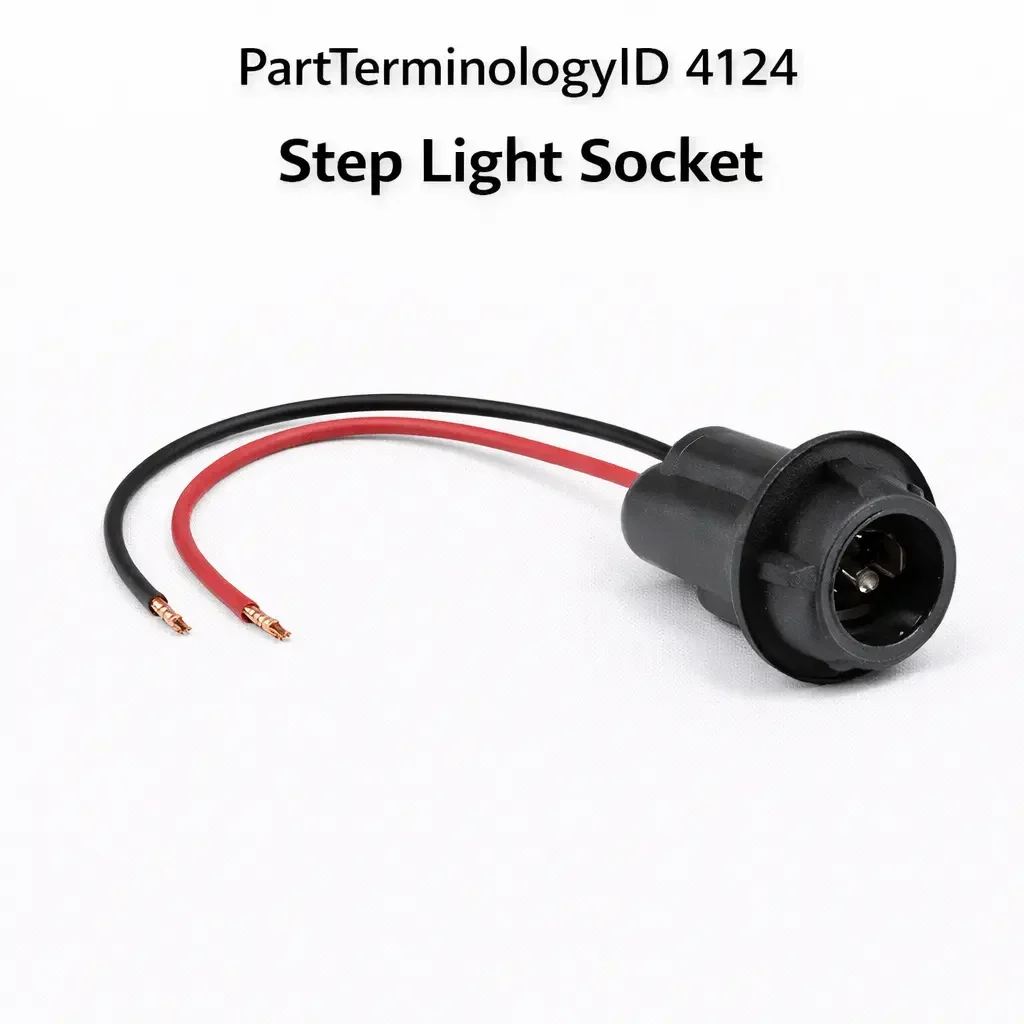
PartTerminologyID 4124, Step Light Socket, is the bulb socket that provides illumination to the door sill, running board, or entry step area when the vehicle door is opened, receiving switched power from the door courtesy light circuit when the door switch signals an open-door condition to assist occupants entering and exiting the vehicle in low-light conditions. That definition covers the step light socket function correctly and leaves unresolved whether the socket is mounted in a rocker panel step lamp housing below the door opening, in a door sill plate assembly that illuminates the sill area when the door opens, in a running board lamp position on trucks and SUVs with factory or aftermarket running boards, or in a door-mounted step lamp position on some van and commercial vehicle applications, whether the step light circuit is activated directly by the door jamb switch completing a ground path or by a BCM-commanded courtesy light output that activates all courtesy lights simultaneously when any door opens, whether the step light shares a circuit with the dome light and interior courtesy lights on a common courtesy light fuse or has a dedicated fuse for the exterior step lamp circuit, whether the socket is exposed to road spray, mud, and debris from its position below the door opening that accelerates corrosion beyond the rate seen in interior courtesy light sockets, and whether the socket is a discrete replaceable component or is integrated into a step lamp assembly requiring full assembly replacement.
For sellers, PartTerminologyID 4124 is the step light socket where the combination of door switch circuit validation and environmental corrosion pre-treatment generates the most returns, because the step light socket occupies a uniquely challenging position that combines the door-switch-gated activation architecture of interior courtesy lights with the environmental exposure of exterior body-mounted sockets. A buyer who finds the step light non-functional may have a failed door jamb switch that is not completing the activation circuit, a blown courtesy light fuse that has disabled all courtesy circuits simultaneously, a failed socket contact, or a failed bulb, with the additional possibility that road-sourced corrosion in the socket mounting housing is the fault source rather than any of the upstream circuit components.
What the Step Light Socket Does
Door switch gating and the BCM-commanded courtesy light output
Step lights on most vehicles activate through the same door courtesy light circuit that activates the dome light and interior step lamps. On direct door switch applications the door jamb switch provides a ground path that completes the step light supply circuit when the door opens. On BCM-commanded applications the door switch sends an input to the BCM which then activates the courtesy light output driver, supplying voltage to all courtesy light positions including the step light socket simultaneously.
A step light that does not activate when a specific door is opened has either a door jamb switch fault on that door or a BCM input fault for that door, while the step light circuit itself remains functional if the light activates from other doors. A step light that does not activate from any door has a supply circuit fault, a blown courtesy fuse, a BCM output driver fault, or a socket fault. Confirming whether the dome light and other courtesy lights are also non-functional when the door is opened separates a shared circuit fault from a step light-specific socket fault in a single observation.
Environmental exposure at the rocker panel position
The step light socket at the rocker panel or door sill position is exposed to road spray from the front and rear tires during normal driving, mud and debris during off-road or unpaved road operation, road salt during winter driving, and pressure washing from below during vehicle cleaning. The socket housing and mounting position trap moisture and debris that cannot drain freely due to the enclosed housing design.
Corrosion at the step light socket develops from the same mechanism as license plate light socket corrosion but at a faster rate due to higher debris loading and more direct spray exposure. A buyer who replaces a step light socket without removing debris from the housing, cleaning the mounting area, and applying dielectric grease to the replacement socket terminals will find the replacement corroded within one to two seasons on high-exposure applications in northern climates with road salt use.
Why This Part Generates Returns
Buyers return step light sockets because the door jamb switch has failed and the socket correctly receives no activation signal, the courtesy light fuse has blown and the dome light and other courtesy circuits are also non-functional simultaneously, the step light bulb has failed and the socket is undamaged, the replacement socket corrodes from the same road-sourced contamination as the original because the housing was not cleaned and sealed at installation, the socket is integrated into a step lamp assembly with no discrete replaceable socket, and the BCM output driver for the courtesy light circuit has failed producing no activation at any courtesy light position simultaneously.
Status in New Databases
PartTerminologyID 4124 is cataloged in PIES/PCdb as Step Light Socket. Under PIES 8.0 and PCdb 2.0 there is no change to the terminology or classification for this PartTerminologyID.
Top Return Scenarios
Scenario 1: "Courtesy fuse blown, dome light also non-functional, socket replaced without fuse check"
The step light does not activate when the door is opened. The dome light is also non-functional from the same door opening. The courtesy light fuse has blown. The buyer focuses on the step light and replaces the socket. The blown fuse remains. The replacement socket also has no supply voltage.
Prevention language: "Courtesy fuse check: Confirm the dome light and other courtesy lights are functional when the door is opened before diagnosing the step light socket. If the dome light is also non-functional, the fault is the shared courtesy light fuse rather than the step light socket. Check the courtesy fuse before ordering a socket on an all-courtesy-lights-out complaint."
Scenario 2: "Door jamb switch fault, step light does not activate from one door, other doors activate correctly"
The step light does not activate when the driver door is opened but activates correctly when the passenger door is opened. The driver door jamb switch has failed. The BCM receives no open-door signal from the driver door and does not activate the courtesy light output for that door. The buyer replaces the step light socket. The jamb switch fault remains. No change in step light behavior from the driver door.
Prevention language: "Door jamb switch validation: A step light that activates from some doors but not others has a door jamb switch fault on the non-activating door rather than a socket fault. Confirm the step light activates from at least one door before diagnosing the socket. If the step light does not activate from any door, check the courtesy fuse and confirm BCM output voltage at the socket terminal before replacing the socket."
Scenario 3: "Replacement socket corrodes within one season, mounting area not cleaned at installation"
The buyer replaces the step light socket after the original corroded from road salt exposure. The rocker panel mounting housing is not cleaned of salt and debris before installation. The replacement socket terminals corrode from the same road salt accumulation within the following winter season. The buyer returns the replacement as defective.
Prevention language: "Corrosion pre-treatment: Before installing the replacement step light socket, clean the rocker panel housing recess thoroughly of road salt, mud, and debris using electrical contact cleaner. Apply dielectric grease to the replacement socket terminal contacts and the socket body seating surface. The step light position receives direct road spray and the replacement socket will corrode at the same rate as the original if the housing is not cleaned and sealed at installation."
Scenario 4: "Failed step light bulb, functional socket, socket returned after bulb replacement resolves dark light"
The step light is dark when the door is opened. The dome light activates confirming the courtesy circuit is active. The socket is undamaged and supply voltage is present at the terminal with the door open. The bulb has a failed filament. The buyer replaces the socket. The step light illuminates. The buyer returns the original socket as defective when the bulb was the failed component.
Prevention language: "Bulb pre-check: Confirm the dome light activates when the door is opened to confirm the courtesy circuit is active. If the courtesy circuit is active and supply voltage is present at the step light socket terminal but the light does not illuminate, inspect the bulb filament before replacing the socket. Replace the bulb first on a dark step light with confirmed supply voltage."
Listing Requirements
PartTerminologyID: 4124
Mounting position: rocker panel, door sill, running board, or door mount (mandatory)
Activation architecture: direct door switch or BCM-commanded courtesy output (mandatory)
Shared courtesy fuse note (mandatory)
Bulb base type and wattage specification (mandatory)
Socket architecture: discrete replaceable or integrated step lamp assembly (mandatory)
Environmental corrosion pre-treatment note (mandatory)
Door jamb switch validation note (mandatory)
Courtesy fuse check note (mandatory)
Bulb pre-check note (mandatory)
OEM part number cross-reference (mandatory)
Catalog Checklist for ACES/PIES Teams
PartTerminologyID = 4124
Require mounting position (mandatory)
Require activation architecture (mandatory)
Require shared courtesy fuse identification (mandatory)
Require bulb base type and specification (mandatory)
Require corrosion pre-treatment note (mandatory)
Prevent courtesy fuse socket return: blown fuse disables all courtesy circuits simultaneously; dome light function check must precede step light socket diagnosis
Prevent door switch fault socket return: step light inactive from one door with other doors active is a jamb switch fault; switch validation must precede socket diagnosis
Prevent corrosion repeat return: road salt contamination corrodes replacement socket identically without pre-treatment; housing cleaning and dielectric grease are mandatory installation steps
FAQ (Buyer Language)
My step light does not come on when I open the driver door but works when I open the passenger door. Is it the socket?
A step light that activates from some doors but not others is a door jamb switch fault on the non-activating door rather than a socket fault. The socket is confirmed functional by the activation from the passenger door. Inspect and replace the driver door jamb switch.
My step light and dome light both stopped working at the same time. What is the fault?
Simultaneous loss of the step light and dome light when the door is opened points to the shared courtesy light fuse rather than individual socket faults. Check the courtesy fuse in the fuse panel before replacing any socket.
How do I protect the replacement step light socket from road salt corrosion?
Clean the rocker panel housing recess thoroughly with electrical contact cleaner before installing the replacement. Apply dielectric grease to the socket terminal contacts and the housing seating surface. Reapply the grease at each annual service. In high road salt environments inspect the socket terminals at the start of each winter season and refresh the dielectric grease application.
My step light works intermittently depending on road conditions. What is causing this?
Intermittent step light operation that correlates with road vibration or wet conditions points to a socket with corroded terminals at the early stage of corrosion development or a socket not fully retained in its housing. Remove the socket, inspect the terminals for early oxidation, clean and apply dielectric grease, and confirm the socket is fully seated and locked before ordering a replacement.
How do I confirm supply voltage is reaching the step light socket?
Open the door to activate the courtesy circuit. Probe the supply terminal of the step light socket with a test light. The test light should illuminate. No illumination with the door open and courtesy circuit confirmed active from the dome light indicates an open circuit in the step light branch wiring rather than a socket fault.
What Sellers Get Wrong About PartTerminologyID 4124
The most common error is omitting the corrosion pre-treatment note. The step light socket is exposed to road spray and salt that corrode the terminal contacts faster than almost any other body-mounted socket. A buyer who replaces the socket without cleaning the mounting housing and applying dielectric grease returns within one to two seasons with the same corrosion symptom on the replacement. Without the pre-treatment note buyers attribute the repeat failure to part quality when the environmental source was never addressed. The corrosion pre-treatment note converts a repeat return cycle into a durable repair.
The second error is omitting the courtesy fuse check note. A blown courtesy fuse disables the step light and dome light simultaneously. Buyers who focus on the step light as the conspicuously absent lamp replace it without checking whether the dome light is also affected. The dome light function check is a single observation that separates a fuse fault from a socket fault.
The third error is omitting the door jamb switch validation note. A step light that activates from some doors but not others is a jamb switch fault on the non-activating door. Without the validation note buyers replace the step light socket when the jamb switch is the fault source and find no change in activation from the affected door.
Cross-Sell Logic
Step Light Bulb: for buyers where the socket is confirmed functional, supply voltage is confirmed at the terminal with the door open, and the dome light is confirmed activating, but the step light does not illuminate, indicating a failed bulb filament is the correct repair.
Door Jamb Switch: for buyers where the step light does not activate from a specific door while other doors activate the step light correctly, indicating a failed door jamb switch on the non-activating door rather than a socket fault.
Courtesy Light Fuse: for buyers where the step light and dome light are both non-functional simultaneously from door opening, indicating a blown shared courtesy fuse rather than individual socket faults.
BCM: for buyers where the courtesy fuse is intact, all door jamb switches are confirmed closing, and no courtesy lights activate from any door, indicating a BCM output driver fault for the courtesy light circuit rather than a socket fault.
Step Lamp Assembly: for buyers on integrated assembly applications where no discrete replaceable socket exists and a failed step light requires complete lamp assembly replacement.
Final Take for PartTerminologyID 4124
Step Light Socket (PartTerminologyID 4124) is the entry illumination component where corrosion pre-treatment guidance, courtesy fuse validation, door jamb switch confirmation, and bulb pre-check are the four attributes that prevent the four most common return scenarios. Every listing without corrosion pre-treatment generates repeat returns from buyers whose replacement socket corrodes from the same road salt source. Every listing without the courtesy fuse check generates returns from buyers who replaced a socket on a blown fuse circuit. Every listing without door jamb switch validation generates returns from buyers who replaced a socket when a jamb switch was the fault source. Every listing without bulb pre-check generates returns from buyers who replaced a functional socket when a bulb was the correct repair.
Together these four attributes make every listing under this PartTerminologyID complete.