
Written by Arthur Simitian | PartsAdvisory
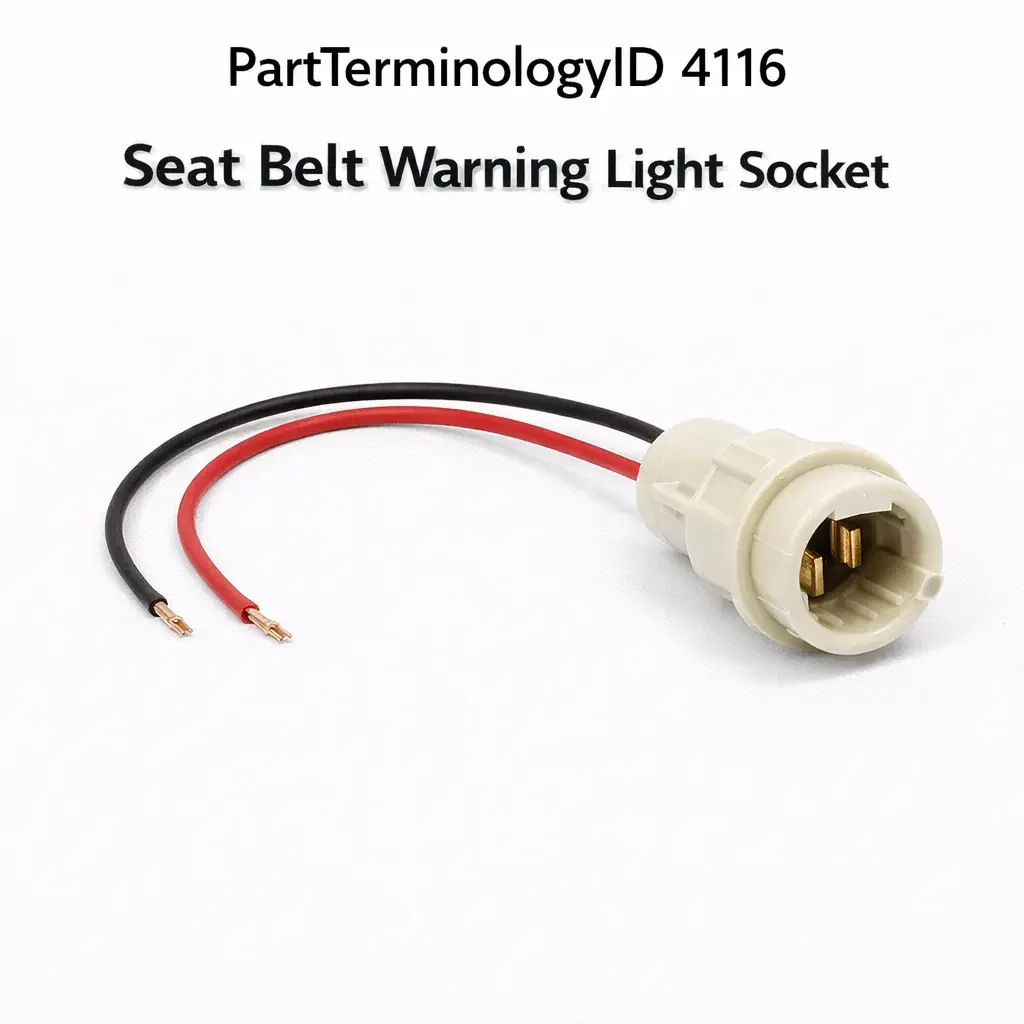
PartTerminologyID 4116, Seat Belt Warning Light Socket, is the bulb socket that holds the seat belt reminder indicator bulb in the instrument cluster, receiving switched power from the restraint control module, BCM, or a dedicated seat belt warning circuit when the ignition is on and the driver or a monitored passenger seat occupant is detected without a buckled seat belt. That definition covers the seat belt warning light socket function correctly and leaves unresolved whether the socket is a discrete replaceable bulb socket in a conventional instrument cluster, a PCB-integrated bulb holder soldered to the instrument cluster circuit board, or an LED indicator integrated directly into the cluster display that has no discrete socket at all, whether the seat belt warning circuit activates from a simple buckle switch that grounds the lamp circuit when the belt is unbuckled, a seat occupancy sensor combined with the buckle switch that requires both an occupant and an unbuckled belt to trigger the warning, or a full restraint control module that monitors multiple seat positions and produces a timed audible and visual alert sequence, whether the warning light illuminates continuously when triggered or flashes with the warning buzzer during the initial alert period before settling to a continuous indication, and whether a failed socket produces a continuously illuminated warning, a dark warning with the belt unbuckled, or an intermittent indication depending on which failure mode has occurred.
For sellers, PartTerminologyID 4116 is the seat belt warning socket where occupancy sensor gating is the most return-generating attribute, because the seat belt warning circuit on all vehicles produced after the late 1990s requires both a seated occupant detected by the seat occupancy sensor and an unbuckled seat belt before the BCM or restraint module activates the warning lamp circuit. A buyer who tests the seat belt warning with no one seated in the monitored seat may find no warning activation and conclude the socket has failed, when the occupancy sensor is correctly preventing activation in the absence of an occupant. Socket replacement does not change the occupancy sensor gating condition and the buyer returns the socket when the warning is still absent under the same unoccupied test condition.
What the Seat Belt Warning Light Socket Does
Buckle switch only versus occupancy sensor combined gating
On vehicles produced before the mid-1990s the seat belt warning circuit used a simple buckle switch that completed the lamp ground circuit when the seat belt was unbuckled and the ignition was on, regardless of whether anyone was seated. These applications did not use an occupancy sensor and the warning activated any time the belt was unbuckled with the ignition on. Testing these applications requires only that the ignition is on and the belt is unbuckled.
On all current-generation vehicles the BCM or restraint control module reads both the seat buckle switch and the seat occupancy sensor simultaneously before activating the warning lamp output. The occupancy sensor in the seat cushion must register a seated occupant of sufficient weight before the warning is authorized. An unoccupied seat with an unbuckled belt does not trigger the warning. A seat with an occupant below the sensor's weight threshold, such as a child in a rear-facing infant seat, may also not trigger the warning depending on the sensor calibration.
A buyer who tests the seat belt warning by sitting in the seat, buckling and unbuckling the belt while observing the cluster warning lamp, is performing the correct test for an occupancy-gated application. A buyer who pulls the buckle switch connection and probes for circuit activation without sitting in the seat is not satisfying the occupancy condition and will not activate the warning on gated applications regardless of socket condition.
Instrument cluster architecture and PCB-integrated indicator
The seat belt warning indicator on conventional instrument clusters uses a discrete replaceable socket with a small bulb that illuminates the seat belt pictogram on the cluster face. The socket is accessed from the rear of the cluster after cluster removal from the dash. This architecture is the applicable design under PartTerminologyID 4116.
On current-generation instrument clusters the seat belt warning is displayed as an LED indicator or an LCD segment on the cluster display panel with no discrete replaceable socket or bulb. A dark or non-activating seat belt warning on these applications cannot be resolved by socket replacement and requires cluster diagnosis or replacement. A buyer who orders a discrete socket for a current-generation LED cluster application returns it as having no installation point.
Why This Part Generates Returns
Buyers return seat belt warning light sockets because the occupancy sensor is not detecting a seated occupant during testing and the BCM correctly does not activate the warning lamp circuit, the instrument cluster uses PCB-integrated or LED indicators with no discrete replaceable socket, the seat belt warning bulb has failed and the socket is undamaged, a restraint control module fault is preventing warning lamp activation with a functional socket, and the seat belt warning circuit on this vehicle produces a timed chime and light sequence that has completed its alert cycle and the driver misinterprets the absence of a continuing warning as a socket fault.
Status in New Databases
PartTerminologyID 4116 is cataloged in PIES/PCdb as Seat Belt Warning Light Socket. Under PIES 8.0 and PCdb 2.0 there is no change to the terminology or classification for this PartTerminologyID.
Top Return Scenarios
Scenario 1: "Occupancy sensor not satisfied during testing, warning not activated, socket replaced with no change"
The buyer's seat belt warning light does not activate when the belt is unbuckled with the ignition on. The buyer is testing without sitting in the seat. The occupancy sensor is not registering an occupant. The BCM correctly does not activate the warning lamp. The buyer replaces the socket. The test condition remains unoccupied. No change in warning behavior.
Prevention language: "Occupancy sensor gating: On this application the seat belt warning activates only when the seat occupancy sensor detects a seated occupant and the seat belt is unbuckled simultaneously. Testing without a seated occupant will not activate the warning regardless of socket condition. Sit in the seat with the belt unbuckled and the ignition on to confirm whether the warning activates before diagnosing the socket."
Scenario 2: "PCB-integrated cluster indicator, no discrete socket, ordered part has no installation point"
The seat belt warning indicator does not illuminate. The instrument cluster uses a PCB-integrated LED indicator with no discrete replaceable socket. The buyer orders a socket under PartTerminologyID 4116. No installation point exists. The buyer returns it as incorrect.
Prevention language: "Cluster architecture: Many current instrument clusters use PCB-integrated LED seat belt warning indicators with no discrete replaceable socket. If your cluster does not have a removable socket at the warning lamp position, this PartTerminologyID does not apply. A non-functional warning indicator on an integrated cluster requires cluster diagnosis or replacement."
Scenario 3: "Failed seat belt warning bulb, socket intact, bulb replacement resolves dark indicator"
The seat belt warning does not illuminate when the occupant is seated with the belt unbuckled. The socket is undamaged. The small indicator bulb has a failed filament. Supply voltage is confirmed at the socket terminal when the warning condition is active. The buyer replaces the socket. The warning illuminates. The buyer returns the original socket as defective when the bulb was the failed component.
Prevention language: "Bulb pre-check: Confirm supply voltage is present at the socket terminal with the occupancy and unbuckled belt conditions satisfied. If supply voltage is present but the warning does not illuminate, inspect the bulb filament before replacing the socket. A failed indicator bulb is a common cause of a dark seat belt warning with a confirmed active circuit."
Scenario 4: "Timed warning cycle completed, warning extinguishes after initial alert, buyer interprets absence as socket fault"
The seat belt warning illuminates and chimes for the first 30 seconds after ignition on with the belt unbuckled, then extinguishes per the BCM alert timer. The buyer notes the warning is absent after the initial period and concludes the socket has intermittently failed. The socket is functioning correctly and the BCM alert cycle has completed as designed.
Prevention language: "Timed warning cycle: On this application the seat belt warning illuminates for a defined period after ignition on with the belt unbuckled, then extinguishes when the alert cycle completes. Absence of the warning after the initial period is correct BCM behavior, not a socket fault. The warning will reactivate on the next ignition cycle if the belt remains unbuckled."
Listing Requirements
PartTerminologyID: 4116
Cluster architecture: discrete replaceable socket or PCB-integrated indicator (mandatory)
Activation architecture: buckle switch only or occupancy sensor combined gating (mandatory)
Warning pattern: continuous or timed alert cycle (mandatory)
Bulb base type and wattage specification (mandatory)
Occupancy sensor gating test condition note (mandatory)
Bulb pre-check note (mandatory)
PCB-integrated cluster note where applicable (mandatory)
Timed warning cycle note where applicable (mandatory)
OEM part number cross-reference (mandatory)
Catalog Checklist for ACES/PIES Teams
PartTerminologyID = 4116
Require cluster architecture: discrete socket or PCB-integrated (mandatory)
Require activation architecture: buckle switch or occupancy sensor gated (mandatory)
Require warning pattern: continuous or timed (mandatory)
Prevent occupancy sensor misdiagnosis: warning correctly inactive without seated occupant; occupancy condition must be satisfied during testing
Prevent PCB-integrated return: no discrete socket on integrated cluster applications; architecture must be confirmed before ordering
Prevent timed cycle misdiagnosis: warning absence after alert period completion is correct BCM behavior; timed cycle note must be listed
FAQ (Buyer Language)
Why does my seat belt warning not come on when the belt is unbuckled?
On current-generation vehicles the seat belt warning requires a seated occupant detected by the seat occupancy sensor and an unbuckled belt simultaneously. Sit in the seat with the belt unbuckled and the ignition on, and confirm whether the warning activates. If the warning does not activate with a confirmed occupant and unbuckled belt, probe the socket supply terminal for voltage before diagnosing the socket.
My seat belt warning comes on for a short time after I start the car but then turns off even though the belt is still unbuckled. Is the socket failing?
Most current seat belt warning systems use a timed alert cycle that illuminates and chimes for a defined period after ignition on, then extinguishes when the cycle completes. The warning extinguishing after the initial period is correct BCM behavior. The warning will reactivate on the next ignition cycle.
How do I access the seat belt warning socket?
The socket is located at the rear of the instrument cluster. Cluster removal from the dash is required on most applications. After removing the cluster, the socket position for the seat belt warning indicator is accessible from the rear of the cluster housing. The socket twists or pulls from its housing position.
My instrument cluster shows a seat belt icon as part of the display. Is there a socket I can replace?
A seat belt warning that is part of the instrument cluster digital display or LCD is a PCB-integrated indicator with no discrete replaceable socket. This PartTerminologyID does not apply to integrated cluster display indicators. A non-functional seat belt warning on a digital cluster requires cluster diagnosis.
What Sellers Get Wrong About PartTerminologyID 4116
The most common error is omitting the occupancy sensor gating note. Buyers on current-generation vehicles test the seat belt warning without satisfying the occupancy condition and conclude the socket has failed when the BCM is correctly not activating the warning. Socket replacement produces no change under the same unoccupied test condition. The occupancy sensor gating note with the correct test procedure converts this return into a confirmed correct diagnosis before any order is placed.
The second error is omitting the PCB-integrated cluster note. Current instrument clusters use integrated LED indicators with no discrete socket across the majority of the current vehicle population. Without the architecture note buyers order a socket that has no installation point and return it immediately.
The third error is omitting the timed warning cycle note. A seat belt warning that extinguishes after the BCM alert period has completed is functioning correctly. Without the timed cycle note buyers interpret the absence of a continuing warning as a socket fault and order an unnecessary replacement.
Cross-Sell Logic
Seat Belt Warning Bulb: for buyers where the socket is confirmed functional, supply voltage is confirmed at the terminal with the occupancy and unbuckled belt conditions satisfied, but the warning does not illuminate, indicating a failed indicator bulb.
Seat Occupancy Sensor: for buyers where the seat belt warning does not activate with a confirmed seated occupant and unbuckled belt, and the fault traces to a failed occupancy sensor that is not registering the occupant rather than a socket fault.
Restraint Control Module or BCM: for buyers where the occupancy and buckle conditions are both confirmed satisfied but no supply voltage is present at the socket terminal, indicating a module output driver fault for the warning lamp circuit.
Instrument Cluster: for buyers on PCB-integrated applications where no discrete socket exists and a non-functional warning indicator requires cluster repair or replacement.
Final Take for PartTerminologyID 4116
Seat Belt Warning Light Socket (PartTerminologyID 4116) is the occupant reminder indicator component where occupancy sensor gating validation, PCB-integrated cluster identification, timed alert cycle disclosure, and bulb pre-check are the four attributes that prevent the four most common return scenarios. Every listing without occupancy gating guidance sends buyers through a socket replacement that changes nothing because the occupancy condition was never satisfied during testing. Every listing without PCB-integrated cluster identification generates returns from buyers with no socket installation point. Every listing without the timed cycle note generates returns from buyers who interpreted correct BCM behavior as a socket fault. Every listing without bulb pre-check generates returns from buyers who replaced a functional socket when a bulb was the correct repair.
Together these four attributes make every listing under this PartTerminologyID complete.