
Written by Arthur Simitian | PartsAdvisory
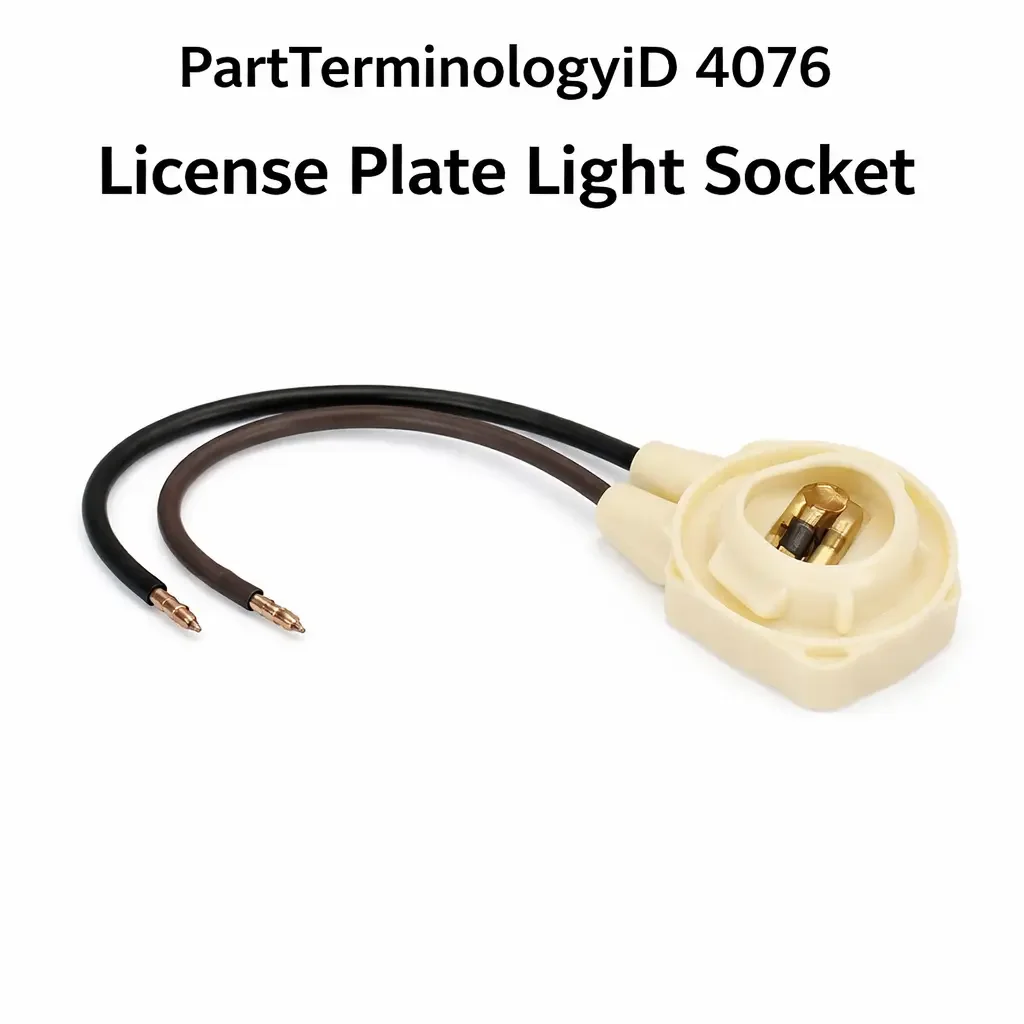
PartTerminologyID 4076, License Plate Light Socket, is the bulb socket that illuminates the rear license plate, receiving switched power from the tail light or parking lamp circuit when the parking lamps or headlamps are activated, providing legally required rear license plate illumination for vehicle identification in low-light conditions. That definition covers the license plate light socket function correctly and leaves unresolved whether the socket is mounted in a single centrally positioned license plate light housing, in dual housings positioned at the left and right edges of the license plate recess, or in a license plate surround assembly where the socket is integrated into a decorative trim piece rather than a functional lamp housing, the bulb base type the socket accepts including festoon, wedge, or bayonet, whether the license plate light circuit is a branch of the tail light circuit that shares the tail light fuse and supply wiring or is taken from a separate parking lamp circuit output, whether a failed license plate light socket will generate a BCM outage warning on vehicles that monitor tail lamp circuit current, the mounting method that secures the socket in the housing including a twist-lock, push-and-clip, or threaded retention, and whether the socket is exposed to direct road spray and weather that accelerates terminal corrosion compared to sockets in more protected lamp positions.
For sellers, PartTerminologyID 4076 is the license plate light socket where terminal corrosion from weather exposure is the most return-generating attribute, because the license plate light socket is one of the most environmentally exposed bulb sockets on the vehicle. Positioned at the rear lower section of the body behind the license plate recess, the socket is directly exposed to road spray, salt, moisture, and debris that enter through the license plate mounting area. A socket that has corroded terminals from environmental exposure produces intermittent or absent illumination that the buyer replaces, but if the corrosion source in the housing and mounting area is not addressed, the replacement socket develops the same terminal corrosion within months. The listing must identify corrosion as the primary socket failure mode and provide guidance on housing cleaning and sealing before replacement socket installation.
What the License Plate Light Socket Does
Tail light circuit branch and the shared fuse architecture
The license plate light circuit on most vehicles is a branch of the tail light circuit, receiving its supply from the same fused output that powers the tail lamps. When the parking lamps or headlamps are activated the tail light supply energizes simultaneously and the license plate light socket receives supply voltage and illuminates the plate. When the tail lamp fuse blows the license plate light goes dark simultaneously with the tail lamps.
A buyer who finds the license plate light non-functional should confirm the tail lamps are also functioning before diagnosing the license plate socket. If the tail lamps are also dark, the fault is the tail lamp fuse or the tail lamp supply circuit rather than the license plate socket. If the tail lamps are functioning and the license plate light is not, the fault is in the license plate light circuit specifically, which narrows the diagnosis to the license plate socket, the bulb, or the branch wiring between the tail lamp supply and the license plate socket.
On some vehicles a separate parking lamp circuit output feeds the license plate light independently of the tail lamp circuit. On these applications a tail lamp fuse fault does not affect license plate light operation and vice versa. The listing must specify whether the license plate light circuit is a tail lamp branch or a separate parking lamp output to give buyers the correct fault isolation logic for their application.
Dual socket architecture and the asymmetric outage
Many vehicles use two license plate light sockets, one at each side of the license plate recess, to provide even illumination across the plate. On dual socket applications both sockets share a single supply from the tail lamp circuit and both are on the same fuse. A fault at one socket produces illumination from one side only and leaves the plate partially lit. A buyer who notices uneven license plate illumination has a single socket fault rather than a supply circuit fault, because the other socket on the same supply is confirmed functional.
Dual socket applications require the listing to specify whether the part number covers both sockets as a set or one socket individually. A buyer who orders a single socket to replace both positions in a dual socket application will return one socket as unneeded or will find the partial illumination continues after replacing only one position.
Environmental exposure and the corrosion failure mechanism
The license plate light socket sits in a position that concentrates environmental exposure more than almost any other body-mounted socket. Road spray directed rearward by the front tires reaches the license plate recess with high velocity during wet road driving. Winter road salt accumulates in the license plate recess and wicks into the socket mounting position through capillary action along the socket body and mounting hardware. The socket mounting housing is typically plastic with no drain provision, allowing moisture to pool at the socket base position during rain events.
Corrosion develops at the socket terminal contact surfaces from the combination of moisture, salt, and the electrochemical potential between the terminal material and the bulb base contact. Green oxidation on tin-plated terminals and white oxidation on aluminum components in the socket area are the visible signs of active corrosion. A socket with corroded terminals has elevated contact resistance that produces a voltage drop at the bulb base, reducing illumination intensity before the contact fails completely.
Replacing a corroded socket without cleaning the housing mounting area, removing accumulated salt and debris from the socket recess, and applying dielectric grease to the replacement socket terminals produces a temporary repair. The moisture and salt source that corroded the original socket is still present and will corrode the replacement terminals within one to two seasons. The listing must include housing cleaning and dielectric grease application as explicit pre-installation steps to convert a temporary repair into a durable one.
Why This Part Generates Returns
Buyers return license plate light sockets because the tail lamp fuse has blown and the license plate light is non-functional along with the tail lamps, the license plate bulb has failed and the socket is undamaged so bulb replacement is the correct repair, the replacement socket develops the same terminal corrosion as the original because the housing moisture source was not addressed at installation, the vehicle uses an integrated LED license plate light assembly with no discrete replaceable socket, and the dual socket application requires two sockets but the buyer ordered only one and returns the second as an unneeded duplicate.
Status in New Databases
PartTerminologyID 4076 is cataloged in PIES/PCdb as License Plate Light Socket. Under PIES 8.0 and PCdb 2.0 there is no change to the terminology or classification for this PartTerminologyID.
Top Return Scenarios
Scenario 1: "Tail lamp fuse blown, license plate light and tail lamps both non-functional, socket replaced without fuse check"
The buyer's license plate light is dark. The tail lamps are also dark when the headlamps are activated but the buyer did not check. The tail lamp fuse has blown. The buyer replaces the license plate light socket. The fuse remains blown. The replacement socket also has no supply voltage.
Prevention language: "Tail lamp fuse check: Before replacing the license plate light socket, confirm the tail lamps are illuminated when the parking lamps or headlamps are activated. If the tail lamps are also dark, the fault is the tail lamp fuse or supply circuit rather than the license plate socket. Check the tail lamp fuse before ordering a socket replacement. A blown fuse disables the license plate light and tail lamps simultaneously on shared supply applications."
Scenario 2: "Failed license plate bulb, functional socket, socket returned after bulb replacement resolves dark plate light"
The license plate is not illuminated at night. The tail lamps are functioning confirming the tail lamp supply is active. The socket is undamaged and terminals are clean. The festoon bulb has a failed filament. The buyer replaces the socket assembly. The plate illuminates. The buyer returns the original socket as defective when the bulb was the failed component.
Prevention language: "Bulb pre-check: Confirm the tail lamps are functioning and supply voltage is present at the license plate socket terminal with the parking lamps active. If supply voltage is present but the plate is not illuminated, remove the socket and inspect the bulb filament before replacing the socket. A failed bulb filament is the most common cause of a dark license plate light with confirmed supply voltage."
Scenario 3: "Replacement socket corrodes within one season, housing moisture source not addressed at installation"
The buyer installs a replacement license plate light socket after the original failed from terminal corrosion. The license plate housing recess is not cleaned of salt accumulation and the socket mounting area is not sealed or treated with dielectric grease. Within one winter driving season the replacement socket terminals show the same green oxidation as the original. The buyer returns the replacement socket as defective on arrival when the environmental corrosion source was the cause.
Prevention language: "Corrosion source treatment: Before installing the replacement socket, clean the license plate light housing recess of accumulated salt, debris, and corrosion deposits using an electrical contact cleaner. Apply a thin layer of dielectric grease to the replacement socket terminal contacts and to the socket body sealing surface against the housing. The dielectric grease barrier prevents moisture and salt from reaching the terminal contact surfaces and extends replacement socket service life significantly. Failure to treat the corrosion source will produce the same terminal corrosion on the replacement socket within one to two seasons."
Scenario 4: "Integrated LED license plate light, no discrete socket, ordered part has no installation point"
The buyer's license plate light is dark. The vehicle uses an integrated LED license plate light assembly built into the bumper or body panel surround with no discrete replaceable socket. The buyer orders a socket under PartTerminologyID 4076. No installation point exists. The buyer returns it as incorrect.
Prevention language: "Integrated LED assembly note: On some current applications the license plate light is provided by an integrated LED assembly with no discrete replaceable socket. If your license plate light housing does not have a removable socket, this PartTerminologyID does not apply. A dark license plate light on an integrated LED application requires light assembly or housing replacement."
Scenario 5: "Dual socket application, buyer orders one socket, second socket also needed, returns extra as unneeded"
The buyer's vehicle has dual license plate light sockets. One socket has failed from corrosion. The buyer orders one replacement socket. After replacing the failed socket the buyer finds the second socket is also developing corrosion and orders a second socket. The original order is returned as the buyer now orders both as a set.
Prevention language: "Dual socket application: This vehicle uses two license plate light sockets. Inspect both socket positions when replacing one. If both sockets show corrosion or degraded terminals, replacing both at the same service interval is more cost-effective than a repeat repair. Confirm whether your application requires one or two sockets before ordering."
Listing Requirements
PartTerminologyID: 4076
Socket count: single or dual socket application (mandatory)
Bulb base type: festoon, wedge, or bayonet (mandatory)
Bulb voltage and wattage specification (mandatory)
Circuit supply: tail lamp branch or dedicated parking lamp output (mandatory)
Socket architecture: discrete replaceable or integrated LED assembly (mandatory)
Environmental exposure and corrosion pre-treatment note (mandatory)
Dielectric grease application note (mandatory)
Tail lamp fuse check note (mandatory)
Bulb pre-check note (mandatory)
Dual socket set versus individual socket identification (mandatory)
OEM part number cross-reference (mandatory)
Catalog Checklist for ACES/PIES Teams
PartTerminologyID = 4076
Require socket count: single or dual (mandatory)
Require bulb base type and specification (mandatory)
Require circuit supply type: tail lamp branch or parking lamp (mandatory)
Require socket architecture: discrete or integrated LED (mandatory)
Prevent tail lamp fuse socket return: blown tail fuse disables plate light and tail lamps simultaneously; tail lamp function check must precede plate socket diagnosis
Prevent corrosion repeat return: replacement socket exposed to same moisture source without treatment corrodes identically; housing cleaning and dielectric grease are mandatory pre-installation steps
Prevent integrated LED return: no discrete socket on integrated LED applications; architecture must be confirmed before ordering
Prevent dual socket single-order confusion: both sockets in dual applications should be inspected simultaneously; set versus individual coverage must be specified
FAQ (Buyer Language)
Why is my license plate light not working but my tail lights are fine?
Functioning tail lights with a dark license plate light isolates the fault to the license plate circuit specifically. Check the license plate bulb first. Remove the socket from the housing and inspect the bulb filament for failure. If the bulb is intact, probe the socket supply terminal for voltage with the parking lamps active. No voltage with the tail lights functioning indicates an open circuit in the branch wiring between the tail lamp supply and the license plate socket rather than a socket contact fault.
How do I prevent my replacement license plate socket from corroding again?
Before installing the replacement socket, clean the housing recess with electrical contact cleaner to remove accumulated salt and corrosion deposits. Apply a thin layer of dielectric grease to the terminal contact faces and to the socket body where it seats against the housing. The dielectric grease prevents moisture and salt from reaching the terminals. Reapply the grease at each annual service or whenever the socket is accessed for bulb replacement.
My license plate light socket terminals are green and corroded. Can I clean them instead of replacing the socket?
Light surface oxidation on the terminal faces can sometimes be cleaned with electrical contact cleaner and a small brass brush to restore adequate contact. If the terminal base metal is pitted, the contact surface is eroded, or the socket body is cracked from the same corrosion process, cleaning is a temporary measure and socket replacement is required. Apply dielectric grease after cleaning to slow reoccurrence.
My vehicle has two license plate lights. Do I need to order two sockets?
Inspect both sockets when you find one has failed. License plate light sockets on dual applications are exposed to identical environmental conditions and typically reach end of life within the same season. Replacing both at the same time avoids a repeat repair within weeks. Confirm whether the listing covers one socket or a set of two before ordering.
Can a bad license plate light socket cause my BCM to generate a warning?
On vehicles where the BCM monitors tail lamp circuit current draw, a failed license plate light socket that reduces circuit current below the expected value may trigger an outage warning. The outage warning resolves when the socket or bulb is replaced. Confirm the warning clears after socket replacement before diagnosing the BCM or tail lamp outage sensor.
Why does my license plate light work sometimes and not other times?
Intermittent license plate illumination points to a socket terminal with marginal contact from early-stage corrosion or a socket that is not fully retained in its housing mount. Remove the socket, inspect the terminals for early oxidation, clean and apply dielectric grease, and confirm the socket is fully seated and locked in the housing before concluding a replacement is needed. Intermittent contact from a partially corroded terminal often responds to cleaning before the corrosion progresses to full contact failure.
What Sellers Get Wrong About PartTerminologyID 4076
The most common error is omitting the corrosion pre-treatment note. The license plate light socket is the most environmentally exposed bulb socket on the vehicle and corrosion is the dominant failure mode across all application ranges. A buyer who replaces the socket without cleaning the housing and applying dielectric grease returns within one to two seasons with the same corrosion symptom on the replacement socket. Without the pre-treatment note buyers attribute the repeat failure to part quality rather than the untreated environmental source. The dielectric grease note and the housing cleaning instruction together convert a temporary repair into a durable one and prevent the repeat return cycle.
The second error is omitting the tail lamp fuse check note. A blown tail lamp fuse disables the license plate light and tail lamps simultaneously. Buyers who notice the license plate light specifically and do not check the tail lamps replace the socket on a blown fuse circuit and return the socket as non-functional. The tail lamp function check is a single observation that separates a fuse fault from a socket fault before any order is placed.
The third error is omitting the dual socket identification. Dual socket applications are common across domestic and European vehicles and a buyer who orders one socket for a two-socket application may find both sockets need replacement or may return the second socket from a set as unneeded. Specifying whether the part number covers one or two sockets eliminates the ordering confusion and the associated return.
The fourth error is omitting the integrated LED assembly note. Current-generation vehicles increasingly use integrated LED license plate light assemblies with no discrete socket. Without the architecture note buyers on these applications order a socket that has no installation point and return it as incorrect.
Cross-Sell Logic
License Plate Light Bulb: for buyers where the socket is confirmed functional, supply voltage is confirmed at the socket terminal with the parking lamps active, and the tail lamps are confirmed functioning, indicating a failed bulb filament is the correct lower-cost repair.
Tail Lamp Assembly or Tail Lamp Fuse: for buyers where the license plate light and tail lamps are both non-functional simultaneously, indicating a blown tail lamp fuse or tail lamp supply circuit fault upstream of the license plate socket.
License Plate Light Assembly: for buyers on integrated LED applications where no discrete socket exists, and for buyers where the license plate housing itself is cracked or water-damaged and cannot provide a sealed mounting environment for the replacement socket.
Dielectric Grease: as a post-installation maintenance item for buyers replacing the license plate socket in a high-corrosion environment, to be applied to the replacement socket terminals and housing seating surface to extend socket service life beyond one season.
Tail Lamp Outage Sensor: for buyers on BCM-monitored tail lamp applications where an outage warning persists after confirmed socket and bulb replacement, indicating a tail lamp outage sensor calibration fault rather than a continuing socket fault.
Why Catalog Data Quality Matters for PartTerminologyID 4076
License plate light socket returns cluster around four scenarios that are all preventable with listing language: the tail lamp fuse misdiagnosis, the bulb-only repair misdirection, the corrosion repeat return, and the integrated LED architecture mismatch. The tail lamp fuse misdiagnosis generates returns because buyers focus on the license plate light without confirming the tail lamps. The bulb misdirection generates returns because the bulb is the most common fault and the socket is undamaged in the majority of dark plate light complaints. The corrosion repeat return is the highest-volume repeat return under this PartTerminologyID and is entirely preventable with housing cleaning and dielectric grease guidance at installation. The integrated LED mismatch generates returns on current-generation vehicles with no discrete socket installation point.
The corrosion pre-treatment note is the single highest-impact attribute for this PartTerminologyID because it addresses the root cause of the dominant failure mode and converts the most common return scenario from a repeat cycle into a durable repair. Without it buyers experience the same failure on the replacement socket and return it as defective on arrival.
Application Range and Fitment Guidance for PartTerminologyID 4076
License plate light socket applications span vehicles from the early 1960s when discrete license plate light sockets became standard equipment through approximately 2015 when integrated LED license plate light assemblies began displacing discrete socket designs across most platforms. Festoon bulb base types are the dominant format on European vehicles and on domestic passenger cars from the 1990s onward. Wedge base sockets appear on domestic trucks, SUVs, and some passenger car applications where the housing geometry favors a vertical bulb mount. Bayonet base sockets appear on older domestic applications from the 1970s and 1980s.
Dual socket applications are common on domestic full-size trucks and SUVs with wide license plate recesses that require two light sources for uniform plate illumination. European vehicles with narrow license plate formats may use a single central socket. Fitment claims must specify socket count per application to prevent single-socket orders on dual-socket applications.
Current-generation vehicles from approximately 2012 onward increasingly integrate the license plate light into a bumper fascia assembly or a body panel surround with an LED strip rather than a discrete socket. Fitment claims under PartTerminologyID 4076 for post-2012 vehicles require confirmation that the specific application retains a discrete socket rather than an integrated LED source.
Final Take for PartTerminologyID 4076
License Plate Light Socket (PartTerminologyID 4076) is the rear identification illumination component where corrosion pre-treatment guidance, tail lamp fuse validation, bulb pre-check, and integrated LED assembly identification are the four attributes that prevent the four most common return scenarios. Every listing without corrosion pre-treatment guidance generates repeat returns from buyers whose replacement socket corrodes from the same untreated moisture source. Every listing without tail lamp fuse check guidance generates returns from buyers who replaced a socket on a blown fuse circuit. Every listing without bulb pre-check generates returns from buyers who replaced a functional socket when a bulb replacement was the correct repair. Every listing without integrated LED assembly identification generates returns from buyers with no discrete socket installation point.
The corrosion pre-treatment note is the attribute most unique to this PartTerminologyID and delivers the highest return prevention value per word of any attribute in the listing. Together with the other three attributes it makes every listing under this PartTerminologyID complete.