
Center High Mount Stop Light Socket (PartTerminologyID 4064): Where Brake Switch Validation and Integrated Assembly Identification Prevent Socket Replacement
Written by Arthur Simitian | PartsAdvisory
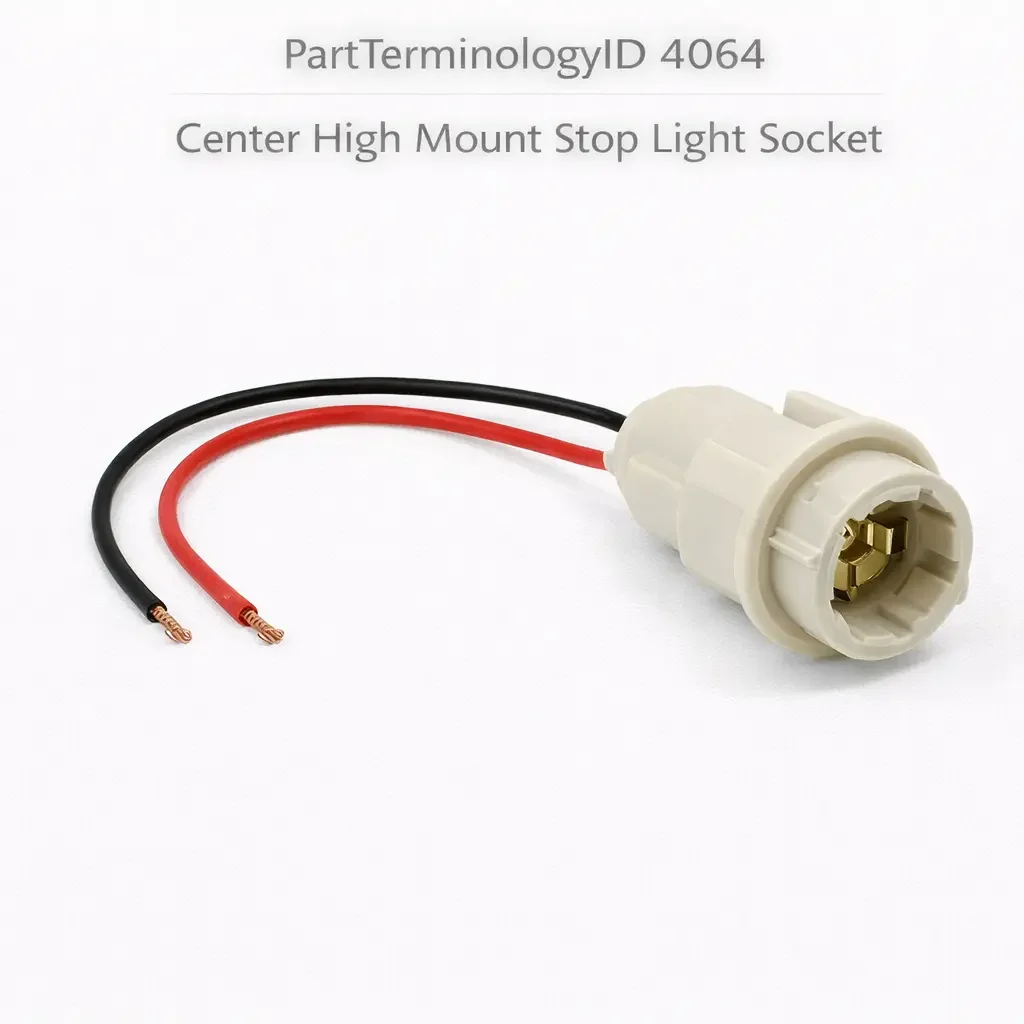
PartTerminologyID 4064, Center High Mount Stop Light Socket, is the bulb socket that holds the center high mount stop light bulb in the CHMSL assembly mounted at the top center of the rear window, rear spoiler, or cab roof panel, receiving switched power from the brake light circuit when the driver depresses the brake pedal to illuminate the stop light visible to following traffic above the line of the standard tail lamp stop lights. That definition covers the CHMSL socket function correctly and leaves unresolved whether the socket holds a single incandescent bulb, a festoon bulb in a horizontal mount position, a wedge-base bulb in a vertical or angled mount position, or a single high-intensity LED lamp element on applications where a discrete replaceable socket exists alongside a partially integrated LED CHMSL design, whether the CHMSL circuit shares the brake light circuit supply directly with the tail lamp stop lights or uses a separate dedicated supply from the same brake switch output, whether the CHMSL socket is a discrete replaceable component that clips or twists into the CHMSL housing or is integrated into a sealed CHMSL assembly that requires full assembly replacement, whether the CHMSL assembly is mounted in the rear window glass with an adhesive base that requires careful removal to access the socket, and whether a failed CHMSL generates a BCM fault code or dashboard warning on vehicles where the BCM monitors the CHMSL circuit current draw.
For sellers, PartTerminologyID 4064 is the CHMSL socket where integrated assembly identification is the most return-generating attribute, because the CHMSL on a significant and growing share of vehicles is a sealed LED assembly with no discrete replaceable socket, and buyers who order a socket replacement part for these applications receive a component with no installation point on their vehicle. The CHMSL is also one of the most frequently inspected lighting components during vehicle safety inspections and roadside stops, which drives a higher-than-average buyer urgency to order a replacement part quickly without fully confirming whether the vehicle uses a discrete socket or an integrated LED assembly.
What the Center High Mount Stop Light Socket Does
CHMSL circuit architecture and the shared brake supply
The CHMSL receives its activation signal from the same brake pedal switch output that activates the tail lamp stop lights on most vehicle applications. When the driver depresses the brake pedal the brake switch closes and supplies voltage to both the tail lamp stop light circuit and the CHMSL circuit simultaneously. The CHMSL illuminates in synchrony with the tail lamp stop lights as a federally mandated third stop light that is positioned higher and more centrally than the outboard tail lamp stop lights to improve visibility to following traffic.
On some applications the CHMSL supply is taken from the same fused supply as the tail lamp stop lights. A blown stop light fuse disables both the tail lamp stop lights and the CHMSL simultaneously. A buyer who finds the CHMSL non-functional and replaces the socket without checking whether the tail lamp stop lights are also non-functional may install the replacement socket into a blown fuse circuit. Confirming the tail lamp stop lights are functional before diagnosing the CHMSL socket separates a shared fuse fault from a CHMSL-specific socket fault in one observation.
On other applications the CHMSL has a dedicated fuse separate from the tail lamp stop light fuse. A blown CHMSL fuse produces a non-functional CHMSL while the tail lamp stop lights continue to operate. This architecture is more common on vehicles where the BCM monitors the CHMSL circuit current independently of the tail lamp stop light circuit. A buyer who finds the CHMSL non-functional with functioning tail lamp stop lights on a dedicated CHMSL fuse application has a CHMSL circuit fault that is isolated to the CHMSL supply, which narrows the diagnosis to the CHMSL fuse, the CHMSL socket, or the CHMSL bulb.
Discrete replaceable socket versus integrated LED CHMSL assembly
The discrete replaceable socket architecture uses a socket body that clips or twists into the CHMSL housing from the interior of the vehicle through an access panel, through the rear window defroster grid area, or from within the rear spoiler cavity. The socket holds an incandescent bulb and can be replaced independently of the CHMSL housing. This architecture is standard on domestic vehicles from the mid-1980s when CHMSL became federally mandated through approximately 2005 across most platforms.
Integrated LED CHMSL assemblies use a sealed LED light bar or LED array as the light source with no discrete replaceable socket or bulb. The LED elements are soldered directly to a circuit board inside the sealed housing. A failed CHMSL on an integrated LED application requires complete CHMSL assembly replacement rather than a socket or bulb swap. Buyers who order a socket under PartTerminologyID 4064 for an integrated LED application receive a part with no installation point and return it as incorrect.
The transition from discrete socket to integrated LED CHMSL architecture accelerated from approximately 2005 onward and is nearly universal on vehicles from 2015 onward. Fitment claims for post-2010 vehicles under this PartTerminologyID require confirmation that the vehicle uses a discrete socket rather than an integrated LED assembly before the application is assigned.
Rear window glass-mounted CHMSL and the adhesive removal consideration
CHMSL assemblies on passenger cars and some hatchbacks are adhered to the interior surface of the rear window glass using a foam adhesive tape or molded adhesive base. Accessing the socket in these assemblies requires carefully separating the CHMSL housing from the glass without cracking the glass, disconnecting the wiring harness, and removing the socket from the housing. Incorrect removal technique applies stress to the rear window glass that can crack the glass along the defroster grid elements or along the mounting footprint edge.
A buyer who damages the rear window glass during CHMSL socket access has created a significantly more expensive repair than the original socket replacement. The listing must note the adhesive removal consideration and recommend using a plastic trim tool or heat gun to soften the adhesive before separation on rear window-mounted applications, rather than a metal pry tool that concentrates stress on the glass surface.
Why This Part Generates Returns
Buyers return CHMSL sockets because the vehicle uses an integrated LED CHMSL assembly with no discrete replaceable socket and the ordered part has no installation point, the CHMSL bulb has a failed filament and the socket is undamaged so a bulb replacement is the correct repair, the brake pedal switch has failed and the socket correctly receives no supply voltage when the pedal is depressed, the stop light fuse has blown and neither the CHMSL nor the tail lamp stop lights are functional, the socket is a rear window glass-mounted application and the buyer is not prepared for the adhesive separation procedure, and the BCM is generating a CHMSL fault code from a current monitoring fault that is in the BCM circuit logic rather than a physical socket fault.
Status in New Databases
PartTerminologyID 4064 is cataloged in PIES/PCdb as Center High Mount Stop Light Socket. Under PIES 8.0 and PCdb 2.0 there is no change to the terminology or classification for this PartTerminologyID.
Top Return Scenarios
Scenario 1: "Integrated LED CHMSL assembly, no discrete socket, ordered part has no installation point"
The buyer's CHMSL is dark. The vehicle uses an integrated LED CHMSL assembly with no discrete replaceable socket. The buyer orders a socket under PartTerminologyID 4064. No installation point exists on the vehicle. The buyer returns the socket as incorrect for the application.
Prevention language: "Integrated LED assembly note: On many current applications the CHMSL uses a sealed LED assembly with no discrete replaceable socket. If your CHMSL assembly does not have a removable socket position, this PartTerminologyID does not apply. A dark CHMSL on an integrated LED application requires complete CHMSL assembly replacement. Confirm your CHMSL assembly has a discrete replaceable socket before ordering."
Scenario 2: "Failed CHMSL bulb, functional socket, socket returned after bulb replacement resolves dark CHMSL"
The CHMSL does not illuminate when the brake pedal is depressed. The tail lamp stop lights function correctly confirming the brake circuit supply is active. The CHMSL socket is undamaged. The incandescent bulb has a failed filament. The buyer replaces the socket. The CHMSL illuminates. The buyer returns the original socket as defective when the bulb was the failed component.
Prevention language: "Bulb pre-check: Confirm the tail lamp stop lights are functioning when the brake pedal is depressed. If the tail lights function and the CHMSL does not, the fault is isolated to the CHMSL bulb or socket. Remove the CHMSL socket and inspect the bulb filament before replacing the socket. Replace the bulb first on a dark CHMSL with functioning tail lamp stop lights."
Scenario 3: "Failed brake pedal switch, no supply voltage at CHMSL socket, stop lights also non-functional"
The CHMSL and tail lamp stop lights both do not illuminate when the brake pedal is depressed. The brake pedal switch has failed open. No supply voltage is present at the CHMSL socket or the tail lamp stop light sockets. The buyer replaces the CHMSL socket. The brake switch fault remains. No change in CHMSL or stop light behavior.
Prevention language: "Brake switch validation: If the CHMSL and the tail lamp stop lights are both non-functional simultaneously, the fault is upstream of both circuits in the brake pedal switch or the stop light fuse rather than the CHMSL socket. Confirm the brake pedal switch is delivering supply voltage to the stop light circuit before diagnosing the CHMSL socket. A CHMSL socket that receives no supply voltage because the brake switch has failed is functioning correctly."
Scenario 4: "Blown stop light fuse, all stop lights non-functional, CHMSL socket replaced without fuse check"
The CHMSL and all tail lamp stop lights are non-functional simultaneously. The stop light circuit fuse has blown. The buyer focuses on the CHMSL as the non-compliant lamp and replaces the CHMSL socket. The blown fuse remains. The replacement CHMSL socket also receives no supply voltage.
Prevention language: "Fuse check: If the CHMSL and the tail lamp stop lights are both non-functional simultaneously, check the stop light fuse before replacing any socket. A blown stop light fuse disables all stop light circuits on the shared supply simultaneously. Fuse replacement restores both the CHMSL and tail lamp stop lights without any socket replacement."
Scenario 5: "Rear window glass-mounted CHMSL, buyer damages glass during socket access"
The buyer attempts to remove the rear window-mounted CHMSL housing using a flathead screwdriver and cracks the rear window glass along the defroster grid. The socket replacement proceeds but the cracked glass requires rear window replacement at significantly greater cost than the original CHMSL socket repair.
Prevention language: "Rear window mount removal: On rear window glass-mounted CHMSL assemblies use a plastic trim removal tool or apply heat from a heat gun at low temperature to soften the adhesive before separating the housing from the glass. Metal tools concentrate stress on the glass and risk cracking the window. Work slowly from one corner across the adhesive footprint rather than prying from the center. Disconnect the wiring harness before attempting to move the housing."
Listing Requirements
PartTerminologyID: 4064
Socket architecture: discrete replaceable or integrated LED assembly (mandatory)
Bulb base type: festoon, wedge, or other (mandatory)
Bulb voltage and wattage specification (mandatory)
Circuit supply: shared stop light fuse or dedicated CHMSL fuse (mandatory)
Mounting type: rear window glass adhesive, spoiler cavity, or cab roof panel (mandatory)
Integrated LED assembly note (mandatory)
Bulb pre-check note (mandatory)
Brake switch validation note (mandatory)
Fuse check note with shared versus dedicated supply identification (mandatory)
Rear window mount removal note where applicable (mandatory)
OEM part number cross-reference (mandatory)
Catalog Checklist for ACES/PIES Teams
PartTerminologyID = 4064
Require socket architecture: discrete or integrated LED (mandatory)
Require bulb base type and specification (mandatory)
Require circuit supply type: shared or dedicated fuse (mandatory)
Require mounting type identification (mandatory)
Prevent integrated LED assembly return: no discrete socket on integrated LED CHMSL; architecture must be confirmed before assigning fitment under this PartTerminologyID
Prevent brake switch fault socket return: simultaneous CHMSL and stop light failure is upstream of CHMSL socket; brake switch and fuse validation must precede socket diagnosis
Prevent shared fuse socket return: blown shared stop light fuse disables CHMSL and tail stop lights simultaneously; fuse check must precede socket replacement on all-stop-lights-out complaints
Prevent rear window glass damage: plastic trim tool and adhesive softening procedure must be noted for rear window glass-mounted applications
FAQ (Buyer Language)
How do I know if my vehicle has a discrete CHMSL socket or an integrated LED assembly?
Access the CHMSL from inside the vehicle by removing any trim panel covering the mounting area or by looking through the rear window glass at the back of the CHMSL housing. A discrete socket will be visible as a separate component that twists or pulls out of the housing with a bulb inside. A sealed housing with no removable component is an integrated LED assembly and requires complete CHMSL replacement rather than a socket swap.
My CHMSL is dark but my tail light stop lights work. What should I check first?
Functioning tail lamp stop lights with a dark CHMSL confirms the brake circuit supply is active and the fault is isolated to the CHMSL specifically. Check the CHMSL bulb before the socket. Remove the CHMSL socket and inspect the bulb filament or apply 12-volt power to the bulb directly to confirm it is functional. Replace the bulb first. If the bulb is functional and the CHMSL still does not illuminate with confirmed supply voltage at the socket terminal, the socket contact is the next diagnostic step.
My CHMSL and all three stop lights are dark when I press the brake pedal. Is it the CHMSL socket?
Simultaneous loss of the CHMSL and both tail lamp stop lights indicates the fault is upstream of all three circuits, either in the brake pedal switch or the stop light fuse. Check the stop light fuse first. If the fuse is intact, probe the brake switch output for supply voltage with the pedal depressed. A CHMSL socket fault would affect the CHMSL only while the tail lamp stop lights continue to function.
My CHMSL is mounted on the rear window glass. How do I remove it safely?
Use a plastic trim removal tool or apply gentle heat from a heat gun at low temperature along the adhesive footprint to soften the mounting adhesive before separation. Start at one corner and work slowly across the adhesive rather than prying from the center. Never use a metal screwdriver to pry the housing away from the glass as this concentrates stress on the glass and risks cracking the window. Disconnect the wiring harness connector before attempting to move the housing fully clear of the glass.
Can I replace just the bulb in my CHMSL without replacing the socket?
Yes, on applications where the bulb is separately replaceable from the socket housing. Remove the socket from the CHMSL housing by twisting or releasing the retaining clip, pull the bulb from the socket, and replace the bulb with the correct base type and wattage specification. If the socket housing itself is cracked, discolored from heat, or has corroded terminal contacts, socket replacement is required in addition to bulb replacement.
My vehicle is failing safety inspection for the CHMSL. Will a socket fix it?
If the CHMSL does not illuminate and your vehicle uses a discrete socket, start with the bulb. A dark CHMSL is the bulb in the majority of inspection failures involving this component. If the bulb is intact and confirmed functional with direct power application, the socket is the next replacement step. Confirm the brake switch is delivering supply voltage to the circuit before attending the reinspection.
What Sellers Get Wrong About PartTerminologyID 4064
The most common error is omitting the integrated LED assembly note. The CHMSL application population has shifted substantially toward integrated LED assemblies over the past decade and a buyer who orders a discrete socket for an integrated LED application returns it immediately as having no installation point. The integrated LED assembly note is the single most return-preventive attribute for this PartTerminologyID because it screens out the entire category of buyers whose vehicles do not have a discrete socket before they place an order.
The second error is omitting the shared fuse check note. A blown stop light fuse produces simultaneous loss of the CHMSL and tail lamp stop lights and is the most common cause of an all-stop-lights-out complaint. A buyer who focuses on the CHMSL as the conspicuously missing lamp replaces the CHMSL socket without checking the fuse, installs the replacement into the still-blown fuse circuit, and returns the replacement as also non-functional. The fuse check note takes one sentence and prevents this return entirely.
The third error is omitting the brake switch validation note. Simultaneous CHMSL and stop light failure is a brake switch fault in most cases. Without the brake switch note buyers replace the CHMSL socket and find no change because the brake switch is still delivering no supply voltage to the stop light circuit.
The fourth error is omitting the rear window mount removal note. Rear window glass cracked during CHMSL socket access is a consequential damage scenario that converts a minor socket replacement into a major window replacement. The plastic tool and adhesive softening guidance prevents glass damage in the majority of cases where buyers are attempting the repair without prior experience with adhesive-mounted CHMSL assemblies.
Cross-Sell Logic
CHMSL Bulb: for buyers where the CHMSL socket is confirmed functional, supply voltage is confirmed at the socket terminal with the brake pedal depressed, and the tail lamp stop lights are confirmed functional, indicating a failed CHMSL bulb filament is the correct repair.
CHMSL Assembly: for buyers on integrated LED CHMSL applications where no discrete socket exists and a dark CHMSL requires complete assembly replacement, and for buyers where the CHMSL housing is cracked or water-damaged beyond socket replacement.
Brake Pedal Switch: for buyers where both the CHMSL and tail lamp stop lights are non-functional with the pedal depressed and the fault traces to a failed brake switch rather than a socket or fuse fault.
Stop Light Fuse: for buyers where both the CHMSL and tail lamp stop lights are non-functional simultaneously and the fault traces to a blown stop light fuse rather than the brake switch or any socket.
BCM: for buyers where the brake switch is confirmed delivering supply to the stop light circuit, the tail lamp stop lights function correctly, and the CHMSL socket supply terminal receives correct voltage but the BCM is generating a CHMSL fault code, indicating a BCM current monitoring fault rather than a physical socket fault.
Why Catalog Data Quality Matters for PartTerminologyID 4064
CHMSL socket returns cluster around four scenarios that are fully preventable with listing language: the integrated LED assembly mismatch, the shared fuse misdiagnosis, the brake switch misdiagnosis, and the rear window glass damage. The integrated LED assembly mismatch generates returns because a substantial share of the vehicle population no longer uses a discrete socket and buyers on these vehicles have no installation point for the ordered part. The shared fuse misdiagnosis generates returns because buyers focused on the CHMSL replace the socket on a blown fuse circuit. The brake switch misdiagnosis generates returns because simultaneous stop light failure is upstream of the CHMSL socket. The rear window glass damage generates a consequential damage scenario that the listing guidance can prevent.
The integrated LED assembly note and the shared fuse check note together address the two scenarios that generate the largest return volume. The brake switch validation note and the rear window removal guidance complete the set of attributes that make every listing under this PartTerminologyID sufficient to prevent the most common return and damage scenarios.
Application Range and Fitment Guidance for PartTerminologyID 4064
CHMSL socket applications under PartTerminologyID 4064 are concentrated in vehicles produced from 1986 when the federal CHMSL mandate took effect for passenger cars through approximately 2010 when integrated LED CHMSL assemblies began displacing discrete socket designs across most platforms. Domestic passenger cars from 1986 through 2000 represent the highest-volume discrete socket application range, as these platforms used consistent festoon and wedge base socket designs across multiple model years.
Light trucks and SUVs were required to have CHMSL from 1994 onward. Cab-mounted CHMSL assemblies on pickup trucks use a different socket position and housing design than rear window-mounted assemblies on passenger cars, and spoiler-mounted assemblies on performance cars use yet another housing approach. Fitment claims must specify the mounting position and confirm the socket design matches the specific housing type on the vehicle.
Wedge-base CHMSL sockets are common on domestic passenger cars from the late 1980s through the late 1990s. Festoon-base CHMSL sockets appear on some European vehicles and on some domestic applications where the CHMSL housing positions the bulb horizontally. Confirming the bulb base type before ordering is mandatory as the socket body design differs between wedge and festoon applications.
Final Take for PartTerminologyID 4064
Center High Mount Stop Light Socket (PartTerminologyID 4064) is the federally mandated third stop light component where integrated LED assembly identification, shared fuse validation, brake switch confirmation, and rear window removal guidance are the four attributes that prevent the four most common return and damage scenarios. Every listing without integrated LED assembly identification generates returns from buyers whose vehicles have no discrete socket installation point. Every listing without fuse check guidance generates returns from buyers who replaced a socket on a blown fuse circuit. Every listing without brake switch validation generates returns from buyers who replaced a CHMSL socket on a brake switch fault. Every listing without rear window removal guidance risks consequential glass damage that converts a minor socket repair into a major window replacement.
Together these four attributes make every listing under this PartTerminologyID complete.