
Written by Arthur Simitian | PartsAdvisory
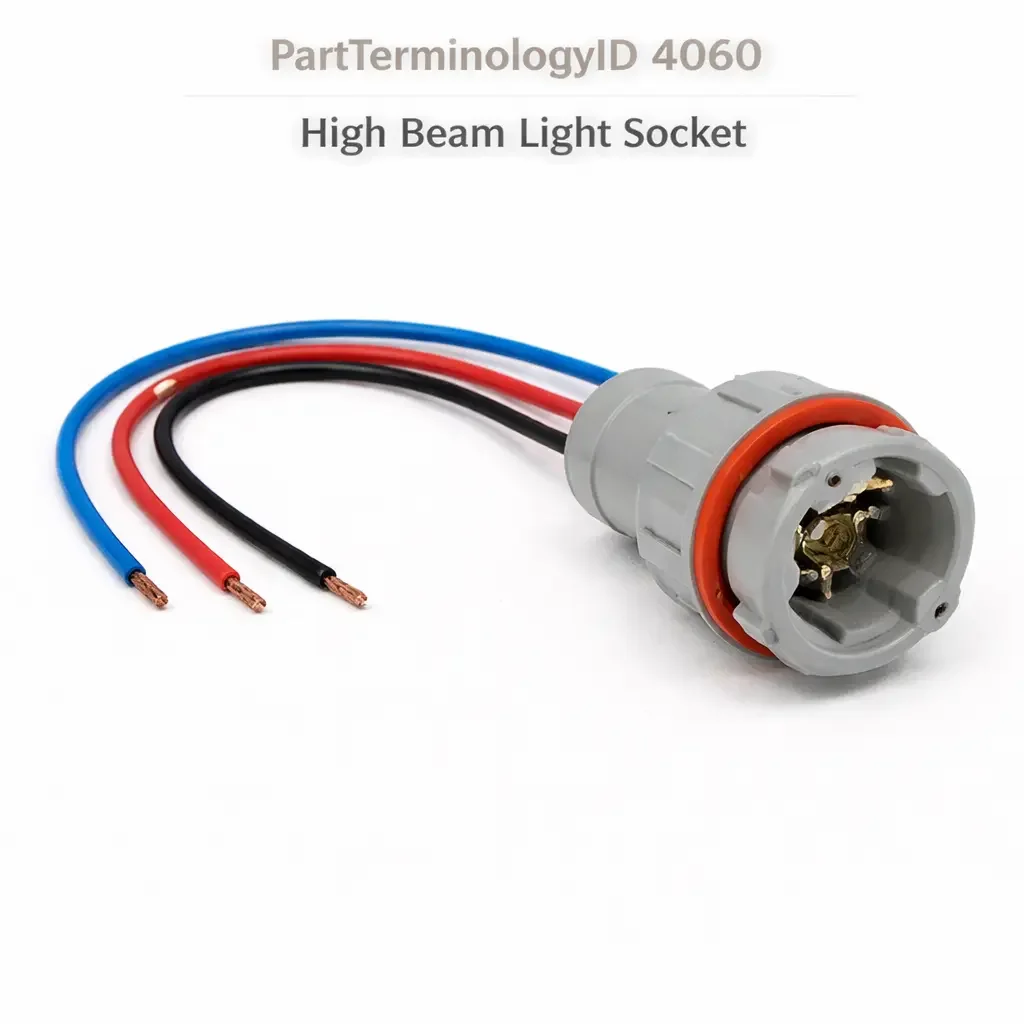
PartTerminologyID 4060, High Beam Light Socket, is the bulb socket that delivers switched power specifically to the high-beam headlamp bulb, either as a dedicated single-filament socket in a separate high-beam lamp housing or as the high-beam terminal circuit within a dual-filament headlamp socket where the high-beam and low-beam filaments share the same bulb and housing. That definition covers the high beam socket function correctly and leaves unresolved whether the socket is a standalone single-filament socket in a dedicated high-beam projector or reflector housing that is physically separate from the low-beam housing, the high-beam terminal contact within a dual-filament H4 or H13 socket body that also serves the low-beam filament through a separate terminal, the high-beam position within a quad-headlamp system where two inboard lamps are dedicated high-beam units and two outboard lamps are dedicated low-beam units, whether the high-beam circuit is switched by the headlamp stalk flash-to-pass circuit which provides a momentary high-beam activation independent of the latched high-beam switch, the bulb base type the socket accepts including 9005, H1, H9, or the high-beam terminal within an H4 or H13 dual-filament base, whether the high-beam circuit on this application is a BCM-commanded output that processes stalk input and any automatic high-beam sensor conditions before activating the socket supply, and whether the socket is a discrete replaceable pigtail or is integrated into the headlamp housing assembly wiring.
For sellers, PartTerminologyID 4060 is the high beam socket where the distinction between a dedicated high-beam socket application and the high-beam terminal within a dual-filament socket is the most return-generating attribute, because a buyer who has a dark high beam on a dual-filament socket application may order a replacement under PartTerminologyID 4060 when the correct repair is a dual-filament socket under PartTerminologyID 4056, or a bulb replacement at the existing dual-filament socket. The high-beam terminal fault pattern in a dual-filament socket produces a functioning low beam with a dark high beam from the same housing, which uniquely identifies a socket terminal contact fault rather than a supply circuit fault or a BCM output fault. The listing must identify whether the application uses a dedicated single-filament high-beam socket or the high-beam terminal within a dual-filament socket to ensure buyers order the correct part for the correct socket architecture.
What the High Beam Light Socket Does
Dedicated single-filament high-beam socket versus high-beam terminal in dual-filament socket
Dedicated single-filament high-beam sockets are present on vehicles where the low-beam and high-beam functions use separate bulbs in separate housings or separate positions within the same housing. These applications include quad-headlamp systems with two dedicated high-beam inboard units, projector headlamp assemblies with separate low-beam projector and high-beam reflector modules within the same housing envelope, and some European headlamp designs that use an H7 low-beam bulb in one socket and an H1 or H9 high-beam bulb in a separate socket within the same lamp assembly.
On dedicated single-filament high-beam socket applications the high-beam socket serves only the high-beam function and a fault in the socket affects the high beam only. The low-beam socket and circuit are entirely separate. A buyer who has a dark high beam on a dedicated single-filament application has a fault in the high-beam socket, high-beam relay, high-beam supply circuit, or high-beam bulb specifically. The diagnostic path is isolated to the high-beam circuit.
Dual-filament high-beam terminal applications use a single socket body such as H4 or H13 that contains separate contacts for the low-beam filament and high-beam filament within the same bulb. The high-beam terminal in a dual-filament socket is a specific contact point within the multi-terminal socket body. A fault at the high-beam terminal produces a dark high beam with a functioning low beam from the same bulb. On these applications the correct replacement is the complete dual-filament socket body that contains both the high-beam and low-beam terminals, not a separate single-terminal high-beam socket. A buyer who orders a dedicated single-filament high-beam socket for a dual-filament application will receive a part that does not match the bulb base or the socket housing on their vehicle.
Flash-to-pass circuit and the momentary high-beam activation path
The flash-to-pass function activates the high-beam circuit momentarily when the driver pulls the turn signal stalk toward them without engaging the latched high-beam switch. On direct stalk-switched applications the flash-to-pass action supplies voltage directly to the high-beam circuit for the duration the stalk is held. On BCM-commanded applications the stalk movement sends a flash-to-pass input to the BCM which activates the high-beam output driver for the duration of the input.
A buyer whose high beams activate from the flash-to-pass action but not from the latched high-beam switch position has a fault in the latched high-beam switch path rather than a socket fault, because the socket correctly receives and responds to the flash-to-pass supply. This symptom pattern confirms the socket is functional and isolates the fault to the stalk switch latching mechanism or the BCM latched high-beam command path. Identifying this diagnostic pattern in the listing prevents a socket replacement order on a stalk switch fault.
Automatic high-beam control and BCM activation conditions
Automatic high-beam systems on current-generation vehicles use a forward-facing camera or light sensor to detect oncoming traffic and automatically switch between low and high beam without driver input. The BCM activates the high-beam socket supply through the automatic high-beam module output. A buyer whose automatic high beams do not activate in appropriate low-light conditions may have an automatic high-beam camera or sensor fault, a BCM logic condition, or a high-beam socket fault. All three produce a dark high beam under automatic mode conditions.
Confirming that the high beams activate correctly from the manual stalk switch before diagnosing an automatic high-beam fault separates a socket or bulb fault from an automatic control system fault. If the high beams activate from the manual stalk but not from the automatic system, the fault is in the automatic high-beam control circuit rather than the socket. If the high beams do not activate from the manual stalk either, the socket, bulb, or high-beam supply circuit is the fault source.
Why This Part Generates Returns
Buyers return high beam light sockets because the high-beam bulb has a failed filament and the socket is undamaged, the application uses a dual-filament socket and the buyer ordered a single-filament high-beam socket that does not fit the dual-filament base type, the high-beam relay or BCM output driver has failed and the socket correctly receives no supply voltage, the flash-to-pass activates the high beams correctly but the latched high-beam switch does not, indicating a stalk switch fault rather than a socket fault, the socket is thermally damaged from a high-wattage aftermarket bulb and the replacement will be damaged by the same bulb if it is not replaced, and the automatic high-beam system has a sensor fault that prevents automatic activation while manual high-beam operation from the stalk remains functional.
Status in New Databases
PartTerminologyID 4060 is cataloged in PIES/PCdb as High Beam Light Socket. Under PIES 8.0 and PCdb 2.0 there is no change to the terminology or classification for this PartTerminologyID.
Top Return Scenarios
Scenario 1: "Dual-filament application, single-filament high-beam socket ordered, does not fit"
The buyer's high beam is dark and the low beam functions correctly from the same housing. The vehicle uses an H4 dual-filament bulb in a dual-filament socket. The buyer orders a dedicated 9005 single-filament high-beam socket. The 9005 socket does not accept the H4 dual-filament bulb. The socket is returned as incorrect for the application.
Prevention language: "Dual-filament architecture check: On applications using H4 or H13 dual-filament bulbs, the high-beam function is provided by the high-beam terminal within the dual-filament socket rather than a separate dedicated single-filament socket. A dark high beam with a functioning low beam from the same housing indicates a failed high-beam terminal contact in the dual-filament socket. Order the complete dual-filament socket assembly that matches the H4 or H13 bulb base rather than a separate single-filament high-beam socket."
Scenario 2: "Failed high-beam bulb filament, socket undamaged, socket returned after bulb replacement resolves dark high beam"
The high beam does not activate from the stalk. The socket is undamaged and all terminals make correct contact. The 9005 high-beam bulb has a failed filament. The buyer replaces the socket. The high beam restores. The buyer returns the original socket as defective when the bulb was the failed component.
Prevention language: "Bulb pre-check: Confirm supply voltage is present at the high-beam socket supply terminal when the high-beam stalk is activated. If supply voltage is present but the high beam does not illuminate, remove the socket and test the bulb directly with a 12-volt supply before replacing the socket. A failed bulb filament is the most common cause of a dark high beam with confirmed supply voltage at the terminal."
Scenario 3: "Flash-to-pass works but latched high beam does not, stalk switch fault diagnosed as socket fault"
The buyer's high beams activate when the stalk is pulled toward the driver for flash-to-pass but do not latch when the stalk is pushed away from the driver. The socket receives supply voltage during flash-to-pass activation confirming it is functional. The stalk switch latching contact has failed. The buyer replaces the high-beam socket. No change in latched high-beam behavior.
Prevention language: "Flash-to-pass confirmation test: If the high beam activates during flash-to-pass but not when the stalk is latched to the high-beam position, the socket is confirmed functional. The fault is in the stalk switch latching contact or the BCM latched high-beam command path rather than the socket. Socket replacement will not restore latched high-beam operation when the stalk switch is the fault source."
Scenario 4: "High-beam relay failed, no supply voltage at socket, socket replaced with no change"
The buyer's high beams do not activate from the stalk or from flash-to-pass. The high-beam relay has failed open. No supply voltage is present at the high-beam socket supply terminal in either high-beam mode. The buyer replaces the socket. The relay fault remains. No change.
Prevention language: "High-beam supply validation: With the stalk in the high-beam position or during flash-to-pass activation, probe the high-beam socket supply terminal for battery voltage. No voltage in both latched and flash-to-pass modes simultaneously indicates a failed high-beam relay, a blown high-beam fuse, or a BCM output driver fault rather than a socket contact fault."
Scenario 5: "Automatic high beam does not activate, manual high beam works, sensor fault misdiagnosed as socket fault"
The buyer's automatic high beams do not activate in low-light conditions. The high beams activate correctly from the manual stalk. The automatic high-beam forward camera has a calibration fault that prevents activation in automatic mode. The socket and bulb are confirmed functional from manual stalk operation. The buyer replaces the socket expecting to restore automatic high-beam operation. No change in automatic mode.
Prevention language: "Automatic high-beam mode versus manual mode: If the high beams activate correctly from the manual stalk but not from the automatic high-beam system, the fault is in the automatic high-beam camera, sensor, or BCM automatic mode logic rather than the socket. Socket replacement will not restore automatic high-beam activation when the manual high-beam mode confirms the socket is functional."
Listing Requirements
PartTerminologyID: 4060
Socket architecture: dedicated single-filament or high-beam terminal within dual-filament (mandatory)
Bulb base type: 9005, H1, H9, or high-beam terminal within H4 or H13 (mandatory)
Quad-headlamp position note where applicable (mandatory)
Flash-to-pass circuit confirmation test note (mandatory)
Automatic high-beam mode versus manual mode distinction note (mandatory)
Maximum rated bulb wattage (mandatory)
Supply voltage validation note (mandatory)
Bulb pre-check note (mandatory)
Dual-filament architecture mismatch prevention note (mandatory)
OEM part number cross-reference (mandatory)
Catalog Checklist for ACES/PIES Teams
PartTerminologyID = 4060
Require socket architecture: dedicated single-filament or dual-filament terminal (mandatory)
Require bulb base type per application (mandatory)
Require flash-to-pass confirmation note (mandatory)
Require automatic versus manual mode distinction note (mandatory)
Require maximum wattage specification (mandatory)
Prevent dual-filament mismatch return: H4 and H13 applications require dual-filament socket under PartTerminologyID 4056, not a single-filament socket under 4060; architecture must be confirmed before assigning fitment
Prevent stalk switch fault socket return: flash-to-pass activation confirms socket is functional; latched-only failure isolates fault to stalk switch, not socket
Prevent automatic high-beam sensor fault socket return: manual activation confirming socket function rules out socket as fault source for automatic mode failure
Prevent high-beam relay fault socket return: supply voltage validation must precede socket diagnosis on no-high-beam complaints
FAQ (Buyer Language)
My low beam works but my high beam does not. Is it the socket?
The answer depends on whether your vehicle uses a dedicated single-filament high-beam socket or a dual-filament socket where both beams share one bulb. If both beams come from separate bulbs in separate sockets, check the high-beam bulb first, then confirm supply voltage at the high-beam socket terminal with the stalk activated. If both beams come from the same dual-filament bulb, the dark high beam with functioning low beam indicates a failed high-beam terminal contact in the dual-filament socket.
How do I know if my vehicle has a separate high-beam socket or a dual-filament socket?
Check the bulb base type. An H4 or H13 bulb is a dual-filament type that serves both low and high beam from the same bulb. A 9005, H1, or H9 bulb is a single-filament type used in a dedicated high-beam socket. If you remove the headlamp bulb and it has two separate filaments visible inside the glass, it is a dual-filament type and PartTerminologyID 4060 as a separate socket does not apply to your application.
My high beams work when I pull the stalk for flash-to-pass but not when I push the stalk to latch them. Is it the socket?
No. Flash-to-pass activation confirms the high-beam socket and bulb are functional. The fault is in the stalk switch latching mechanism that holds the high-beam circuit active. Replace the turn signal and headlamp stalk switch rather than the socket.
How do I check the high-beam bulb before replacing the socket?
With the headlamps in high-beam mode, probe the supply terminal of the high-beam socket with a test light. If supply voltage is present but the high beam does not illuminate, remove the bulb and apply 12-volt power directly to the bulb terminals. A bulb that does not illuminate when powered directly has a failed filament. Replace the bulb before the socket.
My automatic high beams stopped working but the manual high beams are fine. What is the fault?
Manual high-beam activation confirming socket and bulb function rules out the socket as the fault source for automatic mode failure. The fault is in the automatic high-beam camera, forward light sensor, or BCM automatic mode logic. Have the automatic high-beam system inspected for a camera calibration fault or sensor obstruction before diagnosing any electrical component.
What Sellers Get Wrong About PartTerminologyID 4060
The most common error is failing to distinguish dedicated single-filament high-beam socket applications from dual-filament socket applications where the high-beam function is a terminal within the dual-filament socket body. A buyer on a dual-filament application who orders under PartTerminologyID 4060 receives a single-filament socket that does not accept the dual-filament bulb base and returns it immediately as incorrect. The listing that identifies the socket architecture and notes that dual-filament applications require the complete dual-filament socket under PartTerminologyID 4056 prevents this fitment return entirely.
The second error is omitting the flash-to-pass confirmation test note. Flash-to-pass activation is the single most reliable method for confirming high-beam socket functionality without fully engaging the latched high-beam circuit. A socket that activates during flash-to-pass is confirmed functional and the fault is in the latched circuit path. Without the flash-to-pass note buyers replace functioning sockets on stalk switch faults.
The third error is omitting the supply voltage validation note. A failed high-beam relay or BCM output driver produces no supply voltage at the high-beam socket terminal identically to a failed socket contact. Without the supply validation note buyers replace the socket when the relay is the actual fault source.
The fourth error is omitting the automatic high-beam mode distinction note. Buyers whose automatic high beams do not activate in conditions where they expect them attribute the fault to the high-beam circuit components including the socket, when manual stalk operation confirming socket function would immediately rule the socket out as a fault source.
Cross-Sell Logic
High Beam Bulb: for buyers where supply voltage is confirmed at the high-beam socket terminal with the stalk activated but the high beam does not illuminate, indicating a failed bulb filament is the correct repair.
Headlamp Switch or Turn Signal Stalk: for buyers where the high beam activates during flash-to-pass but not when latched, confirming the socket is functional and isolating the fault to the stalk switch latching contact.
High Beam Relay: for buyers where no supply voltage is present at the high-beam socket terminal in both latched and flash-to-pass modes simultaneously, indicating a failed relay contact rather than a socket fault.
BCM or Headlamp Control Module: for buyers where the high-beam relay coil receives no activation from the BCM despite confirmed stalk input, indicating a BCM output driver fault for the high-beam relay circuit.
Automatic High Beam Camera or Sensor: for buyers where the high beams activate correctly from manual stalk operation but not from the automatic high-beam system, indicating an automatic high-beam sensor or camera fault rather than a socket or bulb fault.
Dual-Filament Headlight Socket (PartTerminologyID 4056): for buyers on H4 or H13 dual-filament applications where the high-beam terminal contact has failed within the dual-filament socket body, requiring the complete dual-filament socket assembly rather than a dedicated single-filament high-beam socket.
Why Catalog Data Quality Matters for PartTerminologyID 4060
High beam light socket returns cluster around four scenarios that are fully preventable with listing language: the dual-filament architecture mismatch, the stalk switch flash-to-pass misdiagnosis, the high-beam relay supply circuit misdiagnosis, and the automatic high-beam mode misdiagnosis. The dual-filament mismatch generates returns because buyers on H4 and H13 applications order a single-filament socket that does not fit. The flash-to-pass misdiagnosis generates returns because buyers replace a confirmed-functional socket when the stalk switch latching contact is the actual fault. The relay supply misdiagnosis generates returns because no supply voltage at the socket terminal is attributed to the socket rather than the relay. The automatic high-beam mode misdiagnosis generates returns because buyers attribute automatic mode failure to the socket when manual stalk confirmation rules the socket out.
The dual-filament architecture note and the flash-to-pass confirmation test note together address the two scenarios that are unique to PartTerminologyID 4060 and do not appear with the same frequency in other headlamp socket categories. Both require one sentence in the listing and both are absent in most aftermarket listings for this PartTerminologyID.
Supply voltage validation and bulb pre-check complete the set of attributes that ensure every buyer under this PartTerminologyID confirms a genuine socket fault before the order is placed.
Together these four attributes make every listing under this PartTerminologyID complete.
Application Range and Fitment Guidance for PartTerminologyID 4060
High beam light socket applications as dedicated single-filament sockets are concentrated in vehicles using separate low-beam and high-beam lamp units, which became the dominant headlamp architecture on domestic vehicles from approximately 1995 onward as multi-reflector and projector headlamp assemblies replaced single-reflector quad-headlamp systems. The 9005 single-filament base type is the most common dedicated high-beam socket type on domestic vehicles from the late 1990s through the mid-2010s. H1 is common on European vehicles of the same period. H9 appears on some high-performance headlamp applications from approximately 2005 onward.
Quad-headlamp systems on domestic vehicles from the 1960s through the early 1990s used two dedicated high-beam inboard sealed beam units and two dedicated low-beam outboard sealed beam units. These sealed beam applications do not use a replaceable socket under PartTerminologyID 4060, as the sealed beam unit is the service component. Post-sealed-beam quad-headlamp systems that use replaceable 9005 high-beam bulbs in dedicated inboard housings do apply under this PartTerminologyID.
Dual-filament H4 applications under PartTerminologyID 4056 represent the largest share of headlamp socket fitments where both low and high beam functions are served by a single socket body. Fitment claims under PartTerminologyID 4060 must confirm the application uses a dedicated single-filament high-beam socket rather than the high-beam terminal within an H4 or H13 dual-filament socket body to prevent incorrect fitment assignments.
LED headlamp high-beam positions with integrated LED arrays and no replaceable single-filament socket represent a growing share of current-generation vehicles. On integrated LED applications no socket under PartTerminologyID 4060 applies and a high-beam fault requires headlamp assembly replacement.