
Written by Arthur Simitian | PartsAdvisory
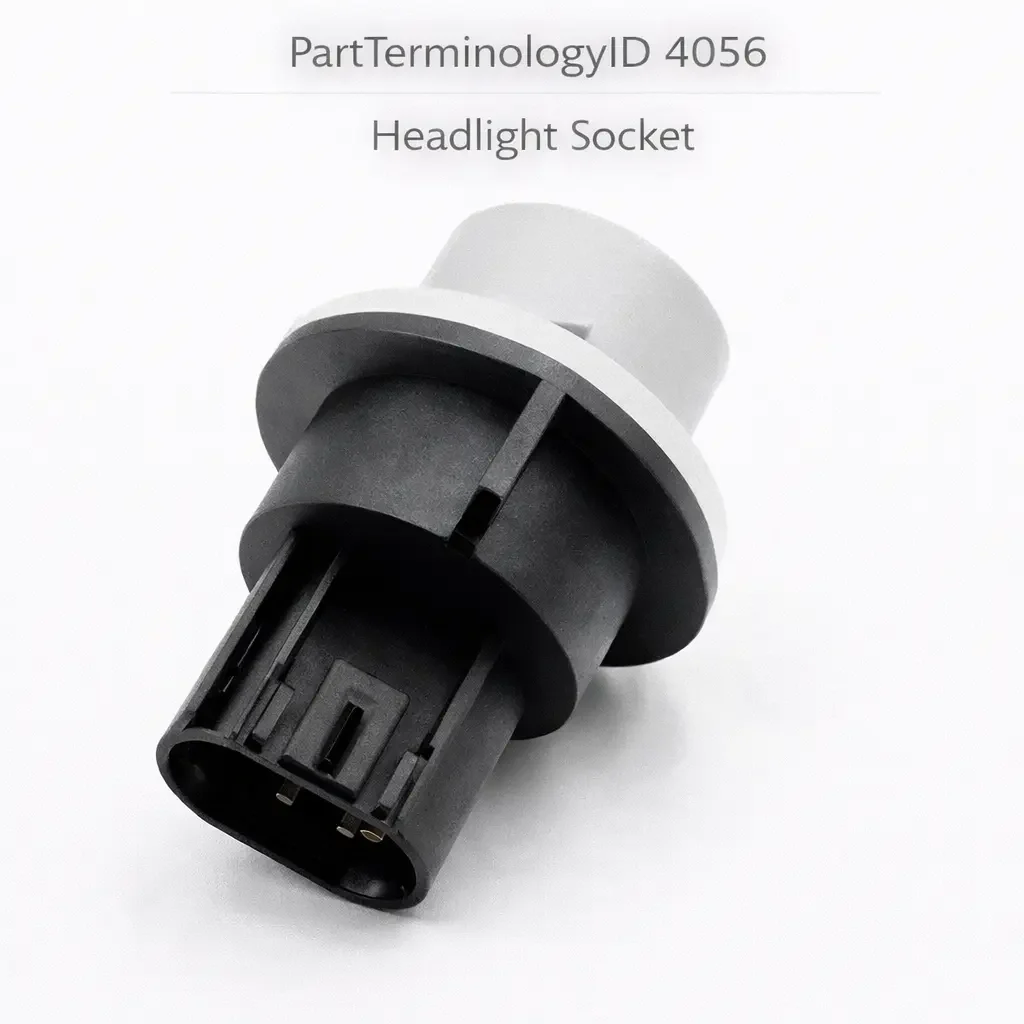
PartTerminologyID 4056, Headlight Socket, is the bulb socket that connects the vehicle wiring harness to the headlight bulb, delivering switched power from the headlamp circuit to illuminate the low-beam or high-beam filament when commanded by the headlamp switch, BCM, or automatic headlamp control module. That definition covers the headlight socket function correctly and leaves unresolved whether the socket serves a halogen bulb in a reflector or projector housing, a high-intensity discharge bulb with an integrated igniter that requires a ballast rather than a direct socket supply, a sealed beam headlamp unit where the bulb and reflector are a single assembly with no discrete replaceable socket, whether the socket body accepts an H1, H4, H7, H11, H13, 9003, 9004, 9005, 9006, or 9007 base type, whether the socket is a three-terminal dual-filament type serving both low and high beam from a single bulb or a single-terminal type serving one beam function from a dedicated single-filament bulb, whether the socket circuit is switched directly by the headlamp switch or is commanded by a BCM or automatic headlamp module output driver, and whether the socket is a discrete replaceable pigtail assembly that splices into the existing harness or is a full headlamp harness section that requires harness connector replacement rather than a pigtail splice.
For sellers, PartTerminologyID 4056 is the headlight socket where thermal damage from a failed or wrong-specification bulb is the most return-generating attribute, because headlamp sockets operate in a high-heat environment directly adjacent to the headlamp bulb and a bulb that draws above its rated wattage or is touched during installation with bare fingers accelerates socket housing degradation that produces the exact same symptoms as a socket that has simply aged past its service life. A buyer who installs a replacement socket without addressing the root cause of the original socket's thermal failure will return the replacement socket in a fraction of the original socket's service life when the same root cause degrades the replacement. The listing must identify thermal damage root causes and the pre-installation steps that prevent immediate replacement socket failure.
What the Headlight Socket Does
Halogen reflector socket versus HID ballast igniter socket versus sealed beam
Halogen headlamp sockets are the dominant application under PartTerminologyID 4056. The socket body accepts a halogen bulb base, clamps the bulb in the correct position relative to the reflector focal point, and delivers 12-volt supply through two or three terminals to the bulb's low-beam filament, high-beam filament, or both depending on the bulb type. The socket must maintain secure bulb retention, correct terminal contact pressure, and adequate heat dissipation during continuous headlamp operation. A socket body that has cracked from thermal cycling loses bulb retention and produces a misaligned beam. A socket with oxidized terminals produces a voltage drop that reduces bulb luminosity and causes the terminal to overheat further under the increased current draw of a dimming bulb.
HID headlamp applications use a ballast and igniter assembly rather than a direct-current socket to power the arc lamp. The socket on HID applications connects the wiring harness to the ballast input rather than directly to the bulb. A fault in the HID headlamp socket circuit prevents the ballast from receiving supply voltage and produces a no-activation symptom identical to a halogen socket fault, but the repair path diverges at the ballast and igniter rather than at the bulb. Listings for headlight sockets must identify whether the application uses a halogen direct socket or an HID ballast input connector to prevent buyers from ordering a halogen socket for an HID application.
Sealed beam headlamp assemblies from vehicles produced before the mid-1980s use a standardized sealed beam unit where the bulb filaments, reflector, and lens are a single sealed glass assembly. The socket on sealed beam applications is a three-prong or four-prong connector on the back of the sealed beam unit. A failed sealed beam requires full unit replacement rather than bulb replacement. A failed socket on a sealed beam application requires the socket harness connector rather than a bulb-type socket. Fitment claims under PartTerminologyID 4056 must confirm the application uses a replaceable bulb rather than a sealed beam before assigning the part.
Dual-filament H4 and H13 socket architecture versus single-filament dedicated beam sockets
Dual-filament headlamp sockets serve bulbs where both the low-beam and high-beam filaments are housed in a single bulb. H4 and H13 base types are the most common dual-filament configurations. The socket has three terminals: low-beam supply, high-beam supply, and ground. A failed low-beam terminal contact produces a dark low beam with a functioning high beam from the same bulb. A failed high-beam terminal contact produces a functioning low beam with a dark high beam. A failed ground terminal produces simultaneous loss of both beam functions from that headlamp position.
The dual-filament fault pattern is diagnostically significant because it identifies a specific terminal contact failure in the socket rather than a bulb fault or a supply circuit fault. A buyer whose low beam is dark but high beam functions from the same headlamp housing has a failed low-beam terminal contact in the dual-filament socket, not a blown fuse, not a failed BCM output, and not a failed bulb on the high-beam filament. This pattern uniquely confirms the socket as the fault source and validates the socket replacement order without further diagnostic steps.
Single-filament dedicated beam sockets serve applications where the low-beam and high-beam functions are handled by separate bulbs in separate sockets, typically H7 low beam and H7 or 9005 high beam in a dedicated projector or reflector housing for each function. A fault in a single-filament socket affects only one beam function and one socket position. The diagnostic path for single-filament applications requires confirming which specific socket and beam function is affected before ordering the correct replacement.
Thermal degradation from improper bulb handling and overcurrent bulbs
Halogen headlamp bulbs must not be touched on the glass envelope during installation. Skin oil contamination on the quartz glass envelope creates a hot spot during bulb operation that causes the glass to fail prematurely. A contaminated bulb that fails early from thermal stress transfers heat to the socket in an uncontrolled manner as the bulb glass fails, accelerating socket housing degradation. A buyer who installs a replacement socket and handles the replacement bulb with bare fingers replicates the condition that degraded the original socket and will find the replacement socket housing cracked and the terminal contacts heat-damaged within months.
High-wattage aftermarket bulbs that exceed the OEM bulb wattage specification deliver more heat to the socket housing than it was designed for. A 100-watt aftermarket bulb installed in a socket rated for a 55-watt OEM halogen bulb overloads the socket contact current rating and melts the housing at the terminal positions over time. A buyer who installs a replacement socket and reinstalls the same high-wattage aftermarket bulb will find the replacement socket thermally damaged from the same overcurrent condition within a shorter period than the original socket. The listing must specify the maximum bulb wattage the socket is rated for and note the no-touch bulb handling requirement.
BCM-commanded headlamp output and the module fault misdiagnosis
Current-generation vehicles route headlamp activation through the BCM or a dedicated lighting control module rather than through a direct headlamp switch-to-socket circuit. The BCM processes the headlamp switch input, automatic headlamp sensor data, and daytime running light logic before commanding the headlamp relay or output driver. A BCM output driver fault produces no headlamp activation from the driver side socket while the passenger side socket may continue functioning if the driver and passenger headlamps are on separate BCM outputs.
A buyer who finds one headlamp non-functional on a BCM-commanded application has either a failed socket, a failed bulb, a failed headlamp relay for that side, or a BCM output driver fault for that side. All four produce identical no-light symptoms at the socket. Confirming supply voltage at the socket supply terminal during headlamp activation separates a supply circuit fault from a socket contact fault. If supply voltage is present at the terminal and the bulb is confirmed functional but the headlamp does not illuminate, the socket contact between the terminal and the bulb base is the fault. If no supply voltage is present at the terminal, the relay, BCM output, or wiring is the fault source.
Why This Part Generates Returns
Buyers return headlight sockets because the replacement socket is thermally damaged by the same high-wattage aftermarket bulb that damaged the original socket, the headlamp bulb was touched during installation contaminating the glass envelope and causing premature bulb failure that damages the replacement socket, the headlamp relay has failed and the socket correctly receives no supply voltage on a BCM-commanded application, the BCM output driver for the headlamp circuit has failed and the socket correctly receives no supply voltage, the socket is a pigtail splice type and the splice was not made correctly causing a high-resistance connection that overheats the pigtail terminals, and the headlamp housing has water intrusion that is corroding the socket terminal contacts from moisture reaching the bulb base position.
Status in New Databases
PartTerminologyID 4056 is cataloged in PIES/PCdb as Headlight Socket. Under PIES 8.0 and PCdb 2.0 there is no change to the terminology or classification for this PartTerminologyID.
Top Return Scenarios
Scenario 1: "High-wattage aftermarket bulb installed, replacement socket thermally damaged within weeks"
The buyer's original headlight socket has melted terminal contacts from an aftermarket 100-watt bulb installed in a socket rated for 55 watts. The buyer replaces the socket and reinstalls the same 100-watt bulb. The replacement socket begins showing thermal discoloration within weeks and the terminals start to oxidize under the continuous overcurrent. The buyer returns the replacement socket as defective on arrival when the overcurrent bulb was the root cause throughout.
Prevention language: "Bulb wattage limit: This socket is rated for a maximum bulb wattage of [X] watts. Installing an aftermarket bulb that exceeds this wattage rating overloads the socket contact current capacity and will thermally damage the replacement socket in a fraction of the original socket's service life. Confirm the replacement bulb matches the OEM wattage specification before installation. Remove any high-wattage aftermarket bulbs before installing the replacement socket."
Scenario 2: "Bulb touched during installation, oil contamination causes premature bulb failure, heat damages replacement socket"
The buyer installs the replacement socket and handles the new halogen bulb with bare fingers. The skin oil on the bulb glass envelope creates thermal stress during operation. The bulb fails within weeks from the contamination hot spot, transferring abnormal heat to the socket terminals during failure. The buyer returns the replacement socket as failing prematurely.
Prevention language: "Bulb handling: Do not touch the glass envelope of the replacement halogen bulb with bare fingers during installation. Skin oil on the quartz glass creates a thermal stress point that causes premature bulb failure and transfers abnormal heat to the socket terminals. Handle the bulb using a clean cloth or the bulb packaging material. If the glass is accidentally touched, clean it with isopropyl alcohol before installation."
Scenario 3: "Failed headlamp relay, no supply voltage at socket, socket replaced with no change"
The left headlamp does not illuminate. The left headlamp relay has failed open. No supply voltage is present at the left headlight socket supply terminal during headlamp activation. The buyer replaces the socket. The relay fault remains. The replacement socket also receives no supply voltage.
Prevention language: "Relay and supply validation: Before replacing the headlight socket, confirm supply voltage is present at the socket supply terminal during headlamp activation. No supply voltage at the terminal indicates a failed headlamp relay, a blown headlamp fuse, or a BCM output driver fault rather than a socket contact fault. A socket that receives no supply voltage is functioning correctly."
Scenario 4: "Pigtail splice socket, poor splice connection, high resistance at splice overheats pigtail terminals"
The buyer installs a pigtail splice replacement socket and uses twist-and-tape wire connections rather than crimped or soldered splice connectors. The twist connections develop high resistance over time from vibration loosening the wire strands. The high-resistance splice generates heat that discolors the pigtail terminals and reduces headlamp brightness. The buyer returns the socket as producing a dim headlamp.
Prevention language: "Pigtail splice installation: When installing a pigtail splice headlight socket, use the correct crimped butt splice connectors or heat-shrink solder connectors for each wire connection. Twist-and-tape wire connections are not acceptable for headlamp circuit splices. A high-resistance splice connection overheats the pigtail terminals under headlamp operating current. Strip the harness wires to the correct length, crimp each splice connector fully, and confirm continuity through each splice before closing the connection."
Scenario 5: "Water intrusion in headlamp housing, corrosion at bulb base contacts, replacement socket corrodes within months"
The headlamp housing seal has failed and moisture enters the housing during rain or vehicle washing. The moisture reaches the bulb base socket position and corrodes the terminal contact surfaces. The buyer replaces the socket. The housing seal fault remains. The replacement socket terminals develop the same corrosion from the same moisture intrusion within months.
Prevention language: "Housing seal inspection: Before installing the replacement socket, inspect the headlamp housing for water intrusion. Moisture inside the headlamp housing will corrode the replacement socket terminals identically to the original. A fogged headlamp lens, visible water droplets inside the housing, or a failed housing dust cover seal indicates active moisture intrusion. Address the housing seal fault before installing the replacement socket to prevent repeat corrosion."
Scenario 6: "Dual-filament socket, low-beam terminal failed, high beam functional, buyer replaces fuse and relay before socket"
The left headlamp low beam is dark. The left headlamp high beam functions correctly from the same housing. The buyer assumes the low-beam circuit has a blown fuse or a relay fault and checks the fuse panel. The low-beam and high-beam circuits share a fuse on this application and the fuse is intact. The buyer replaces the low-beam relay. No change. The dual-filament socket has a failed low-beam terminal contact that produces the dark low beam with functioning high beam from the same bulb.
Prevention language: "Dual-filament fault pattern: A dark low beam with a functioning high beam from the same headlamp housing indicates a failed low-beam terminal contact in the dual-filament socket rather than a fuse or relay fault. A fuse fault affects both beam functions from the same position simultaneously. A relay fault affects only the specific beam circuit the relay controls. A single-beam-function outage with the other beam function intact at the same housing confirms a socket terminal contact fault."
Listing Requirements
PartTerminologyID: 4056
Bulb base type: H1, H4, H7, H11, H13, 9003, 9004, 9005, 9006, 9007, or other (mandatory)
Filament type: single-filament or dual-filament (mandatory)
Maximum rated bulb wattage (mandatory)
Socket body type: discrete pigtail splice or full harness section (mandatory)
Lamp type: halogen reflector, halogen projector, or HID ballast input (mandatory)
Sealed beam inapplicability note where applicable (mandatory)
Bulb wattage limit note (mandatory)
Bulb handling note: no-touch glass envelope (mandatory)
Housing seal inspection note (mandatory)
Pigtail splice installation note where applicable (mandatory)
Supply voltage validation note (mandatory)
Dual-filament fault pattern note where applicable (mandatory)
OEM part number cross-reference (mandatory)
Catalog Checklist for ACES/PIES Teams
PartTerminologyID = 4056
Require bulb base type per application (mandatory)
Require filament type: single or dual (mandatory)
Require maximum rated wattage (mandatory)
Require socket body type: pigtail or full harness (mandatory)
Require lamp type: halogen or HID ballast (mandatory)
Prevent overcurrent bulb thermal damage return: aftermarket high-wattage bulb exceeding socket rating will thermally damage replacement socket; maximum wattage specification and bulb specification check are mandatory pre-installation steps
Prevent contaminated bulb socket damage return: bare-hand bulb contact produces premature bulb failure and socket thermal damage; no-touch handling note is mandatory
Prevent relay fault socket return: no supply voltage at socket terminal is a relay, fuse, or BCM fault; supply voltage validation must precede socket diagnosis
Prevent water intrusion repeat corrosion: housing seal fault causes replacement socket to corrode identically; housing inspection is a mandatory pre-installation step
Prevent pigtail splice resistance failure: twist-and-tape splices are unacceptable; crimped or soldered splice connectors are mandatory for headlamp circuit splices
Prevent dual-filament misdiagnosis: single-function outage with other function intact at same housing is a socket terminal contact fault, not a fuse or relay fault
FAQ (Buyer Language)
Why did my replacement headlight socket fail so quickly after installation?
The most common cause of premature replacement socket failure is a high-wattage aftermarket bulb that exceeds the socket's rated wattage. The overcurrent from the higher-wattage bulb overloads the socket contact material and melts the housing over time. Confirm the installed bulb matches the OEM wattage specification. If an aftermarket high-wattage bulb is installed, replace it with the correct OEM specification bulb at the same time as the socket.
Can I touch the new halogen bulb with my hands during installation?
No. Skin oil on the quartz glass envelope of a halogen bulb creates a thermal stress point during operation that causes premature bulb failure. Handle the replacement bulb using a clean cloth or the plastic bag the bulb came packaged in. If the glass was accidentally touched, clean it with isopropyl alcohol and allow it to dry completely before installing.
My left low beam is out but the high beam works. Is it a blown fuse?
On dual-filament headlamp applications a dark low beam with a functioning high beam from the same housing is the characteristic symptom of a failed low-beam terminal contact in the headlight socket, not a blown fuse. A blown fuse on a shared low and high beam circuit would disable both functions simultaneously. Replace the headlight socket at that position.
How do I confirm supply voltage is reaching the headlight socket?
With the headlamps activated, probe the supply terminal of the headlight socket with a test light. The test light should illuminate. No illumination at the supply terminal with headlamps activated indicates a failed headlamp relay, a blown headlamp fuse, or a BCM output driver fault rather than a socket contact failure. Trace the supply circuit upstream before ordering a socket on a no-supply-voltage complaint.
My headlamp housing has condensation inside. Will this damage the new socket?
Yes. A headlamp housing with a failed seal allows moisture to enter and condense on the interior surfaces including the socket terminal contacts. The moisture accelerates terminal corrosion and will degrade the replacement socket in the same way it degraded the original. Inspect the housing dust cover and perimeter seal before installing the replacement socket. Replace any failed seals or the housing assembly before socket installation.
My vehicle has HID headlamps. Do I need a different socket than standard halogen?
HID headlamp applications use a ballast and igniter assembly rather than a direct 12-volt socket. The wiring harness connector on HID applications connects to the ballast input rather than directly to the bulb. Standard halogen headlight sockets are not interchangeable with HID ballast input connectors. Confirm your headlamp type before ordering under PartTerminologyID 4056.
How do I make a correct pigtail splice when installing a headlight socket pigtail?
Use a crimped butt splice connector or a heat-shrink solder connector rated for the wire gauge of the headlamp harness. Strip both the pigtail wire end and the harness wire end to the length specified by the splice connector. Insert both wire ends fully into the connector and crimp or heat as required. Pull-test each completed splice to confirm retention. Do not use twist-and-tape connections in a headlamp circuit as they will develop high resistance under operating temperature and vibration.
What Sellers Get Wrong About PartTerminologyID 4056
The most common error is omitting the bulb wattage limit. Headlight sockets are one of the highest thermal stress components in the vehicle electrical system and the dominant cause of premature replacement socket failure is an aftermarket bulb that exceeds the socket's rated wattage. Without the wattage limit note buyers reinstall the same high-wattage bulb that destroyed the original socket and return the replacement as defective on arrival when the overcurrent bulb destroyed it in the same way. The wattage limit note and the instruction to confirm the installed bulb against the OEM specification before installation prevent this return.
The second error is omitting the no-touch bulb handling note. Contaminated halogen bulbs fail early and transfer abnormal heat to the socket during failure. Without the handling note buyers who touch the replacement bulb glass during installation replicate the contamination condition and return the socket as failing prematurely.
The third error is omitting the housing seal inspection note. A headlamp housing with failed seals admits moisture that corrodes replacement socket terminals in the same way it corroded the original. Without the inspection note buyers install the replacement socket into a housing with active moisture intrusion and return it as corroding prematurely.
The fourth error is omitting the supply voltage validation note. A failed headlamp relay or BCM output driver produces no supply voltage at the socket terminal identically to a failed socket contact. Without the validation note buyers replace the socket when the relay or BCM is the actual fault source.
The fifth error is omitting the pigtail splice installation note on pigtail splice socket applications. Buyers who use twist-and-tape connections rather than correct crimped splice connectors develop high-resistance connections that overheat the pigtail terminals and dim the headlamp. Without the splice installation note buyers attribute the dim headlamp and hot pigtail to a defective socket rather than a poor splice connection.
Cross-Sell Logic
Headlight Bulb: for buyers where the socket is confirmed functional, supply voltage is confirmed at the socket terminal, the socket housing is undamaged, but the headlamp does not illuminate, indicating a failed bulb filament or contaminated bulb as the correct repair.
Headlamp Relay: for buyers where no supply voltage is present at the headlight socket terminal during headlamp activation and the fault traces to a failed relay contact rather than a socket or BCM fault.
BCM or Headlamp Control Module: for buyers where the headlamp relay coil receives no activation from the BCM despite confirmed headlamp switch input, indicating a BCM output driver fault for the headlamp relay circuit.
Headlamp Assembly: for buyers where water intrusion has damaged the socket terminal contacts and the housing seal is failed beyond individual seal replacement, requiring full headlamp assembly replacement to restore a sealed housing environment for the replacement socket.
Wiring Harness Repair Kit: for buyers where the headlamp harness wiring between the relay and the socket has heat damage or insulation failure from a previous high-wattage bulb overcurrent event, requiring harness section repair before the replacement socket is installed.
Why Catalog Data Quality Matters for PartTerminologyID 4056
Headlight socket returns cluster around five scenarios that are fully preventable with listing language: the overcurrent bulb thermal damage return, the contaminated bulb handling return, the failed relay supply circuit return, the housing moisture intrusion repeat corrosion return, and the pigtail splice resistance return. Each of these scenarios generates a return of a physically damaged or degraded replacement socket where the buyer attributes the failure to the part quality when the root cause was an installation condition that was never addressed.
The overcurrent bulb thermal damage return and the contaminated bulb handling return together generate the largest share of premature replacement socket failures under this PartTerminologyID. Both are entirely preventable with pre-installation guidance. The wattage limit note converts a repeat return into a correct OEM-specification bulb replacement at the time of socket installation. The no-touch handling note converts a contaminated bulb failure into a correct handling practice at installation.
The supply voltage validation note, the housing seal inspection note, and the pigtail splice installation note each address a specific installation context that produces a return when the guidance is absent. Together all five notes ensure every buyer installs the replacement socket under conditions where it can deliver its designed service life.
Application Range and Fitment Guidance for PartTerminologyID 4056
Headlight socket applications span the complete range of vehicles with replaceable-bulb headlamp assemblies from the mid-1980s when sealed beam headlamps were phased out in North America through the present. The H4 dual-filament base type is the dominant global headlamp socket type on vehicles from the mid-1980s through the mid-1990s across domestic, European, and Asian markets. H7 low-beam and 9005 or H1 high-beam single-filament dedicated beam sockets became the dominant architecture on European and domestic premium vehicles from the mid-1990s onward as separate projector-beam low and high beam lamp units became standard.
H11 and H9 single-filament sockets are the most common low-beam and high-beam socket types on domestic passenger cars and light trucks from approximately 2005 through the present. 9006 socket types appear on some domestic vehicles from the late 1990s and early 2000s. H13 dual-filament sockets appear on domestic trucks and SUVs from approximately 2004 through the mid-2010s where a single dual-filament bulb serves both low and high beam in a single reflector housing.
LED headlamp assemblies with integrated LED light sources and no replaceable bulb socket are increasingly standard on new vehicles from approximately 2015 onward. On integrated LED headlamp applications no socket exists under PartTerminologyID 4056 and a headlamp fault requires headlamp assembly replacement. Fitment claims for post-2015 vehicles require confirmation that the application uses a replaceable halogen or HID bulb rather than an integrated LED assembly.
Pigtail splice socket applications are common on domestic trucks and SUVs where the headlamp connector pigtail is a sacrificial component designed to be replaced without splicing into the main body harness wiring. The pigtail socket includes a short wiring section with splice connectors at the harness end. Fitment claims for pigtail splice applications must specify the wire gauge of the pigtail wiring to ensure compatibility with the main harness wire gauge at the splice point.
Final Take for PartTerminologyID 4056
Headlight Socket (PartTerminologyID 4056) is the primary forward illumination interface where bulb wattage specification, no-touch handling guidance, supply voltage validation, housing seal inspection, and pigtail splice installation notes are the five attributes that prevent the five most common return scenarios. Every listing without wattage specification generates premature socket returns from overcurrent aftermarket bulbs. Every listing without handling guidance generates premature socket returns from contaminated bulb glass. Every listing without supply voltage validation generates relay and BCM fault returns where the socket was functional. Every listing without housing seal inspection generates repeat corrosion returns from moisture intrusion. Every listing without pigtail splice guidance generates dim headlamp and overheating returns from high-resistance connections.
Together these five attributes make every listing under this PartTerminologyID complete and give every buyer the installation knowledge needed to achieve the full designed service life of the replacement socket.