
Written by Arthur Simitian | PartsAdvisory
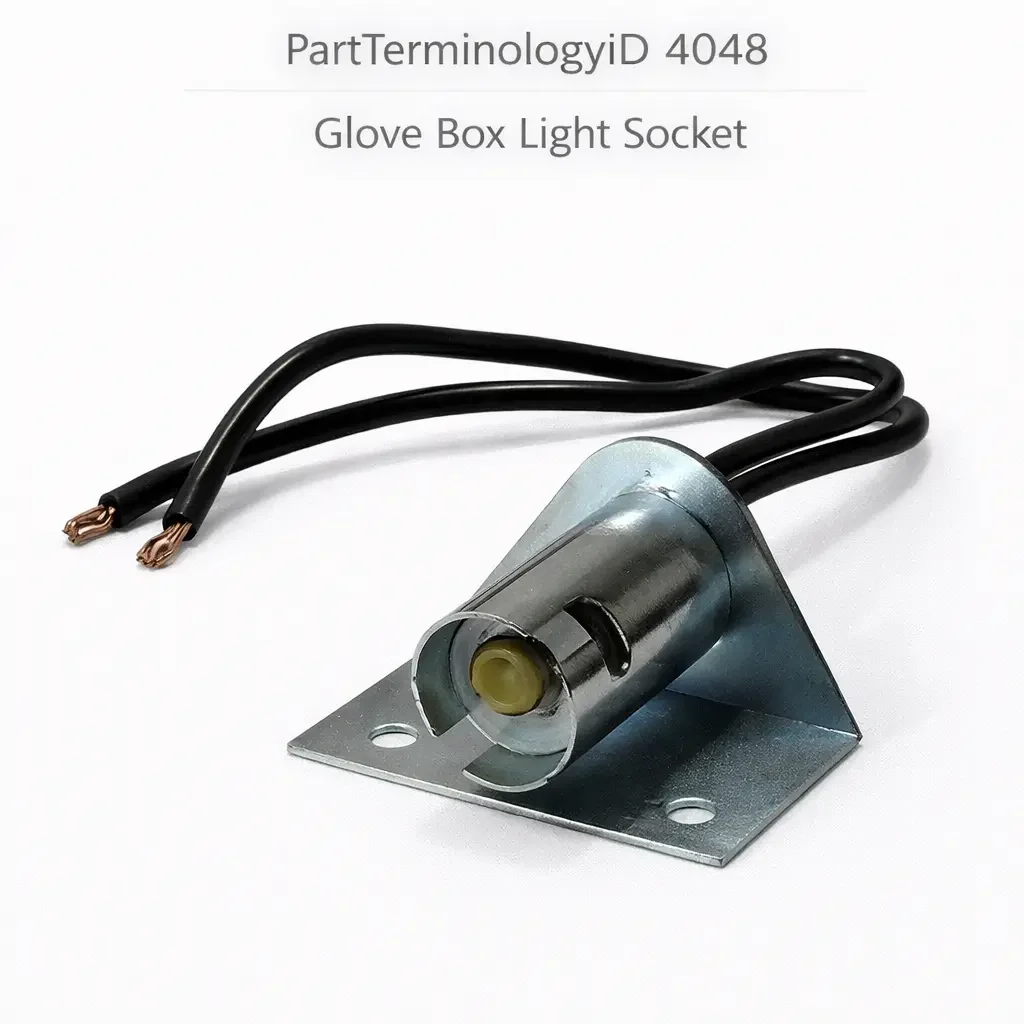
PartTerminologyID 4048, Glove Box Light Socket, is the bulb socket that provides illumination inside the glove compartment, receiving switched power from the glove box door switch circuit when the glove box door is opened and extinguishing when the door is closed. That definition covers the glove box light socket function correctly and leaves unresolved whether the socket is switched by a plunger-style door switch mounted in the glove box opening that is compressed when the door closes and released when the door opens, a magnetic reed switch that activates when the door magnet moves away from the switch body, or a contact switch integrated into the glove box latch mechanism, whether the glove box lighting circuit is always-on and draws directly from the fuse panel regardless of ignition state, or is switched by the ignition-accessory circuit and active only when the ignition is on, the bulb base type the socket accepts, whether the socket is a discrete replaceable component clipped into the glove box liner or is integrated into the glove box housing assembly, and whether the glove box light circuit shares a fuse with other interior courtesy light circuits or has a dedicated fuse.
For sellers, PartTerminologyID 4048 is the glove box light socket where the door switch validation is the most return-generating attribute, because the socket receives supply voltage only when the glove box door switch completes the circuit. A failed door switch that remains in the closed-door position prevents socket activation regardless of socket condition. A buyer who finds no glove box illumination when the door is opened has either a failed door switch, a failed bulb, a failed socket, or a blown courtesy light fuse, and all four produce identical no-light symptoms without circuit isolation.
What the Glove Box Light Socket Does
Door switch circuit and the activation path
The glove box door switch is the primary activation component in the glove box light circuit. On plunger-type switch applications the plunger is held compressed by the closed glove box door, which opens the switch circuit and keeps the light off. When the door opens the plunger extends, closing the switch circuit and completing the supply path to the socket. A plunger switch with a broken spring or a worn plunger body may not fully extend when the door opens, leaving the circuit open and the socket without supply voltage.
On contact-type latch switches the light circuit activates when the latch releases and the door separates from the latch contact. A latch contact switch with worn contact surfaces or corrosion on the contact points may not complete the circuit reliably when the door opens, producing intermittent glove box illumination that the buyer attributes to an intermittent socket contact rather than an intermittent latch switch.
The always-on architecture of most glove box light circuits means the door switch is the only component that prevents continuous battery drain when the door is closed. A door switch stuck in the open-door position keeps the socket circuit active continuously, draining the battery if the socket contains a functioning bulb. A buyer who traces an interior light battery drain to the glove box area may find the door switch stuck open rather than a socket fault.
Shared courtesy light fuse and the multi-circuit outage
The glove box light circuit on most vehicles shares a fuse with other interior courtesy light circuits including the dome light, map lights, trunk light, and vanity mirror lights. A blown courtesy light fuse disables all circuits on the shared fuse simultaneously. A buyer who finds the glove box light non-functional and replaces the socket without checking whether the dome light and other courtesy lights are also non-functional may install the replacement socket into a blown fuse circuit and find no change.
Confirming whether other courtesy light circuits on the same fuse are also non-functional before diagnosing the glove box socket takes one check and separates a blown shared fuse from a socket fault. If the dome light also does not work, the fault is the shared fuse. If the dome light works and the glove box light does not, the fault is in the glove box circuit specifically.
Why This Part Generates Returns
Buyers return glove box light sockets because the door switch has failed in the closed-door position and the socket correctly receives no supply voltage, the glove box light bulb has a failed filament and the socket is undamaged, the shared courtesy light fuse has blown and the socket correctly receives no supply voltage along with all other circuits on the shared fuse, the socket is integrated into the glove box housing with no discrete replaceable socket on this application, and the door switch is stuck in the open-door position producing continuous illumination that drains the battery and the buyer attributes the drain to a socket fault.
Status in New Databases
PartTerminologyID 4048 is cataloged in PIES/PCdb as Glove Box Light Socket. Under PIES 8.0 and PCdb 2.0 there is no change to the terminology or classification for this PartTerminologyID.
Top Return Scenarios
Scenario 1: "Failed door switch, socket receives no supply voltage, socket replaced with no change"
The glove box light does not illuminate when the door is opened. The door plunger switch has a failed spring and the plunger does not extend when the door opens. The circuit remains open. No supply voltage reaches the socket. The buyer replaces the socket. The door switch fault remains. No change in glove box illumination.
Prevention language: "Door switch validation: Confirm supply voltage is present at the glove box light socket terminal with the glove box door open before replacing the socket. No supply voltage with the door open indicates a failed door switch, a blown courtesy light fuse, or an open circuit in the supply wiring rather than a socket fault. Press and release the door switch plunger manually and confirm the circuit activates before diagnosing the socket."
Scenario 2: "Failed bulb, functional socket, socket returned after bulb replacement resolves dark light"
The glove box does not illuminate when opened. The socket is undamaged. The festoon or wedge bulb has a failed filament. The buyer replaces the socket. The glove box illuminates. The buyer returns the original socket.
Prevention language: "Bulb pre-check: Remove the socket from the glove box liner and inspect the bulb filament before replacing the socket. Replace a failed bulb first. A bulb replacement resolves the dark glove box at lower cost than socket replacement on applications where the bulb is separately replaceable."
Scenario 3: "Blown shared courtesy fuse, dome light also non-functional, socket replaced without fuse check"
The glove box light is non-functional. The dome light is also non-functional. Both circuits share a fuse that has blown. The buyer replaces the glove box socket. The blown fuse remains. The replacement socket also has no supply voltage.
Prevention language: "Shared fuse check: The glove box light circuit shares a fuse with the dome light and other courtesy light circuits on this application. Confirm the dome light and other courtesy lights are functioning before diagnosing a glove box socket fault. If multiple courtesy lights are non-functional simultaneously, check the shared courtesy light fuse before replacing any socket."
Scenario 4: "Door switch stuck open, glove box light on continuously, battery drains overnight"
The glove box door plunger switch has failed in the extended position, holding the circuit active continuously. The glove box light illuminates even with the door closed. The battery drains overnight. The buyer traces the drain to the glove box light circuit and replaces the socket expecting the continuous illumination to stop. The stuck switch remains. The replacement socket also illuminates continuously from the same stuck switch.
Prevention language: "Continuous illumination diagnosis: A glove box light that remains on with the door closed has a door switch stuck in the open-door position rather than a socket fault. The switch is holding the circuit active continuously. Replace the door switch to extinguish the light and prevent battery drain. Socket replacement will not resolve continuous illumination from a stuck door switch."
Listing Requirements
PartTerminologyID: 4048
Door switch type: plunger, magnetic reed, or latch contact (mandatory)
Circuit switching: always-on or ignition-accessory-switched (mandatory)
Shared courtesy light fuse note (mandatory)
Bulb base type and wattage specification (mandatory)
Socket architecture: discrete replaceable or integrated glove box housing (mandatory)
Door switch validation note (mandatory)
Bulb pre-check note (mandatory)
Continuous illumination diagnosis note (mandatory)
Shared fuse check note (mandatory)
OEM part number cross-reference (mandatory)
Catalog Checklist for ACES/PIES Teams
PartTerminologyID = 4048
Require door switch type (mandatory)
Require circuit switching architecture (mandatory)
Require shared courtesy fuse note (mandatory)
Require bulb base type and specification (mandatory)
Prevent door switch misdiagnosis: failed door switch produces no socket activation identically to a failed socket; door switch circuit validation must precede socket diagnosis
Prevent shared fuse socket return: blown shared fuse disables multiple courtesy circuits simultaneously; multi-circuit outage check must precede single socket diagnosis
Prevent continuous illumination socket return: stuck door switch produces continuous glove box illumination; door switch is the fault source, not the socket
FAQ (Buyer Language)
Why does my glove box light not turn on when I open the door?
Confirm supply voltage is reaching the socket by pressing the door switch plunger manually with a door open and checking for illumination. If no illumination occurs with confirmed supply voltage at the socket, the bulb or socket is the fault. If no supply voltage is present, check the door switch and the courtesy light fuse before ordering a socket.
How do I check if the door switch is working?
Locate the door switch in the glove box opening, typically a plunger button on the box frame. With the door open the plunger should extend fully. Press the plunger manually with the glove box open and observe whether the light activates and deactivates with plunger movement. A plunger that does not produce light activation when released indicates a failed switch rather than a socket fault.
My glove box light stays on even when the door is closed. Is it the socket?
A glove box light that remains on with the door closed has a stuck door switch rather than a socket fault. The switch is holding the circuit active continuously. Close the door firmly and confirm whether the light extinguishes. If it does not, inspect the door switch plunger for a broken spring or debris preventing compression. Replace the switch rather than the socket.
My dome light also stopped working at the same time as my glove box light. What is the cause?
Simultaneous loss of the dome light and glove box light points to the shared courtesy light fuse rather than individual socket faults. Check the courtesy light fuse in the fuse panel and replace it if blown before diagnosing either socket individually.
What Sellers Get Wrong About PartTerminologyID 4048
The most common error is omitting the door switch validation note. The glove box light socket is correctly inactive when the door switch is not completing the circuit. A buyer whose door switch has failed in the closed position finds no illumination and no socket supply voltage, orders a replacement socket, and finds the same result because the switch fault remains. The door switch validation note redirects the buyer to confirm supply voltage at the socket terminal and to test the switch plunger before concluding the socket is the fault source.
The second error is omitting the shared fuse check note. A blown courtesy light fuse disables the glove box light along with the dome light and other courtesy circuits simultaneously. Without the shared fuse note buyers replace the glove box socket without checking whether other circuits on the same fuse are also affected, installing the replacement into a blown fuse circuit and returning it as non-functional.
The third error is omitting the continuous illumination diagnosis note. A stuck door switch producing continuous illumination and battery drain is not a socket fault and socket replacement will not resolve it. Without the diagnosis note buyers replace the socket expecting the continuous light to stop, find no change, and return the socket.
Cross-Sell Logic
Glove Box Light Bulb: for buyers where the socket is confirmed functional and supply voltage is present at the terminal with the door open, but the glove box does not illuminate, indicating a failed bulb filament.
Glove Box Door Switch: for buyers where no supply voltage is present at the socket terminal with the door open and the fault traces to a failed door switch rather than a socket or fuse fault, and for buyers with continuous glove box illumination from a switch stuck in the open-door position.
Courtesy Light Fuse: for buyers where simultaneous loss of the glove box light and dome light confirms a blown shared courtesy light fuse rather than individual socket faults.
Glove Box Housing Assembly: for buyers on integrated socket applications where no discrete replaceable socket exists and a glove box light fault requires housing replacement.
Final Take for PartTerminologyID 4048
Glove Box Light Socket (PartTerminologyID 4048) is the compartment illumination component where door switch validation, shared fuse check, continuous illumination diagnosis, and bulb pre-check are the four attributes that prevent the four most common return scenarios. Every listing without door switch validation sends buyers through a socket replacement that changes nothing because the switch fault remains. Every listing without the shared fuse note generates returns from buyers who replaced a socket on a blown fuse circuit. Every listing without the continuous illumination note generates returns from buyers who expected socket replacement to stop a light kept active by a stuck switch. Every listing without bulb pre-check generates returns from buyers who replaced a functional socket when a bulb was the correct repair.
Together these four attributes make every listing under this PartTerminologyID complete.