
Written by Arthur Simitian | PartsAdvisory
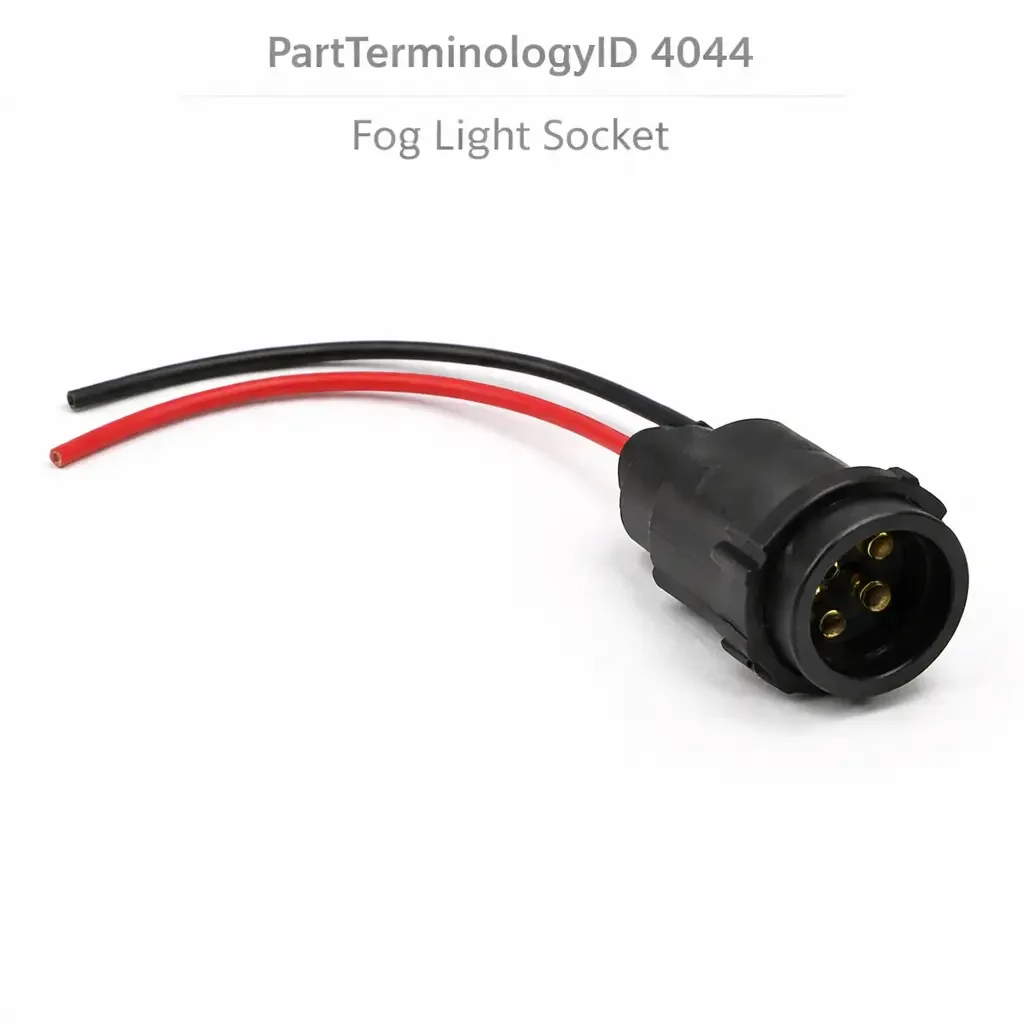
PartTerminologyID 4044, Fog Light Socket, is the bulb socket that holds the fog light bulb in the front or rear fog light housing, receiving switched power from the fog light circuit when the driver activates the fog light switch under eligible headlamp and vehicle conditions. That definition covers the fog light socket function correctly and leaves unresolved whether the socket is in a front fog light assembly mounted low in the front bumper to project a wide, low beam that reduces glare reflection from fog and precipitation, or in a rear fog light assembly that provides a high-intensity red warning light to following traffic in low-visibility conditions, the activation conditions the fog light circuit requires before the BCM or fog light relay will authorize socket supply voltage including which headlamp state must be active and whether a maximum vehicle speed applies, the bulb base type and wattage the socket accepts, whether the fog light circuit uses a dedicated relay switched by the fog light switch or is a BCM-commanded output that processes the switch input against additional vehicle state conditions, and whether the socket is a discrete replaceable component in the fog light housing or is integrated into a sealed lamp assembly.
For sellers, PartTerminologyID 4044 is the fog light socket where the headlamp state activation requirement is the most return-generating attribute, because the BCM or fog light relay on most applications will not authorize fog light activation unless the headlamp switch is in a specific position. A buyer who activates the fog light switch with the headlamps off will find no fog light activation on most applications because the activation condition is not satisfied. A buyer whose parking lamp circuit has a fault that prevents the BCM from reading an active lighting state will find no fog light activation even with the fog light switch engaged and the headlamps visually illuminated. Both conditions produce a no-activation symptom that the buyer attributes to the socket rather than the activation condition logic.
What the Fog Light Socket Does
Front fog light activation conditions and BCM gating logic
Front fog lights on most current-generation vehicles require the parking lamps or headlamps to be active before the BCM will authorize fog light circuit activation. This requirement prevents fog lights from being used as a substitute for proper headlamp illumination. On some platforms the BCM additionally requires the headlamps to be in the low-beam position and will not authorize front fog lights when the high-beam circuit is active, automatically extinguishing the fog lights when the driver switches to high beam.
The fog light switch input passes through the BCM on most current applications rather than directly switching the fog light relay. The BCM reads the switch input, confirms the headlamp state, and then commands the fog light relay or output driver to activate the circuit. A buyer whose fog light switch input is valid and whose headlamps are confirmed active but whose fog light socket receives no supply voltage has a BCM output driver fault or a fog light relay fault rather than a socket fault in most cases. Identifying this activation chain in the listing gives buyers the diagnostic path that separates a socket fault from a BCM or relay fault before any part is ordered.
Rear fog light activation conditions and the single-lamp architecture
Rear fog lights in markets that require them operate on separate activation logic from front fog lights. The rear fog light typically requires the headlamps to be in the low-beam or high-beam position, not simply the parking lamp position, and is activated through a separate dedicated switch or a second position on the front fog light switch. On some European-specification vehicles the rear fog light is a single high-intensity red lamp mounted on the driver side of the rear lamp assembly to indicate to following traffic that low-visibility conditions are present.
A buyer who activates the rear fog light switch and finds no activation may have a headlamp state condition that is not satisfied, a fuse specific to the rear fog light circuit that has blown, or a socket fault. The rear fog light circuit fuse is often separate from the front fog light circuit fuse, so a blown rear fog light fuse does not affect front fog light operation. The listing must specify whether the socket is for a front or rear fog light application and identify the activation conditions specific to that position.
Fog light relay architecture and the supply voltage validation
Most fog light circuits include a dedicated relay that handles the current for high-wattage halogen fog light bulbs. The relay coil is activated by the BCM output or directly by the fog light switch depending on the application architecture. A failed fog light relay produces no supply voltage at the socket terminal with all activation conditions satisfied, which appears identical to a failed socket contact at the supply terminal.
Confirming relay output voltage at the fog light socket supply terminal before ordering a socket replacement separates a relay fault from a socket fault. On BCM-commanded applications confirming BCM output voltage at the relay coil terminal separates a BCM driver fault from a relay fault. The diagnostic chain runs from the fog light switch through the BCM to the relay coil, from the relay contact to the socket supply terminal, and from the socket through the bulb to ground. A systematic voltage check from the relay output to the socket terminal takes one probe measurement and conclusively identifies whether the fault is in the relay, the wiring, or the socket.
Why This Part Generates Returns
Buyers return fog light sockets because the headlamp activation condition is not satisfied and the BCM correctly does not authorize fog light circuit activation, the fog light fuse has blown from a wiring short or overcurrent event and the socket correctly receives no supply voltage, the fog light bulb has a failed filament and the socket is undamaged so the correct repair is a bulb replacement rather than a socket replacement, the fog light relay has failed and the socket receives no supply voltage despite all activation conditions being satisfied, and the fog light housing retaining clip is broken causing the socket to seat intermittently and produce variable fog light operation.
Status in New Databases
PartTerminologyID 4044 is cataloged in PIES/PCdb as Fog Light Socket. Under PIES 8.0 and PCdb 2.0 there is no change to the terminology or classification for this PartTerminologyID.
Top Return Scenarios
Scenario 1: "Headlamp activation condition not satisfied, fog light correctly inactive, socket replaced with no change"
The buyer's front fog lights do not activate when the fog light switch is pressed. The headlamps are off. The BCM requires the parking lamps or headlamps to be active before authorizing fog light circuit output. No supply voltage is present at the fog light socket. The buyer replaces the socket. The headlamp activation condition remains unsatisfied during testing. No change in fog light behavior.
Prevention language: "Activation condition: On this application front fog lights activate only when the parking lamps or headlamps are active. Pressing the fog light switch with the headlamps off will not activate the fog lights regardless of socket condition. Confirm the headlamps are active and the fog light switch is engaged before testing for supply voltage at the socket. A socket that receives no supply voltage because the activation condition is not satisfied is functioning correctly."
Scenario 2: "Blown fog light fuse, no supply voltage at socket, socket replaced without fuse check"
The fog lights do not activate with the headlamps on and the fog light switch engaged. The fog light circuit fuse has blown from a wiring short in the fog light housing wiring. No supply voltage is present at the fog light relay input or socket terminal. The buyer replaces the fog light socket. The blown fuse remains. The replacement socket also receives no supply voltage.
Prevention language: "Fuse check: Before replacing the fog light socket, locate the fog light fuse in the vehicle fuse panel and confirm it is intact. A blown fog light fuse produces no supply voltage at the socket terminal regardless of socket condition. Replace the fuse first. If the fuse blows again after replacement, inspect the fog light housing wiring for a short to ground before installing a new fuse or socket."
Scenario 3: "Failed fog light bulb, functional socket, socket returned after bulb replacement resolves dark fog light"
The fog light does not illuminate with the headlamps and fog light switch active. The socket is undamaged. The halogen fog light bulb has a failed filament. The buyer replaces the socket. The fog light illuminates. The buyer returns the original socket as defective when the bulb was the failed component throughout.
Prevention language: "Bulb pre-check: Remove the fog light socket from the housing and inspect the bulb filament before replacing the socket. Halogen fog light bulbs have a relatively short service life compared to the socket housing. A failed filament is visible as a collapsed tungsten wire inside the glass envelope. Apply direct 12-volt power to the socket terminals and confirm the bulb illuminates before concluding the socket contact has failed."
Scenario 4: "Failed fog light relay, all activation conditions satisfied, no supply voltage at socket"
The buyer's fog lights do not activate with the headlamps on and the fog light switch engaged. The BCM is confirmed commanding the fog light relay coil. The relay coil is receiving activation voltage. The relay contact has failed open. No supply voltage is present at the fog light socket supply terminal. The buyer replaces the socket. The relay fault remains. The replacement socket also receives no supply voltage from the open relay contact.
Prevention language: "Relay output validation: With the headlamps active and the fog light switch engaged, probe the fog light relay output terminal with a test light. A relay with confirmed coil activation voltage but no output voltage has a failed contact. This is a relay fault rather than a socket fault. Replace the relay before diagnosing the socket on a no-supply-voltage complaint with all activation conditions confirmed satisfied."
Scenario 5: "High-beam fog light cutoff, fog lights extinguish when driver switches to high beam, misdiagnosed as intermittent socket fault"
The buyer's front fog lights work correctly at low beam but extinguish when the driver switches to high beam. The BCM fog light logic on this application automatically deactivates the front fog lights when the high-beam circuit becomes active. The buyer attributes the high-beam extinguishment to an intermittent socket fault. The buyer replaces the socket. The fog lights continue to extinguish at high beam because the BCM cutoff logic is functioning correctly.
Prevention language: "High-beam cutoff note: On this application the BCM automatically deactivates the front fog lights when the headlamps switch to high beam. Fog lights extinguishing when high beam is engaged is the designed behavior of the activation logic, not a socket fault. The fog lights will restore when the headlamps return to low beam."
Listing Requirements
PartTerminologyID: 4044
Socket position: front fog or rear fog (mandatory)
Activation conditions: headlamp state required and high-beam cutoff where applicable (mandatory)
Relay architecture: dedicated relay or BCM direct output (mandatory)
Bulb base type and wattage specification (mandatory)
Fuse location and rating (mandatory)
Socket architecture: discrete replaceable or sealed housing (mandatory)
Activation condition test note (mandatory)
Fuse check note (mandatory)
Relay output validation note (mandatory)
Bulb pre-check note (mandatory)
High-beam cutoff note where applicable (mandatory)
OEM part number cross-reference (mandatory)
Catalog Checklist for ACES/PIES Teams
PartTerminologyID = 4044
Require socket position: front or rear fog (mandatory)
Require activation conditions per position (mandatory)
Require relay architecture disclosure (mandatory)
Require bulb base type and specification (mandatory)
Require fuse location and rating (mandatory)
Prevent activation condition misdiagnosis: socket correctly non-activated without required headlamp state; activation conditions and correct test sequence must be listed
Prevent blown fuse socket return: fuse check must precede socket diagnosis on every no-supply-voltage complaint
Prevent relay fault socket return: relay output voltage validation must precede socket replacement when activation conditions are confirmed satisfied but no supply voltage is present at the socket
Prevent high-beam cutoff misdiagnosis: automatic fog light deactivation at high beam is BCM designed behavior; must be identified to prevent intermittent fault misdiagnosis
FAQ (Buyer Language)
Why do my fog lights not turn on when I press the fog light switch?
On most applications fog lights require the parking lamps or headlamps to be active before the BCM authorizes fog light circuit output. Press the fog light switch with the headlamps or parking lamps active and confirm activation. If the fog lights still do not activate with the headlamps on, check the fog light fuse before diagnosing the socket.
How do I confirm supply voltage is reaching the fog light socket?
With the headlamps active and the fog light switch engaged, probe the supply terminal of the fog light socket connector with a test light. Voltage at the terminal with no fog light illumination points to a failed bulb or failed socket contact. No voltage at the terminal with all activation conditions satisfied points to a blown fuse, failed relay, or BCM output driver fault upstream of the socket.
How do I check the fog light bulb before replacing the socket?
Remove the fog light socket from the housing by twisting it counterclockwise or releasing the retaining clip. Inspect the halogen bulb filament for a collapsed tungsten wire inside the glass envelope. Apply direct 12-volt power to the socket terminals and confirm the bulb illuminates. A bulb that does not light when powered directly has a failed filament and bulb replacement resolves the dark fog light.
My fog lights turn off automatically when I switch to high beam. Is the socket failing?
No. Most BCM fog light activation logic automatically deactivates the front fog lights when the high-beam circuit becomes active. This is designed behavior intended to prevent combined high-beam and fog light operation. The fog lights will restore when the headlamps return to low beam. This is not a socket fault.
Can a blown fuse cause the fog lights to not work even though the headlamps are fine?
Yes. The fog light circuit typically has a dedicated fuse separate from the headlamp circuit. A blown fog light fuse produces no supply voltage at the fog light socket regardless of headlamp condition. Check the fog light fuse in the fuse panel before replacing the socket on a no-activation complaint with functional headlamps.
My fog lights worked yesterday but not today. What should I check first?
Check the fog light fuse first. An intermittent wiring short or a brief overcurrent event can blow the fuse without any visible damage to the housing or wiring. A fresh fuse that immediately blows again indicates a wiring short that must be corrected before the fuse and socket can function correctly.
What Sellers Get Wrong About PartTerminologyID 4044
The most common error is omitting the activation condition from the listing. The fog light socket is correctly inactive without the required headlamp state being active. Buyers who test with the headlamps off find no fog light activation and order a replacement socket that behaves identically under the same test condition. A single sentence identifying the required headlamp state and instructing buyers to test with headlamps active prevents this return entirely. It is the highest-impact single attribute for this PartTerminologyID.
The second error is omitting the fuse check note. A blown fog light fuse produces no supply voltage at the socket terminal identically to a failed socket contact. Fog light housing wiring is exposed to road debris, moisture, and vibration that can cause intermittent shorts that blow the fuse without permanently damaging the wiring. A buyer who does not check the fuse orders a replacement socket that also has no supply voltage from the still-blown fuse circuit. The fuse check note converts the majority of blown-fuse complaints into fuse replacements rather than socket returns.
The third error is omitting the relay output validation note. A failed fog light relay and a failed socket contact produce the same symptom at the socket supply terminal: no voltage with all activation conditions satisfied. Without the relay validation note buyers replace the socket when the relay is the failed component. A single relay output voltage check separates the two fault sources before any part is ordered.
The fourth error is omitting the high-beam cutoff note on applications where the BCM automatically deactivates fog lights at high beam. Buyers who observe the fog lights extinguishing when they switch to high beam attribute the behavior to an intermittent socket fault and order a replacement socket that exhibits the same designed behavior. The high-beam cutoff note converts this return into a confirmation that the system is functioning correctly.
Cross-Sell Logic
Fog Light Bulb: for buyers where the socket is confirmed functional and supply voltage is confirmed at the socket terminal with all activation conditions satisfied, but the fog light does not illuminate, indicating a failed bulb filament is the correct repair.
Fog Light Relay: for buyers where all activation conditions are satisfied and BCM relay coil command voltage is confirmed but no output voltage is present at the relay contact output, indicating a failed relay contact rather than a socket fault.
BCM: for buyers where the fog light relay coil receives no activation voltage from the BCM despite confirmed headlamp state and a valid fog light switch input, indicating a BCM output driver fault for the fog light relay circuit.
Fog Light Assembly: for buyers on sealed housing applications where no discrete replaceable socket exists and a fog light fault requires complete housing replacement, and for buyers where the fog light housing is physically damaged from road debris impact.
Fog Light Fuse: for buyers where no supply voltage is present at the fog light relay input or socket terminal and the fault traces to a blown fuse in the fog light circuit rather than a relay or socket fault.
Why Catalog Data Quality Matters for PartTerminologyID 4044
Fog light socket returns cluster around four scenarios that are fully preventable with listing language: the activation condition misdiagnosis, the blown fuse misdiagnosis, the bulb-only repair misdirection, and the relay fault socket return. The activation condition misdiagnosis generates the largest share of returns because buyers test without satisfying the required headlamp state and conclude the socket has failed. The blown fuse misdiagnosis generates returns because buyers do not check the fuse before ordering a socket. The bulb misdirection generates returns because halogen fog light bulbs fail more frequently than the socket housing. The relay fault generates returns because relay and socket faults produce identical symptoms at the socket terminal without relay output validation.
The activation condition note and the fuse check note together address the two scenarios that account for the largest return volume. Both require one to two sentences in the listing. Both are absent in most aftermarket listings for this PartTerminologyID. Adding both notes converts the majority of fog light socket returns into correct activation condition diagnoses or correct fuse replacements before any socket order is placed.
Application Range and Fitment Guidance for PartTerminologyID 4044
Fog light socket applications span vehicles from the late 1970s when factory front fog lights became available on domestic performance and luxury vehicles through the present. Factory front fog lights are standard or optional equipment on a broad range of current domestic, European, and Asian vehicles. Rear fog lights are required equipment in European markets and are present on European-specification vehicles sold in North America, making rear fog light socket applications concentrated in imported European vehicles and European-specification domestic vehicles.
H11 and H8 single-ended halogen base types are the dominant front fog light bulb formats on domestic and Asian vehicles from approximately 2000 onward. H3 is the common fog light base type on European vehicles and on domestic vehicles from the 1980s and 1990s. 9006 base type fog light applications appear on some domestic vehicles from the late 1990s and early 2000s. Rear fog light applications typically use P21W or W21W single-filament bulbs in bayonet or wedge base sockets. Bulb base type is a mandatory fitment attribute for every fog light socket listing.
LED fog light assemblies with integrated LED arrays and no discrete replaceable socket are increasingly common on current-generation vehicles from approximately 2015 onward. Fitment claims under PartTerminologyID 4044 for recent model year vehicles require confirmation that the application uses a discrete socket rather than an integrated LED assembly.
Final Take for PartTerminologyID 4044
Fog Light Socket (PartTerminologyID 4044) is the low-visibility illumination component where activation condition disclosure, fuse validation, relay output confirmation, and bulb pre-check are the four attributes that prevent the four most common return scenarios. Every listing without activation condition disclosure generates returns from buyers who tested under incorrect conditions. Every listing without fuse check guidance generates returns from buyers who installed a replacement socket into a blown fuse circuit. Every listing without relay output validation generates returns from buyers who replaced the socket when the relay was the failed component. Every listing without bulb pre-check generates returns from buyers who replaced a functional socket when a bulb was the correct repair.
Together these four attributes make every listing under this PartTerminologyID complete.