
Written by Arthur Simitian | PartsAdvisory
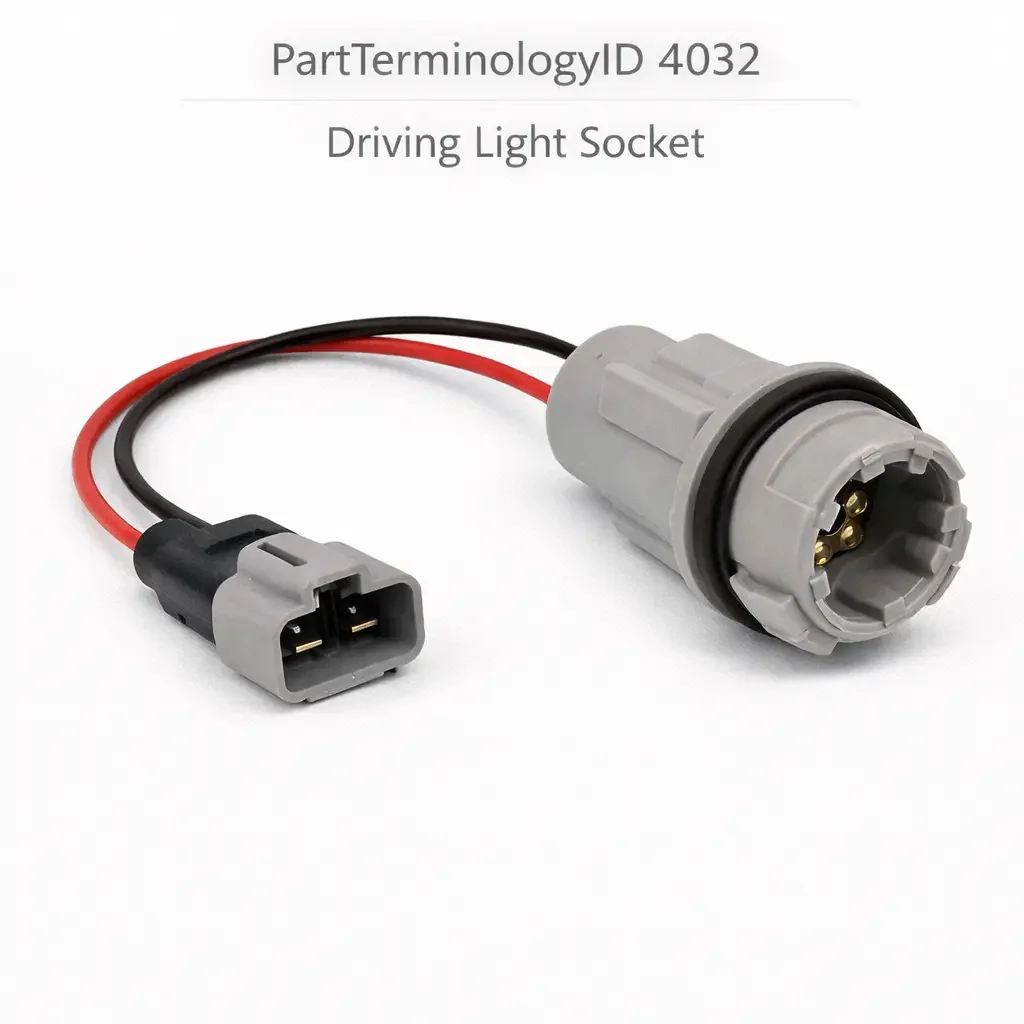
PartTerminologyID 4032, Driving Light Socket, is the bulb socket that holds the driving light bulb in the auxiliary forward lighting assembly, receiving switched power from the driving light circuit when the driver activates the driving lights through the headlamp high-beam circuit, a dedicated driving light switch, or a BCM-commanded output that enables the driving light circuit under defined conditions. That definition covers the driving light socket function correctly and leaves unresolved whether the driving light circuit is activated exclusively through the high-beam circuit so that driving lights illuminate only when high beams are on, through a dedicated toggle or push switch that allows driving lights to operate independently of the headlamp position, or through a BCM output that gates driving light activation on both the high-beam state and a minimum vehicle speed threshold, the bulb base type and wattage the socket accepts, whether the socket is mounted in a dedicated auxiliary driving light housing that is separate from the headlamp assembly or is integrated into a front bumper or grille-mounted driving light bar assembly, whether the driving light relay is a separate component in the circuit between the headlamp switch and the socket or is integrated into the BCM output architecture, and whether the socket is a discrete replaceable component or is integrated into a sealed driving light housing that requires full assembly replacement.
For sellers, PartTerminologyID 4032 is the driving light socket where the headlamp interlock condition is the most return-generating attribute, because the driving light circuit on the majority of vehicle applications activates only when the headlamp high-beam circuit is active. A buyer who tests the driving light with the headlamps off or with the low-beam headlamps on will find no driving light activation on a correctly functioning socket that is waiting for the high-beam interlock condition to be satisfied. A buyer whose high-beam headlamps have a fault that prevents high-beam activation will find no driving light activation on any driving light circuit that uses the high-beam interlock, regardless of driving light socket condition. Both scenarios produce a no-activation symptom at the driving light socket that is indistinguishable from a failed socket without interlock condition validation.
What the Driving Light Socket Does
High-beam interlock versus dedicated switch activation
High-beam interlock driving light circuits connect the driving light relay coil or BCM activation input to the high-beam circuit so that driving light activation is contingent on the high-beam headlamps being active. When the driver flashes to high beam, the driving lights activate simultaneously. When the driver returns to low beam, the driving lights extinguish. This architecture prevents driving lights from being used as a substitute for proper headlamp illumination at low beam and complies with regulations in markets that prohibit driving lights at low beam.
A buyer who activates the driving lights from the cab switch with the headlamps in low beam will find no driving light activation on a high-beam interlock application. The driving light relay receives no coil activation voltage because the high-beam circuit output that feeds the relay coil is inactive at low beam. The socket correctly receives no supply voltage. This is the single most common misdiagnosis scenario under this PartTerminologyID and a single sentence in the listing identifying the high-beam interlock condition prevents it.
Dedicated switch activation applications allow the driver to activate driving lights through a separate switch regardless of headlamp position, subject to any BCM speed or ambient light conditions that may gate activation on some platforms. On these applications the driving light circuit is independent of the high-beam circuit and a failed driving light switch rather than a headlamp fault is the relevant upstream component to validate before the socket is diagnosed.
Driving light relay and the coil activation path
Most driving light circuits include a dedicated relay that handles the high current required by high-wattage driving light bulbs. The relay coil is activated by the high-beam circuit output or a dedicated switch output and the relay contact switches the main driving light supply current to the socket. A failed driving light relay produces no socket supply voltage with the activation condition satisfied, which appears identical to a failed socket contact at the supply terminal. Confirming relay coil activation voltage and relay contact output voltage at the relay socket before diagnosing the driving light bulb socket separates a relay fault from a socket fault and prevents replacing the wrong component.
On BCM-commanded applications the BCM monitors the headlamp state and commands the driving light relay through a BCM output driver. A BCM output driver fault for the driving light relay coil produces no relay activation despite a confirmed high-beam state, which produces no socket supply voltage at the driving light socket. This scenario is indistinguishable from a failed relay or a failed socket at the socket terminal and requires relay socket coil voltage validation before the socket is ordered.
Why This Part Generates Returns
Buyers return driving light sockets because the high-beam interlock condition is not satisfied and the socket correctly receives no supply voltage during low-beam or headlamps-off testing, the driving light bulb has a failed filament and the socket is undamaged so the correct repair is a bulb replacement rather than a socket replacement, the driving light relay has failed and the socket receives no supply voltage despite a confirmed high-beam state and a functional socket, a BCM output driver fault prevents driving light relay activation with a functional socket, and the driving light housing retaining feature is broken causing the socket to seat intermittently producing variable driving light operation that the buyer attributes to a failing socket contact.
Status in New Databases
PartTerminologyID 4032 is cataloged in PIES/PCdb as Driving Light Socket. Under PIES 8.0 and PCdb 2.0 there is no change to the terminology or classification for this PartTerminologyID.
Top Return Scenarios
Scenario 1: "High-beam interlock not satisfied, buyer tests at low beam, no activation misdiagnosed as socket fault"
The buyer's driving lights do not activate. The buyer tests with the headlamps in low beam. The driving light circuit requires high-beam activation before the relay coil energizes. No supply voltage is present at the driving light socket in low beam. The buyer replaces the socket. Testing continues in low beam. No change in driving light behavior.
Prevention language: "High-beam interlock condition: On this application the driving lights activate only when the headlamp high-beam circuit is active. Driving lights will not activate with the headlamps off or in low beam regardless of socket condition. Confirm the headlamps are in the high-beam position before testing for driving light activation. A socket that receives no supply voltage because the high-beam interlock is not satisfied is functioning correctly."
Scenario 2: "Failed driving light bulb, functional socket, socket returned after bulb replacement resolves dark light"
The driving light does not illuminate with the high beams active. The socket is undamaged. The high-wattage halogen bulb has a failed filament. The buyer replaces the socket assembly. The driving light illuminates. The buyer returns the original socket as defective when the bulb was the failed component throughout.
Prevention language: "Bulb pre-check: Remove the driving light socket from the housing and inspect the bulb filament before replacing the socket. A failed halogen filament is visible as a broken wire or collapsed support inside the glass envelope. Apply direct 12-volt power to the socket terminals and confirm the bulb illuminates. Replace the bulb before ordering a socket replacement."
Scenario 3: "Failed driving light relay, no supply voltage at socket, relay replaced instead of socket"
The driving lights do not activate with the high beams on. The driving light relay has failed open. No supply voltage is present at the driving light socket supply terminal despite a confirmed high-beam state. The buyer probes the socket terminal, finds no voltage, and concludes the socket is not receiving supply. The relay is the actual fault but the buyer orders a socket. The relay fault remains after socket installation.
Prevention language: "Relay validation: Before replacing the driving light socket, confirm the driving light relay is closing and delivering supply voltage to the socket terminal with the high beams active. Probe the relay output terminal with the high beams on. No supply voltage at the relay output with confirmed relay coil activation indicates a failed relay contact. No supply voltage at the relay coil terminal with the high beams on indicates a coil activation path fault. Both conditions are relay or activation path faults rather than socket faults."
Scenario 4: "Aftermarket driving light installed, socket wiring not connected to high-beam interlock, no activation from high beam"
The buyer has installed aftermarket driving lights and wired the supply directly from the battery through a relay without connecting the relay coil to the high-beam circuit. The relay coil has no activation signal. The driving lights do not activate from the high-beam switch. The buyer replaces the driving light socket. No change. The wiring omission is the fault.
Prevention language: "Activation wiring validation: On aftermarket driving light installations confirm the relay coil activation wire is connected to the high-beam circuit output or the intended activation switch. A relay coil with no activation signal produces no driving light operation regardless of socket condition. Verify the complete activation wiring path before diagnosing the socket."
Listing Requirements
PartTerminologyID: 4032
Activation architecture: high-beam interlock, dedicated switch, or BCM-commanded (mandatory)
Driving light relay note: separate relay or integrated BCM output (mandatory)
Bulb base type and wattage specification (mandatory)
Housing type: dedicated auxiliary housing or integrated bumper assembly (mandatory)
Socket architecture: discrete replaceable or sealed housing (mandatory)
High-beam interlock test condition note (mandatory)
Relay validation note (mandatory)
Bulb pre-check note (mandatory)
OEM part number cross-reference (mandatory)
Catalog Checklist for ACES/PIES Teams
PartTerminologyID = 4032
Require activation architecture: high-beam interlock, dedicated switch, or BCM (mandatory)
Require relay note: separate relay or BCM output (mandatory)
Require bulb base type and specification (mandatory)
Require high-beam interlock test condition note (mandatory)
Require relay validation note (mandatory)
Require bulb pre-check note (mandatory)
Prevent interlock misdiagnosis: socket correctly non-activated at low beam or headlamps off on high-beam interlock applications; test condition must be identified so buyers validate under high-beam conditions before diagnosing the socket
Prevent relay fault socket return: a failed relay produces no supply voltage at the socket terminal identically to a failed socket contact; relay output voltage validation must precede socket diagnosis
Prevent bulb-only repair socket return: a failed bulb in a functional socket is resolved by bulb replacement; bulb inspection must precede socket replacement
FAQ (Buyer Language)
Why do my driving lights not activate when I turn on my headlights?
On high-beam interlock applications driving lights activate only when the headlamps are in the high-beam position, not at low beam. Switch to high beam and confirm driving light activation before diagnosing a socket fault. If the driving lights do not activate in high beam, confirm supply voltage is present at the driving light socket terminal before concluding the socket has failed.
How do I confirm supply voltage is reaching the driving light socket?
With the headlamps in the high-beam position, probe the supply terminal of the driving light socket connector with a test light or multimeter. Supply voltage at the terminal with no driving light illumination indicates a failed bulb filament or failed socket contact. No supply voltage at the terminal with high beams active indicates a relay fault, BCM driver fault, or open circuit in the supply wiring.
How do I check the driving light bulb before replacing the socket?
Remove the driving light housing access cover and pull the socket from the housing. Inspect the bulb filament visually. On halogen driving light bulbs a collapsed tungsten filament or broken support wire confirms a failed bulb. Apply 12-volt power to the socket terminals directly and confirm the bulb illuminates before concluding the socket contact has failed.
Can a failed driving light relay cause the socket to have no power?
Yes. The driving light relay switches the main supply current to the socket and a failed relay contact produces no supply voltage at the socket terminal identically to a failed socket contact. Probe the relay output terminal with the activation condition satisfied before replacing the socket. A relay that has no output voltage with confirmed coil activation is the failed component rather than the socket.
My driving lights worked before but stopped after I replaced the headlamp bulbs. What happened?
A headlamp bulb replacement that results in lost driving light function on a high-beam interlock application may indicate the new headlamp bulb has an open high-beam filament or the headlamp connector was not fully reseated during replacement. Confirm the high-beam headlamps are operating correctly before diagnosing the driving light circuit.
What Sellers Get Wrong About PartTerminologyID 4032
The most common error is omitting the high-beam interlock condition from the listing. The driving light socket is correctly non-activated at low beam and headlamps-off positions on the majority of driving light applications. A buyer who tests without activating high beam concludes the socket has failed and orders a replacement that behaves identically under the same test condition. The listing that identifies the high-beam interlock and specifies that testing must be performed with high beams active prevents this return and redirects the buyer to confirm the correct activation condition before any diagnosis begins.
The second error is omitting the relay validation note. A failed driving light relay produces no supply voltage at the socket terminal identically to a failed socket contact. Without the relay validation note buyers replace the socket when the relay is the failed component. The relay output voltage check is a one-step validation that conclusively separates a relay fault from a socket fault before any part is ordered.
The third error is omitting the bulb pre-check note. High-wattage halogen driving light bulbs are high-wear components that fail more frequently than the socket. A socket replacement on a failed bulb generates a return when the replacement socket also fails to illuminate from the same failed bulb installed in it.
Cross-Sell Logic
Driving Light Bulb: for buyers where the socket is confirmed functional, supply voltage is confirmed at the socket terminal with the activation condition satisfied, but the driving light does not illuminate, indicating a failed bulb filament is the correct repair.
Driving Light Relay: for buyers where supply voltage is absent at the driving light socket terminal with the high-beam interlock satisfied and relay coil activation confirmed, indicating a failed relay contact rather than a socket fault.
BCM: for buyers where relay coil activation voltage is absent at the driving light relay socket despite confirmed high-beam headlamp operation, indicating a BCM output driver fault for the driving light relay coil circuit.
Headlamp Switch or High-Beam Circuit: for buyers where the high-beam headlamps are also non-functional and the driving light activation fault traces to the absence of a high-beam circuit output rather than a driving light circuit fault.
Driving Light Assembly: for buyers on sealed housing applications where no discrete replaceable socket exists and a driving light fault requires complete housing replacement.
Why Catalog Data Quality Matters for PartTerminologyID 4032
Driving light socket returns cluster around three scenarios that are fully preventable with listing language: the high-beam interlock misdiagnosis, the relay fault socket return, and the bulb-only repair misdirection. The interlock misdiagnosis generates the largest share of returns because buyers test under incorrect conditions and conclude the socket has failed when the circuit is correctly non-activated. The relay fault socket return generates returns because the relay and socket faults produce identical symptoms at the socket terminal and buyers replace the wrong component without validating the relay output. The bulb misdirection generates returns because buyers replace a functional socket when a high-wattage bulb replacement was the correct and lower-cost repair.
The high-beam interlock note and the relay validation note together address the two scenarios that account for the largest share of returns. Both require one to two sentences in the listing and both are absent in most aftermarket listings for this PartTerminologyID.
Application Range and Fitment Guidance for PartTerminologyID 4032
Driving light socket applications are concentrated in vehicles and aftermarket installations from the late 1970s through the present where auxiliary forward lighting was added to improve visibility beyond the range of standard headlamps. Factory-installed driving lights are most common on domestic trucks, SUVs, and performance-oriented passenger cars from the 1980s through the 2000s. Aftermarket driving light installations represent a significant share of the application population and introduce wiring architecture variations that differ from factory installations.
Halogen bulb base types dominate the driving light socket application range. H3 single-ended halogen bulbs are the most common factory driving light bulb type across domestic and European applications. H1 and 9005 base types appear on specific factory and aftermarket driving light assemblies. Sealed beam driving light assemblies use an integrated bulb and reflector unit where the socket is part of the sealed beam rather than a discrete replaceable socket, and these applications fall outside the scope of PartTerminologyID 4032.
Current-generation auxiliary lighting increasingly uses LED light bars and LED driving light assemblies with integrated LED arrays and no discrete replaceable socket. These applications do not use a socket under PartTerminologyID 4032. Fitment claims for aftermarket LED driving light assemblies should not be assigned under this PartTerminologyID.
Final Take for PartTerminologyID 4032
Driving Light Socket (PartTerminologyID 4032) is the auxiliary forward illumination component where high-beam interlock disclosure, relay validation, and bulb pre-check are the three attributes that prevent the three most common return scenarios. Every listing without interlock disclosure sends buyers through a socket replacement that changes nothing because the activation condition was never satisfied during testing. Every listing without relay validation sends buyers replacing the socket when the relay was the failed component. Every listing without bulb pre-check generates returns from buyers who replaced a functional socket when a bulb replacement was the correct repair.
Together these three attributes make every listing under this PartTerminologyID complete.