
Written by Arthur Simitian | PartsAdvisory
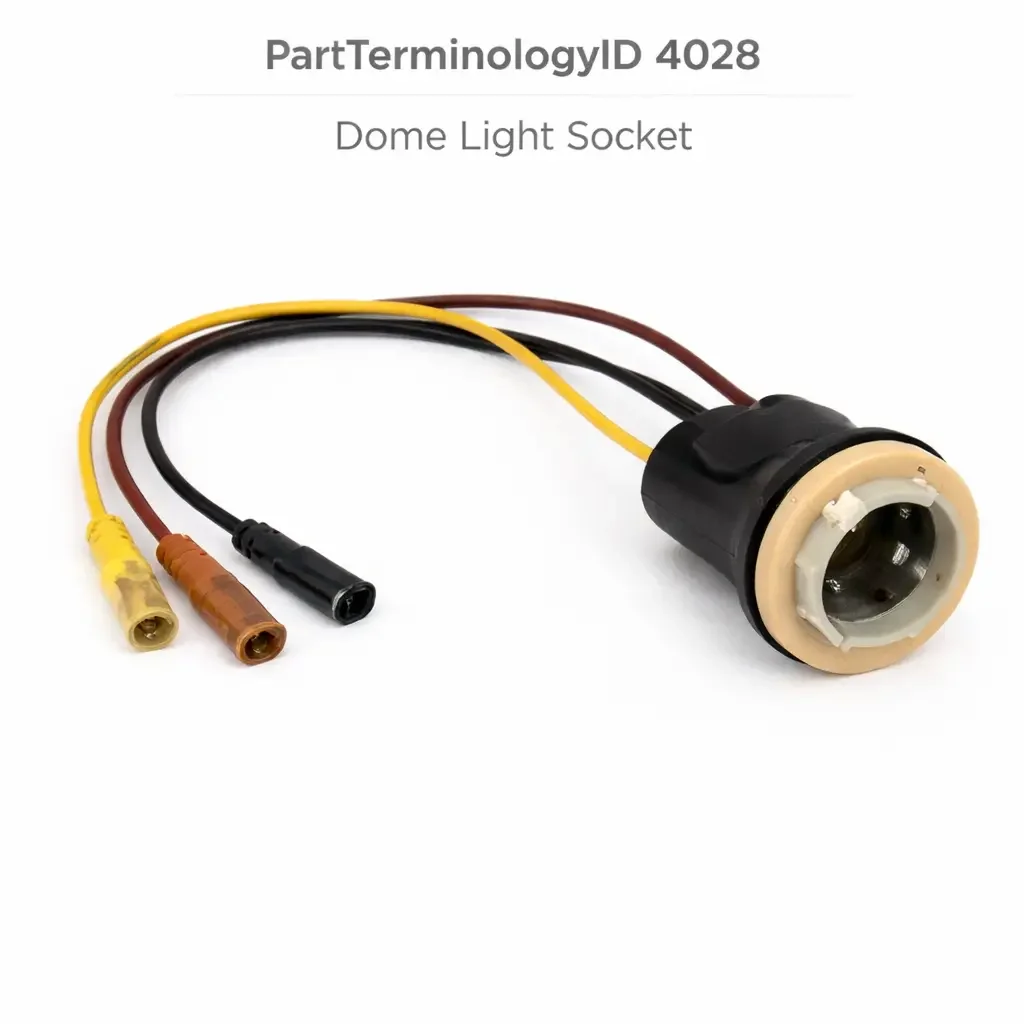
PartTerminologyID 4028, Dome Light Socket, is the bulb socket that holds the interior dome light bulb in the overhead lamp housing, receiving switched power from the dome light circuit to illuminate the passenger compartment when a door is opened, when the interior light switch is set to the on position, or when the BCM activates the courtesy light circuit in response to a key fob unlock command. That definition covers the dome light socket function correctly and leaves unresolved whether the socket receives power from a direct door jamb switch circuit, a BCM-commanded courtesy light output, or both through a combined switching architecture that allows multiple activation paths, whether the dome light circuit includes a time-delay feature that keeps the socket energized for a defined period after the last door closes, whether the socket accepts a festoon bulb, a wedge-base bulb, or a bayonet-base bulb, whether the dome light assembly contains a single socket or multiple sockets serving separate illumination zones within the same housing, and whether the socket is a discrete replaceable component in the overhead housing or is integrated into a map light and dome light assembly that requires full assembly access to address a socket fault.
For sellers, PartTerminologyID 4028 is the dome light socket where door jamb switch circuit validation is the most return-generating attribute, because the dome light socket receives power only when at least one door jamb switch is closed or when the BCM commands the courtesy light output active. A dome light that does not illuminate when a door is opened may have a failed door jamb switch that is not signaling the dome light circuit rather than a failed socket. A dome light that does not illuminate from the manual switch position but illuminates when a door is opened has a manual switch fault rather than a socket fault. A dome light that illuminates from door opening but does not stay on for the expected delay period after the door closes has a BCM time-delay logic condition rather than a socket fault. All three produce dome light behavior that buyers attribute to the socket before the activation circuit is validated.
What the Dome Light Socket Does
Direct door jamb switch activation versus BCM-commanded courtesy light output
On older vehicles the dome light circuit is a simple series circuit: battery voltage feeds through a fuse to the dome light socket supply terminal, and each door jamb switch provides a ground path that completes the circuit when the door opens. The manual on-off switch on the dome light housing connects the socket supply to a permanent ground for continuous illumination regardless of door position. No module processes the door switch inputs before the dome light activates. A failed door jamb switch on these applications removes one ground path but other doors can still activate the dome light through their individual jamb switches.
On BCM-commanded applications the door jamb switch inputs are read by the BCM, which then activates the dome light through a BCM output driver rather than through a direct switch-to-socket circuit. The BCM applies time-delay logic that keeps the dome light active for a defined period after the last door closes. On these applications a failed door jamb switch produces no dome light activation from that specific door, but the BCM output driver and the socket are both functional. A BCM output driver fault produces no dome light activation from any door regardless of jamb switch condition. A buyer who finds the dome light non-functional on a BCM-commanded application must confirm the BCM output is reaching the socket before diagnosing the socket itself.
Time-delay illumination and the fade-out feature
BCM-managed dome light circuits on most current vehicles include a time-delay that keeps the dome light active for 15 to 30 seconds after the last door closes, then either switches off immediately or gradually dims to off over several seconds on vehicles with a fade-out feature. A dome light that extinguishes immediately when the door closes rather than remaining on for the delay period has a BCM time-delay logic condition or a door jamb switch that is not holding the circuit active long enough for the BCM to register the unlock-to-close sequence. This condition does not reflect a socket fault and socket replacement will not restore the time-delay behavior.
A dome light that remains on continuously and does not extinguish after the delay period has a door jamb switch that is stuck in the open-door position, signaling the BCM that a door remains open. The BCM continues to command the dome light active because it believes a door is still open. A buyer who finds the dome light continuously on and orders a replacement socket will install it and find the dome light remains continuously on because the stuck jamb switch is still signaling the BCM.
Why This Part Generates Returns
Buyers return dome light sockets because a door jamb switch has failed and is not completing the activation circuit despite the door being open, the dome light bulb has a failed filament and the socket is undamaged so the correct repair is a bulb replacement, the manual interior light switch on the dome housing has an internal fault that prevents activation from the switch position while door-activated operation remains functional, the BCM output driver for the courtesy light circuit has failed and the socket correctly receives no supply voltage, and the dome light housing retaining clip or socket twist-lock has broken causing intermittent contact that the buyer attributes to a failed socket.
Status in New Databases
PartTerminologyID 4028 is cataloged in PIES/PCdb as Dome Light Socket. Under PIES 8.0 and PCdb 2.0 there is no change to the terminology or classification for this PartTerminologyID.
Top Return Scenarios
Scenario 1: "Failed door jamb switch, dome light does not activate from that door, socket replaced with no change"
The dome light does not activate when the driver door is opened. The driver door jamb switch has failed open and is not completing the activation circuit. The dome light activates correctly when the passenger door is opened. The buyer replaces the dome light socket. The jamb switch fault remains. The dome light still does not activate from the driver door.
Prevention language: "Door jamb switch validation: The dome light socket activates when a door jamb switch completes the activation circuit. A failed door jamb switch prevents dome light activation from that specific door while other doors continue to activate the light correctly. Confirm the dome light activates from at least one door before diagnosing a socket fault. If the dome light does not activate from any door, confirm supply voltage is present at the socket terminal with a door open before replacing the socket."
Scenario 2: "Failed dome light bulb, functional socket, socket returned after bulb replacement resolves dark light"
The dome light does not illuminate when any door is opened. The socket is undamaged. The festoon bulb filament has failed. The buyer replaces the socket assembly. The dome light illuminates. The buyer returns the original socket as defective when the bulb was the failed component.
Prevention language: "Bulb pre-check: Remove the dome light socket from the housing and inspect the bulb filament before replacing the socket. A failed filament on a festoon bulb is visible as a broken wire inside the glass tube. Replace the bulb first. If the bulb is intact and the dome light does not illuminate with confirmed supply voltage at the socket terminal, the socket contact is the next diagnostic step."
Scenario 3: "Dome light on continuously, stuck door jamb switch, socket replaced with no change"
The dome light remains on continuously and does not extinguish after all doors are closed. A door jamb switch is stuck in the compressed position, continuously signaling the BCM that the door is open. The BCM keeps the dome light circuit active. The buyer replaces the dome light socket. The stuck jamb switch remains. The dome light continues illuminating continuously.
Prevention language: "Continuous illumination diagnosis: A dome light that remains on after all doors are closed has a door jamb switch stuck in the open-door signal position rather than a socket fault. The BCM continues commanding the dome light active because it reads an open-door condition. Identify and replace the stuck jamb switch before diagnosing the socket on a continuous-illumination complaint."
Scenario 4: "BCM output driver fault, no supply voltage at socket, all activation paths produce no dome light"
The dome light does not activate from any door or from the manual switch position. The BCM output driver for the courtesy light circuit has failed open. No supply voltage is present at the dome light socket terminal regardless of door position or manual switch setting. The buyer replaces the socket. The BCM driver fault remains. No change in dome light behavior.
Prevention language: "BCM output validation: On BCM-commanded applications confirm supply voltage is present at the dome light socket terminal with a door open before replacing the socket. No supply voltage from any door or manual switch position simultaneously indicates a BCM output driver fault rather than a socket fault. A socket that receives no supply voltage is functioning correctly."
Listing Requirements
PartTerminologyID: 4028
Activation architecture: direct door jamb switch or BCM-commanded courtesy light (mandatory)
Time-delay and fade-out feature note where applicable (mandatory)
Bulb base type: festoon, wedge, or bayonet (mandatory)
Bulb voltage and wattage specification (mandatory)
Socket count in housing: single or multi-socket assembly (mandatory)
Door jamb switch validation note (mandatory)
Bulb pre-check note (mandatory)
Continuous illumination diagnosis note (mandatory)
BCM output validation note on module-commanded applications (mandatory)
OEM part number cross-reference (mandatory)
Catalog Checklist for ACES/PIES Teams
PartTerminologyID = 4028
Require activation architecture: direct switch or BCM-commanded (mandatory)
Require time-delay disclosure where applicable (mandatory)
Require bulb base type and specification (mandatory)
Require door jamb switch validation note (mandatory)
Require bulb pre-check note (mandatory)
Prevent door jamb switch misdiagnosis: a failed jamb switch prevents activation from that door while the socket remains functional; jamb switch circuit validation must precede socket diagnosis
Prevent continuous illumination socket return: a stuck jamb switch producing continuous dome light is not a socket fault; jamb switch inspection must precede socket replacement on continuous-on complaints
Prevent BCM driver fault socket return: no supply voltage from all activation paths simultaneously indicates a BCM driver fault; BCM output validation must precede socket replacement
FAQ (Buyer Language)
Why does my dome light not turn on when I open a specific door?
The dome light activation from each door depends on that door's jamb switch completing the circuit. A failed jamb switch on one door prevents activation from that door while all other doors continue to work. Confirm the dome light activates from at least one other door before diagnosing a socket fault. If the dome light activates from other doors, the fault is the jamb switch on the non-activating door rather than the socket.
How do I check the dome light bulb before replacing the socket?
Remove the dome light lens and access the socket. On festoon bulb applications remove the bulb from the spring clips and inspect the filament for a broken wire. Apply direct 12-volt power to the bulb ends and confirm it illuminates. A bulb that does not light when powered directly has a failed filament. Replace the bulb before ordering a socket.
My dome light stays on all the time and will not turn off. Is it the socket?
A dome light that stays on continuously after all doors are closed has a stuck door jamb switch signaling an open door to the BCM. The socket is functioning correctly and is being kept active by the BCM in response to the stuck switch signal. Identify which door's jamb switch is stuck by opening and closing each door individually while watching for the dome light to respond. Replace the stuck jamb switch.
My dome light works when I open a door but will not turn on from the manual switch. What is wrong?
A dome light that activates from door opening but not from the manual switch has a fault in the manual switch mechanism within the dome light housing rather than a socket fault. The socket is confirmed functional because it activates correctly from door opening. Inspect or replace the manual switch component in the dome housing.
Can a BCM fault cause the dome light to stop working from all activation paths?
Yes. On BCM-commanded courtesy light applications the BCM output driver for the dome light circuit activates the socket regardless of which door is opened or whether the manual switch is engaged. A BCM output driver fault produces no dome light activation from any input simultaneously. Confirm supply voltage at the socket terminal with a door open before ordering a socket on an all-paths-failed complaint.
What Sellers Get Wrong About PartTerminologyID 4028
The most common error is omitting the door jamb switch validation note. The dome light socket activates only when the door jamb switch circuit is complete or the BCM commands the courtesy light output. A buyer who finds the dome light non-functional from one door has a jamb switch fault in most cases rather than a socket fault. Without the jamb switch validation note buyers replace the socket and find the dome light still does not activate from the affected door because the jamb switch remains failed. The listing that directs buyers to confirm activation from multiple doors and to validate supply voltage at the socket before ordering a replacement prevents this return.
The second error is omitting the bulb pre-check note. Dome light bulbs, particularly festoon types, are among the most commonly failed interior lighting components and the socket is intact in the majority of cases. Without the pre-check note buyers replace the socket rather than the bulb and return the socket when the dome light remains dark from the same failed bulb in the replacement socket.
The third error is omitting the continuous illumination diagnosis note. A dome light stuck on is a stuck jamb switch fault, not a socket fault. Without the diagnosis note buyers replace the socket expecting the continuous illumination to stop, find no change, and return the socket.
Cross-Sell Logic
Dome Light Bulb: for buyers where the socket is confirmed functional and supply voltage is present at the terminal with a door open, but the dome light does not illuminate, indicating a failed bulb filament is the correct repair.
Door Jamb Switch: for buyers where the dome light does not activate from a specific door while activating correctly from all other doors, indicating a failed jamb switch at the non-activating door rather than a socket fault, and for buyers with continuous dome light illumination from a jamb switch stuck in the open-door signal position.
BCM: for buyers where supply voltage is absent at the dome light socket terminal from all activation paths simultaneously with confirmed valid door jamb switch inputs, indicating a BCM output driver fault for the courtesy light circuit.
Dome Light Assembly: for buyers where the dome light housing retaining clip or socket position is broken and cannot hold the socket in correct contact, requiring housing replacement rather than socket replacement alone.
Why Catalog Data Quality Matters for PartTerminologyID 4028
Dome light socket returns cluster around three scenarios that are fully preventable with listing language: the door jamb switch misdiagnosis, the bulb-only repair misdirection, and the continuous illumination misdiagnosis. The jamb switch misdiagnosis generates returns because the buyer replaced a functional socket while the jamb switch circuit fault remained. The bulb misdirection generates returns because the buyer replaced a functional socket when a bulb was the failed component. The continuous illumination misdiagnosis generates returns because the buyer expected socket replacement to stop a dome light that was being actively commanded on by a stuck jamb switch signal.
The door jamb switch validation note and the bulb pre-check note together address the two scenarios that account for the largest share of returns. Adding the continuous illumination note completes the three attributes that make every listing under this PartTerminologyID sufficient to prevent the most common return scenarios.
Application Range and Fitment Guidance for PartTerminologyID 4028
Dome light socket applications span vehicles from the early 1950s when interior courtesy lighting became standard equipment through the present. Direct door switch circuits with no BCM intermediary are the dominant architecture on vehicles produced before approximately 1995. BCM-commanded courtesy light outputs with time-delay and fade-out features became standard on most platforms from the mid-1990s onward.
Festoon bulb base types are the most common dome light bulb format across the application range. Wedge and bayonet base dome light applications are less common and concentrated on specific European and Japanese vehicle platforms. Confirming the bulb base type before ordering is mandatory because a socket ordered with the wrong base type has no installation path for the correct bulb.
Multi-socket dome light assemblies on larger vehicles including minivans, SUVs, and full-size trucks contain separate front dome, rear dome, and cargo light socket positions within a single or related housing assembly. Fitment claims must specify which socket position within the assembly the part covers to prevent a rear dome socket being ordered for a front dome position or vice versa on the same vehicle.
Final Take for PartTerminologyID 4028
Dome Light Socket (PartTerminologyID 4028) is the interior courtesy illumination component where door jamb switch validation, bulb pre-check, and continuous illumination diagnosis are the three attributes that prevent the three most common return scenarios. Every listing without jamb switch validation sends buyers through a socket replacement that changes nothing because the jamb switch circuit fault remains. Every listing without bulb pre-check generates returns from buyers who replaced a functional socket when a bulb was the correct repair. Every listing without the continuous illumination note generates returns from buyers who expected a socket replacement to stop a dome light being commanded active by a stuck jamb switch.
Together these three attributes make every listing under this PartTerminologyID complete.