
Written by Arthur Simitian | PartsAdvisory
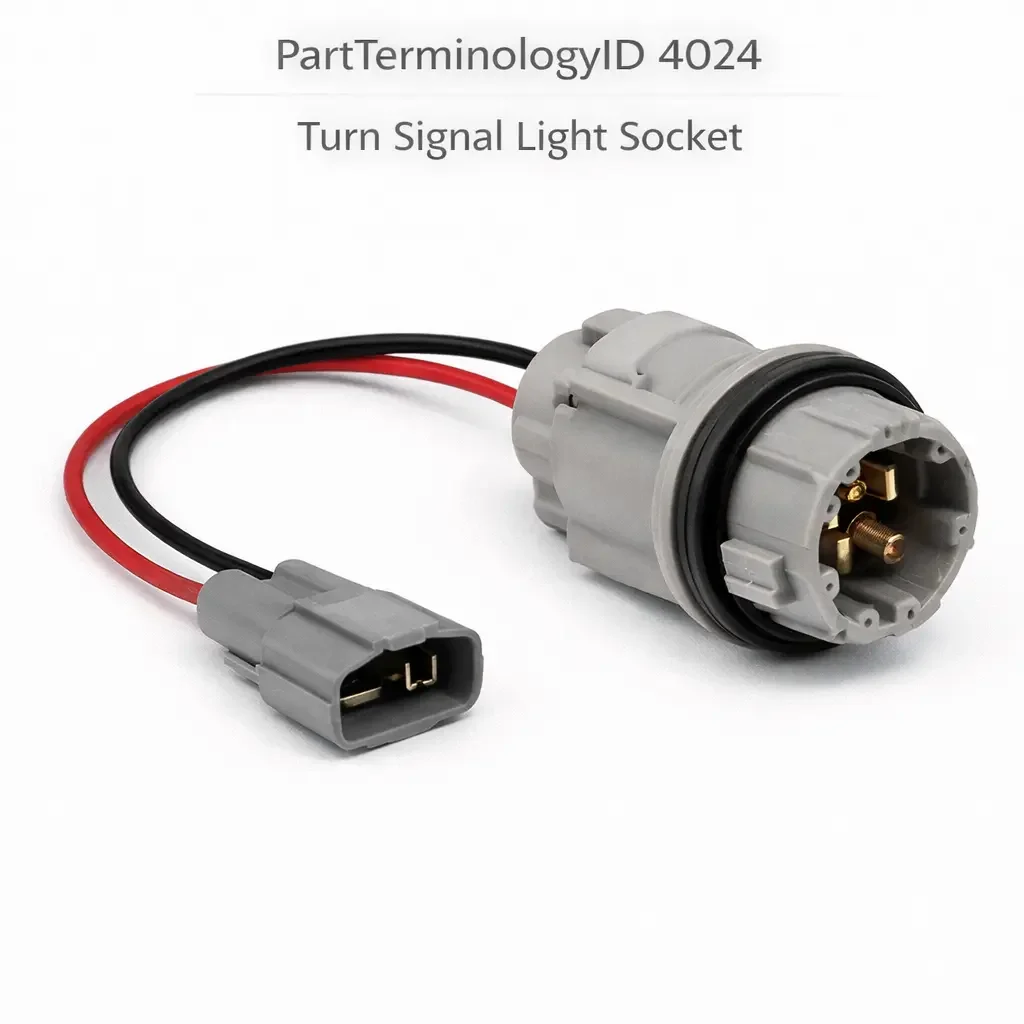
PartTerminologyID 4024, Turn Signal Light Socket, is the bulb socket that holds the turn signal bulb in the front or rear lamp assembly, receiving pulsed power from the turn signal flasher circuit when the driver engages the turn signal stalk to indicate a directional change. That definition covers the turn signal socket function correctly and leaves unresolved whether the socket holds a single-filament dedicated turn signal bulb or a dual-filament bulb that combines the turn signal and parking light functions, the bulb base type and wattage the socket accepts, whether the flasher circuit uses an electromechanical thermal flasher, a load-sensing electronic flasher, or a BCM-integrated flash output, whether a failed or missing bulb in this socket produces a hyper-flash condition that the buyer attributes to the socket rather than the missing bulb load, and whether the socket is a discrete replaceable component or integrated into a sealed lamp assembly.
For sellers, PartTerminologyID 4024 is the turn signal socket where hyper-flash misdiagnosis is the most return-generating attribute. The turn signal circuit on most vehicles uses a load-sensing flash rate that accelerates when bulb current drops below the expected value. A buyer who installs an LED turn signal bulb observes hyper-flash from the reduced LED current and replaces the socket rather than addressing the load incompatibility. A buyer with a failed bulb at one position observes hyper-flash at all remaining operating positions and replaces the socket at a flashing position rather than finding the dark position. Both scenarios generate socket returns from buyers who never needed a socket.
What the Turn Signal Light Socket Does
Thermal flasher versus load-sensing electronic flasher versus BCM flash output
Electromechanical thermal flashers heat a bimetallic strip with circuit current until the strip opens and then cools and closes the circuit to produce the flash. The flash rate depends on current: a failed bulb reduces current and slows the flash rate on thermal flasher applications. Buyers on thermal flasher vehicles observe a slow-flash bulb-out indication rather than hyper-flash when a bulb fails.
Load-sensing electronic flashers use a fixed oscillator for the flash frequency but monitor circuit current against a minimum threshold. Current below the threshold accelerates the flash rate as a bulb-out warning. An LED bulb drawing 0.3 amperes where an incandescent drew 2 amperes falls below the threshold and triggers hyper-flash regardless of whether any bulb has failed. BCM-integrated flash outputs on current-generation vehicles behave identically: the BCM monitors output current and produces hyper-flash and a dashboard indicator change when current drops below the incandescent calibration threshold.
The flasher type is a mandatory listing attribute because it determines whether a bulb failure produces slow-flash or hyper-flash, which in turn determines the correct diagnostic path for the buyer.
Single-filament versus dual-filament socket and the fault pattern difference
Single-filament dedicated turn signal sockets produce a dark turn signal and a hyper-flash or slow-flash indication when the bulb fails. Dual-filament combined parking and turn signal sockets have three terminals: one for pulsed turn signal supply, one for steady parking light supply, and one for shared ground. A failed turn signal terminal contact in a dual-filament socket produces a dark turn signal with a functioning parking light from the same position. A failed parking light terminal contact produces a functioning turn signal with a dark parking light. A failed ground terminal produces simultaneous loss of both functions.
The dual-filament fault pattern where one function is dark and the other operates correctly is a reliable indicator of a single terminal contact failure in the socket. A supply circuit fault affecting the turn signal supply produces the same dark turn signal but leaves the parking light unaffected only if the parking supply is on a separate circuit path. Identifying this fault pattern in the listing gives buyers the diagnostic shortcut that confirms a socket contact fault before any further diagnosis is needed.
Why This Part Generates Returns
Buyers return turn signal light sockets because an LED turn signal bulb draws insufficient current for the load-sensing flasher threshold and produces hyper-flash that the buyer attributes to the socket, a turn signal bulb has a failed filament and the socket is undamaged so the correct repair is a bulb replacement, the flasher unit has failed and produces no pulsed output so the turn signal does not activate regardless of socket condition, the buyer observes hyper-flash at a functioning socket position rather than identifying the dark bulb position as the fault source, and the socket is integrated into a sealed lamp assembly with no discrete replaceable socket.
Status in New Databases
PartTerminologyID 4024 is cataloged in PIES/PCdb as Turn Signal Light Socket. Under PIES 8.0 and PCdb 2.0 there is no change to the terminology or classification for this PartTerminologyID.
Top Return Scenarios
Scenario 1: "LED turn signal bulb installed, hyper-flash produced, socket replaced with no change"
The buyer installed LED turn signal bulbs and now has hyper-flash on the modified circuit. The load-sensing flasher interprets the reduced LED current as a bulb-out condition and accelerates the flash rate. The buyer replaces the socket. The LED bulb remains in the replacement socket. The hyper-flash continues because the load-sensing threshold condition is unchanged.
Prevention language: "LED hyper-flash note: LED turn signal bulbs draw significantly less current than the incandescent bulbs the flasher or BCM is calibrated for. This reduced current triggers the hyper-flash bulb-out indication regardless of socket condition. Socket replacement does not resolve LED-induced hyper-flash. Install a load resistor in parallel with each LED turn signal bulb to simulate incandescent current draw, or replace the flasher with an LED-compatible unit that does not use load-sensing flash rate control."
Scenario 2: "Failed bulb at one position, hyper-flash at all operating positions, buyer replaces socket at flashing position"
The buyer observes hyper-flash on the left turn signal circuit. The left rear turn signal bulb has a failed filament. The left front socket and bulb are functioning correctly but are flashing rapidly. The buyer replaces the left front socket. The failed rear bulb remains. The hyper-flash continues because circuit current is still reduced by the missing rear bulb load.
Prevention language: "Hyper-flash bulb-out diagnosis: Hyper-flash on a turn signal circuit indicates a failed bulb somewhere in the circuit. Inspect all turn signal positions on the affected side including front, rear, and any side repeater positions for a dark bulb before replacing any socket. The rapid flash rate appears at all operating positions simultaneously and does not identify which position has the failed bulb."
Scenario 3: "Failed flasher unit, no pulsed output, turn signal does not activate on either side"
The turn signal does not activate on either side. The flasher has failed and produces no pulsed output. No supply voltage is present at any turn signal socket on either side. The buyer replaces the left front socket. No change on either side.
Prevention language: "Flasher validation: A failed flasher produces no turn signal activation on either side simultaneously. A socket fault affects only one position or one side. If the turn signal does not activate on both sides, check the flasher before replacing any socket."
Scenario 4: "Dual-filament socket turn signal terminal failed, parking light functional, flasher replaced instead of socket"
The left front turn signal does not flash. The left front parking light from the same position illuminates correctly. The dual-filament socket has a failed turn signal terminal contact. The buyer concludes the flasher is the fault and replaces it. The flasher replacement does not restore the turn signal because the socket contact failure is the actual fault.
Prevention language: "Dual-filament fault pattern: A dark turn signal with a functioning parking light from the same bulb position indicates a failed turn signal terminal contact in the dual-filament socket, not a flasher fault. A flasher fault produces no flashing on either side simultaneously. A single-position dark turn signal with a functioning secondary filament at the same position confirms a socket contact fault at that specific position."
Listing Requirements
PartTerminologyID: 4024
Socket position: front, rear, side repeater, or mirror-mounted (mandatory)
Filament type: single-filament or dual-filament combined parking and turn (mandatory)
Bulb base type and wattage specification (mandatory)
Flasher type: thermal, load-sensing electronic, or BCM-integrated (mandatory)
LED hyper-flash compatibility note (mandatory)
Hyper-flash bulb-out diagnosis note (mandatory)
Flasher validation note (mandatory)
Dual-filament fault pattern note where applicable (mandatory)
Socket architecture: discrete replaceable or integrated assembly (mandatory)
OEM part number cross-reference (mandatory)
Catalog Checklist for ACES/PIES Teams
PartTerminologyID = 4024
Require socket position: front, rear, side repeater, or mirror (mandatory)
Require filament type: single or dual-filament (mandatory)
Require bulb base type and specification (mandatory)
Require flasher type disclosure (mandatory)
Require LED hyper-flash note (mandatory)
Require hyper-flash bulb-out diagnosis note (mandatory)
Prevent LED hyper-flash socket return: LED current below load-sensing threshold triggers hyper-flash regardless of socket condition; load resistor or LED-compatible flasher is the correct solution
Prevent hyper-flash position misdiagnosis: hyper-flash appears at all operating positions; failed bulb is at the dark position; all positions must be inspected before any socket is replaced
Prevent flasher fault socket return: both-sides-failed symptom points to the flasher, not individual sockets
FAQ (Buyer Language)
My turn signal is flashing too fast. Is it the socket?
Hyper-flash is almost never caused by a socket fault. The most common causes are a failed bulb somewhere in the circuit reducing total current draw, or an LED bulb whose lower current triggers the load-sensing hyper-flash indication. Inspect all turn signal positions on the affected side for a dark bulb before diagnosing any socket.
How do I find which bulb is causing the hyper-flash?
With the turn signal activated, observe all positions on the affected side. A position that is dark while all others are flashing is the failed bulb causing the hyper-flash. Replace the bulb at the dark position. If all positions are flashing and LED bulbs are installed, the LED current draw is the cause.
My turn signal does not flash on either side. Is it the socket?
Both-sides-failed simultaneous points to the flasher unit rather than any individual socket. A socket fault affects only one position or one side. Replace the flasher first.
My parking light works at a position but the turn signal does not flash. What is the fault?
A functioning parking light with a dark turn signal from the same dual-filament bulb position is a reliable indicator of a failed turn signal terminal contact in the socket at that position. Replace the socket at that specific position.
Will LED turn signal bulbs work in my socket?
LED bulbs fit physically if the base type matches but will produce hyper-flash on load-sensing systems. Install a load resistor in parallel with each LED bulb or replace the flasher with an LED-compatible unit to resolve the hyper-flash without replacing the socket.
What Sellers Get Wrong About PartTerminologyID 4024
The most common error is omitting the LED hyper-flash note. LED turn signal retrofits are among the most common lighting modifications and hyper-flash is the universal consequence on load-sensing systems. A buyer who installs LED bulbs, observes hyper-flash, and orders a replacement socket will find the replacement produces the same hyper-flash from the same LED bulbs. The LED hyper-flash note converts this return into a load resistor or LED-compatible flasher order.
The second error is omitting the hyper-flash bulb-out diagnosis note. Buyers replace sockets at flashing positions rather than finding the dark position. Without the diagnosis note the correct bulb position goes unaddressed and the socket return is inevitable.
The third error is omitting the flasher validation note. Both-sides-failed complaints generate socket orders rather than flasher orders without explicit guidance that a flasher fault is the distinguishing symptom for both-sides-failed.
The fourth error is omitting the dual-filament fault pattern note. A dark turn signal with a functioning parking light from the same position conclusively identifies a socket contact fault. Without the pattern note buyers replace flashers on this symptom rather than the socket, generating a flasher return followed by a socket return.
Cross-Sell Logic
Turn Signal Bulb: for buyers where the socket is confirmed functional and pulsed supply voltage is present at the terminal but the turn signal does not flash, indicating a failed bulb filament.
LED Load Resistor: for buyers with LED turn signal bulbs producing hyper-flash on load-sensing flasher systems, indicating a load resistor per LED bulb resolves the hyper-flash without socket replacement.
Turn Signal Flasher: for buyers where the turn signal does not activate on either side simultaneously, and for buyers with LED bulbs who want to eliminate load resistors by replacing with an LED-compatible flasher.
Front or Rear Lamp Assembly: for buyers on integrated LED assembly applications where no discrete socket exists and a failed turn signal position requires assembly replacement.
Turn Signal Stalk Switch: for buyers where pulsed supply voltage is absent at the socket terminal and the fault traces to a stalk switch contact failure rather than a flasher or socket fault.
Why Catalog Data Quality Matters for PartTerminologyID 4024
Turn signal socket returns cluster around four scenarios that are all preventable with listing language: LED hyper-flash, hyper-flash position misdiagnosis, flasher fault misdiagnosis, and dual-filament fault pattern misdiagnosis. The LED hyper-flash return generates the highest volume because the modification is widespread and the consequence on load-sensing systems is universal. The position misdiagnosis generates returns because buyers replace sockets at flashing positions rather than finding the dark bulb. The flasher misdiagnosis generates returns on both-sides-failed complaints. The dual-filament pattern misdiagnosis generates returns when buyers replace flashers on a single-position dark turn signal that is conclusively a socket contact fault.
The LED hyper-flash note and the hyper-flash position diagnosis note together address the two largest return sources. Both require one to two sentences. Both are absent in most aftermarket listings for this PartTerminologyID.
Application Range and Fitment Guidance for PartTerminologyID 4024
Turn signal socket applications span every vehicle with an electrical turn signal system from the mid-1950s through the present. The 1157 dual-contact bayonet base is the dominant combined parking and turn signal socket type on domestic vehicles from the 1960s through the late 1990s. The 3157 wedge base replaced the 1157 on many domestic applications from the 1980s onward. European vehicles used PY21W amber bayonet base sockets. Side repeater and mirror-mounted turn signal positions use smaller base types specific to their housing designs.
Current-generation vehicles increasingly use integrated LED lamp assemblies with no discrete replaceable turn signal socket, concentrating the discrete socket application range on vehicles produced before approximately 2015 on most passenger car platforms. Light trucks and commercial vehicles retained discrete socket designs longer. Fitment claims for recent model year vehicles require confirmation that the application retains a discrete socket before assigning under PartTerminologyID 4024.
Final Take for PartTerminologyID 4024
Turn Signal Light Socket (PartTerminologyID 4024) is the directional indication component where LED hyper-flash disclosure, hyper-flash position diagnosis, flasher validation, and dual-filament fault pattern identification are the four attributes that prevent the four most common return scenarios. Every listing without LED hyper-flash disclosure generates returns from buyers whose socket was functional throughout. Every listing without hyper-flash position diagnosis sends buyers replacing sockets at flashing positions while the dark bulb goes unaddressed. Every listing without flasher validation sends both-sides-failed buyers through socket replacements. Every listing without dual-filament fault pattern identification sends buyers replacing flashers on a socket contact fault.
Together these four attributes make every listing under this PartTerminologyID complete.