
Written by Arthur Simitian | PartsAdvisory
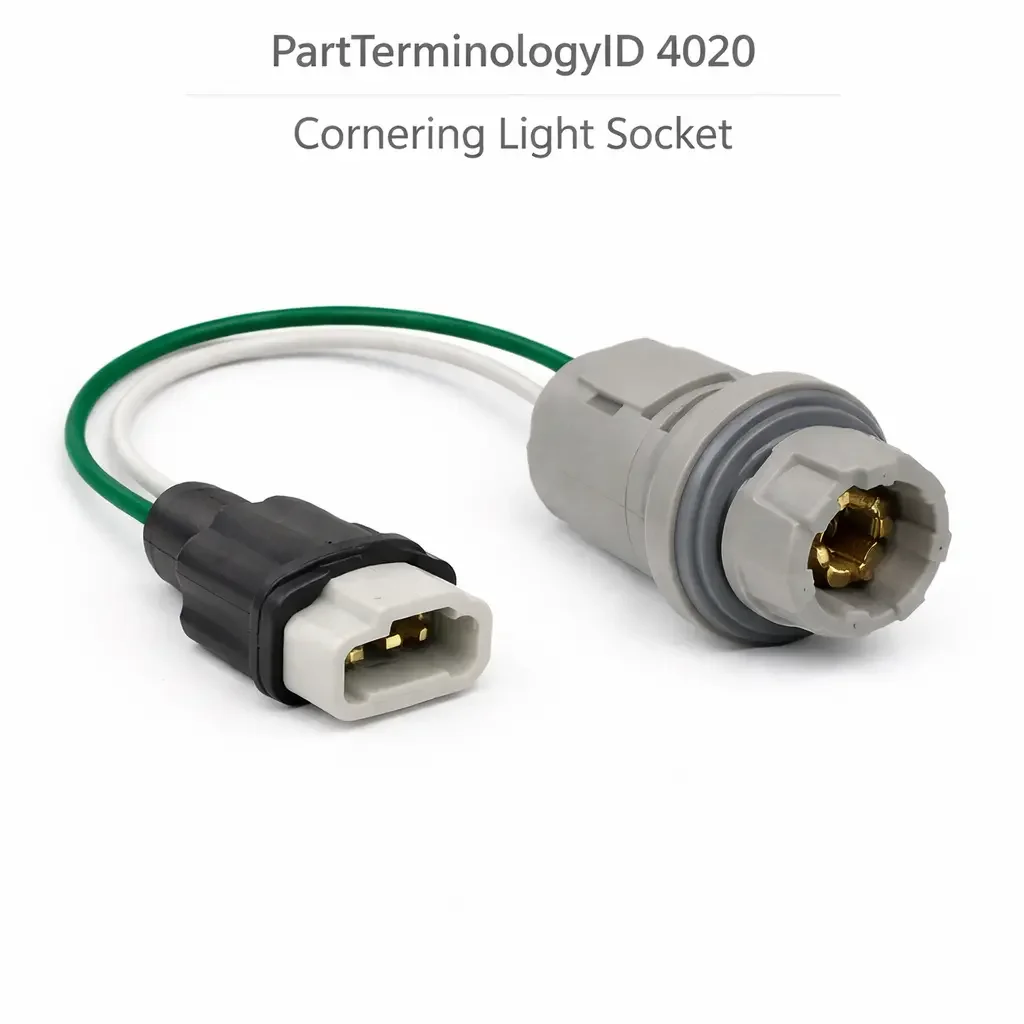
PartTerminologyID 4020, Cornering Light Socket, is the bulb socket that holds the cornering light bulb in the front lamp assembly, receiving switched power from the cornering light circuit when the driver activates the turn signal or turns the steering wheel beyond a defined angle, illuminating the area to the side of the vehicle in the direction of the intended turn to improve visibility during low-speed cornering maneuvers. That definition covers the cornering light socket function correctly and leaves unresolved whether the cornering light circuit is activated by the turn signal stalk input, a steering angle sensor input, or both inputs simultaneously depending on vehicle speed and steering angle, the vehicle speed threshold below which the cornering light circuit is permitted to activate on speed-limited cornering light systems that restrict operation to low-speed maneuvers only, whether the socket is mounted in a dedicated cornering light housing positioned at the outboard edge of the front lamp assembly or is integrated into the front turn signal housing where the cornering light bulb occupies a separate socket position alongside the turn signal bulb, the bulb base type the socket accepts and the wattage specification, whether the cornering light circuit is switched directly by the turn signal switch output or is commanded by the BCM after processing the turn signal input and any speed or steering angle conditions, and whether the cornering light socket is a discrete replaceable component in the lamp housing or is integrated into a lamp assembly that requires full assembly replacement.
For sellers, PartTerminologyID 4020 is the cornering light socket where the activation condition logic is the most return-generating attribute, because the cornering light does not activate under all driving conditions and a buyer who tests the cornering light at highway speed or with the vehicle stationary may find no activation on a system that restricts cornering light operation to low-speed conditions only. A cornering light that does not activate when the turn signal is engaged at highway speed may be correctly inhibited by the vehicle speed threshold on the BCM activation logic. A cornering light that activates with the turn signal but not when the steering wheel is turned without the turn signal engaged may be operating on turn-signal-only activation logic rather than steering-angle-activated logic. Both conditions produce a no-activation symptom under specific test conditions that the buyer may attribute to a socket fault when the socket is correctly non-activated by the BCM condition logic.
What the Cornering Light Socket Does
Turn signal activation versus steering angle activation and the dual-input architecture
Cornering light systems on earlier vehicles activated exclusively through the turn signal stalk input. When the driver engaged the turn signal, the cornering light on the corresponding side illuminated simultaneously with or slightly ahead of the turn signal flash. The cornering light remained on continuously during the turn signal activation rather than flashing with the turn signal, providing steady illumination of the corner rather than the intermittent flash that the turn signal produces. On these applications the cornering light socket circuit is a direct branch from the turn signal supply before the turn signal flasher, so the cornering light receives steady voltage while the turn signal receives pulsed voltage from the flasher.
Steering angle sensor activated cornering light systems on later vehicles activate the cornering light based on steering wheel position beyond a defined angle threshold, independently of whether the turn signal is engaged. Parking maneuvers, tight urban turns, and driveway approaches that require significant steering input activate the cornering light without a turn signal input. These systems typically incorporate a vehicle speed threshold that permits cornering light activation only below a maximum speed, typically 25 to 45 km/h depending on the manufacturer, to restrict the function to low-speed maneuvering conditions where the forward lamp coverage is most limited.
Dual-input systems activate the cornering light through either the turn signal input or the steering angle sensor input, whichever occurs first at eligible vehicle speeds. A buyer who tests the cornering light by engaging the turn signal at highway speed and finds no activation may have a speed-limited dual-input system that correctly inhibits activation above the speed threshold. The same system tested at parking lot speed with the turn signal engaged will activate correctly. The listing must identify the activation architecture and the speed threshold to prevent buyers from diagnosing a socket fault based on a high-speed test that is outside the system's designed operating range.
Dedicated cornering light housing versus integrated turn signal position
Vehicles with dedicated cornering light housings mount a separate lamp assembly at the outboard front corner of the vehicle, distinct from the headlamp and turn signal assemblies. The cornering light socket in a dedicated housing is typically the only socket in that housing and its function is exclusively cornering light illumination. Access to the dedicated housing socket is straightforward and the socket is typically a discrete replaceable component.
Vehicles that integrate the cornering light into the front turn signal housing use a multi-socket turn signal assembly where one socket position is connected to the turn signal circuit and a second socket position is connected to the cornering light circuit. The two sockets may accept the same or different bulb base types depending on the assembly design. A buyer who replaces the turn signal socket in a multi-socket housing when the cornering light socket is the failed component has ordered the wrong socket for the fault. The listing must identify whether the socket is in a dedicated housing or an integrated multi-socket assembly and must specify which socket position in the assembly the part number covers.
Why This Part Generates Returns
Buyers return cornering light sockets because the BCM speed threshold is active and the cornering light is correctly not activating during highway-speed turn signal use, the cornering light bulb has a failed filament and the socket is undamaged so the correct repair is a bulb replacement rather than a socket replacement, the turn signal flasher or turn signal switch has a fault that prevents the cornering light activation signal from reaching the BCM or socket supply circuit, the socket is in an integrated turn signal housing and the buyer ordered a turn signal socket rather than the cornering light socket position, the lamp housing retaining clip or socket twist-lock feature has broken and the socket is not seating correctly producing intermittent illumination, and the cornering light circuit on this vehicle is BCM-commanded and a BCM output driver fault is preventing cornering light activation with a functional socket.
Status in New Databases
PartTerminologyID 4020 is cataloged in PIES/PCdb as Cornering Light Socket. Under PIES 8.0 and PCdb 2.0 there is no change to the terminology or classification for this PartTerminologyID.
Top Return Scenarios
Scenario 1: "Speed threshold active, cornering light correctly inhibited at highway speed, socket replaced with no change"
The buyer's cornering light does not activate when the turn signal is engaged during highway driving. The BCM cornering light activation logic includes a speed threshold that inhibits activation above 40 km/h. The buyer tests the cornering light at highway speed and finds no activation. The socket is functioning correctly and will activate when tested below the speed threshold. The buyer replaces the socket. No change in behavior at highway speed.
Prevention language: "Speed threshold condition: On this application the cornering light is activated only below a vehicle speed threshold of approximately [X] km/h. The cornering light will not activate when the turn signal is engaged above this speed, even with a functioning socket. Test cornering light activation at low speed in a parking area before diagnosing a socket fault. A cornering light that activates correctly below the speed threshold is functioning correctly."
Scenario 2: "Failed cornering light bulb, functional socket, socket returned after bulb replacement resolves dark light"
The cornering light does not illuminate when activated. The socket is undamaged and seating correctly in the housing. The cornering light bulb filament has failed. The buyer replaces the socket assembly. The cornering light illuminates. The buyer returns the original socket as defective when the bulb was the failed component throughout.
Prevention language: "Bulb pre-check: Remove the cornering light socket from the lamp housing and inspect the bulb filament before replacing the socket. A failed filament is visible as a broken wire inside the bulb glass. Replace the bulb first. If the bulb is intact and the cornering light does not illuminate with confirmed supply voltage at the socket terminal, the socket contact is the next diagnostic step."
Scenario 3: "Integrated turn signal housing, turn signal socket ordered instead of cornering light socket position"
The buyer's cornering light is dark. The front lamp assembly on this vehicle integrates both the turn signal and cornering light functions in a single multi-socket housing. The buyer identifies the lamp assembly as the turn signal housing and orders a turn signal socket. The turn signal socket is installed in the turn signal position. The cornering light position, which uses a separate socket, remains unaddressed. The cornering light is still dark.
Prevention language: "Multi-socket housing note: On this application the cornering light socket is a separate socket position within the front turn signal housing. The turn signal and cornering light functions use different socket positions and may use different bulb base types within the same housing. Confirm you are ordering the socket for the cornering light position rather than the turn signal position before placing the order."
Scenario 4: "BCM output driver fault, turn signal input valid, cornering light socket receives no activation voltage"
The buyer's cornering light does not activate when the turn signal is engaged at eligible speed. The turn signal switch is sending a valid input to the BCM. The BCM output driver pin for the cornering light relay or direct socket supply has failed open. No supply voltage is present at the cornering light socket terminal during turn signal activation. The buyer replaces the socket. The BCM driver fault remains. No change in cornering light behavior.
Prevention language: "BCM output validation: On this application the cornering light circuit is activated by a BCM output based on the turn signal input and speed condition. Confirm supply voltage is present at the cornering light socket terminal during eligible activation conditions before replacing the socket. No supply voltage with the turn signal active below the speed threshold indicates a BCM output driver fault rather than a socket fault."
Listing Requirements
PartTerminologyID: 4020
Activation architecture: turn signal only, steering angle only, or dual-input (mandatory)
Speed threshold for activation where applicable (mandatory)
Housing type: dedicated cornering light housing or integrated turn signal housing (mandatory)
Socket position in multi-socket housings (mandatory)
Bulb base type and wattage specification (mandatory)
BCM-commanded versus direct-switched circuit note (mandatory)
Bulb pre-check note (mandatory)
Speed threshold test condition note (mandatory)
OEM part number cross-reference (mandatory)
Catalog Checklist for ACES/PIES Teams
PartTerminologyID = 4020
Require activation architecture: turn signal, steering angle, or dual-input (mandatory)
Require speed threshold disclosure where applicable (mandatory)
Require housing type: dedicated or integrated multi-socket (mandatory)
Require socket position identification in multi-socket housings (mandatory)
Require bulb base type and specification (mandatory)
Prevent speed threshold misdiagnosis: cornering light correctly inhibited above speed threshold is not a socket fault; speed threshold and correct test condition must be listed
Prevent multi-socket position misdirection: turn signal socket and cornering light socket are separate positions in integrated housings; socket position must be explicitly identified to prevent wrong position orders
Prevent BCM driver fault socket return: no supply voltage at socket terminal from a BCM driver fault is not a socket fault; BCM output validation must precede socket replacement on no-activation complaints
FAQ (Buyer Language)
Why does my cornering light not activate when I use the turn signal on the highway?
On speed-limited cornering light systems the BCM inhibits cornering light activation above a defined vehicle speed threshold. The cornering light is designed for low-speed maneuvering and does not activate during highway-speed lane changes or turns. Test the cornering light at low speed in a parking area before diagnosing a socket fault. Activation at low speed with no activation at highway speed is correct system behavior.
How do I check the cornering light bulb before replacing the socket?
Remove the socket from the lamp housing by twisting or pulling it from its retaining position. Inspect the bulb filament visually for a broken wire inside the glass. Apply direct 12-volt power to the socket terminals and confirm the bulb illuminates. A bulb that does not illuminate when powered directly has a failed filament and bulb replacement resolves the dark cornering light without socket replacement.
My vehicle has the cornering light and turn signal in the same housing. How do I know which socket to order?
In multi-socket front lamp housings the turn signal and cornering light sockets are separate components occupying different positions in the housing. The turn signal socket flashes with the turn signal. The cornering light socket illuminates steadily during cornering activation. Identify which socket position is dark and confirm the bulb base type at that position before ordering. The cornering light socket position and the turn signal socket position may use different bulb types even in the same housing.
Can a turn signal switch fault prevent the cornering light from activating?
Yes. On turn-signal-activated cornering light systems the turn signal switch input is the triggering event for cornering light activation. A turn signal switch with a failed contact that sends no input to the BCM will prevent cornering light activation on the affected side. Confirm the turn signal is operating correctly on both sides before diagnosing a cornering light socket fault on a no-activation complaint on one side only.
My cornering light works on one side but not the other. Is it the socket?
A cornering light that works on one side but not the other with confirmed turn signal operation on both sides narrows the fault to the non-functioning side circuit: the socket, the bulb, the supply wiring, or the BCM output for that side. Confirm the bulb is functional and supply voltage is present at the socket terminal during activation before concluding the socket is the fault.
What Sellers Get Wrong About PartTerminologyID 4020
The most common error is omitting the speed threshold condition from the listing. Cornering light systems on the majority of current-generation vehicles with this feature restrict activation to low-speed conditions only. A buyer who tests the cornering light during highway driving and finds no activation on a correctly speed-limited system will order a socket, install it, and find no change at highway speed because the system is still correctly inhibited above the threshold. The listing that identifies the speed threshold and directs buyers to test at low speed prevents this return and replaces it with a confirmed correct diagnosis at the correct operating condition.
The second error is failing to identify the socket position within multi-socket integrated housings. A buyer who sees a dark cornering light in a front lamp assembly that also contains the turn signal, sidemarker, and sometimes a daytime running light will identify the assembly as the turn signal housing and order a turn signal socket. The cornering light socket is a different position with a different circuit and may have a different bulb type. Without explicit socket position identification in the listing the buyer orders the wrong position socket, installs it, and finds the cornering light still dark because the correct socket position was never addressed.
The third error is omitting the BCM output validation note on BCM-commanded applications. No supply voltage at the cornering light socket terminal with the turn signal active at eligible speed is a BCM output driver fault on these applications rather than a socket fault. Without the BCM output validation note buyers replace the socket and find no change because the BCM driver fault produces the same no-voltage condition at the replacement socket terminal.
Cross-Sell Logic
Cornering Light Bulb: for buyers where socket inspection confirms the socket is undamaged and seating correctly, supply voltage is confirmed at the socket terminal during activation, but the cornering light does not illuminate, indicating a failed bulb filament is the correct repair rather than socket replacement.
Front Lamp Assembly: for buyers on integrated housing applications where the socket housing retaining feature is damaged and the socket cannot seat correctly without housing repair, and for buyers where the complete lamp assembly is the correct service unit for the cornering light circuit on integrated LED applications.
BCM: for buyers where supply voltage is absent at the cornering light socket terminal during confirmed eligible activation conditions with a valid turn signal input and confirmed speed below the activation threshold, indicating a BCM output driver fault for the cornering light circuit.
Turn Signal Switch: for buyers where the cornering light does not activate on one side and the turn signal on that side also has a fault, indicating a turn signal switch contact failure that is preventing both the turn signal and cornering light activation signals from reaching the BCM on the affected side.
Steering Angle Sensor: for buyers on steering-angle-activated cornering light systems where the cornering light does not activate during low-speed turns without the turn signal engaged, and the turn-signal-activated mode functions correctly, indicating a steering angle sensor fault that is preventing angle-triggered activation.
Why Catalog Data Quality Matters for PartTerminologyID 4020
Cornering light socket returns cluster around three scenarios that are fully preventable with listing language: the speed threshold misdiagnosis, the multi-socket position misdirection, and the BCM output driver misdiagnosis. The speed threshold misdiagnosis generates returns because the buyer tested under conditions outside the designed activation range and concluded the socket was faulty when the system was correctly inhibited. The multi-socket position misdirection generates returns because the buyer ordered a turn signal socket for a cornering light socket position and installed it without addressing the actual failed component. The BCM output driver misdiagnosis generates returns because the buyer replaced a socket that was correctly receiving no supply voltage due to a BCM driver fault rather than a socket contact failure.
None of these scenarios reflect a product defect. All three reflect missing listing information. The speed threshold note, the socket position identification, and the BCM output validation note together address the three scenarios that account for the majority of returns under this PartTerminologyID. Each attribute requires one to two sentences in the listing and all three are absent in most aftermarket listings for this PartTerminologyID.
Application Range and Fitment Guidance for PartTerminologyID 4020
Cornering light socket applications are concentrated in vehicles produced from the late 1960s through the mid-2000s when cornering lights were a premium convenience feature on domestic full-size cars, European luxury vehicles, and Japanese market vehicles with high-specification lighting packages. Early applications used simple turn-signal-switched circuits with direct-switched cornering light sockets and no BCM intermediary or speed threshold logic. These applications are the most straightforward to diagnose because the activation chain runs directly from the turn signal switch to the socket supply terminal.
Steering-angle-activated cornering light systems became more common from the mid-1990s onward on European vehicles and on domestic vehicles with advanced lighting packages. These systems introduced BCM processing of the steering angle sensor input and vehicle speed conditions before commanding the cornering light output, adding diagnostic complexity that earlier turn-signal-switched applications did not have.
Current-generation vehicles increasingly provide cornering light function through adaptive front lighting systems that physically aim the headlamp beam in the direction of a turn rather than through a separate cornering light bulb and socket. On these applications there is no discrete cornering light socket and PartTerminologyID 4020 does not apply. Fitment claims for post-2010 vehicles should confirm the vehicle uses a discrete cornering light bulb and socket rather than an adaptive headlamp system before assigning applications under this PartTerminologyID.
Dedicated cornering light housings are more common on domestic full-size cars from the 1970s and 1980s where the front lamp assemblies were large enough to accommodate a separate outboard cornering light position. European vehicles of the same era more commonly integrated the cornering light into the front turn signal or parking lamp housing as a separate bulb position within a multi-socket assembly. Asian market vehicles with cornering lights typically used integrated multi-socket front lamp assemblies rather than dedicated housings.
Final Take for PartTerminologyID 4020
Cornering Light Socket (PartTerminologyID 4020) is the low-speed visibility component where speed threshold disclosure, socket position identification in multi-socket housings, and BCM output validation are the three attributes that prevent the three most common return scenarios. Every listing without speed threshold disclosure sends buyers who test at highway speed through a socket replacement that changes nothing because the system was correctly inhibited throughout. Every listing without socket position identification risks a buyer ordering a turn signal socket for a cornering light position in an integrated housing and finding the cornering light still dark after installation. Every listing without BCM output validation sends BCM-commanded application buyers through a socket replacement that changes nothing because the BCM driver fault produces the same no-voltage condition at the replacement socket.
The speed threshold note and the socket position identification together address the two scenarios that are unique to cornering light sockets among all socket categories. Speed threshold inhibition is not a diagnostic consideration for any other socket type and the incorrect test condition it generates is entirely preventable with one sentence in the listing. Multi-socket housing position confusion is not present in single-function lamp assemblies and requires explicit position identification to prevent wrong-socket orders in integrated assemblies.
BCM output validation and bulb pre-check complete the set of attributes that ensure every buyer under this PartTerminologyID has the diagnostic information needed to confirm a socket fault under the correct activation conditions before the order is placed.
Together with speed threshold disclosure and socket position identification, these four attributes make every listing under this PartTerminologyID complete.