
12 Volt Accessory Power Outlet Socket (PartTerminologyID 4016): Where Fuse Validation, Load Current Rating, and Circuit Architecture Prevent Socket Replacement
Written by Arthur Simitian | PartsAdvisory
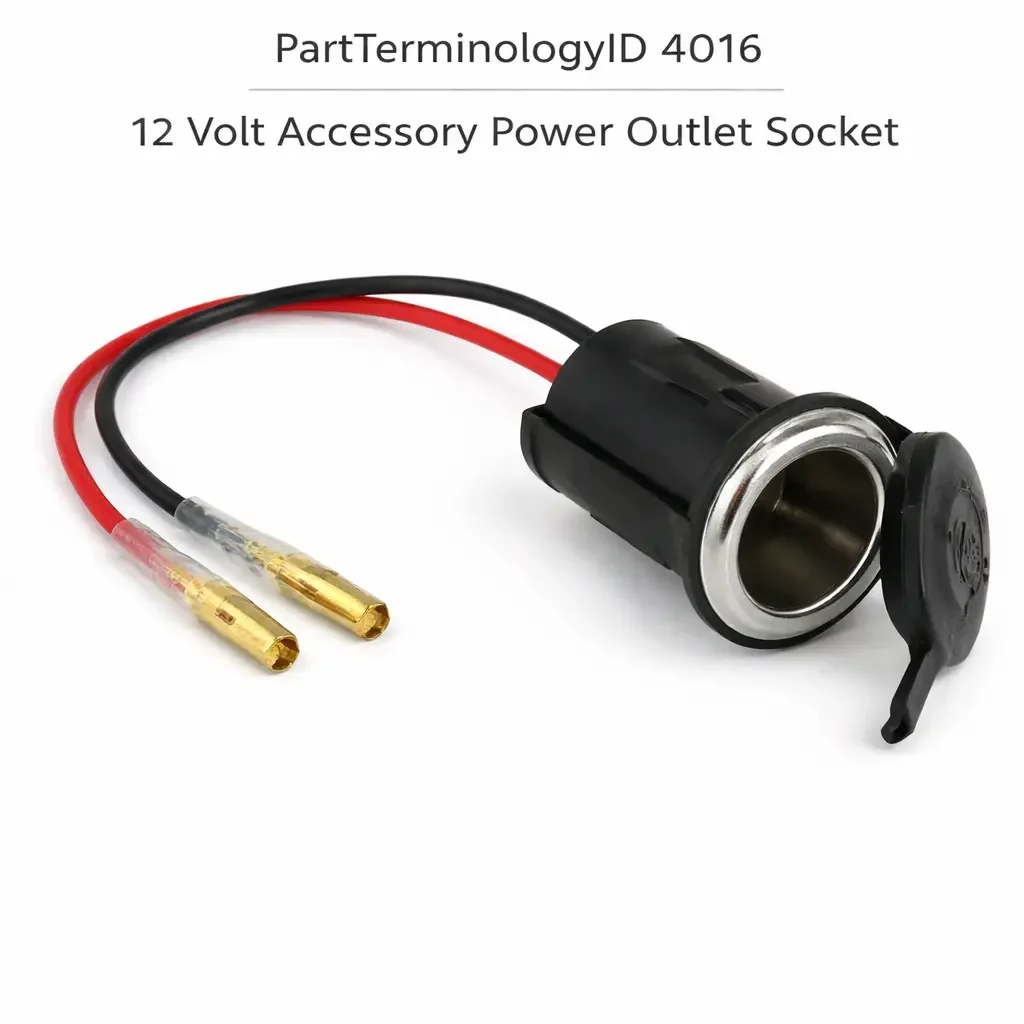
PartTerminologyID 4016, 12 Volt Accessory Power Outlet Socket, is the socket assembly that provides a 12-volt DC power output to accessory devices through a cigarette lighter-style receptacle, enabling the driver or passengers to power or charge portable devices including phone chargers, tire inflators, portable coolers, dashcams, GPS units, and other 12-volt accessory loads from the vehicle electrical system. That definition covers the 12-volt accessory outlet function correctly and leaves unresolved whether the socket is the original cigarette lighter receptacle that has been repurposed as an accessory power outlet on vehicles that deleted the cigarette lighter element, a dedicated accessory power outlet that was never designed to accept a lighter element and does not include a heating element or lighter socket collar, or a dual-function socket that accepts both a cigarette lighter element and accessory power plugs through the same receptacle opening, whether the socket circuit is switched by the ignition-accessory circuit and active only when the ignition is on, is switched by the ignition-run circuit and active only when the engine is running, or is an always-on circuit that remains live with the ignition off and the key removed, whether the socket draws from a dedicated fuse in the vehicle fuse panel or shares a fuse with other accessory circuits on a combined fuse, the current rating of the socket contact and housing that limits the maximum accessory load the outlet can supply without overheating, whether the socket is a discrete replaceable assembly that threads or clips into the console or instrument panel housing or is integrated into a console assembly that requires full console disassembly to access, and whether a failed socket on this vehicle will generate a BCM fault code or accessory power management warning due to the loss of expected circuit continuity in a monitored accessory circuit.
For sellers, PartTerminologyID 4016 is the 12-volt accessory power outlet socket where the always-on versus ignition-switched circuit architecture is the most return-generating attribute, because a buyer who finds the outlet non-functional may have a blown fuse from an overcurrent event on an always-on circuit that drained the battery while a high-draw device was left connected overnight, a failed socket contact from repeated high-current accessory use, a failed socket internal spring that prevents positive contact with the accessory plug tip, or an ignition-switched circuit that is correctly inactive with the ignition off. All four conditions produce identical no-power symptoms at the outlet and require different repairs. The listing must identify the circuit switching architecture, the fuse location and rating, and the socket current limit to give buyers the diagnostic path that resolves the complaint without a socket replacement when the actual fault is a blown fuse or an overcurrent accessory device.
What the 12 Volt Accessory Power Outlet Socket Does
Always-on circuit versus ignition-switched circuit and the battery drain scenario
Always-on accessory power outlet circuits remain live with the ignition off, the key removed, and the vehicle parked. This architecture allows devices like GPS units and dashcams to continue operating or charging after the driver leaves the vehicle. The trade-off is that a high-draw device left connected to an always-on outlet will drain the battery over an extended park period. A tire inflator drawing 15 amperes left connected to an always-on outlet will drain a standard 60 ampere-hour battery to a discharged state in approximately four hours. A buyer who returns to a dead battery after an overnight park and traces the drain to the accessory outlet circuit has an always-on circuit that is functioning correctly while the connected device was the drain source.
The always-on circuit architecture also means the outlet fuse protects a live circuit at all times, not only when the vehicle is in use. A fuse on an always-on outlet circuit that blows while the vehicle is parked produces a non-functional outlet that the buyer discovers the next time a device is connected. The buyer may not associate the non-functional outlet with the device that caused the overcurrent event because the device was removed before the blown fuse was discovered. Without knowledge of the always-on architecture the buyer may assume the socket failed spontaneously rather than tracing the fault to the blown fuse.
Ignition-switched outlet circuits are active only when the ignition is in the accessory or run position. These circuits do not drain the battery from connected devices when the vehicle is parked and are the safer architecture for high-draw accessory use. A buyer who finds the outlet non-functional with the ignition off on an ignition-switched application has a correctly non-functional outlet rather than a failed socket. The listing must identify the switching architecture and the ignition state required for socket activation so buyers can confirm the outlet is being tested under correct conditions before diagnosing a socket fault.
Socket contact spring and the intermittent connection failure
The 12-volt accessory outlet socket uses a spring-loaded center contact that presses against the tip of the inserted accessory plug to deliver positive voltage. The spring contact must maintain sufficient tension against the plug tip to ensure low contact resistance throughout the accessory connection. A spring contact that has lost tension from repeated high-current use, physical deformation from a plug being forced in at an angle, or corrosion on the spring contact surface will produce intermittent or absent power delivery to the connected device while the socket fuse and supply wiring remain intact.
A buyer whose accessory outlet works with some plugs but not others may have a worn spring contact that no longer maintains positive pressure against thinner or shorter plug tips. A buyer whose outlet works intermittently when the plug is wiggled has a spring contact with insufficient tension to maintain consistent contact. Both symptoms point to a failed socket spring contact rather than a supply circuit fault. A supply circuit fault produces complete absence of power regardless of plug type or plug position, while a spring contact fault produces variable behavior depending on plug geometry and insertion angle.
The socket ground contact ring is a second failure point independent of the spring contact. The ground ring is the outer cylindrical contact surface of the socket that makes contact with the sleeve of the accessory plug. A ground ring with corrosion or physical deformation produces a high-resistance ground path that causes accessory devices to operate at reduced power or to malfunction from ground-referenced signal errors. A GPS unit that produces incorrect location data, a phone charger that delivers less than rated charging current, or a portable cooler that runs at reduced speed may all reflect a high-resistance socket ground ring rather than a device fault or a battery voltage issue.
Fuse protection and the overcurrent device destruction scenario
The 12-volt accessory outlet socket is protected by a dedicated fuse or a shared fuse in the vehicle fuse panel. The fuse rating determines the maximum sustained current the circuit can deliver before the fuse element melts and interrupts the circuit. Standard accessory outlet fuses range from 10 to 20 amperes depending on the vehicle application and the intended accessory load. The socket contact and housing are rated for the same or slightly higher current than the fuse to ensure the fuse is the first component to fail under overcurrent conditions rather than the socket contact melting.
A device that draws above the fuse rating blows the fuse and leaves the socket undamaged. A device that draws near the fuse rating for extended periods may not blow the fuse but will overheat the socket contact and housing over time, gradually degrading the contact material and increasing contact resistance. A buyer whose outlet works initially but degrades over months of heavy accessory use has a thermally degraded socket contact from sustained near-rated current operation rather than a sudden failure event. The listing must specify the socket current rating and note that devices drawing near the maximum rating should be connected for minimum duration to extend socket contact life.
Multiple outlet circuit architecture and the shared fuse misdiagnosis
Many vehicles provide two or more 12-volt accessory outlets at different locations including the front console, rear console, cargo area, and instrument panel. On some platforms all outlets share a single fuse. On others each outlet position has a dedicated fuse. A buyer who finds one outlet non-functional and assumes the socket has failed may have a blown shared fuse that has rendered all outlets on the shared circuit non-functional, which the buyer has not confirmed because they tested only the one outlet.
On vehicles where outlets are on separate fuses, a blown fuse at one outlet position does not affect the other outlet positions. A buyer who replaces a socket under the assumption that the fuse is intact without checking the fuse will install a new socket into a blown fuse circuit and find no power at the replacement socket. The fuse check must precede socket diagnosis on every no-power accessory outlet complaint. The listing must identify whether the socket shares a fuse with other outlets and direct buyers to check all fuses in the accessory outlet circuit before ordering a socket replacement.
Why This Part Generates Returns
Buyers return 12-volt accessory power outlet sockets because the outlet fuse has blown from an overcurrent accessory device and the socket itself is undamaged so the correct repair is a fuse replacement rather than a socket replacement, the outlet circuit is ignition-switched and the buyer tested with the ignition off finding no power on a correctly non-active circuit, the socket contact spring has lost tension from physical deformation rather than electrical failure and the buyer has not identified the spring as the fault component, a high-draw device left on an always-on circuit has drained the battery and the buyer attributes the dead battery to a failed socket rather than the connected device, the socket is correctly delivering power but the connected accessory device has an internal fault preventing it from operating on a functional outlet, the socket is integrated into a center console assembly and the buyer receives the socket assembly but cannot install it without full console disassembly that they were not prepared for, and the replacement socket has a contact current rating that is lower than the original and the buyer is connecting the same high-draw device that degraded the original socket.
Status in New Databases
PartTerminologyID 4016 is cataloged in PIES/PCdb as 12 Volt Accessory Power Outlet Socket. Under PIES 8.0 and PCdb 2.0 there is no change to the terminology or classification for this PartTerminologyID.
Top Return Scenarios
Scenario 1: "Blown fuse from overcurrent device, socket undamaged, socket replaced without fuse check"
The buyer's accessory outlet has no power. A tire inflator was connected the previous day and drew above the fuse rating during a long inflation session. The fuse blew and interrupted the circuit. The socket itself is undamaged. The buyer does not check the fuse and orders a replacement socket. The replacement socket is installed into the blown fuse circuit. The replacement socket also has no power. The buyer returns the replacement socket as defective.
Prevention language: "Fuse check first: Before replacing the socket, locate the accessory outlet fuse in the vehicle fuse panel and confirm it is intact. A blown fuse is the most common cause of a non-functional accessory outlet and socket replacement does not restore power on a blown fuse circuit. Replace the fuse first. If the fuse blows again after replacement, identify and disconnect the overcurrent device before installing a new fuse or socket."
Scenario 2: "Ignition-switched circuit tested with ignition off, no power diagnosed as socket fault"
The buyer tests the accessory outlet with the ignition off and finds no power. The outlet circuit on this vehicle is switched by the ignition-accessory circuit and is inactive with the ignition off. The socket is functioning correctly. The buyer orders a replacement socket. The replacement socket also produces no power with the ignition off.
Prevention language: "Circuit switching: On this application the accessory outlet is switched by the ignition-accessory circuit and is active only when the ignition is in the accessory or run position. No power at the outlet with the ignition off is correct operation for this application. Confirm the outlet is being tested with the ignition in the accessory or run position before diagnosing a socket fault."
Scenario 3: "Worn spring contact, intermittent power delivery, some plugs work and others do not"
The socket center contact spring has lost tension from repeated high-current use. Standard-diameter accessory plugs with a full-height tip make intermittent contact. A slim phone charger plug with a shorter tip makes no contact at all. The buyer tests multiple devices and finds inconsistent operation across different plug types. The buyer attributes the inconsistency to a failing socket rather than identifying the worn spring as the specific fault.
Prevention language: "Spring contact inspection: Before replacing the socket assembly, inspect the center contact spring inside the socket opening. A spring that does not visibly protrude from the socket floor or that moves without resistance when pressed with a small tool has lost its contact tension. A worn spring contact produces intermittent power delivery that varies by plug type and insertion depth. Spring deformation is a mechanical fault that confirms socket replacement is the correct repair."
Scenario 4: "Always-on circuit, high-draw device left connected overnight, battery drained, buyer attributes dead battery to socket fault"
The buyer returns to a dead battery after leaving a portable cooler connected to the always-on accessory outlet overnight. The cooler drew 8 amperes continuously for eight hours, discharging the battery below the engine start threshold. The buyer assumes the socket has developed a fault that drained the battery and orders a replacement socket. The socket is functioning correctly. The always-on circuit architecture and the extended high-draw device connection are the cause of the battery drain.
Prevention language: "Always-on circuit note: On this application the accessory outlet circuit remains live with the ignition off. High-draw devices connected to this outlet will continue drawing current when the vehicle is parked and can drain the battery over extended periods. Disconnect high-draw accessory devices before leaving the vehicle parked for extended periods. A battery drained by a device connected to a functioning always-on outlet is not a socket fault."
Scenario 5: "Accessory device fault, outlet delivers power correctly, device does not operate"
The buyer's GPS unit does not power on when connected to the accessory outlet. The outlet is delivering correct 12-volt supply to the device plug. The GPS unit has an internal power circuit fault that prevents it from operating on a functional outlet. The buyer returns the socket as non-functional when the outlet was supplying power throughout.
Prevention language: "Device verification: Before replacing the socket, confirm the outlet is delivering voltage by connecting a known-good device such as a phone charger and confirming the device operates. If a known-good device operates correctly on the outlet, the outlet is functional and the original device has an internal fault. Socket replacement will not resolve a device that is non-functional on a working outlet."
Scenario 6: "Shared fuse circuit, one outlet non-functional, buyer replaces socket without confirming other outlets on same fuse are also non-functional"
The buyer finds the front console accessory outlet non-functional. The vehicle has a front console outlet and a rear console outlet on a shared fuse. The shared fuse has blown. Both outlets are non-functional. The buyer tests only the front outlet, assumes the front socket has failed, and orders a front socket replacement. The replacement socket is installed. The replacement socket also has no power because the shared fuse is still blown.
Prevention language: "Shared fuse check: On this application the front and rear accessory outlets share a single fuse. A blown shared fuse renders all outlets on the circuit non-functional simultaneously. Confirm whether other outlets on the vehicle are also non-functional before diagnosing a single socket fault. If all outlets on the shared circuit are non-functional, the fault is the shared fuse rather than any individual socket."
Listing Requirements
PartTerminologyID: 4016
Circuit switching architecture: always-on, ignition-accessory-switched, or ignition-run-switched (mandatory)
Socket contact current rating (mandatory)
Fuse rating and fuse panel location (mandatory)
Shared versus dedicated fuse note (mandatory)
Socket type: cigarette lighter repurposed, dedicated accessory outlet, or dual-function (mandatory)
Socket architecture: discrete replaceable or integrated console assembly (mandatory)
Fuse check note (mandatory)
Circuit switching test condition note (mandatory)
Spring contact inspection note (mandatory)
Always-on battery drain note where applicable (mandatory)
Device verification note (mandatory)
OEM part number cross-reference (mandatory)
Catalog Checklist for ACES/PIES Teams
PartTerminologyID = 4016
Require circuit switching architecture: always-on, ignition-accessory, or ignition-run (mandatory)
Require socket contact current rating (mandatory)
Require fuse rating and location (mandatory)
Require shared versus dedicated fuse identification (mandatory)
Require socket type: repurposed lighter, dedicated accessory, or dual-function (mandatory)
Prevent blown fuse socket return: a blown fuse is the most common cause of a non-functional outlet; fuse check must precede socket diagnosis on every no-power complaint; socket replacement does not restore power on a blown fuse circuit
Prevent ignition-switched misdiagnosis: outlet inactive with ignition off is correct operation for ignition-switched applications; switching architecture and correct test condition must be listed
Prevent always-on battery drain misattribution: battery drain from a connected device on a functioning always-on outlet is not a socket fault; always-on architecture and device disconnect guidance must be listed
Prevent shared fuse single-socket diagnosis: a blown shared fuse disables all outlets on the circuit; shared fuse confirmation must precede single socket replacement diagnosis
Prevent device fault socket return: a device that does not operate on a functional outlet has an internal fault; known-good device verification must precede socket replacement diagnosis
FAQ (Buyer Language)
My accessory outlet has no power. What should I check before replacing the socket?
Check the accessory outlet fuse in the vehicle fuse panel first. A blown fuse is the most common cause of a non-functional outlet and fuse replacement restores power without socket replacement. If the fuse is intact, confirm the outlet is being tested with the ignition in the correct position for the circuit switching architecture on your vehicle. If the fuse is intact and the ignition state is correct, probe the socket supply terminal for battery voltage before concluding the socket has failed.
How do I know if my accessory outlet is always-on or ignition-switched?
With the ignition off and the key removed, insert a phone charger or other low-draw device into the outlet. If the device receives power, the outlet is always-on. If the device receives no power with the ignition off but receives power when the ignition is turned to accessory, the outlet is ignition-switched.
Can leaving a device plugged in overnight damage the accessory outlet socket?
High-draw devices left connected to an always-on outlet can drain the battery and overheat the socket contact if the device draws near the fuse rating continuously. Low-draw devices like phone chargers left connected overnight on an always-on circuit draw minimal current and typically do not damage the socket. A tire inflator, portable cooler, or inverter drawing 10 or more amperes left connected for extended periods on an always-on circuit risks both battery drain and socket contact thermal degradation.
My outlet works with some devices but not others. What is causing this?
Variable outlet performance across different device plugs points to a worn or deformed center contact spring rather than a supply circuit fault. A supply circuit fault produces no power to any device. A worn spring that does not maintain tension against shorter or thinner plug tips produces no contact with those plugs while still contacting plugs with taller or larger-diameter tips. Inspect the spring contact inside the socket opening and replace the socket if the spring shows no visible protrusion or collapses under light pressure.
Can I use the accessory outlet to power a device that draws more than the fuse rating?
No. A device that draws above the fuse rating will blow the fuse and interrupt the circuit. Repeated overcurrent events that blow the fuse before it fully interrupts the circuit can also arc-damage the socket contact over time. Use only devices whose current draw is confirmed below the fuse rating for the outlet circuit. For high-draw accessories, a dedicated circuit with appropriate wiring and fuse sizing installed by a qualified installer is the correct approach rather than exceeding the stock outlet rating.
My vehicle has two accessory outlets and one does not work. Is it the socket?
Before ordering a socket replacement confirm whether both outlets share a single fuse. If both outlets share a fuse, check the shared fuse and confirm the other outlet is also non-functional. A blown shared fuse renders both outlets non-functional and fuse replacement is the correct repair for both positions. If the outlets have separate fuses, check the fuse for the non-functional outlet before ordering a socket replacement.
Why does my replacement socket also have no power after installation?
A replacement socket installed on a blown fuse circuit will have no power identically to the original socket. Confirm the fuse was checked and replaced before the new socket was installed. If the fuse blows again after replacement, identify and disconnect the device that caused the overcurrent event before installing another fuse.
What Sellers Get Wrong About PartTerminologyID 4016
The most common error is omitting the fuse check guidance. A blown fuse is the single most common cause of a non-functional 12-volt accessory outlet across all vehicle applications and age ranges. The socket itself is frequently undamaged when the fuse blows, particularly on single overcurrent events from a device that briefly exceeds the fuse rating. A buyer who does not check the fuse first orders a socket, installs it into the blown fuse circuit, finds no power at the replacement socket, and returns it as defective. The listing that directs buyers to check the fuse before ordering a socket converts the majority of no-power outlet complaints into fuse replacements rather than socket returns. This single note prevents more returns per word than any other attribute for this PartTerminologyID.
The second error is omitting the circuit switching architecture and the correct test condition. Ignition-switched outlet circuits are inactive with the ignition off. A buyer who tests with the ignition off finds no power on a correctly functioning ignition-switched outlet and orders a replacement socket that also has no power when tested under the same incorrect conditions. The listing that identifies the switching architecture and specifies the ignition state required for testing prevents this return entirely. Always-on circuits require a different note: the battery drain scenario from a connected high-draw device is the most common always-on complaint and the buyer needs to understand that a battery drained by a connected device is not a socket fault before ordering.
The third error is omitting the spring contact inspection note. The spring contact fault is a mechanical failure that is distinct from a supply circuit fault and produces a characteristic symptom pattern of variable performance across different plug types. Without the spring contact inspection note buyers do not know to look inside the socket opening before concluding the socket requires replacement. A spring contact inspection that confirms deformation or loss of tension validates the socket replacement order. A spring contact inspection that shows a fully intact spring with good tension redirects the diagnosis to the supply circuit or the connected device.
The fourth error is omitting the device verification guidance. A device that does not operate on a functional outlet has an internal fault that socket replacement will not resolve. Without the device verification note buyers on device fault complaints replace the socket and find the device still does not operate, returning the socket as non-functional when it was delivering correct voltage throughout. A single sentence directing buyers to test a known-good device on the outlet before ordering a socket prevents this return entirely.
The fifth error is omitting the shared fuse note on multi-outlet applications. A buyer who tests one outlet on a shared fuse circuit and finds it non-functional may replace that socket without confirming the other outlets on the shared fuse are also non-functional. After socket replacement the buyer finds the same fuse has blown again because the overcurrent device that caused the original blown fuse is still connected to the other outlet on the same shared circuit. The shared fuse note directs buyers to confirm all outlets on the shared circuit before diagnosing any single socket, preventing both the misdiagnosis and the repeat fuse failure.
Cross-Sell Logic
Accessory Outlet Fuse: for buyers where the outlet has no power, the socket spring contact is confirmed intact, and the supply circuit traces to a blown fuse in the fuse panel rather than a socket fault, indicating fuse replacement resolves the no-power complaint without socket replacement.
Accessory Power Inverter or Device: for buyers where the outlet is confirmed delivering correct 12-volt supply voltage and the fault is in the connected device rather than the outlet circuit, indicating the device requires repair or replacement rather than the socket.
Always-On Fuse and Battery: for buyers on always-on circuit applications where a high-draw device left connected overnight has drained the battery and blown the fuse, indicating both fuse replacement and battery recharging or replacement are required rather than socket replacement.
Center Console Assembly: for buyers on integrated console socket applications where the socket is not a discrete replaceable component and restoration of the outlet requires center console assembly replacement or disassembly beyond the scope of a simple socket swap.
BCM or Accessory Power Module: for buyers on vehicles with BCM-managed accessory power circuits where the fuse is intact, the socket spring is confirmed functional, the ignition state is correct, and no supply voltage is present at the socket terminal, indicating a BCM output driver fault or accessory power module fault rather than a socket fault.
Wiring Repair Kit or Pigtail: for buyers where supply voltage is confirmed present at an intermediate connector in the accessory outlet supply wiring but absent at the socket terminal, indicating a damaged connector or corroded terminal between the supply point and the socket requires wiring repair rather than socket replacement.
Why Catalog Data Quality Matters for PartTerminologyID 4016
12-volt accessory power outlet socket returns cluster around five scenarios that are fully preventable with listing language: the blown fuse misdiagnosis, the ignition-switched test condition misdiagnosis, the spring contact unidentified fault, the always-on battery drain misattribution, and the device fault socket return. Together these five scenarios account for the substantial majority of returns under this PartTerminologyID and none of them reflect a defective product.
The blown fuse misdiagnosis is the highest-volume return scenario across all vehicle applications. A fuse replacement costs a fraction of a socket replacement and resolves the no-power complaint in the majority of cases. Every listing that omits the fuse check note sends buyers through a socket replacement that is unnecessary in most cases and generates a return when the replacement socket also has no power on a still-blown fuse circuit.
The ignition-switched test condition misdiagnosis is unique to accessory outlet listings among socket categories because no other socket category has a switching architecture that makes the socket correctly inactive under common testing conditions. A brake light socket is never tested with the brake pedal released and the socket expected to be active. A backup light socket is never tested without the vehicle in reverse. But a 12-volt accessory outlet is frequently tested with the ignition off because the buyer assumes an accessory outlet should always have power. Without the switching architecture identification, ignition-switched outlet applications generate returns from buyers who installed a replacement socket that also had no power under the same incorrect test condition.
The spring contact fault and the device verification note together address two scenarios that are specific to the physical architecture of the accessory outlet socket and the variety of devices connected to it. Both require specific inspection steps that buyers will not take without explicit guidance in the listing. Both prevent returns where the socket was functional and either the spring fault was confirmed by inspection or the device was the actual failed component.
Application Range and Fitment Guidance for PartTerminologyID 4016
12-volt accessory power outlet socket applications span vehicles from the early 1950s when the 12-volt cigarette lighter receptacle became the standard accessory power interface in domestic vehicles through the present day. The cigarette lighter socket form factor established in the 1950s became the universal accessory power connector standard for portable automotive accessories and remains the dominant physical interface for 12-volt accessory devices in the current vehicle and accessory population despite the widespread adoption of USB charging ports that supplement but have not replaced the 12-volt outlet on most platforms.
Dedicated accessory power outlets that accept the standard accessory plug form factor but are not designed to accept a cigarette lighter element became common from the late 1980s onward as vehicle manufacturers accommodated the growing aftermarket accessory market while removing cigarette lighters from non-smoking-oriented trim levels. These dedicated outlets use the same socket opening diameter as the cigarette lighter receptacle but omit the lighter element socket collar and the lighter heating element housing features. A dedicated accessory outlet socket is not interchangeable with a cigarette lighter socket assembly on applications where the lighter function is required.
Multiple outlet positions became standard on domestic vehicles from the mid-1990s onward as cell phone chargers, GPS units, and portable electronic devices proliferated. Rear console and cargo area outlets became common on SUVs and minivans from the late 1990s through the 2000s, and these positions use the same socket form factor as the front console outlets but may use different circuit switching architectures. A front console ignition-switched outlet on the same vehicle as a rear cargo always-on outlet requires the listing to specify the switching architecture per outlet position rather than applying a single architecture note to all outlet positions on the vehicle.
USB charging integration alongside 12-volt outlet sockets became common from approximately 2012 onward. Some vehicles integrate a USB charging port and a 12-volt outlet in a shared console module where both the USB port and the 12-volt socket draw from the same fused supply circuit. A fault in the shared supply circuit disables both the USB and 12-volt outlets simultaneously, which can help confirm the supply circuit as the fault source when both outputs are affected. Fitment claims for integrated USB plus 12-volt outlet assemblies must identify whether the replacement covers the complete integrated module or only the 12-volt socket portion of the assembly.
High-current outlet applications rated above 20 amperes are available on some truck and commercial vehicle platforms to support high-draw accessories including portable welders, compressors, and commercial coolers. These heavy-duty outlet sockets use reinforced contact materials and heavier wiring than standard passenger car outlets. A standard 15-ampere passenger car outlet socket applied to a heavy-duty outlet position will fail immediately from the first high-current accessory connection. Fitment claims must specify the contact current rating and confirm the replacement matches the OEM current rating for heavy-duty outlet applications.
Final Take for PartTerminologyID 4016
12 Volt Accessory Power Outlet Socket (PartTerminologyID 4016) is the accessory power delivery component where fuse validation, circuit switching architecture disclosure, spring contact inspection guidance, always-on battery drain education, and device verification are the five attributes that prevent the five most common return scenarios. Every listing without fuse check guidance sends the largest single segment of no-power outlet buyers through a socket replacement that changes nothing because the fuse was the fault source throughout. Every listing without switching architecture disclosure sends ignition-switched outlet buyers through a socket replacement that behaves identically to the original under the same incorrect test condition. Every listing without spring contact inspection guidance leaves buyers unable to confirm the specific mechanical fault before ordering. Every listing without the always-on battery drain note generates returns from buyers who misattribute a battery drain event to a socket fault. Every listing without the device verification note generates returns from buyers whose device was the failed component on a functioning outlet.
The fuse check note and the circuit switching architecture disclosure together address the two scenarios that account for the largest share of returns under this PartTerminologyID by a significant margin. Fuse misdiagnosis generates the largest absolute volume of returns because it is the most common cause of a non-functional outlet and the least commonly checked component before a socket is ordered. Switching architecture misdiagnosis generates returns on ignition-switched and always-on circuit complaints that are easily prevented with one sentence identifying the correct test condition.
Spring contact inspection, device verification, and shared fuse guidance complete the set of attributes that ensure every buyer under this PartTerminologyID has the full diagnostic path needed to confirm a socket fault before the order is placed and to avoid returning a functional socket that was correctly delivering power throughout the complaint.
Together with fuse validation and switching architecture disclosure, these five attributes make every listing under this PartTerminologyID complete and convert the majority of no-power outlet complaints into correct fuse replacements, correct test condition confirmations, or correct device diagnoses rather than unnecessary socket returns.