
Clock Light Socket (PartTerminologyID 4012): Where Instrument Panel Lighting Architecture and Bulb Specification Prevent Socket Replacement
Written by Arthur Simitian | PartsAdvisory
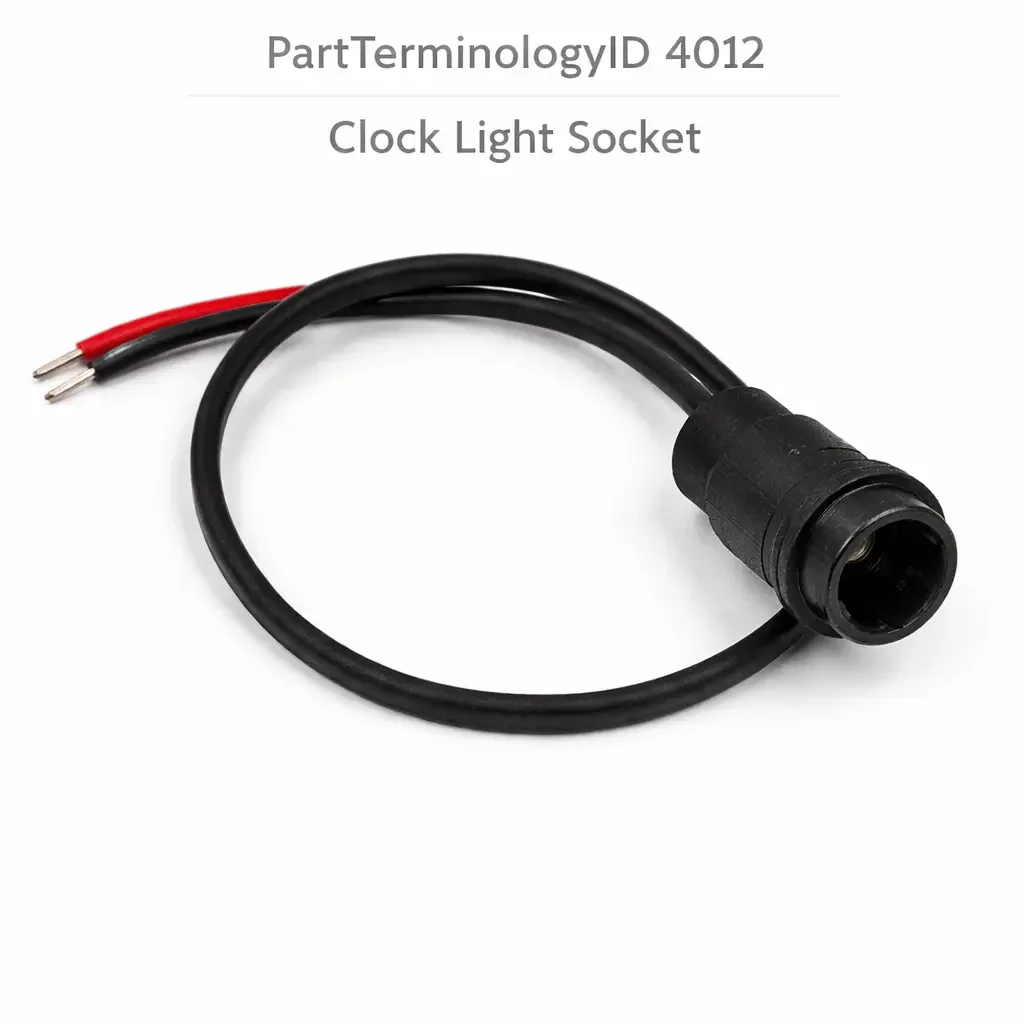
PartTerminologyID 4012, Clock Light Socket, is the bulb socket that provides illumination to the analog or digital clock mounted in the instrument panel, center console, or overhead console, receiving switched power from the instrument panel lighting circuit or the ignition-switched accessory circuit to illuminate the clock face or display when the vehicle lighting is active. That definition covers the clock illumination socket function correctly and leaves unresolved whether the socket illuminates a backlit analog clock face, provides edge lighting to a digital display lens, or delivers power to a discrete clock position indicator bulb on a combined instrument cluster clock integration, whether the socket accepts a wedge-base, bayonet-base, or festoon bulb, the voltage and wattage rating the socket is designed for, whether the clock illumination circuit is switched by the instrument panel lighting circuit and illuminates only when the headlamps or parking lamps are active or is switched by the ignition-accessory circuit and illuminates whenever the ignition is on, whether the clock module itself draws power from the socket circuit or from a separate always-on memory circuit that maintains timekeeping independent of the illumination supply, and whether the socket is a discrete replaceable component clipped into the clock housing or is integrated into a clock module assembly that requires full module replacement to address a socket fault.
For sellers, PartTerminologyID 4012 is the clock light socket where the distinction between the illumination circuit and the clock power circuit is the most return-generating attribute, because the clock on most vehicles draws its operating power from a dedicated always-on memory supply circuit that is entirely separate from the illumination socket circuit. A buyer who finds the clock display dark may have a failed illumination socket, a failed illumination bulb, a failed instrument panel lighting supply to the socket, or a failed clock module power supply that has caused the entire clock to stop functioning rather than just the illumination. All four conditions produce a dark clock display but only one is resolved by socket replacement. The listing must identify the separation between the clock illumination circuit and the clock operating power circuit so buyers confirm which circuit has failed before ordering a socket.
What the Clock Light Socket Does
Illumination circuit versus clock operating power circuit
The clock illumination circuit supplies power to the socket and bulb to backlight the clock face during nighttime driving or whenever the panel lighting is active. This circuit is typically switched by the instrument panel dimmer circuit and its brightness may be adjustable through the panel dimmer control. The illumination circuit does not power the clock mechanism or display logic. Removing the illumination bulb leaves the clock fully functional and timekeeping accurate while making the display unreadable in low light.
The clock operating power circuit supplies continuous or ignition-switched power to the clock module to maintain timekeeping and drive the display logic. This circuit is typically connected to a fused always-on supply or an ignition-accessory supply depending on whether the clock retains time when the ignition is off. A failed clock operating power supply produces a completely non-functional clock with no display, no timekeeping, and no response to setting controls. This condition is not resolved by socket replacement because the illumination socket does not supply the clock module's operating power.
A buyer whose clock display is completely dark and shows no time, no segments, and no response to controls has a clock module power fault rather than an illumination socket fault. A buyer whose clock displays the correct time but is unreadable in low light due to a dark backlight has an illumination socket or bulb fault. The listing must make this distinction explicit to prevent socket orders on clock module power faults.
Panel lighting-switched versus ignition-switched illumination and the testing condition
Clock illumination sockets on most vehicles are switched by the instrument panel lighting circuit and illuminate only when the parking lamps or headlamps are active. Testing socket function with the ignition on and headlamps off will show no illumination on a correctly functioning panel lighting-switched socket. A buyer who cannot see the clock illumination during daytime driving and tests the socket without activating the headlamps will find no illumination and may conclude the socket has failed when it is functioning correctly.
Some vehicles switch the clock illumination from the ignition-accessory circuit so the clock backlight is active whenever the ignition is on regardless of headlamp state. On these applications the illumination socket should produce light with the ignition in the accessory or run position at any time of day. A buyer on this application who finds no clock illumination with the ignition on has either a failed socket, a failed bulb, or an open circuit in the ignition-accessory supply to the socket.
Why This Part Generates Returns
Buyers return clock light sockets because the clock module operating power circuit has failed and the entire clock is non-functional rather than just dark, which socket replacement does not address, the bulb in the existing socket has failed and the socket itself is undamaged so the correct repair is a bulb replacement rather than a socket replacement, the socket is panel lighting-switched and the buyer tested socket function without activating the headlamps, the instrument panel dimmer control has been set to minimum brightness and the clock illumination is active but too dim to see rather than completely absent, and the clock module assembly on this vehicle integrates the illumination circuit into the module board with no discrete replaceable socket.
Status in New Databases
PartTerminologyID 4012 is cataloged in PIES/PCdb as Clock Light Socket. Under PIES 8.0 and PCdb 2.0 there is no change to the terminology or classification for this PartTerminologyID.
Top Return Scenarios
Scenario 1: "Clock module power fault, entire clock non-functional, socket replaced with no change"
The buyer's clock display is completely dark with no time displayed and no response to the set controls. The clock module has lost its operating power supply due to a blown fuse on the clock memory circuit or a failed clock module internally. The buyer replaces the clock light socket. The socket replacement restores no function because the illumination socket does not supply the clock module operating power. No change in clock behavior.
Prevention language: "Clock operating power versus illumination circuit: This socket provides illumination to the clock face only and does not supply the clock module operating power. A completely dark clock with no time displayed and no response to set controls indicates a failed clock module power supply, a blown clock memory fuse, or a failed clock module rather than an illumination socket fault. Confirm the clock module is receiving operating power and functioning before diagnosing an illumination socket fault."
Scenario 2: "Failed illumination bulb, functional socket, socket returned after bulb replacement resolves dark display"
The clock face is dark during nighttime driving but the clock displays time correctly. The socket is undamaged. The illumination bulb filament has failed. The buyer replaces the socket assembly. The clock illumination restores. The buyer returns the original socket as defective when the bulb was the failed component.
Prevention language: "Bulb pre-check: Remove the clock illumination socket and inspect the bulb filament before replacing the socket. A failed filament is visible as a broken wire inside the bulb glass. On applications where the bulb is separately replaceable from the socket, bulb replacement resolves a dark clock face at lower cost than socket replacement. Confirm the bulb has failed before ordering a socket replacement."
Scenario 3: "Panel lighting-switched socket, buyer testing without headlamps, dark clock misdiagnosed as socket fault"
The buyer cannot see the clock illumination during daytime driving. The socket is panel lighting-switched and produces illumination only when the headlamps or parking lamps are active. The buyer tests with the ignition on and headlamps off and finds no clock illumination. The buyer orders a replacement socket. The replacement socket also produces no illumination without the headlamps on.
Prevention language: "Switching circuit: On this application the clock illumination socket is switched by the instrument panel lighting circuit and illuminates only when the headlamps or parking lamps are active. No clock illumination with the ignition on and headlamps off is correct functioning for a panel lighting-switched socket. Confirm the socket is tested with the panel lighting circuit active before diagnosing a socket fault."
Scenario 4: "Panel dimmer at minimum setting, clock illumination active but not visible, socket replaced with no change"
The instrument panel dimmer control has been set to its minimum brightness position. The clock illumination socket is active and delivering power to a functioning bulb but the dimmer circuit is reducing the supply voltage to a level that produces no visible illumination. The buyer replaces the socket. The dimmer setting remains at minimum. The replacement socket produces the same imperceptible illumination at the minimum dimmer setting.
Prevention language: "Dimmer control check: Before diagnosing a clock illumination socket fault, confirm the instrument panel dimmer control is not set to minimum brightness. A dimmer at minimum setting reduces the panel lighting supply voltage to near zero, producing no visible illumination from a correctly functioning socket and bulb. Adjust the dimmer to mid-range and confirm the clock illumination responds before ordering a socket replacement."
Listing Requirements
PartTerminologyID: 4012
Socket architecture: discrete replaceable or integrated into clock module (mandatory)
Bulb base type: wedge, bayonet, or festoon (mandatory)
Bulb voltage and wattage specification (mandatory)
Switching circuit: panel lighting-switched or ignition-accessory-switched (mandatory)
Clock operating power versus illumination circuit distinction note (mandatory)
Bulb pre-check note (mandatory)
Dimmer control check note (mandatory)
Integrated clock module note where applicable (mandatory)
OEM part number cross-reference (mandatory)
Catalog Checklist for ACES/PIES Teams
PartTerminologyID = 4012
Require socket architecture: discrete or integrated (mandatory)
Require bulb base type and specification (mandatory)
Require switching circuit: panel lighting or ignition-accessory (mandatory)
Require clock operating power versus illumination distinction note (mandatory)
Require bulb pre-check note (mandatory)
Prevent clock module power fault socket return: a completely non-functional clock is a module power fault; illumination socket replacement does not restore clock operating power; circuit distinction must be listed to prevent socket orders on module power faults
Prevent panel lighting switching misdiagnosis: socket illuminates only with headlamps active; testing without headlamps produces no illumination from a correctly functioning socket; switching circuit must be identified so buyers test under correct conditions
Prevent dimmer misdiagnosis: minimum dimmer setting produces no visible illumination from a functional socket; dimmer check must precede socket diagnosis on a dark clock complaint
FAQ (Buyer Language)
My clock shows no time and does not respond to the set controls. Is it the socket?
A clock that shows no time and does not respond to controls has lost its operating power supply rather than just its illumination. The clock illumination socket does not supply the clock module operating power. Check the clock memory fuse first. If the fuse is intact, the clock module itself may have failed. Socket replacement will not restore a non-functional clock.
My clock displays the correct time but I cannot see it at night. Is it the socket?
A clock that displays time correctly but is dark at night has an illumination fault rather than a clock module fault. This is the condition that socket or bulb replacement addresses. Remove the socket and inspect the bulb filament first. A failed filament is the most common cause of a dark clock face on a functioning clock.
How do I check if the clock illumination socket is receiving power?
With the headlamps or parking lamps active, probe the supply terminal of the clock illumination socket connector with a test light or multimeter. A functioning panel lighting supply will show voltage at the supply terminal. No voltage with the headlamps on indicates an open circuit in the panel lighting supply to the socket rather than a socket fault.
Why does my clock only illuminate when the headlights are on?
Most vehicles switch the clock illumination from the instrument panel lighting circuit rather than the ignition circuit. Clock illumination that activates only with the headlamps or parking lamps is the designed behavior for panel lighting-switched applications and is not a fault condition.
Can I replace just the bulb in the clock socket or do I need the whole socket?
On applications where the bulb is separately replaceable from the socket housing, bulb replacement is the correct first step and resolves the dark clock face at lower cost than full socket replacement. Confirm the bulb base type and wattage specification before ordering. If the socket housing itself has a cracked or damaged contact that prevents bulb retention or electrical contact, socket replacement is required.
What Sellers Get Wrong About PartTerminologyID 4012
The most common error is omitting the clock operating power versus illumination circuit distinction. A completely non-functional clock with no display and no response to controls is a clock module power fault that socket replacement does not address. Without the circuit distinction note buyers on module power faults order a socket, install it, and find no change because the clock module has no operating power regardless of socket condition. The listing that distinguishes the illumination circuit from the operating power circuit and directs buyers to confirm the clock module is receiving operating power before ordering a socket prevents this return and redirects the buyer to the correct fuse or module diagnosis.
The second error is omitting the bulb pre-check note. A dark clock face on a functioning clock is most commonly a failed illumination bulb rather than a failed socket. Without the bulb pre-check note buyers replace the socket rather than the bulb and return the socket when the clock face remains dark from the same failed bulb in the replacement socket.
The third error is omitting the switching circuit identification and the dimmer control check. A panel lighting-switched socket tested without the headlamps on produces no illumination from a correctly functioning socket. A socket tested with the dimmer at minimum produces the same result. Without both notes buyers on these applications order a replacement socket that behaves identically to the original under the same incorrect test conditions.
Cross-Sell Logic
Clock Illumination Bulb: for buyers where socket inspection confirms the socket terminals are making correct contact and supply voltage is confirmed at the socket with the panel lighting active, but the clock face is dark, indicating a failed bulb filament is the correct repair rather than socket replacement.
Clock Module or Clock Assembly: for buyers where the clock is completely non-functional with no time displayed and no response to controls, indicating a clock module operating power fault or failed clock module rather than an illumination socket fault.
Instrument Panel Dimmer Switch: for buyers where the clock illumination socket and bulb are confirmed functional but the clock face brightness is not adjustable through the dimmer control, indicating a failed dimmer switch that is holding the panel lighting circuit at a fixed voltage level.
Instrument Cluster: for buyers on vehicles where the clock is integrated into the instrument cluster and the illumination socket is part of the cluster printed circuit board rather than a discrete clock module, indicating the cluster assembly is the correct service unit.
Panel Lighting Fuse: for buyers where no supply voltage is present at the clock illumination socket terminal with the headlamps active and the fault traces to a blown panel lighting fuse rather than a socket or wiring fault.
Why Catalog Data Quality Matters for PartTerminologyID 4012
Clock light socket returns cluster around three scenarios that are fully preventable with listing language: the clock module power fault misdirection, the bulb-only repair misdirection, and the panel lighting switching and dimmer misdiagnosis. The clock module power fault misdirection generates returns because the buyer replaced an illumination socket on a clock that had no operating power and was non-functional for reasons the socket could not address. The bulb-only repair misdirection generates returns because the buyer replaced a functional socket when a bulb replacement was the correct and sufficient repair. The switching and dimmer misdiagnosis generates returns because the buyer tested socket function under incorrect conditions and reached a false fault conclusion.
None of these scenarios reflect a product defect. All three reflect missing listing information. The clock operating power distinction note, the bulb pre-check note, and the switching circuit and dimmer check notes together address the three scenarios that account for the majority of returns under this PartTerminologyID. Each attribute requires one to two sentences in the listing and all three are absent in most aftermarket listings for this PartTerminologyID.
Application Range and Fitment Guidance for PartTerminologyID 4012
Clock light socket applications are concentrated in vehicles produced from the late 1960s through the early 2010s when analog and early digital clocks with discrete replaceable illumination sockets were standard or optional equipment across domestic, European, and Asian vehicle platforms. Domestic full-size cars and trucks from the 1970s through the 1990s represent the highest-volume application range for discrete clock light sockets, as these platforms used consistent socket designs across multiple model years and the clocks were mounted as discrete modules in the instrument panel or center console with accessible socket positions.
From the late 1990s onward clock functions were increasingly integrated into the instrument cluster, radio display, or infotainment system rather than provided as discrete clock modules. On these integrated applications the clock illumination is provided by the cluster or radio display backlighting rather than a discrete clock illumination socket, and PartTerminologyID 4012 does not apply. Fitment claims for post-2000 vehicles should confirm the vehicle uses a discrete clock module with a separate illumination socket rather than a cluster-integrated or radio-integrated clock display before assigning applications under this PartTerminologyID.
Overhead console clock applications on domestic trucks and vans from the 1980s through the early 2000s use different socket positions and access methods than instrument panel clock applications on the same platforms. Fitment claims must distinguish between overhead console and instrument panel clock socket positions where both exist to prevent an instrument panel socket being ordered for an overhead console application with a different housing design.
Final Take for PartTerminologyID 4012
Clock Light Socket (PartTerminologyID 4012) is the timepiece illumination component where operating power circuit distinction, bulb pre-check, and switching circuit identification are the three attributes that prevent the three most common return scenarios. Every listing without the operating power distinction generates returns from buyers whose clock was non-functional due to a module power fault that socket replacement could not address. Every listing without bulb pre-check guidance generates returns from buyers who replaced a functional socket when a bulb replacement was the correct repair. Every listing without switching circuit identification and dimmer check guidance generates returns from buyers who tested socket function under incorrect conditions and reached a false fault conclusion.
The operating power distinction note and the bulb pre-check note together address the two scenarios that account for the largest share of returns under this PartTerminologyID. Module power misdirection generates the uninformed-buyer return where the socket was not the correct repair path for the actual fault. Bulb misdirection generates the over-repair return where a lower-cost bulb was the actual failed component. Adding both notes to the listing converts both return scenarios into either a correct module or fuse diagnosis or a correct bulb order rather than a socket return.
Switching circuit identification and dimmer control check complete the set of attributes that ensure every buyer under this PartTerminologyID has the diagnostic information needed to confirm a socket fault before the order is placed.
Together with operating power circuit distinction and bulb pre-check, these four attributes make every listing under this PartTerminologyID complete.