
Written by Arthur Simitian | PartsAdvisory
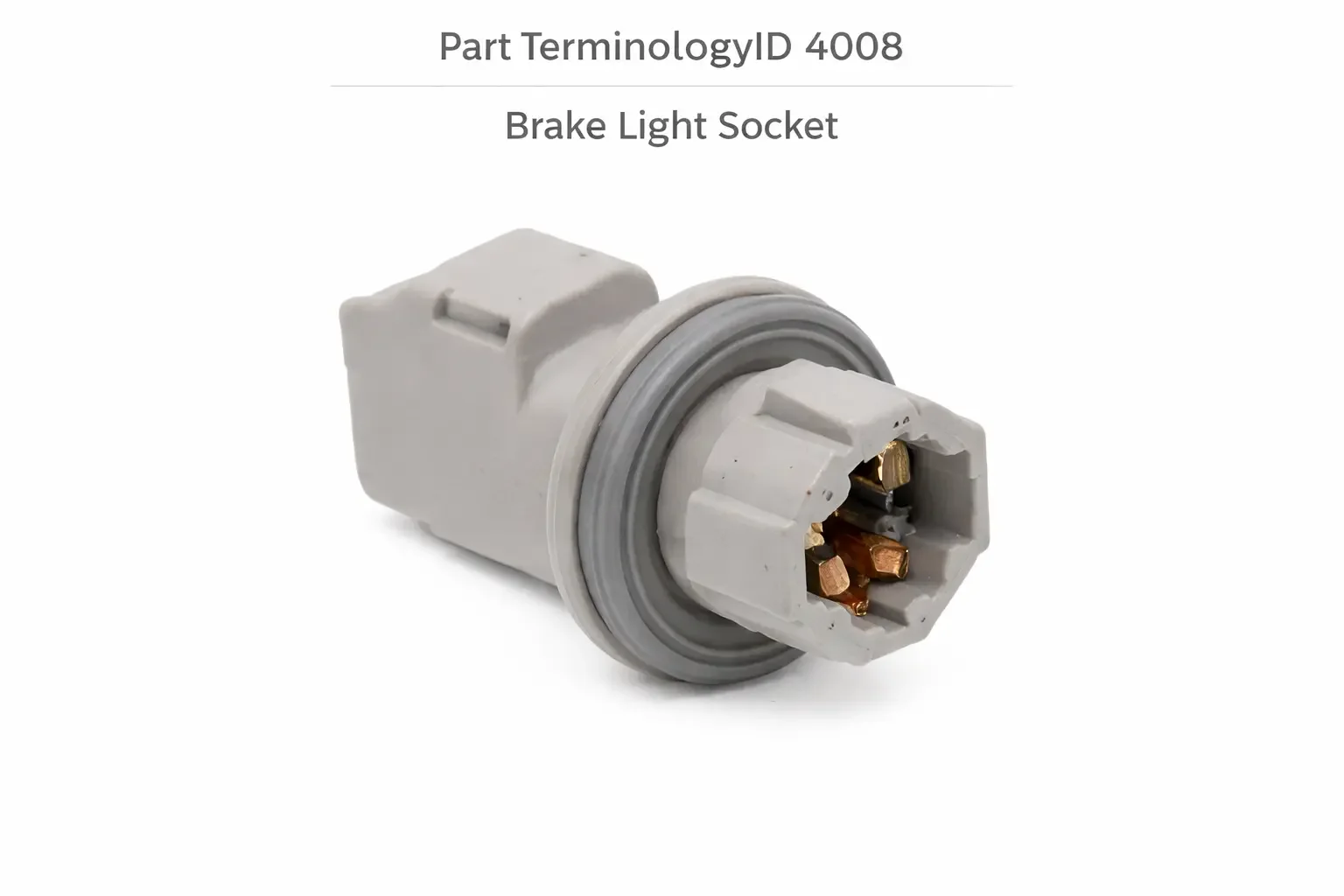
PartTerminologyID 4008, Brake Light Socket, is the bulb socket that holds the stop light bulb in the tail lamp assembly, receiving switched power from the brake light circuit when the driver depresses the brake pedal and delivering current to the bulb to illuminate the brake indicators for following traffic. That definition covers the brake light socket function correctly and leaves unresolved whether the socket holds a single-filament bulb dedicated to brake illumination only or a dual-filament bulb that combines the brake light function with the tail light function in a single bulb, the bulb base type the socket accepts including single-contact bayonet, dual-contact bayonet, or wedge base, whether the brake light circuit is switched by a mechanical brake pedal position switch, a brake pedal sensor that sends a signal to the BCM which then activates the brake light circuit output, or a direct-switched circuit with no module intermediary, whether a failed brake light socket on this vehicle will generate a BCM fault code or outage warning due to the loss of expected current draw in the brake light circuit, and whether the socket is a discrete replaceable component in the tail lamp housing or is integrated into a sealed tail lamp assembly that requires full assembly replacement.
For sellers, PartTerminologyID 4008 is the brake light socket where the dual-filament combined tail and stop circuit is the most return-generating attribute, because the dual-filament 1157-type socket is the dominant brake light socket architecture across decades of domestic vehicle production and the two filament circuits share the same socket body with separate contact terminals, making a socket contact fault on one filament circuit produce symptoms that appear to involve the other filament circuit. A brake light socket with a failed contact on the brake filament circuit produces a tail light that illuminates correctly and a brake light that does not, which a buyer may attribute to a wiring fault or BCM fault rather than a socket contact failure on the brake terminal. A socket with a failed contact on the tail filament circuit produces the reverse symptom: brake light illuminates correctly and tail light does not, which the buyer may order as a tail light socket rather than a brake light socket. Identifying the dual-filament architecture and both filament circuits in the listing prevents misidentification of the failed circuit and ensures the buyer orders the correct replacement.
What the Brake Light Socket Does
Single-filament dedicated brake socket versus dual-filament combined stop and tail socket
Single-filament brake light sockets hold a bulb dedicated exclusively to brake illumination. These sockets have two terminals, one for switched brake circuit power and one for ground. A failed socket contact on a single-filament brake socket produces a dark brake light only and does not affect any other lighting function in the tail lamp assembly. Diagnosis is straightforward: confirmed brake switch output voltage at the socket supply terminal with the pedal depressed and a confirmed functioning bulb that does not illuminate points to a failed socket contact.
Dual-filament combined stop and tail sockets hold a bulb with two separate filaments. The high-intensity filament illuminates when the brake pedal is depressed. The low-intensity filament illuminates with the tail lights whenever the parking lamps or headlamps are active. The socket has three terminals: one for brake circuit switched power, one for tail circuit switched power, and one for shared ground. A socket body with a failed brake terminal contact produces a dark brake light with a functioning tail light from the same bulb. A socket body with a failed tail terminal contact produces a functioning brake light with a dark tail light from the same bulb. A socket body with a failed ground terminal produces both the brake and tail filaments failing simultaneously.
Brake switch signal path and the BCM-commanded brake light circuit
On older vehicles a dedicated brake pedal position switch mounted on the brake pedal arm directly supplies switched battery voltage to the brake light circuit when depressed. The supply path runs from the fuse through the brake switch to the brake light socket supply terminal with no module intermediary. Confirmed voltage at the brake switch output with the pedal depressed and no voltage at the socket supply terminal indicates an open circuit in the wiring between the switch and the socket rather than a socket fault.
On current-generation vehicles the brake pedal sensor sends a pedal position signal to the BCM, which activates a BCM output driver for the brake light circuit. The socket receives brake circuit power from the BCM output rather than directly from the pedal switch. A BCM output driver fault produces no brake light activation with a functional socket and a valid pedal input signal. A buyer who finds no voltage at the brake socket supply terminal with the pedal depressed on a BCM-commanded application has a BCM driver fault or pedal sensor fault rather than a socket fault in most cases.
Why This Part Generates Returns
Buyers return brake light sockets because the brake pedal position switch has failed and the socket correctly receives no switched power when the pedal is depressed, the dual-filament bulb has a failed brake filament and the socket is functional so the correct repair is a bulb replacement rather than a socket replacement, the socket is integrated into a sealed LED tail lamp assembly with no discrete replaceable socket and the ordered part has no installation point, a BCM output driver fault is preventing brake circuit activation and the socket is correctly receiving no supply voltage, and the dual-filament socket ground terminal has corroded producing both filament failures simultaneously that the buyer attributes to a wiring fault or multiple bulb failures rather than a single socket ground contact fault.
Status in New Databases
PartTerminologyID 4008 is cataloged in PIES/PCdb as Brake Light Socket. Under PIES 8.0 and PCdb 2.0 there is no change to the terminology or classification for this PartTerminologyID.
Top Return Scenarios
Scenario 1: "Failed brake pedal switch, no voltage at socket, socket replaced with no change"
The buyer's brake lights do not illuminate when the pedal is depressed. The brake pedal position switch has failed open. No switched voltage is present at the brake light socket supply terminal with the pedal fully depressed. The buyer replaces the brake light socket. The pedal switch fault remains. The replacement socket also receives no switched voltage. No change in brake light behavior.
Prevention language: "Brake switch validation: Confirm switched voltage is present at the brake light socket supply terminal with the brake pedal fully depressed before replacing the socket. No voltage at the socket supply terminal with the pedal depressed indicates a failed brake pedal switch, a BCM output driver fault on BCM-commanded applications, or an open circuit in the brake light supply wiring rather than a socket fault. A socket that receives no supply voltage is functioning correctly."
Scenario 2: "Failed brake filament in dual-filament bulb, tail light functions, brake light dark, socket returned"
The brake light is dark but the tail light from the same position illuminates correctly when the parking lamps are active. The dual-filament bulb has a failed high-intensity brake filament while the low-intensity tail filament remains functional. The socket is undamaged and both terminals are making correct contact. The buyer replaces the socket. The replacement socket delivers voltage to the same failed brake filament. No change in brake light behavior.
Prevention language: "Dual-filament bulb pre-check: On dual-filament combined stop and tail applications, confirm both filaments are functional before replacing the socket. A tail light that illuminates from the same position while the brake light does not indicates a failed brake filament in an otherwise functional bulb and socket. Replace the dual-filament bulb before ordering a socket replacement."
Scenario 3: "Failed socket ground terminal, both filaments dark, misdiagnosed as wiring fault"
The dual-filament brake light socket ground terminal has corroded and lost contact. Both the brake and tail filaments from this socket are dark. The buyer tests the supply terminals and confirms switched voltage is present on both the brake and tail supply terminals. The buyer concludes a wiring fault is preventing ground continuity and begins tracing the ground circuit. The socket ground contact is the actual fault and socket replacement restores both functions simultaneously.
Prevention language: "Ground terminal check: On dual-filament sockets a failed ground terminal produces simultaneous loss of both the brake and tail light functions from the same position. Confirm supply voltage is present on both the brake and tail supply terminals at the socket before tracing the ground circuit. Both supply terminals showing voltage with both filaments dark indicates a failed socket ground contact rather than a wiring ground fault."
Scenario 4: "Integrated LED tail lamp assembly, no discrete socket, ordered part has no installation point"
The buyer's brake light is dark. The tail lamp assembly on this vehicle integrates the brake light circuit into a sealed LED assembly with no discrete replaceable socket. The buyer orders a replacement socket under PartTerminologyID 4008. The socket has no installation point. The buyer returns it as incorrect.
Prevention language: "Integrated assembly note: On some applications the brake light circuit is integrated into a sealed tail lamp assembly or LED board with no discrete replaceable socket. If your tail lamp assembly does not have a removable socket, this PartTerminologyID does not apply to your vehicle. A dark brake light on an integrated assembly application requires tail lamp assembly replacement rather than socket replacement."
Listing Requirements
PartTerminologyID: 4008
Socket architecture: discrete replaceable or integrated assembly (mandatory)
Filament type: single-filament or dual-filament combined stop and tail (mandatory)
Bulb base type: single-contact bayonet, dual-contact bayonet, or wedge (mandatory)
Bulb voltage and wattage specification (mandatory)
Activation architecture: direct brake switch, BCM-commanded, or pedal sensor (mandatory)
Brake switch validation note (mandatory)
Dual-filament bulb pre-check note (mandatory)
Ground terminal check note for dual-filament applications (mandatory)
Integrated assembly note where applicable (mandatory)
OEM part number cross-reference (mandatory)
Catalog Checklist for ACES/PIES Teams
PartTerminologyID = 4008
Require socket architecture: discrete or integrated (mandatory)
Require filament type: single or dual-filament (mandatory)
Require bulb base type and specification (mandatory)
Require activation architecture: direct switch, BCM, or pedal sensor (mandatory)
Require brake switch validation note (mandatory)
Require dual-filament bulb pre-check note (mandatory)
Prevent no-voltage socket return: no supply voltage at socket terminal is a brake switch, pedal sensor, or BCM driver fault; supply voltage validation is required before socket diagnosis
Prevent dual-filament bulb return: failed brake filament with functioning tail filament is a bulb fault; dual-filament bulb inspection must precede socket replacement on a dark brake light with functioning tail light
Prevent ground terminal misdiagnosis: simultaneous loss of both filaments from a dual-filament socket with confirmed supply voltage on both terminals is a socket ground contact fault; ground terminal check must precede ground circuit tracing
FAQ (Buyer Language)
How do I confirm the brake light socket is receiving power before replacing it?
With the ignition on and the brake pedal fully depressed, probe the brake supply terminal of the socket connector with a test light or multimeter. A functioning brake supply circuit will show battery voltage. No voltage with the pedal depressed indicates a brake switch fault, BCM driver fault, or open circuit in the supply wiring rather than a socket fault.
My tail light works but the brake light from the same position does not. Is it the socket?
On dual-filament combined stop and tail applications a functioning tail light with a dark brake light from the same bulb position most commonly indicates a failed brake filament in the dual-filament bulb rather than a socket contact fault. Remove the bulb and inspect or test both filaments before ordering a socket replacement. A bulb replacement resolves this symptom in the majority of cases.
Both the brake and tail light are dark from one position. What does that indicate?
On dual-filament socket applications simultaneous loss of both functions from a single position with confirmed supply voltage on both terminals indicates a failed socket ground contact. The socket body ground terminal has lost contact with the tail lamp housing ground connection. Socket replacement restores both functions simultaneously and is more likely than a wiring ground fault on a single-position dual-outage complaint.
How do I know if my vehicle uses a direct brake switch or a BCM-commanded brake circuit?
On direct brake switch applications a test light at the brake pedal switch output terminal will show voltage when the pedal is depressed, and this voltage feeds directly to the brake light socket supply terminal. On BCM-commanded applications the brake pedal switch sends a signal to the BCM and the BCM activates the brake circuit output. If there is no direct wire path from the brake switch to the tail lamp socket and the brake circuit passes through a fuse box relay or module output, the application is BCM-commanded.
Can I use an LED bulb in my brake light socket?
LED replacement bulbs can be installed in most brake light sockets if the base type matches. On vehicles with brake light outage sensors calibrated for incandescent current draw, an LED bulb may trigger a false outage warning. On BCM-commanded applications the BCM monitors brake circuit current and may generate a fault code if LED current draw falls below the expected incandescent threshold. Confirm outage sensor and BCM compatibility before installing LED bulbs in the brake light socket.
What Sellers Get Wrong About PartTerminologyID 4008
The most common error is omitting the brake switch validation note. The brake light socket receives supply voltage only when the brake circuit is active. A buyer who finds no supply voltage at the socket terminal with the pedal depressed has a brake switch, BCM driver, or wiring fault in the majority of cases rather than a socket fault. Without the brake switch validation note buyers replace the socket and find no change because the supply circuit fault remains. The listing that directs buyers to confirm supply voltage at the socket terminal before diagnosing the socket prevents this return and redirects the buyer to the correct fault source.
The second error is omitting the dual-filament bulb pre-check note. A dark brake light with a functioning tail light from the same position is the most common brake light complaint across the entire application range and in the majority of cases the dual-filament bulb has a failed brake filament while the socket is functional. Without the bulb pre-check note buyers replace the socket rather than the bulb and return the socket when the brake light remains dark from the same failed bulb installed in the replacement socket.
The third error is omitting the ground terminal note on dual-filament applications. Simultaneous loss of both functions from a single socket position with confirmed supply voltage on both terminals is a socket ground contact fault that is conclusively identified by the symptom pattern. Without the ground terminal note buyers spend time tracing the ground circuit before replacing the socket, delaying the correct repair.
Cross-Sell Logic
Brake Light Bulb: for buyers where socket inspection confirms the socket terminals are making correct contact and supply voltage is confirmed at the socket, but the brake light is dark, indicating a failed bulb filament is the correct repair rather than socket replacement.
Brake Pedal Position Switch: for buyers where no supply voltage is present at the brake socket supply terminal with the pedal fully depressed and the fault traces to a failed brake pedal switch rather than a socket or wiring fault.
BCM: for buyers on BCM-commanded brake light applications where no supply voltage is present at the socket terminal, the pedal sensor is confirmed sending a valid pedal input, and the fault traces to a BCM output driver fault for the brake light circuit.
Tail Lamp Assembly: for buyers on integrated assembly applications where no discrete replaceable socket exists and a dark brake light requires tail lamp assembly replacement, and for buyers where the tail lamp housing socket retaining feature is broken beyond individual repair.
LED Load Resistor: for buyers who install LED brake light bulbs and receive a BCM outage warning or fault code due to below-threshold LED current draw on applications with BCM brake circuit current monitoring.
Why Catalog Data Quality Matters for PartTerminologyID 4008
Brake light socket returns cluster around three scenarios that are fully preventable with listing language: the brake switch validation return, the dual-filament bulb misdirection, and the ground terminal misdiagnosis. The brake switch validation return generates returns because the buyer replaced a socket that was correctly receiving no voltage due to a supply circuit fault. The dual-filament bulb misdirection generates returns because the buyer replaced a functional socket when a bulb replacement was the correct and sufficient repair. The ground terminal misdiagnosis delays the correct repair and generates returns when buyers trace the ground circuit, find no fault, and return the socket after eventually discovering the socket ground contact was the fault source throughout.
None of these scenarios reflect a product defect. All three reflect missing listing information. The brake switch validation note, the dual-filament bulb pre-check note, and the ground terminal check note together address the three scenarios that account for the majority of returns under this PartTerminologyID. Each attribute requires one to two sentences in the listing and all three are absent in most aftermarket listings for this PartTerminologyID.
Application Range and Fitment Guidance for PartTerminologyID 4008
Brake light socket applications span vehicles from the early 1950s when brake lights became standard equipment through the present. The dual-filament 1157-type bayonet base socket is the dominant architecture across domestic vehicles from the 1960s through the early 2000s, representing the largest single fitment volume under this PartTerminologyID. European vehicles of the same era used W21W and P21W single-filament wedge base sockets in separate brake and tail light positions rather than the dual-filament combined architecture common on domestic vehicles.
The transition from discrete replaceable sockets to integrated LED tail lamp assemblies began around 2008 and has accelerated through the current model year vehicle population. Applications from 2015 onward are more likely to use sealed LED assemblies than discrete socket designs on passenger cars and crossovers, while light trucks and full-size SUVs retained discrete socket architectures longer on many platforms. Fitment claims under PartTerminologyID 4008 for post-2015 vehicles require confirmation that the specific application retains a discrete socket.
Third brake light socket applications are a separate fitment consideration from the primary brake light sockets in the tail lamp assemblies. Third brake light sockets are typically mounted in the rear window, rear spoiler, or cab roof panel and use different base types and housing designs than the tail lamp brake light sockets. A fitment claim that assigns a tail lamp socket to a third brake light application or vice versa will deliver a socket with an incompatible housing design or base type.
Final Take for PartTerminologyID 4008
Brake Light Socket (PartTerminologyID 4008) is the stop illumination component where brake switch validation, dual-filament bulb pre-check, and ground terminal identification are the three attributes that prevent the three most common return scenarios. Every listing without brake switch validation sends buyers through a socket replacement that changes nothing because the supply voltage fault remains. Every listing without dual-filament bulb pre-check generates returns from buyers who replaced a functional socket when a bulb replacement was the correct repair. Every listing without the ground terminal note leaves buyers tracing ground circuits before eventually identifying a socket contact fault that the symptom pattern would have identified immediately.
The brake switch validation note and the dual-filament bulb pre-check note together address the two scenarios that account for the largest share of returns under this PartTerminologyID. Supply circuit misdiagnosis generates the frustrated-buyer return where the socket was functional and nothing changed. Dual-filament bulb misdirection generates the over-repair return where a lower-cost bulb was the actual failed component. Adding both notes to the listing converts both return scenarios into either correct supply circuit diagnosis or correct bulb orders rather than socket returns.
Ground terminal identification and integrated assembly disclosure complete the set of attributes that ensure every buyer under this PartTerminologyID has the diagnostic information needed to confirm a socket fault before the order is placed.
Together with brake switch validation and dual-filament bulb pre-check, these four attributes make every listing under this PartTerminologyID complete.