
Written by Arthur Simitian | PartsAdvisory
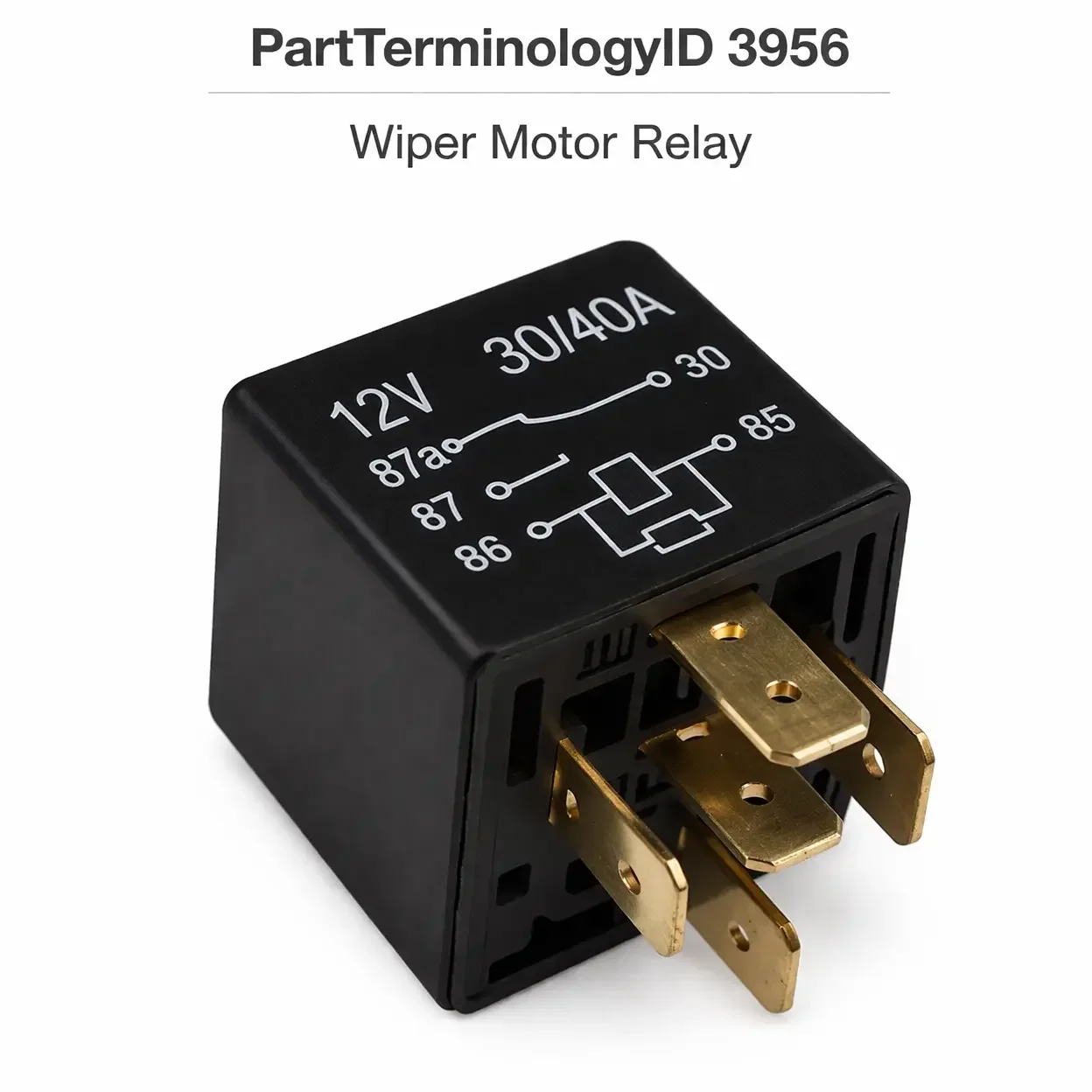
PartTerminologyID 3956, Wiper Motor Relay, is the relay that switches power to the windshield wiper motor, enabling the wiper control module, BCM, or multifunction stalk switch to activate low-speed, high-speed, or intermittent wiper operation. That definition covers the wiper motor switching function correctly and leaves unresolved whether the relay controls the low-speed wiper circuit, the high-speed wiper circuit, or both through separate relay contacts on a dual-relay architecture, the park switch circuit that allows the wiper motor to complete its current sweep and return to the parked position after the wiper stalk is turned off, whether the relay is a normally closed park circuit relay that holds the motor run circuit active until the park switch opens at the parked blade position or a normally open relay that activates only on direct stalk or module command, the wiper control module or BCM output driver type and coil resistance tolerance, and whether the wiper motor relay is shared with the washer pump relay on vehicles where a single relay output activates both the wiper motor and washer pump simultaneously during a combined wash-and-wipe cycle.
For sellers, PartTerminologyID 3956 is the wiper motor relay where the park circuit relay architecture is the most return-generating architectural attribute, because the park switch relay on most wiper systems holds the motor run circuit active after the stalk is turned off until the wiper blades reach the parked position, and a misunderstanding of this normally closed park relay behavior generates the highest volume of incorrect relay replacements. A buyer who turns off the wipers and finds the blades stop mid-sweep rather than returning to the parked position has either a failed park switch relay that opens the motor circuit before the blades reach park, or a failed park switch inside the motor that never signals the relay to open. Both produce identical mid-sweep stop symptoms and require different repairs. The listing must identify the park circuit relay architecture and the park switch as separate diagnostic components to prevent relay replacement when the park switch is the actual fault source.
What the Wiper Motor Relay Does
Low-speed relay versus high-speed relay and the dual-relay architecture
Wiper motors on most vehicles use two separate brush circuits to produce low-speed and high-speed wiper operation. On single-relay applications one relay switches the active speed circuit based on stalk position. On dual-relay applications a dedicated low-speed relay and a separate high-speed relay switch their respective motor circuits independently. A fitment claim that assigns a single relay part number to a dual-relay application will deliver the correct relay for one speed circuit while the other speed circuit remains unaddressed, producing a symptom of one wiper speed operating correctly and one speed not operating that the buyer may attribute to the replacement relay being incorrect when the second relay was never replaced.
High-speed wiper motors draw 8 to 15 amperes at startup and 4 to 8 amperes at steady state. Low-speed operation draws 3 to 6 amperes. A relay contact rated for low-speed current only applied to a high-speed application will overheat from the higher startup inrush on the high-speed circuit. The listing must specify which wiper speed circuit the relay controls and the contact current rating must reflect the inrush and steady-state current of that specific circuit.
Park switch circuit and the mid-sweep blade stop misdiagnosis
The park switch circuit on wiper motor relay applications uses a cam-operated switch inside the wiper motor that opens when the wiper blades reach the parked position. The relay that controls the park circuit is typically normally closed, holding the motor run circuit active after the stalk is turned off. The motor continues running, driving the blades through their current arc back to the park position. When the blades reach park the cam opens the park switch, which signals the relay to open the motor circuit and stop the motor.
A normally closed park relay that has failed open will interrupt the motor circuit immediately when the stalk is turned off, stopping the blades wherever they are in their arc at that moment. A park switch inside the motor that has failed open will never signal the relay to open, causing the blades to cycle continuously past the park position rather than stopping. A park switch that has failed closed will signal the relay to open immediately, producing the same mid-sweep stop as a failed open park relay. All three faults produce mid-sweep blade stop symptoms that are indistinguishable without isolating the park switch circuit from the relay contact.
Why This Part Generates Returns
Buyers return wiper motor relays because the park switch inside the wiper motor has failed and the relay is correctly following the park switch signal it receives, the wiper control module or BCM output driver for the relay coil has failed and the relay correctly receives no activation signal despite a functional stalk input, the relay is a dual-relay application and only one relay was replaced while the second relay for the other speed circuit also requires replacement, the wiper motor armature has a high-resistance winding fault that draws insufficient current to operate at the commanded speed but does not draw enough excess current to damage the relay, and the relay contact is rated for low-speed current and is installed on a high-speed circuit application where repeated inrush current is degrading the contact.
Status in New Databases
PartTerminologyID 3956 is cataloged in PIES/PCdb as Wiper Motor Relay. Under PIES 8.0 and PCdb 2.0 there is no change to the terminology or classification for this PartTerminologyID.
Top Return Scenarios
Scenario 1: "Failed park switch inside motor, blades stop mid-sweep, relay replaced with no change"
The wiper blades stop mid-sweep when the stalk is turned off. The park switch cam inside the wiper motor has a worn contact that produces an intermittent or false open signal before the blades reach the parked position. The park relay receives the false open signal and interrupts the motor circuit mid-sweep. The buyer replaces the park relay. The park switch fault remains. The replacement relay receives the same false open signal from the faulty park switch. No change in blade behavior.
Prevention language: "Park switch validation: The wiper park relay opens the motor circuit only when the park switch inside the wiper motor signals the parked blade position. A failed park switch that produces a false open signal before the blades reach park will cause the replacement relay to stop the motor mid-sweep identically to a failed relay contact. Confirm the park switch signal at the relay coil circuit before replacing the relay on a mid-sweep stop complaint."
Scenario 2: "BCM output driver fault, stalk input valid, wiper relay coil receives no activation voltage"
The wipers do not operate when the stalk is engaged. The stalk switch is sending a valid wiper input to the BCM. The BCM output driver pin for the wiper motor relay coil has failed open internally. No coil activation voltage is present at the relay socket. The buyer replaces the relay. The BCM driver fault remains. The replacement relay also receives no coil activation voltage. No change in wiper operation.
Prevention language: "BCM output driver validation: On this application the wiper motor relay coil is activated by a BCM output driver, not directly by the stalk switch. Confirm BCM output voltage is present at the relay coil terminal with the stalk engaged before replacing the relay. No coil voltage with a confirmed valid stalk input indicates a BCM output driver fault rather than a relay fault."
Scenario 3: "Dual-relay application, one speed relay replaced, second speed relay also failed, partial wiper operation"
The wipers operate at low speed but not at high speed. The vehicle uses a dual-relay architecture with a dedicated low-speed relay and a separate high-speed relay. The buyer replaces the high-speed relay. Low-speed operation is unchanged. High-speed operation restores briefly but then fails again because the low-speed relay, which was also degraded, has now failed completely under the increased demand of being the only functional relay in the circuit. The buyer returns the high-speed relay as failing prematurely.
Prevention language: "Dual relay architecture: This application uses separate low-speed and high-speed wiper motor relays. When one speed circuit relay fails, the second relay on the same motor circuit should be inspected and replaced at the same service interval. A degraded second relay will fail shortly after the first relay is replaced, producing a repeat repair on a different speed circuit."
Scenario 4: "Wiper motor armature fault, reduced motor speed, misdiagnosed as relay contact voltage drop"
The wiper motor armature has a high-resistance winding fault that reduces motor speed below the commanded rate. The buyer observes slow wiper operation and measures voltage at the motor terminals during operation, finding correct relay contact voltage delivery. The buyer attributes the slow speed to relay contact resistance and replaces the relay. The armature fault remains. The replacement relay delivers the same voltage to the same degraded motor. No change in wiper speed.
Prevention language: "Wiper motor pre-check: Slow or intermittent wiper operation with correct voltage delivered at the motor terminals indicates a wiper motor fault rather than a relay fault. A relay that delivers correct voltage to a degraded motor is functioning correctly. Confirm motor operating speed against specification before diagnosing a relay contact fault on a slow wiper complaint."
Listing Requirements
PartTerminologyID: 3956
Controlled speed circuit: low-speed, high-speed, or park circuit (mandatory)
Relay architecture: single relay or dual relay per speed circuit (mandatory)
Contact type: normally open or normally closed park relay (mandatory)
Contact current rating: high-speed inrush and steady-state or low-speed (mandatory)
Park switch circuit description and park switch validation note (mandatory)
Coil resistance within control module or BCM driver tolerance (mandatory)
BCM output driver validation note on module-commanded applications (mandatory)
OEM part number cross-reference (mandatory)
Catalog Checklist for ACES/PIES Teams
PartTerminologyID = 3956
Require controlled speed circuit: low-speed, high-speed, or park (mandatory)
Require relay architecture: single or dual relay (mandatory)
Require contact type: normally open or normally closed (mandatory)
Require contact current rating matched to controlled speed circuit (mandatory)
Prevent park switch misdiagnosis: park switch fault inside wiper motor produces identical mid-sweep stop to failed park relay; park switch validation is required before relay replacement on mid-sweep stop complaints
Prevent BCM driver fault relay return: no coil voltage on BCM-commanded applications does not confirm a relay fault; BCM output driver validation is required before relay diagnosis
Prevent dual-relay partial replacement: both speed circuit relays should be inspected when one fails; degraded second relay will fail shortly after first replacement
FAQ (Buyer Language)
Why do my wipers stop in the middle of the windshield instead of returning to the parked position?
Mid-sweep blade stop is most commonly caused by a failed park switch inside the wiper motor rather than a failed park relay. The park switch signals the relay when the blades reach the parked position. A park switch fault that produces a premature open signal stops the motor before the blades reach park. Confirm the park switch signal is correct before replacing the park relay.
How do I know if my vehicle uses one wiper relay or two?
Check whether your vehicle has separate high-speed and low-speed wiper operation. Dual-relay architectures typically have one relay per speed circuit. Consult the fuse and relay diagram for your vehicle to confirm whether one or two wiper motor relays are present before ordering. Replacing only one relay on a dual-relay application leaves the second relay unaddressed.
My wipers work at low speed but not high speed. Is it the relay?
A single non-functioning wiper speed on a dual-relay application points to the relay for that specific speed circuit rather than a wiper motor fault, because the motor is confirmed functional at the other speed. Confirm the relay for the non-functioning speed circuit is receiving coil activation voltage before replacing it. No coil voltage indicates a control module or stalk switch fault upstream of the relay.
Can a wiper motor fault cause the relay to fail?
A wiper motor with a seized armature or shorted winding will draw excess current through the relay contact and accelerate contact degradation. A motor drawing significantly above its rated current will weld the relay contact over repeated activation cycles. Measure motor current draw and compare to the rated specification before installing a replacement relay on an application with a history of repeated relay failures.
Why do my wipers keep running after I turn them off?
Wipers that continue past the parked position and cycle continuously indicate a park switch fault that prevents the park relay from receiving the stop signal. The relay holds the motor circuit active because the park switch never signals the parked blade position. Inspect the park switch inside the wiper motor before replacing the park relay on a continuous-run complaint.
What Sellers Get Wrong About PartTerminologyID 3956
The most common error is omitting the park switch circuit description from the listing. The park relay is a normally closed relay that holds the motor circuit active until the park switch signals the parked position. A buyer who does not understand this architecture replaces the park relay when the blades stop mid-sweep and finds no change because the park switch inside the motor was the fault source all along. The listing that describes the park circuit relay architecture and identifies the park switch as a separate diagnostic component that must be validated before relay replacement prevents this scenario and redirects the buyer to the correct repair.
The second error is omitting the dual-relay architecture note. A buyer who replaces only the failed speed circuit relay on a dual-relay application returns within weeks with the second speed circuit failing. Without the dual-relay note the buyer has no reason to inspect the second relay during the first repair. Adding the dual-relay note as a service interval guidance converts a repeat return into a single complete repair.
The third error is omitting the BCM output driver validation note on module-commanded applications. A BCM output driver fault produces no coil activation voltage at the relay socket, which presents identically to a failed relay. Without the validation note buyers replace the relay and find no change because the BCM driver fault was the actual fault source throughout.
Cross-Sell Logic
Wiper Motor: for buyers where the relay is confirmed delivering correct switched voltage to the motor terminals but wiper speed is slow, intermittent, or absent, indicating a wiper motor armature fault, brush wear, or seized bearing rather than a relay fault.
Park Switch or Wiper Motor Assembly: for buyers where mid-sweep blade stop is confirmed and park switch signal validation at the relay circuit confirms the park switch inside the motor is producing a false or premature open signal rather than a relay contact fault.
BCM or Wiper Control Module: for buyers where the relay coil receives no activation voltage despite a confirmed valid stalk input, indicating a BCM or wiper control module output driver fault on the wiper motor relay coil output.
Multifunction Stalk Switch: for buyers on direct stalk-switched applications where the relay coil receives no activation voltage with the stalk engaged, indicating a failed stalk switch internal contact rather than a relay or module fault.
Windshield Washer Relay: on applications where the wiper motor relay and washer pump relay share a combined wash-and-wipe activation circuit, a washer pump fault that draws excess current through a shared relay contact affects both the wiper and washer circuits and both components should be confirmed before relay replacement.
Why Catalog Data Quality Matters for PartTerminologyID 3956
Wiper motor relay returns cluster around three scenarios that are fully preventable with listing language: the park switch misdiagnosis, the BCM driver fault misdiagnosis, and the dual-relay partial replacement. The park switch misdiagnosis generates returns because the buyer replaced a park relay that was correctly following a faulty park switch signal. The BCM driver fault misdiagnosis generates returns because the buyer replaced a relay that was receiving no coil voltage due to a BCM driver fault rather than a relay fault. The dual-relay partial replacement generates returns because the buyer replaced only one relay on a dual-relay application and the second relay failed shortly after.
None of these scenarios reflect a product defect. All three reflect missing listing information. The park circuit description, the BCM output driver validation note, and the dual-relay architecture disclosure together address the three scenarios that account for the majority of returns under this PartTerminologyID. Each attribute requires one to two sentences in the listing and all three are absent in most aftermarket listings for this PartTerminologyID.
Application Range and Fitment Guidance for PartTerminologyID 3956
Wiper motor relay applications span vehicles from the late 1960s when relay-switched wiper motor circuits replaced direct-switched wiper systems through the present. Early applications used simple stalk-direct relay switching with mechanical park switch circuits and no BCM intermediary. Applications from the mid-1990s onward increasingly route stalk inputs through the BCM or a dedicated wiper control module before commanding the relay, adding the module output driver as a diagnostic component that early applications did not include.
The park switch relay architecture is common across domestic, European, and Asian vehicles throughout the application period. Park switch relay design varies between normally closed park relay implementations that hold the motor circuit active until the park switch opens and normally open implementations where the park switch directly energizes the relay coil to maintain motor operation through the park arc. Fitment claims must identify which park relay architecture applies to the specific vehicle to prevent a normally open relay being installed on a normally closed application or vice versa.
Dual-relay wiper motor architectures are common on vehicles with high-speed wiper circuits drawing above 10 amperes where a single relay contact would be oversized for low-speed operation or undersized for high-speed operation. European vehicles and larger domestic vehicles with extended wiper blade travel are more likely to use dual-relay architectures than compact vehicles with standard wiper systems.
Final Take for PartTerminologyID 3956
Wiper Motor Relay (PartTerminologyID 3956) is the wiper activation relay where park circuit architecture disclosure, dual-relay identification, and BCM output driver validation are the three attributes that prevent the three most common return scenarios. Every listing without park circuit disclosure sends buyers through a relay replacement that changes nothing because the park switch inside the motor was the fault source. Every listing without dual-relay identification leaves buyers with a partially repaired wiper system that generates a repeat return when the second relay fails. Every listing without BCM output driver validation sends BCM-commanded application buyers through a relay replacement that changes nothing because the BCM driver fault remains.
The park circuit architecture disclosure and the BCM output driver validation note together address the two scenarios that account for the largest share of returns under this PartTerminologyID. Park switch misdiagnosis generates the frustrated-buyer return where the relay was functional and nothing changed. BCM driver misdiagnosis generates the same frustrated-buyer return from a different diagnostic path. Adding both notes to the listing converts both return scenarios into either correct orders or correct prior diagnoses that prevent the order entirely.
Dual-relay disclosure and wiper motor pre-check complete the set of attributes that ensure every buyer under this PartTerminologyID receives a relay that matches their circuit's functional requirements before installation begins.
Together with park circuit disclosure and BCM output driver validation, these four attributes make every listing under this PartTerminologyID complete.