
Written by Arthur Simitian | PartsAdvisory
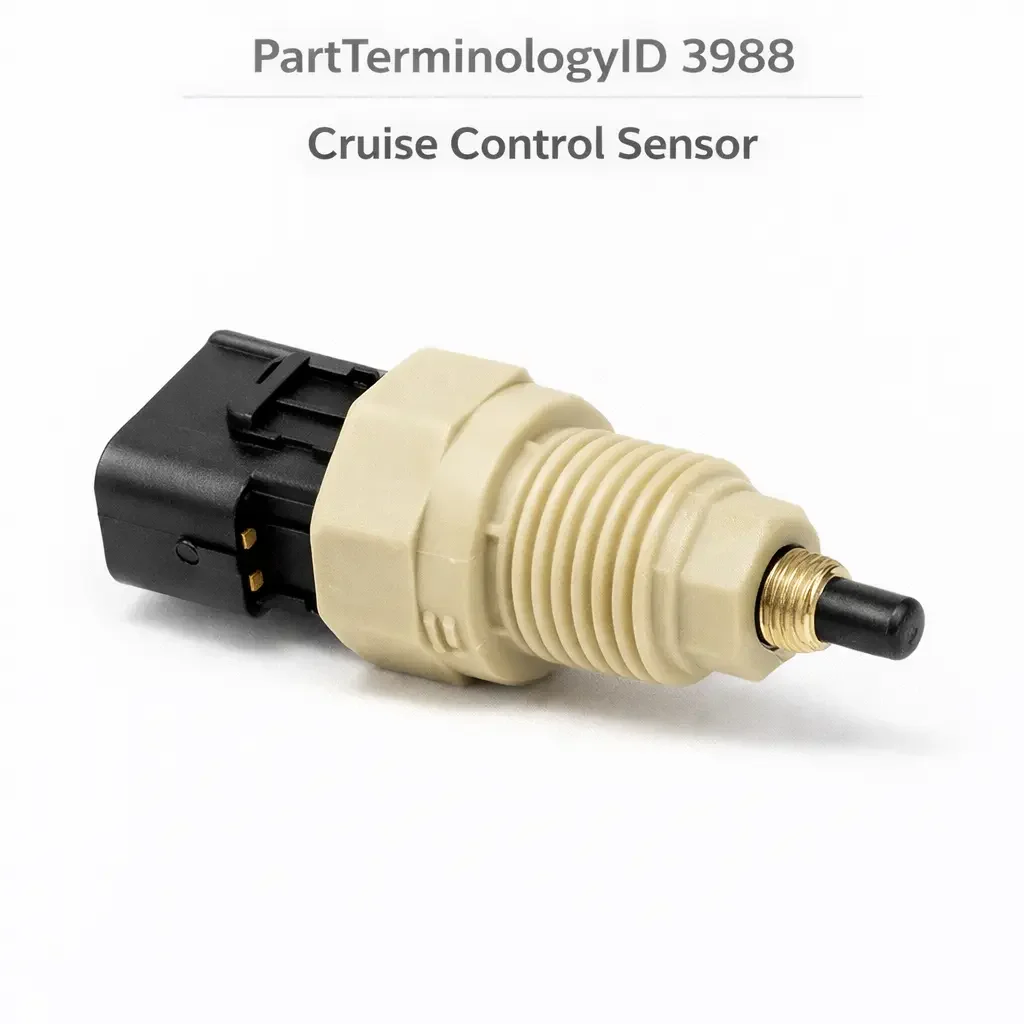
PartTerminologyID 3988, Cruise Control Sensor, is the sensor that provides vehicle speed or throttle position data to the cruise control module or PCM to enable set-speed maintenance, acceleration, and deceleration commands during cruise control operation. That definition covers the cruise control sensing function correctly and leaves unresolved whether the sensor measures vehicle speed from a transmission output shaft, a wheel speed signal, or a dedicated cruise control speed pickup that is separate from the ABS wheel speed sensor network, whether the sensor output is a magnetic reluctance signal, a Hall-effect digital pulse, or an analog voltage that the cruise control module interprets as vehicle speed, the signal frequency or voltage range that the cruise control module requires to confirm a valid speed input before engaging, whether the sensor is shared with the speedometer circuit and an instrument cluster speed display fault will present simultaneously with a cruise control engagement fault, and whether the cruise control sensor on this application is a discrete replaceable sensor or is integrated into the vehicle speed sensor assembly that serves multiple systems simultaneously.
For sellers, PartTerminologyID 3988 is the cruise control sensor where the shared vehicle speed signal architecture is the most return-generating attribute, because the vehicle speed signal on most current applications is generated by a single sensor that feeds the PCM, ABS module, instrument cluster, and cruise control module simultaneously from one output. A cruise control that will not engage may reflect a failed vehicle speed sensor that is also affecting the speedometer and ABS system, or it may reflect a cruise control module fault that cannot process a valid speed signal it is receiving correctly. A buyer who replaces the cruise control sensor and finds no change in cruise control engagement may have a cruise control module fault, a stalk switch fault, a brake pedal switch fault that is signaling the module to disengage, or a vehicle speed signal that is valid at the sensor but has an open circuit between the sensor output and the cruise control module input. All of these produce identical no-engage symptoms without signal path isolation.
What the Cruise Control Sensor Does
Dedicated cruise control speed pickup versus shared vehicle speed sensor
Older vehicles from the late 1970s through the early 1990s frequently used a dedicated cruise control speed transducer mounted at the transmission output shaft or speedometer cable drive, separate from any ABS or PCM vehicle speed sensor. These dedicated sensors produced an analog voltage or pulse signal used exclusively by the cruise control amplifier module. A fault in this sensor affected cruise control operation only and did not produce a speedometer error or ABS fault code. Diagnosis on these applications was isolated to the cruise control circuit without cross-system effects.
Current applications use the ABS wheel speed sensor network or a single transmission output shaft speed sensor as the vehicle speed source for all systems including cruise control. The cruise control module receives its speed input from the PCM or directly from the ABS module rather than from a dedicated sensor. A failed vehicle speed sensor on these applications produces simultaneous faults across the speedometer, ABS, traction control, and cruise control systems. A buyer who has an ABS fault code and a non-functioning cruise control on the same vehicle has a vehicle speed sensor fault rather than a discrete cruise control sensor fault, and the part to order is the vehicle speed sensor or ABS wheel speed sensor rather than a part cataloged under PartTerminologyID 3988.
Signal validation threshold and the no-engage speed requirement
The cruise control module requires the vehicle speed signal to exceed a minimum engagement threshold, typically 25 to 35 mph depending on the manufacturer, before allowing the driver to set the cruise speed. A vehicle speed signal that is present but reading below the engagement threshold due to a signal frequency error, a reluctance sensor air gap that is too large, or a tone ring with missing or damaged teeth will prevent cruise control engagement without generating a diagnostic fault code on some implementations. The module receives a speed signal and considers the system functional but will not engage because the commanded speed is below the minimum threshold from the module's perspective.
A buyer who cannot engage cruise control at highway speed on a vehicle with an oversized reluctance sensor air gap may find no fault codes, a functioning speedometer showing correct speed, and a cruise control module that is receiving a signal but interpreting the frequency as a below-threshold speed due to the reduced signal amplitude from the excessive air gap. Air gap adjustment or sensor repositioning resolves the engagement fault without sensor replacement on these applications.
Why This Part Generates Returns
Buyers return cruise control sensors because the cruise control module itself has failed and cannot process a valid speed signal it is receiving correctly, the brake pedal position switch has failed in the applied position and is continuously signaling the cruise control module to disengage regardless of pedal position, the cruise control stalk switch has an internal fault that prevents the set or resume commands from reaching the module despite a valid speed signal being present, the vehicle speed signal is valid at the sensor output but has an open or high-resistance connection between the sensor and the cruise control module input terminal, and the sensor is a shared vehicle speed sensor that serves ABS and PCM functions and the returning buyer ordered under PartTerminologyID 3988 when the correct part is cataloged under the vehicle speed sensor or ABS sensor terminology.
Status in New Databases
PartTerminologyID 3988 is cataloged in PIES/PCdb as Cruise Control Sensor. Under PIES 8.0 and PCdb 2.0 there is no change to the terminology or classification for this PartTerminologyID.
Top Return Scenarios
Scenario 1: "Brake pedal switch failed applied, module receives continuous disengage signal, cruise will not engage"
The buyer's cruise control will not engage at any speed. The brake pedal position switch has failed in the applied state and continuously sends a brake-applied signal to the cruise control module. The module interprets this as a continuous brake application and will not authorize engagement. The buyer replaces the cruise control sensor. The brake switch fault remains. The module continues receiving a continuous disengage signal. No change in cruise control behavior.
Prevention language: "Brake pedal switch validation: The cruise control module will not engage when it receives a brake-applied signal from the brake pedal position switch. A brake pedal switch that has failed in the applied state sends a continuous disengage signal regardless of pedal position. Confirm the brake pedal switch releases correctly and sends a non-applied signal to the cruise control module before diagnosing a sensor fault on a no-engage complaint."
Scenario 2: "Stalk switch fault, set and resume commands not reaching module, valid speed signal present"
The buyer's cruise control will not set or resume despite the vehicle reaching engagement speed. The cruise control stalk switch has an internal contact fault that prevents the set and resume commands from reaching the cruise control module input. The module receives a valid speed signal but never receives a set command to activate. The buyer replaces the cruise control sensor. The stalk switch fault remains. No change in cruise control behavior.
Prevention language: "Stalk switch input validation: Cruise control that will not set or resume despite reaching engagement speed may reflect a stalk switch fault rather than a sensor fault. Confirm the stalk switch is delivering set and resume command signals to the cruise control module input before diagnosing a sensor fault. A module receiving a valid speed signal but no stalk command will not engage regardless of sensor condition."
Scenario 3: "Open circuit between sensor output and module input, sensor replaced with no change"
The cruise control sensor output signal is valid at the sensor connector. An open circuit exists in the wiring between the sensor output terminal and the cruise control module input terminal due to a corroded connector pin or a chafed wire in the harness. The cruise control module receives no speed signal. The buyer replaces the sensor. The open circuit remains between the new sensor output and the module input. No change in cruise control engagement.
Prevention language: "Signal path continuity check: Confirm the vehicle speed signal is present at the cruise control module input terminal, not only at the sensor output connector, before replacing the sensor. An open circuit or high-resistance connection in the wiring between the sensor output and the module input will prevent the module from receiving a valid speed signal regardless of sensor condition."
Scenario 4: "Shared VSS cataloged under wrong terminology, buyer orders cruise control sensor, correct part is ABS wheel speed sensor"
The buyer has simultaneous faults across the speedometer, ABS warning light, and cruise control on a current-generation vehicle. The vehicle speed signal is generated by a single ABS wheel speed sensor that feeds all systems. The buyer searches for a cruise control sensor and finds a listing under PartTerminologyID 3988. The listing does not note that this application uses a shared ABS wheel speed sensor rather than a discrete cruise control sensor. The buyer installs the part. The ABS fault code remains because the ABS wheel speed sensor is the correct replacement part on this application.
Prevention language: "Shared sensor architecture note: On this application the cruise control speed input is derived from the ABS wheel speed sensor network rather than a discrete cruise control sensor. Simultaneous faults across the speedometer, ABS, and cruise control systems indicate a vehicle speed sensor or ABS wheel speed sensor fault rather than a discrete cruise control sensor fault. Confirm which sensor architecture your vehicle uses before ordering under this PartTerminologyID."
Listing Requirements
PartTerminologyID: 3988
Sensor type: dedicated cruise control pickup or shared VSS input (mandatory)
Signal output type: magnetic reluctance, Hall-effect digital, or analog voltage (mandatory)
Minimum engagement speed threshold where applicable (mandatory)
Air gap specification for reluctance sensors (mandatory)
Brake pedal switch validation note (mandatory)
Stalk switch input validation note (mandatory)
Signal path continuity check note (mandatory)
Shared sensor architecture note where applicable (mandatory)
OEM part number cross-reference (mandatory)
Catalog Checklist for ACES/PIES Teams
PartTerminologyID = 3988
Require sensor type: dedicated or shared VSS (mandatory)
Require signal output type (mandatory)
Require air gap specification for reluctance sensor applications (mandatory)
Require brake pedal switch validation note (mandatory)
Require stalk switch input validation note (mandatory)
Prevent shared architecture mismatch: current applications that derive cruise control speed from ABS wheel speed sensors should note the shared architecture to prevent orders under 3988 when the correct part is cataloged under VSS or ABS sensor terminology
Prevent brake switch misdiagnosis: a brake pedal switch failed in the applied state produces identical no-engage symptom to a failed speed sensor; brake switch validation is a mandatory pre-diagnosis step
Prevent signal path return: valid sensor output with open circuit between sensor and module produces no-engage symptom identical to failed sensor; module input terminal signal check is required before sensor replacement
FAQ (Buyer Language)
Why will my cruise control not engage even though the speedometer reads correctly?
A functioning speedometer with non-engaging cruise control indicates the vehicle speed signal is reaching the instrument cluster but may not be reaching the cruise control module input. Confirm the speed signal is present at the cruise control module input terminal. Also confirm the brake pedal switch is releasing correctly and the stalk switch is sending valid set commands to the module. All three inputs must be valid for cruise control to engage.
How do I check if the brake pedal switch is preventing cruise control from engaging?
With the brake pedal fully released, confirm the brake pedal switch is sending a non-applied signal to the cruise control module. On most applications a test light or multimeter at the brake switch output terminal will show no voltage with the pedal released and voltage when the pedal is applied. A switch that shows voltage at the module input with the pedal fully released has failed in the applied position and is continuously preventing engagement.
My cruise control worked yesterday but does not engage today. What changed?
Intermittent cruise control loss is commonly caused by an intermittent brake pedal switch contact, an intermittent stalk switch contact, or an intermittent speed signal connection rather than a sensor failure. Confirm all three inputs are present and stable before replacing the sensor on an intermittent engagement complaint.
Can a bad ABS wheel speed sensor cause cruise control to stop working?
Yes on current-generation vehicles where the cruise control module receives its speed input from the ABS wheel speed sensor network through the PCM. A failed ABS wheel speed sensor that causes simultaneous ABS, speedometer, and cruise control faults indicates the vehicle speed signal source is the failed component rather than a discrete cruise control sensor. The correct replacement part on these applications is the ABS wheel speed sensor, not a part cataloged under PartTerminologyID 3988.
What is the minimum speed required for cruise control to engage?
Minimum engagement speed varies by manufacturer and is typically 25 to 35 mph. A vehicle speed signal that reads below this threshold at the cruise control module, due to an excessive reluctance sensor air gap or a damaged tone ring, will prevent engagement even at highway speeds where the speedometer reads correctly. Confirm the speed signal amplitude and frequency at the module input match the manufacturer specification if the module is receiving a signal but will not engage at confirmed highway speed.
What Sellers Get Wrong About PartTerminologyID 3988
The most common error is omitting the shared sensor architecture note on current-generation vehicle applications. Most vehicles produced after the mid-1990s do not use a discrete cruise control sensor. The cruise control speed input comes from the ABS wheel speed sensor network or a shared transmission output shaft sensor. A buyer who experiences simultaneous ABS, speedometer, and cruise control faults and orders a part under PartTerminologyID 3988 on one of these applications will receive a part that does not address the actual failed component. The listing that identifies the shared sensor architecture and redirects buyers with multi-system faults to the correct VSS or ABS sensor terminology prevents this cross-terminology return.
The second error is omitting the brake pedal switch validation note. The brake pedal switch is the single most common cause of cruise control no-engage complaints that result in sensor replacement. A brake switch failed in the applied position sends a continuous disengage command that overrides every other input to the module. Without the brake switch validation note buyers have no reason to check the switch before ordering a sensor and the return is inevitable when the switch is the actual fault source.
The third error is omitting the signal path continuity check note. A valid sensor output with an open circuit between the sensor connector and the module input terminal produces a no-engage symptom that is indistinguishable from a failed sensor at the sensor connector. Buyers who replace the sensor and find no change because the open circuit in the harness was the actual fault source return the sensor as non-functional when it was never the fault source.
Cross-Sell Logic
Brake Pedal Position Switch: for buyers where cruise control will not engage at any speed and brake pedal switch validation confirms the switch is sending a continuous applied signal to the cruise control module regardless of pedal position.
Cruise Control Stalk Switch: for buyers where the speed signal is confirmed valid at the module input and the brake switch is confirmed releasing correctly, but the module will not respond to set or resume commands, indicating a stalk switch internal contact fault preventing command signals from reaching the module.
ABS Wheel Speed Sensor: for buyers with simultaneous ABS warning, speedometer error, and cruise control failure on current-generation vehicles where the cruise control speed input is derived from the ABS wheel speed sensor network rather than a discrete cruise control sensor.
Cruise Control Module: for buyers where the speed signal is confirmed valid at the module input, the brake switch is confirmed releasing correctly, and the stalk switch is confirmed delivering valid set commands, but the cruise control will not engage, indicating a module internal processing fault.
Vehicle Speed Sensor: for buyers on older applications where a dedicated transmission output shaft VSS serves both the speedometer and cruise control and simultaneous speedometer and cruise control faults point to the shared sensor rather than a discrete cruise control sensor fault.
Why Catalog Data Quality Matters for PartTerminologyID 3988
Cruise control sensor returns cluster around three scenarios that are fully preventable with listing language: the shared sensor architecture mismatch, the brake pedal switch misdiagnosis, and the signal path open circuit misdiagnosis. The shared architecture mismatch generates returns because the buyer ordered under PartTerminologyID 3988 when the correct part was an ABS wheel speed sensor or VSS cataloged under different terminology. The brake switch misdiagnosis generates returns because the buyer replaced a sensor that was delivering a valid signal to a module that was being told to disengage by a stuck brake switch. The signal path open circuit misdiagnosis generates returns because the buyer replaced a functional sensor when the fault was in the wiring between the sensor and the module.
None of these scenarios reflect a product defect. All three reflect missing listing information. The shared sensor architecture note, the brake pedal switch validation note, and the signal path continuity check note together address the three scenarios that account for the majority of returns under this PartTerminologyID. Each attribute requires one to two sentences in the listing and all three are absent in most aftermarket listings for this PartTerminologyID.
Application Range and Fitment Guidance for PartTerminologyID 3988
Cruise control sensor applications under PartTerminologyID 3988 are most concentrated in vehicles produced from the late 1970s through the mid-1990s when dedicated cruise control speed transducers were common equipment on vehicles with factory cruise control. These sensors were mounted at the transmission output shaft, speedometer cable drive, or a dedicated pickup point on the driveline and produced signals used exclusively by the cruise control amplifier or module.
From the mid-1990s onward the cruise control speed input transitioned to shared sensor architectures on most platforms. Discrete cruise control sensor applications under PartTerminologyID 3988 become increasingly rare in the post-1995 vehicle population as OBD II systems standardized vehicle speed signal distribution through the PCM. Fitment claims under PartTerminologyID 3988 for post-1995 vehicles should be reviewed carefully to confirm the vehicle uses a discrete cruise control sensor rather than a shared VSS or ABS-derived speed input.
Magnetic reluctance cruise control sensors require air gap adjustment to the tone ring during installation. An air gap that is too large reduces signal amplitude below the module input threshold and prevents engagement. An air gap that is too small risks sensor contact with the rotating tone ring at operating temperature when the sensor housing expands thermally. Air gap specification is a mandatory listing attribute for reluctance sensor applications and is absent in most aftermarket fitment claims for this PartTerminologyID.
Final Take for PartTerminologyID 3988
Cruise Control Sensor (PartTerminologyID 3988) is the speed sensing component where shared sensor architecture disclosure, brake pedal switch validation, and signal path continuity check are the three attributes that prevent the three most common return scenarios. Every listing without shared architecture disclosure risks a buyer ordering under 3988 when the correct part is an ABS wheel speed sensor or VSS on a current-generation vehicle. Every listing without the brake pedal switch validation note risks a sensor replacement that changes nothing because the module was being continuously commanded to disengage by a stuck brake switch. Every listing without the signal path continuity check note risks a sensor replacement that changes nothing because the fault was an open circuit in the harness between the sensor and the module.
The shared sensor architecture note and the brake pedal switch validation note together address the two scenarios that account for the largest share of returns under this PartTerminologyID. Architecture mismatch generates the cross-terminology return where the correct part was in a different category. Brake switch misdiagnosis generates the frustrated-buyer return where the sensor was functional and nothing changed. Adding both notes to the listing converts both return scenarios into either correct orders under the correct terminology or correct prior diagnoses that prevent the order entirely.
Signal path continuity check and stalk switch input validation complete the set of attributes that ensure every buyer under this PartTerminologyID receives a sensor that matches their circuit's functional requirements before installation begins.
Together with shared architecture disclosure and brake pedal switch validation, these four attributes make every listing under this PartTerminologyID complete.