
Written by Arthur Simitian | PartsAdvisory
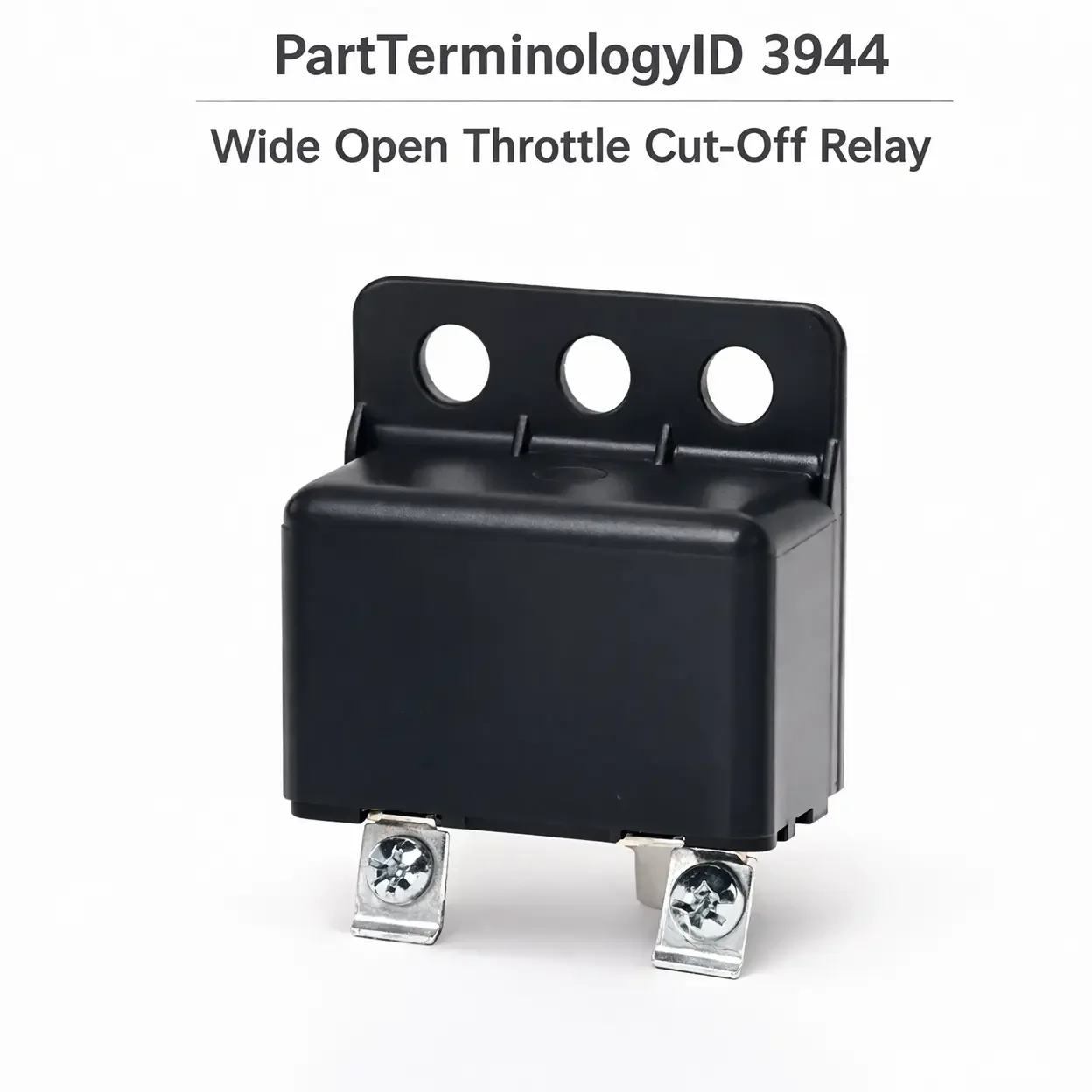
PartTerminologyID 3944, Wide Open Throttle Cut-Off Relay, is the relay that interrupts power to a high-draw accessory circuit when the PCM or ECM detects a wide open throttle condition, allowing the engine to dedicate full available power to acceleration by shedding accessory electrical load at the moment maximum engine output is demanded. That definition covers the WOT accessory cut-off switching function correctly and leaves unresolved which accessory circuit the relay interrupts on a given vehicle application, as the cut-off target varies by manufacturer and may include the air conditioning compressor clutch, the electric cooling fan high-speed circuit, the power steering pump motor on electrically assisted systems, or a combined accessory load bus that sheds multiple accessories simultaneously at WOT, the throttle position threshold at which the PCM commands the relay to open, whether the relay is normally closed so that it holds the accessory circuit active during all non-WOT conditions and opens only at WOT or is normally open so that it must be actively held closed during normal operation, the PCM output driver type that controls the relay coil, and whether the relay returns the interrupted accessory circuit to active state immediately upon throttle position dropping below the WOT threshold or introduces a timed delay before restoring the accessory load to prevent compressor clutch cycling at the WOT threshold boundary.
For sellers, PartTerminologyID 3944 is the WOT cut-off relay where the normally closed contact architecture is the most return-generating architectural attribute, because the relay on most WOT cut-off applications is normally closed and the accessory circuit it protects is active whenever the relay is not being commanded open by the PCM. A normally closed relay that has failed open will interrupt the accessory circuit continuously, producing a symptom of a permanently disabled accessory that appears identical to a PCM-commanded WOT cut-off that is stuck active. A buyer who finds the air conditioning inoperative at all throttle positions has either a failed normally closed relay contact that is open at rest, or a PCM output driver that is continuously commanding the relay open regardless of throttle position. Both produce the same symptom and require different repairs. The listing must identify the normally closed architecture and the distinction between a failed-open relay contact and a PCM output fault to prevent relay replacement when the PCM driver is the actual fault source.
What the Wide Open Throttle Cut-Off Relay Does
Normally closed contact architecture and the resting state accessory supply
The WOT cut-off relay on most applications uses a normally closed contact that completes the accessory circuit at rest with no coil energization. The PCM energizes the relay coil only at WOT to open the normally closed contact and interrupt the accessory circuit. During all normal driving conditions below the WOT threshold the relay coil is de-energized and the contact is closed, supplying the accessory circuit without any active PCM command. This architecture means the relay must hold the accessory circuit closed reliably for the full operating life of the vehicle at all non-WOT conditions, and must open cleanly and quickly when the PCM commands WOT cut-off.
A normally closed relay with a contact that has developed high resistance from arcing or corrosion will supply reduced voltage to the accessory during normal operation, producing a degraded accessory performance symptom that is unrelated to WOT conditions. A buyer who notices weak air conditioning performance during normal driving, not only at WOT, may have a degraded normally closed contact rather than a PCM activation fault. The listing must make the normally closed architecture explicit so buyers understand that the relay is active during normal driving and that contact degradation affects everyday operation rather than only WOT cut-off events.
PCM throttle position threshold and the accessory restoration delay
The PCM monitors throttle position sensor input and commands the WOT cut-off relay coil to energize when the throttle position exceeds the WOT threshold, typically 90 to 100 percent throttle angle depending on the manufacturer's calibration. The relay contact opens, interrupting the accessory circuit. When throttle position drops below the threshold, the PCM de-energizes the relay coil and the normally closed contact returns to the closed position, restoring the accessory circuit.
On applications where the interrupted accessory is an air conditioning compressor clutch, some PCM calibrations introduce a brief delay before restoring the compressor to prevent compressor clutch cycling when throttle position oscillates near the WOT threshold during performance driving. A buyer who notices the air conditioning takes several seconds to restore after a full-throttle acceleration event may be observing correct PCM delay logic rather than a relay that is slow to return to the normally closed position. The listing must note the PCM restoration delay where applicable so buyers do not diagnose a slow relay return on a correctly functioning circuit.
Why This Part Generates Returns
Buyers return wide open throttle cut-off relays because the PCM output driver is continuously commanding the relay coil open due to a throttle position sensor fault that reads WOT regardless of actual throttle angle and the relay is correctly following the PCM command, the normally closed relay contact has failed open at rest and the accessory is disabled during all driving conditions rather than only at WOT, the relay is correctly interrupting the accessory circuit at WOT and the buyer is unaware that accessory cut-off at full throttle is the designed behavior of the circuit, the accessory circuit that the relay protects has an independent fault that prevents operation after relay replacement, and the relay coil resistance is outside the PCM driver output tolerance and the PCM cannot fully energize the coil to open the contact at WOT resulting in incomplete accessory cut-off.
Status in New Databases
PartTerminologyID 3944 is cataloged in PIES/PCdb as Wide Open Throttle Cut-Off Relay. Under PIES 8.0 and PCdb 2.0 there is no change to the terminology or classification for this PartTerminologyID.
Top Return Scenarios
Scenario 1: "TPS fault reads WOT continuously, PCM commands relay open at all throttle positions, accessory disabled during normal driving"
The buyer's air conditioning does not operate at any throttle position. The throttle position sensor has an out-of-range fault that reads at or above the WOT threshold continuously. The PCM receives a continuous WOT input and commands the cut-off relay coil energized at all times. The normally closed contact is held open continuously. The air conditioning compressor clutch receives no power. The buyer replaces the relay. The TPS fault remains. The PCM continues commanding the relay open. No change in air conditioning behavior.
Prevention language: "PCM throttle position input validation: The WOT cut-off relay coil is energized by the PCM only when the throttle position sensor input reaches the WOT threshold. A throttle position sensor with an out-of-range fault that reads at or near WOT continuously will cause the PCM to hold the relay coil energized at all throttle positions, disabling the accessory circuit during all driving conditions. Confirm the throttle position sensor reads correctly across its full range before diagnosing a relay fault on a continuously disabled accessory."
Scenario 2: "Buyer unaware of WOT cut-off design, air conditioning dropping out at full throttle interpreted as relay fault"
The buyer's air conditioning drops out during full-throttle acceleration. The WOT cut-off relay is functioning correctly and interrupting the compressor clutch circuit on PCM command at the designed throttle threshold. The buyer has not encountered this behavior previously and believes the air conditioning system has developed a fault. The relay is returned as causing intermittent air conditioning failure.
Prevention language: "Designed WOT behavior: On this application the WOT cut-off relay is designed to interrupt the air conditioning compressor clutch circuit when the PCM detects full-throttle demand. Air conditioning dropout during full-throttle acceleration is the intended operation of this relay, not a fault condition. The accessory circuit restores when throttle position returns below the WOT threshold. A relay that interrupts the accessory at WOT and restores it below WOT is functioning correctly."
Scenario 3: "Failed open normally closed contact, accessory disabled at rest, misdiagnosed as PCM fault"
The normally closed relay contact has failed open due to contact erosion from arcing at the WOT cut-off transition. The accessory circuit is open at rest with no PCM coil command active. The air conditioning compressor clutch receives no power during normal driving. The buyer measures no PCM coil activation voltage at the relay socket and concludes the PCM is not commanding the relay. The buyer replaces the PCM. The relay contact remains open at rest. The new PCM does not restore the accessory circuit.
Prevention language: "Normally closed contact check: This relay uses a normally closed contact that completes the accessory circuit at rest with no coil energization. A failed open contact will disable the accessory during all driving conditions with no PCM coil activation present. Confirm continuity through the normally closed contact terminals with the relay coil de-energized before concluding the PCM is not commanding the relay. A normally closed contact that is open at rest with no coil activation is a failed relay, not a PCM fault."
Scenario 4: "Accessory circuit independent fault, relay replaced, accessory still does not operate"
The air conditioning compressor clutch has an independent coil winding fault. The WOT cut-off relay is functioning correctly and supplying voltage to the compressor clutch circuit during normal driving. The compressor clutch does not engage because the clutch coil is open-circuit. The buyer attributes the no-engage symptom to the WOT cut-off relay and replaces it. The compressor clutch fault remains. The replacement relay also supplies voltage to an open-circuit clutch. No change in behavior.
Prevention language: "Accessory circuit pre-check: Before replacing the WOT cut-off relay, confirm the accessory circuit load is functional by verifying continuity and normal current draw through the accessory. An air conditioning compressor clutch coil should measure 3 to 5 ohms. An open-circuit clutch coil will not engage regardless of relay condition. Confirm the accessory load is functional before ordering a relay replacement."
Listing Requirements
PartTerminologyID: 3944
Contact type: normally closed (mandatory)
Interrupted accessory circuit: A/C compressor, cooling fan, power steering, or combined load bus (mandatory)
PCM WOT throttle position threshold (mandatory)
Accessory restoration delay note where applicable (mandatory)
Coil resistance within PCM driver output tolerance (mandatory)
Normally closed contact continuity pre-check note (mandatory)
TPS validation note (mandatory)
OEM part number cross-reference (mandatory)
Catalog Checklist for ACES/PIES Teams
PartTerminologyID = 3944
Require contact type: normally closed (mandatory)
Require interrupted accessory circuit identified per application (mandatory)
Require PCM WOT threshold disclosure (mandatory)
Require normally closed contact continuity pre-check note (mandatory)
Prevent TPS fault misdiagnosis: a TPS reading at WOT continuously causes the PCM to hold the relay open at all throttle positions; the relay is correctly following the PCM command; TPS validation is a mandatory pre-diagnosis step
Prevent designed-behavior return: WOT accessory cut-off is the intended relay function; accessory dropout at full throttle is not a fault condition; listing must identify the designed WOT cut-off behavior explicitly
Prevent normally closed contact misdiagnosis as PCM fault: a failed open normally closed contact disables the accessory at rest with no PCM coil command; contact continuity check must precede PCM diagnosis
FAQ (Buyer Language)
Why does my air conditioning stop working when I accelerate hard?
On vehicles equipped with a WOT cut-off relay, the PCM interrupts the air conditioning compressor clutch circuit at full throttle to allow the engine to direct maximum power to acceleration. Air conditioning dropout during hard acceleration is the designed behavior of this circuit. The compressor restores when throttle position returns below the WOT threshold.
How do I check if the WOT cut-off relay normally closed contact has failed?
Remove the relay from its socket and measure continuity between the normally closed contact terminals with the coil de-energized. A properly functioning normally closed relay shows continuity between the contact terminals at rest. No continuity at rest indicates a failed open contact that is disabling the accessory circuit regardless of PCM command.
Can a bad throttle position sensor cause the WOT cut-off relay to disable my accessories during normal driving?
Yes. A throttle position sensor with an out-of-range fault that reads at or near the WOT threshold continuously will cause the PCM to hold the cut-off relay coil energized at all throttle positions. The accessory circuit will remain interrupted during normal driving. Confirm the TPS reads correctly across its full range before diagnosing a relay fault on a continuously disabled accessory complaint.
Why does my air conditioning take a few seconds to come back on after a full-throttle acceleration run?
Some PCM calibrations introduce a brief delay before restoring the compressor clutch circuit after WOT cut-off to prevent clutch cycling when throttle position oscillates near the WOT threshold. A delay of 2 to 5 seconds before air conditioning restoration after a full-throttle event may be correct PCM behavior rather than a slow relay return. Confirm the delay duration against the manufacturer specification before diagnosing a relay return-to-normal fault.
What other accessories can the WOT cut-off relay interrupt besides air conditioning?
The interrupted accessory varies by vehicle application. Common cut-off targets include the air conditioning compressor clutch, the electric cooling fan high-speed circuit, the power steering pump motor on electric power steering systems, and combined accessory load buses on performance vehicles. Confirm which accessory circuit the WOT cut-off relay controls on your specific vehicle before diagnosing the relay or the accessory independently.
What Sellers Get Wrong About PartTerminologyID 3944
The most common error is omitting the normally closed contact architecture from the listing. Most buyers assume relays are normally open and that the relay must be activated to supply the circuit. A WOT cut-off relay with a normally closed contact supplies the accessory circuit at rest and interrupts it only on PCM command at WOT. A buyer who finds no coil activation voltage at the relay socket during normal driving and concludes the PCM is not commanding the relay is observing correct normally closed relay operation, not a PCM fault. The listing that identifies the normally closed architecture and explains that the contact supplies the accessory without any PCM command during normal operation prevents both a wasted PCM replacement and a wasted relay replacement on a correctly functioning circuit.
The second error is omitting the designed WOT cut-off behavior disclosure. A significant share of WOT cut-off relay returns come from buyers who have never encountered the designed accessory dropout behavior and believe the air conditioning has developed an intermittent fault. A single sentence in the listing identifying that accessory dropout during full-throttle acceleration is the designed function of this relay eliminates this return scenario entirely for buyers who simply did not know the circuit was intended to cut off.
The third error is omitting the TPS validation note. A throttle position sensor fault that reads continuously at WOT produces a permanently interrupted accessory circuit that appears identical to a failed normally closed relay contact. Without the TPS validation note, the buyer replaces the relay and finds no change because the PCM is still receiving a WOT input from the faulty sensor and is still commanding the relay open.
Cross-Sell Logic
Throttle Position Sensor: for buyers where the WOT cut-off relay coil is confirmed continuously energized during normal driving and diagnosis confirms the PCM is receiving a continuous WOT input from a failed or out-of-range TPS rather than a relay fault.
A/C Compressor Clutch: for buyers where the relay is confirmed supplying voltage to the compressor clutch circuit during normal driving but the compressor does not engage, indicating a failed clutch coil, worn clutch plate, or open-circuit clutch winding rather than a relay fault.
PCM or ECM: for buyers where the relay coil receives no activation voltage at confirmed WOT with a validated TPS input and the normally closed contact is confirmed intact, indicating a PCM output driver fault on the WOT cut-off relay coil output.
Cooling Fan Relay: on applications where the WOT cut-off relay interrupts the high-speed cooling fan circuit rather than the A/C compressor, a cooling fan motor fault drawing excess current through the WOT relay contact will accelerate contact degradation and should be confirmed before relay replacement.
Power Steering Control Module: on electric power steering applications where the WOT cut-off relay interrupts the EPS motor circuit, a power steering control module fault that draws excess current at WOT will degrade the relay contact and must be addressed before replacement relay installation.
Why Catalog Data Quality Matters for PartTerminologyID 3944
Wide open throttle cut-off relay returns cluster around three scenarios that are fully preventable with listing language: the TPS fault misdiagnosis, the designed-behavior return, and the normally closed contact misidentification as a PCM fault. The TPS fault misdiagnosis generates returns because the buyer replaced a correctly functioning relay that was following a continuous PCM WOT command from a faulty sensor. The designed-behavior return generates returns from buyers who did not know that accessory dropout at full throttle is the intended circuit function. The normally closed contact misidentification generates returns because buyers assumed the relay was normally open and misread the absence of coil activation voltage as a PCM fault rather than correct normally closed relay operation.
None of these scenarios reflect a product defect. All three reflect missing listing information. The normally closed contact disclosure, the designed WOT behavior statement, and the TPS validation note together address the three scenarios that account for the majority of returns under this PartTerminologyID. Each attribute requires one to two sentences in the listing and all three are absent in most aftermarket listings for this PartTerminologyID.
Application Range and Fitment Guidance for PartTerminologyID 3944
Wide open throttle cut-off relay applications are concentrated in vehicles produced from the late 1970s through the mid-2000s when PCM-commanded relay-based accessory load shedding was the primary method for maximizing available engine power during full-throttle demand. Early applications on carbureted and early fuel-injected vehicles used simple throttle switch inputs to command the cut-off relay at mechanical wide open throttle. Later applications used PCM throttle position sensor inputs with calibrated thresholds that could be adjusted by the manufacturer for different performance and fuel economy tradeoffs.
Current-generation vehicles increasingly integrate accessory load shedding into the PCM's accessory control logic without a dedicated WOT cut-off relay, using direct PCM outputs to the accessory control modules rather than relay-based circuit interruption. Applications for PartTerminologyID 3944 are therefore more concentrated in vehicles from the 1980s through the early 2010s than in the current model year vehicle population.
Air conditioning compressor cut-off is the most common WOT cut-off application across domestic, European, and Asian vehicles during the primary application period. Cooling fan high-speed cut-off is common on performance vehicles where the high-speed fan draws sufficient current to measurably affect available engine power. Combined accessory load bus cut-off applications appear on some performance-oriented domestic vehicles where multiple accessories are shed simultaneously through a single relay at WOT.
Final Take for PartTerminologyID 3944
Wide Open Throttle Cut-Off Relay (PartTerminologyID 3944) is the performance load management relay where normally closed contact disclosure, designed WOT behavior statement, and TPS validation note are the three attributes that prevent the three most common return scenarios. Every listing without normally closed contact disclosure risks a buyer misidentifying correct normally closed relay operation as a PCM fault and replacing the PCM rather than the relay. Every listing without the designed WOT behavior statement generates returns from buyers who did not know accessory dropout at full throttle is the intended circuit function. Every listing without the TPS validation note sends buyers through a relay replacement that changes nothing because the PCM is still receiving a continuous WOT command from a faulty sensor.
The normally closed contact disclosure and the designed WOT behavior statement together address the two scenarios that are unique to this PartTerminologyID and do not appear in other relay categories. Both require one sentence each in the listing. Both are absent in most aftermarket listings for this PartTerminologyID.
TPS validation and accessory circuit pre-check complete the set of attributes that ensure every buyer under this PartTerminologyID receives a relay that matches their circuit's functional requirements before installation begins.
Together with normally closed contact disclosure and designed behavior statement, these four attributes make every listing under this PartTerminologyID complete.