
Written by Arthur Simitian | PartsAdvisory
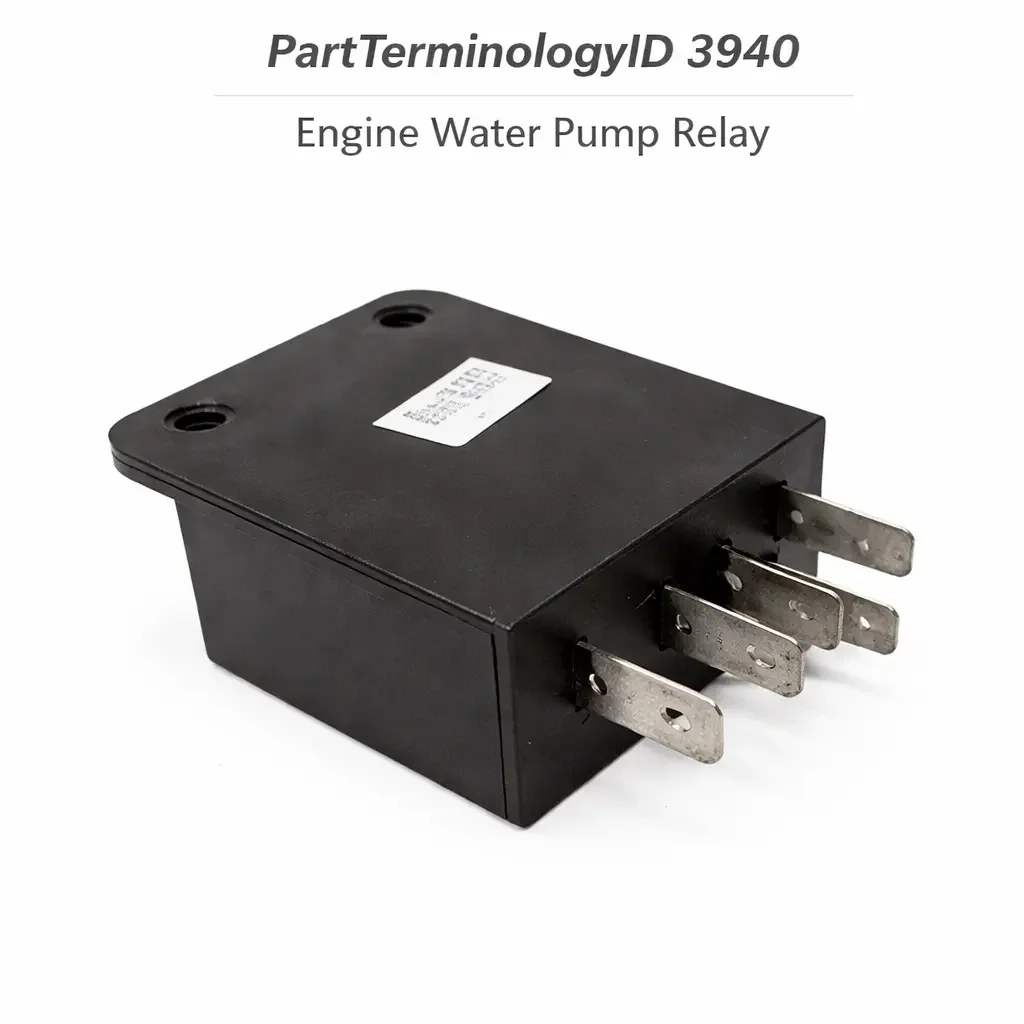
PartTerminologyID 3940, Engine Water Pump Relay, is the relay that switches power to the electric engine water pump motor, enabling the ECM or powertrain control module to activate coolant circulation independent of engine speed on vehicles equipped with an electrically driven water pump rather than a belt-driven mechanical pump. That definition covers the electric water pump activation switching function correctly and leaves unresolved whether the pump load is a primary coolant circulation pump that replaces the mechanical pump entirely, an auxiliary electric pump that supplements a belt-driven primary pump during specific thermal management conditions, or a post-run coolant pump that continues circulating coolant after engine shutdown to protect turbocharger bearings and prevent heat soak, the ECM thermal management logic that determines at which coolant temperature thresholds and engine load conditions the relay activates, whether the relay is a continuous-duty contact that holds closed for extended engine-on periods or a switched contact that cycles on and off as the ECM manages coolant temperature, the coil resistance tolerance that the ECM output driver requires, and whether the water pump relay is shared with the electric cooling fan relay on vehicles where a single relay output controls both coolant circulation and fan activation simultaneously.
For sellers, PartTerminologyID 3940 is the water pump relay where the ECM thermal management activation threshold is the most return-generating architectural attribute, because the ECM activates the water pump relay based on coolant temperature sensor readings, engine load data, and post-run timer logic rather than a simple switched input. A water pump that does not run at idle on a cool engine may be correctly off because the ECM has not reached the coolant temperature threshold that requires pump activation at low load. A water pump that does not run after engine shutdown may be correctly off because the post-run timer on this vehicle does not activate the pump for turbocharger cooling on naturally aspirated applications. A water pump that cycles on and off during normal operation may be correctly following the ECM thermal management duty cycle rather than exhibiting an intermittent relay fault. All of these conditions produce a pump-not-running symptom that appears to be a relay fault when the relay is correctly non-activated by the ECM thermal logic.
What the Engine Water Pump Relay Does
Primary electric pump versus auxiliary pump and the continuous duty requirement
Primary electric water pumps that replace the belt-driven mechanical pump entirely are high-current loads drawing 15 to 40 amperes during full-flow operation, depending on pump motor size and coolant flow rate. These pumps run continuously at varying speeds on electronically controlled variable-speed implementations or at fixed speed on single-speed relay-switched implementations for the full engine operating duration. A relay contact rated for intermittent duty applied to a primary electric water pump application will overheat from continuous energization current and fail prematurely from thermal degradation of the contact material.
Auxiliary electric pumps that supplement a belt-driven primary pump draw 5 to 15 amperes and activate only under specific ECM-commanded conditions such as cabin heating demand at low engine speed, turbocharger cooling during high-load operation, or battery thermal management on hybrid applications. Post-run coolant pumps draw 3 to 8 amperes and activate only after engine shutdown for a timed duration to circulate coolant through the turbocharger center section. The relay for each application must be rated for the specific duty cycle of the pump it switches. A relay sized for a post-run auxiliary pump applied to a primary pump application will fail from continuous-duty current well above its intermittent rating.
ECM thermal management thresholds and the non-activated relay misdiagnosis
The ECM activates the water pump relay based on a combination of inputs including coolant temperature sensor reading, intake air temperature, engine load percentage, vehicle speed, and elapsed run time. A cold engine at low idle may not reach the coolant temperature threshold that triggers pump activation for several minutes after start. A naturally aspirated engine that does not require post-run cooling will not activate the pump relay after shutdown regardless of how long the engine ran. An engine with a failed coolant temperature sensor that reads abnormally low will not reach the ECM activation threshold and will not command the relay to close even as actual coolant temperature rises.
A buyer who checks for water pump operation immediately after a cold start and finds no pump running may be below the ECM activation threshold for that ambient and load condition. A buyer whose turbocharged vehicle does not run the post-run pump may have a post-run timer that has already completed its cycle before the buyer checked. A buyer whose pump runs intermittently during a drive cycle may be observing correct ECM thermal management cycling rather than a relay fault. All three present identically to relay faults without knowledge of the ECM activation logic.
Why This Part Generates Returns
Buyers return engine water pump relay because the ECM has not reached the thermal threshold that commands relay activation and the pump is correctly off, the electric water pump motor has seized and draws locked-rotor current that welds the relay contact immediately after installation, the coolant temperature sensor has failed low and prevents the ECM from reading the actual coolant temperature required to command relay activation, the relay is a continuous-duty application and an intermittent-duty relay was installed that is failing from thermal overload during extended engine operation, and the relay is shared with the electric cooling fan circuit and a cooling fan motor fault is drawing excess current that is attributed to a relay fault when the fan motor is the actual failed component.
Status in New Databases
PartTerminologyID 3940 is cataloged in PIES/PCdb as Engine Water Pump Relay. Under PIES 8.0 and PCdb 2.0 there is no change to the terminology or classification for this PartTerminologyID.
Top Return Scenarios
Scenario 1: "ECM thermal threshold not reached, pump correctly off, buyer diagnoses relay fault at cold idle"
The buyer observes no water pump operation at cold idle shortly after engine start. The ECM coolant temperature input has not reached the activation threshold for electric water pump operation at low load on a cold engine. The relay receives no coil activation voltage. The buyer replaces the relay. The ECM thermal threshold remains unmet at the same operating condition. No change in pump behavior.
Prevention language: "ECM activation threshold: The water pump relay activates only when the ECM coolant temperature input reaches the commanded activation threshold for the current engine load and operating condition. A cold engine at low idle may not trigger relay activation for several minutes after start. Confirm the engine has reached normal operating temperature and the ECM is commanding relay activation before diagnosing a relay fault. A relay that receives no coil voltage below the ECM activation threshold is functioning correctly."
Scenario 2: "Seized pump motor, locked-rotor current welds relay contact at installation"
The electric water pump motor bearing has seized. When the relay closes on ECM command, the motor draws locked-rotor current of 40 to 80 amperes through a contact rated for 20 amperes of normal pump operation. The relay contact welds in the closed position within seconds. The pump runs at zero flow with the motor stalled. Coolant temperature rises rapidly. The buyer returns the relay as defective. The seized pump motor must be replaced before any relay will survive the circuit.
Prevention language: "Pump motor pre-check: Before installing the replacement relay, confirm the water pump motor rotates freely by hand after disconnecting the pump connector. A pump motor with a seized bearing draws locked-rotor current that welds the replacement relay contact immediately. Apply direct 12-volt power to the pump motor terminals and confirm the motor runs freely and draws within its normal current specification before installing a new relay."
Scenario 3: "Failed coolant temperature sensor reads low, ECM never commands relay activation, engine overheats"
The coolant temperature sensor has an open-circuit fault and reads at the cold end of its range continuously. The ECM receives a coolant temperature input that never reaches the pump activation threshold regardless of actual engine temperature. The relay receives no activation command. Coolant is not circulated. The engine overheats. The buyer replaces the water pump relay after finding no relay activation voltage. The sensor fault remains. The replacement relay also receives no activation voltage.
Prevention language: "Coolant temperature sensor validation: The ECM activates the water pump relay based on the coolant temperature sensor input. A failed coolant temperature sensor that reads below the activation threshold prevents the ECM from commanding relay activation regardless of actual coolant temperature. Confirm the coolant temperature sensor reading matches actual engine temperature before diagnosing a relay fault on a no-activation complaint."
Scenario 4: "Intermittent-duty relay installed on continuous-duty primary pump application, relay fails from thermal overload"
The buyer installs a general-purpose relay with an intermittent-duty contact rating on a primary electric water pump application. The pump runs continuously for the full engine operating duration. The relay contact temperature rises above the contact material thermal limit during extended operation. The contact resistance increases until the relay delivers insufficient voltage to maintain full pump motor speed. Coolant flow decreases and engine temperature rises during extended highway driving. The buyer returns the relay as failing under load.
Prevention language: "Continuous duty rating: Primary electric water pump applications require a relay with a continuous-duty contact rating. A relay with an intermittent-duty contact rating will overheat from continuous energization current during extended engine operation. Confirm the replacement relay is rated for continuous duty before installation on primary electric water pump applications."
Listing Requirements
PartTerminologyID: 3940
Pump type: primary electric, auxiliary supplement, or post-run turbo cooling (mandatory)
Duty cycle: continuous or intermittent (mandatory)
ECM activation threshold conditions (mandatory)
Contact current rating for continuous or intermittent duty (mandatory)
Coil resistance within ECM driver tolerance (mandatory)
Shared cooling fan relay note where applicable (mandatory)
Pump motor free-rotation pre-check note (mandatory)
Coolant temperature sensor validation note (mandatory)
OEM part number cross-reference (mandatory)
Catalog Checklist for ACES/PIES Teams
PartTerminologyID = 3940
Require pump type: primary, auxiliary, or post-run (mandatory)
Require duty cycle specification: continuous or intermittent (mandatory)
Require ECM activation threshold conditions listed explicitly (mandatory)
Require contact current rating matched to duty cycle (mandatory)
Prevent ECM threshold misdiagnosis: pump is correctly off below ECM activation threshold at cold idle; relay is functioning correctly when no coil voltage is present below threshold; threshold conditions must be listed to redirect buyer diagnosis
Prevent seized pump relay destruction: locked-rotor current welds relay contact at installation; pump motor free-rotation check is a mandatory pre-installation step
Prevent continuous-duty failure: intermittent-duty relay installed on primary pump application fails from thermal overload; duty cycle specification is mandatory for this PartTerminologyID
Note shared cooling fan relay applications where applicable
FAQ (Buyer Language)
Why is my electric water pump not running at idle on a cold engine?
The ECM activates the water pump relay based on coolant temperature and engine load inputs. A cold engine at low idle may not reach the ECM activation threshold for several minutes after start. Allow the engine to reach normal operating temperature and confirm the ECM is commanding relay activation before diagnosing a relay fault.
How do I check the water pump motor before replacing the relay?
Disconnect the pump motor connector and attempt to rotate the pump impeller by hand through the pump housing. A freely rotating impeller indicates the motor bearing is not seized. Apply direct 12-volt power to the pump terminals and confirm the motor runs and draws within its normal current specification. A motor that does not rotate or draws above its rated current has a mechanical or winding fault that will destroy the replacement relay contact.
Why does my water pump relay keep failing after replacement?
Repeated relay contact failure after replacement indicates a load fault rather than a relay quality issue. A seized pump motor, a shorted pump winding, or a shared cooling fan motor drawing excess current will weld any relay contact connected to the circuit. Measure current draw in the pump circuit during operation and compare to the relay contact rating before installing another replacement.
Should the post-run water pump run every time I shut off the engine?
Post-run pump activation depends on the ECM post-run timer logic, which activates based on coolant temperature at shutdown and engine load history during the preceding drive cycle. A short idle trip on a cool engine may not reach the coolant temperature threshold that triggers post-run pump activation. Post-run pump operation on every shutdown is not expected on all operating conditions.
Can a failed coolant temperature sensor prevent the water pump relay from activating?
Yes. The ECM uses the coolant temperature sensor input as the primary trigger for water pump relay activation. A sensor with an open-circuit or out-of-range fault that reads below the activation threshold prevents the ECM from commanding relay activation regardless of actual coolant temperature. Validate the coolant temperature sensor reading against actual engine temperature before diagnosing a relay fault on a no-activation complaint.
What Sellers Get Wrong About PartTerminologyID 3940
The most common error is omitting the ECM activation threshold conditions from the listing. The water pump relay does not activate when the ECM has not reached the coolant temperature and load conditions that command pump operation. A buyer who checks for pump operation at cold idle, shortly after start, or on a naturally aspirated engine expecting post-run activation will find no relay coil voltage in each of these conditions and will attribute the absence of activation to a relay fault. The listing that identifies the ECM activation conditions and directs the buyer to confirm the engine is at operating temperature and the ECM is commanding activation prevents a wasted relay replacement and redirects the buyer to the actual operating condition.
The second error is omitting the duty cycle specification. Primary electric water pump relays are continuous-duty applications. A general-purpose or intermittent-duty relay installed on a primary pump application will fail from thermal overload during extended engine operation, generating a return of a physically degraded relay contact that appears to have failed gradually. Without the duty cycle specification, buyers have no basis for selecting a continuous-duty relay over an intermittent-duty relay for the same socket.
The third error is omitting the pump motor free-rotation pre-check. A seized pump motor draws locked-rotor current that welds the replacement relay contact within seconds of installation. The buyer returns a relay with a visibly welded contact believing it was defective on arrival. The pre-check note converts this return into a pump motor replacement order.
Cross-Sell Logic
Electric Water Pump Motor: for buyers where the relay is confirmed delivering switched voltage to the pump motor terminals but no coolant flow is produced, or where the relay contact welds immediately after installation indicating a seized pump motor drawing locked-rotor current.
Coolant Temperature Sensor: for buyers where the relay receives no coil activation voltage from the ECM despite the engine being at operating temperature, and diagnosis confirms the ECM coolant temperature input is reading below the activation threshold due to a failed sensor rather than a relay fault.
ECM or PCM: for buyers where the relay coil receives no activation voltage despite confirmed normal coolant temperature sensor input and confirmed engine operating conditions that should command pump activation, indicating an ECM output driver fault on the water pump relay coil output.
Electric Cooling Fan Relay: on shared-relay applications where both the water pump and electric cooling fan share a relay output; a cooling fan motor fault that draws excess current will weld the shared contact and affect both the pump and fan circuits simultaneously.
Turbocharger Coolant Line: for buyers whose post-run pump is confirmed operational but turbocharger heat soak damage is present, indicating a blocked or restricted coolant line to the turbocharger center section rather than a pump or relay fault.
Why Catalog Data Quality Matters for PartTerminologyID 3940
Engine water pump relay returns cluster around three scenarios that are fully preventable with listing language: the ECM threshold misdiagnosis, the seized pump motor relay destruction, and the continuous-duty relay mismatch. The threshold misdiagnosis generates returns because the buyer replaced a correctly non-activated relay and found no change. The seized pump motor generates returns because the buyer found a physically welded relay contact and assumed the part was defective on arrival. The continuous-duty mismatch generates returns because an intermittent-duty relay fails from thermal overload during extended pump operation and the buyer attributes the failure to part quality.
None of these scenarios reflect a product defect. All three reflect missing listing information. The ECM activation threshold note, the pump motor pre-check note, and the duty cycle specification together address the three scenarios that account for the majority of returns under this PartTerminologyID. Each attribute requires one to two sentences in the listing and all three are absent in most aftermarket listings for this PartTerminologyID.
Application Range and Fitment Guidance for PartTerminologyID 3940
Engine water pump relay applications are concentrated in vehicles produced from the mid-1990s onward as electric water pump technology expanded from hybrid and electric vehicle thermal management systems into turbocharged gasoline engines requiring post-run cooling and into small-displacement engines where electric pump speed control improves thermal management efficiency. Belt-driven mechanical water pumps remain the dominant architecture in the current vehicle population, and electric water pump relay applications are concentrated in European, Japanese, and Korean vehicles with turbocharged engines and in domestic hybrid applications.
Post-run coolant pump relay applications are common on turbocharged vehicles from the early 2000s onward where turbocharger bearing cooling after engine shutdown prevents oil coking in the center section. These applications use intermittent-duty relays activated by a post-run timer in the ECM or a dedicated post-run control module. Fitment claims for post-run pump relays must distinguish the post-run application from the primary electric pump application, as the duty cycle, current rating, and coil specifications differ substantially between the two.
Variable-speed electric water pump applications on current-generation vehicles use a PWM-controlled pump motor rather than a relay-switched single-speed motor. The relay on these applications switches main power to the pump controller rather than directly to the pump motor, and the pump controller modulates motor speed electronically. A relay for a PWM pump application that is replaced with a relay sized for a direct-switched motor application may introduce contact resistance that interferes with the pump controller's supply voltage.
Final Take for PartTerminologyID 3940
Engine Water Pump Relay (PartTerminologyID 3940) is the thermal management relay where ECM activation threshold disclosure, duty cycle specification, and pump motor pre-check are the three attributes that prevent the three most common return scenarios. Every listing without ECM threshold guidance sends buyers through a relay replacement that changes nothing because the relay was correctly non-activated below the thermal management threshold. Every listing without the duty cycle specification risks a continuous-duty application receiving an intermittent-duty relay that fails from thermal overload during extended engine operation. Every listing without the pump motor pre-check note risks a relay returned with a welded contact from a seized motor the buyer did not know to check.
The ECM activation threshold note and the pump motor pre-check note together address the two scenarios that account for the largest share of returns under this PartTerminologyID. Threshold misdiagnosis generates the frustrated-buyer return where the relay was functional and nothing changed. Seized pump motor generates the damaged-part return where the buyer assumes the relay was defective on arrival. Adding both notes to the listing converts both return scenarios into either correct orders or correct prior diagnoses that prevent the order entirely.
Duty cycle specification and shared cooling fan disclosure complete the set of attributes that ensure every buyer under this PartTerminologyID receives a relay that matches their circuit's functional requirements before installation begins.
Together with ECM activation thresholds and pump motor pre-check, these four attributes make every listing under this PartTerminologyID complete.