
Written by Arthur Simitian | PartsAdvisory
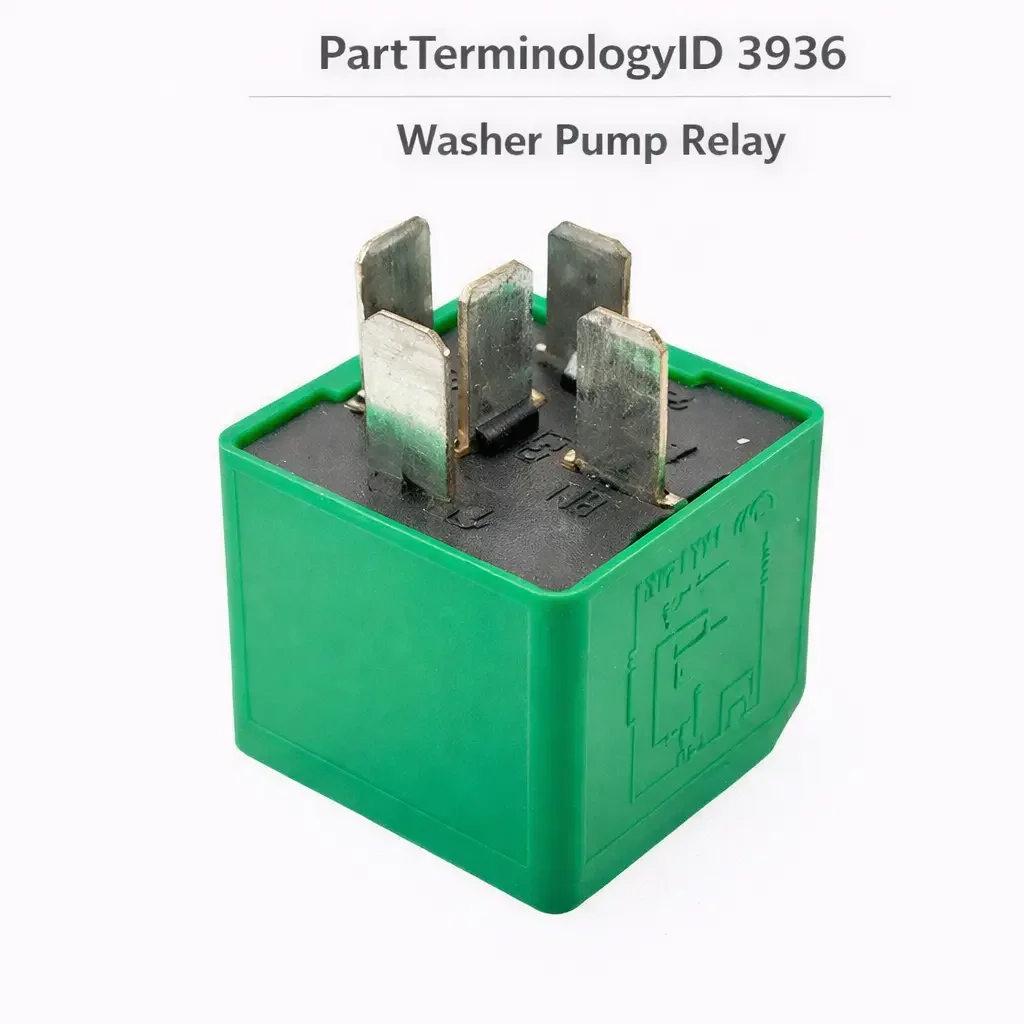
PartTerminologyID 3936, Washer Pump Relay, is the relay that switches power to the windshield washer pump motor, enabling the wiper control module, BCM, or a dedicated multifunction switch to activate the washer fluid spray when the driver engages the wash cycle. That definition covers the washer pump switching function correctly and leaves unresolved whether the pump load is a single front washer motor, a rear washer motor on a separate relay output, or a combined front and rear washer system sharing a single relay contact, the wiper interlock logic that requires wiper blade activation to accompany or follow washer pump operation on vehicles where the control module gates pump activation through confirmed wiper motor running state, whether the relay is a normally-open contact that holds closed for the duration of the wash cycle or pulses briefly to deliver a timed fluid burst, the coil resistance tolerance that the wiper control module or BCM driver output requires, and whether the washer pump relay is shared with the headlamp washer system on vehicles where a single relay switches both the windshield washer and the headlamp cleaning nozzle pump simultaneously.
For sellers, PartTerminologyID 3936 is the washer pump relay where the wiper system interlock condition is the most return-generating architectural attribute, because the wiper control module on many vehicle platforms will not activate the washer pump relay unless the wiper system is confirmed operational. A washer pump that does not spray when the wash stalk is pulled may be correctly inhibited because the wiper motor has a fault that prevents the control module from confirming wiper blade movement before authorizing pump activation. A wash cycle that activates the relay but delivers no fluid may reflect a failed pump motor or a clogged washer nozzle rather than a relay fault. A rear washer that does not operate while the front washer functions correctly may reflect a separate rear washer relay circuit rather than a shared relay fault. All of these conditions produce a no-spray symptom that appears to be a relay fault when the relay is correctly responding to the control module output it is receiving.
What the Washer Pump Relay Does
Single pump versus dual pump architecture and the shared relay current
Front washer pump motors draw 2 to 5 amperes during operation depending on pump design, fluid viscosity, and nozzle restriction. A relay contact rated for single-pump current applied to a dual front-and-rear pump architecture where both motors run simultaneously will overheat the contact from combined current draw. Rear washer systems on some vehicles use a dedicated rear washer relay rather than sharing the front washer relay, and fitment claims that assign a front washer relay part to the rear washer circuit on a split-relay architecture will deliver a correctly functioning relay to the wrong socket.
Headlamp washer systems on European-specification vehicles use a high-pressure pump that draws 8 to 15 amperes, significantly above a standard windshield washer pump. On vehicles where the windshield washer relay and headlamp washer relay share a single relay contact, the combined pump current during a simultaneous wash cycle substantially exceeds the current draw of either pump alone. A relay contact sized only for windshield washer current on a shared-relay application will degrade rapidly under repeated combined-pump activation cycles.
Wiper interlock logic and the non-activated relay misdiagnosis
The wiper control module on vehicles with wiper interlock logic confirms wiper motor operation before authorizing washer pump relay activation. This interlock prevents washer fluid from being sprayed onto a dry windshield without wiper blade movement to distribute and clear the fluid. A wiper motor with a failed park switch that prevents the control module from reading wiper blade position may block washer pump relay activation even though the wiper blades are physically moving. A wiper motor with a high-resistance brush contact that causes intermittent wiper operation may produce intermittent washer pump activation that the buyer attributes to an intermittent relay fault.
A buyer whose washer pump does not spray has a wiper interlock condition that must be resolved before the washer pump relay is diagnosed. Confirming wiper motor operation and the control module's ability to read wiper blade position is the first diagnostic step on interlock-equipped vehicles. A relay that receives no coil voltage because the wiper interlock condition is unsatisfied is functioning correctly.
Why This Part Generates Returns
Buyers return washer pump relays because the wiper interlock condition is active and the relay correctly receives no activation signal, the washer pump motor has seized and draws locked-rotor current that welds the relay contact immediately after installation, the washer nozzle is clogged and the pump motor draws excess current against the blocked nozzle restriction that degrades the relay contact over time, the relay is correctly activating but the washer fluid reservoir is empty and no fluid is delivered, and the relay is shared with the headlamp washer system and a headlamp washer pump fault is generating a relay circuit fault code when the headlamp pump is the actual failed component.
Status in New Databases
PartTerminologyID 3936 is cataloged in PIES/PCdb as Washer Pump Relay. Under PIES 8.0 and PCdb 2.0 there is no change to the terminology or classification for this PartTerminologyID.
Top Return Scenarios
Scenario 1: "Wiper park switch fault, interlock unsatisfied, washer pump relay not activated"
The buyer's washer pump does not spray when the wash stalk is pulled. The wiper motor park switch has an open-circuit fault. The wiper control module cannot confirm wiper blade position and will not authorize washer pump relay activation. The wiper blades are moving but the interlock condition remains unsatisfied. The buyer replaces the washer pump relay. The park switch fault remains. No change in washer pump behavior.
Prevention language: "Wiper interlock condition: On this application the washer pump relay is activated only after the wiper control module confirms wiper blade operation through the wiper motor park switch signal. A wiper motor park switch fault prevents the control module from confirming blade position and blocks relay activation regardless of wash stalk input. Confirm wiper park switch operation before diagnosing a washer pump relay fault."
Scenario 2: "Seized pump motor, locked-rotor current welds relay contact at installation"
The washer pump motor has seized internally. When the relay closes, the motor draws locked-rotor current of 15 to 25 amperes through a contact rated for 5 amperes of normal pump operation. The relay contact welds in the closed position within seconds. The washer pump runs continuously and drains the fluid reservoir. The buyer returns the relay as defective. The seized pump motor must be replaced before any relay will survive the circuit.
Prevention language: "Pump motor pre-check: Before installing the replacement relay, confirm the washer pump motor rotates freely and draws normal operating current. A seized pump motor draws locked-rotor current that welds the replacement relay contact immediately. Apply direct 12-volt power to the pump motor terminals and confirm the motor runs and draws within its normal current specification before installing a new relay."
Scenario 3: "Clogged washer nozzle, pump draws excess current against restriction, relay contact degrades over weeks"
The washer nozzle orifice is blocked by mineral deposits. The pump motor draws above-normal current against the restricted nozzle. The relay contact operates within its rating initially but degrades from sustained above-normal current on each wash cycle. The contact resistance increases over several weeks until the relay delivers insufficient voltage to run the pump at full speed. The washer spray becomes weak before stopping. The buyer returns the relay as gradually failing. The clogged nozzle is the root cause.
Prevention language: "Nozzle restriction check: A clogged washer nozzle increases pump motor current draw above the normal operating specification. Sustained above-normal current degrades the relay contact over time. Confirm washer nozzles are clear and unobstructed before installing a replacement relay. Clear any mineral deposit blockage from nozzle orifices before installation."
Scenario 4: "Headlamp washer pump fault, shared relay, fault code references washer pump relay"
The vehicle has a headlamp washer system sharing the windshield washer relay contact. The headlamp washer pump has an internal winding short. The control module detects excess current draw in the washer relay circuit and logs a relay fault code. The buyer replaces the windshield washer relay. The headlamp pump short remains. The fault code reappears and the replacement relay contact welds from the headlamp pump's excess current.
Prevention language: "Headlamp washer shared relay note: On this application the washer pump relay also powers the headlamp washer pump. A fault code referencing the washer pump relay circuit may originate from the headlamp washer pump rather than the windshield washer pump or relay. Confirm both pump motors draw within specification before replacing the relay."
Listing Requirements
PartTerminologyID: 3936
Pump architecture: front only, rear only, or combined front and rear (mandatory)
Wiper interlock condition note where applicable (mandatory)
Contact current rating: single pump or combined pump load (mandatory)
Shared headlamp washer relay note where applicable (mandatory)
Coil resistance within control module driver tolerance (mandatory)
Pump motor current pre-check note (mandatory)
Nozzle restriction check note (mandatory)
OEM part number cross-reference (mandatory)
Catalog Checklist for ACES/PIES Teams
PartTerminologyID = 3936
Require pump architecture: front only, rear only, or combined (mandatory)
Require wiper interlock condition disclosure where applicable (mandatory)
Require pump motor current pre-check note (mandatory)
Require contact current rating for single or combined pump load (mandatory)
Prevent wiper interlock misdiagnosis: a wiper park switch fault prevents control module confirmation of blade position and blocks relay activation; relay is correctly non-activated during unsatisfied interlock; interlock condition must be listed to redirect buyer diagnosis before relay order
Prevent seized pump relay destruction: locked-rotor pump current welds relay contact at installation; pump motor free-rotation check is a mandatory pre-installation step
Note shared headlamp washer relay applications: headlamp washer pump current substantially exceeds windshield washer pump current; combined load must be reflected in contact current rating
FAQ (Buyer Language)
Why does my washer pump not spray even though the wipers are working?
On vehicles with wiper interlock logic, the control module confirms wiper blade position through the park switch signal before activating the washer pump relay. A park switch fault prevents the interlock from being satisfied even when the blades are physically moving. Confirm the park switch signal is valid at the control module input before diagnosing a relay fault.
How do I check the washer pump motor before replacing the relay?
Disconnect the pump motor connector and apply direct 12-volt power to the pump terminals. Confirm the motor runs and draws 2 to 5 amperes. A motor that does not rotate or draws above 10 amperes has a mechanical or winding fault that will destroy any relay contact it is connected to. Replace a failed pump motor before installing a new relay.
Why does my washer spray weakly instead of not at all?
Weak spray typically indicates a partially clogged nozzle or a relay contact with elevated resistance from contact degradation. Confirm the nozzles are clear first. If nozzles are clear, measure voltage at the pump motor terminals during operation. A reading below 11 volts indicates contact resistance in the relay or wiring rather than full circuit voltage reaching the pump.
Can a low fluid reservoir cause the relay to stop working?
No. An empty reservoir does not prevent relay activation. The relay closes on control module command regardless of fluid level. An empty reservoir produces no spray despite a correctly functioning relay. Confirm the reservoir is filled before diagnosing a relay fault on a no-spray complaint.
Why does my rear washer work but the front washer does not?
Front and rear washer pumps may use separate relay circuits on some vehicles. A front washer relay fault that leaves the rear washer functional confirms the rear washer circuit is intact and isolates the fault to the front washer relay or its wiring. Confirm whether your vehicle uses a shared or split front and rear washer relay architecture before ordering a replacement.
What Sellers Get Wrong About PartTerminologyID 3936
The most common error is omitting the wiper interlock condition from the listing. The washer pump relay does not activate when the wiper control module cannot confirm wiper blade position through the park switch signal. A buyer whose wipers are operating visually but whose park switch has an open-circuit fault will find no washer pump activation and no relay coil voltage, which presents identically to a failed relay. The listing that identifies the wiper interlock condition and directs the buyer to confirm park switch operation before diagnosing a relay fault prevents a wasted relay replacement and redirects the buyer to the actual fault source.
The second error is omitting the pump motor current pre-check note. A seized pump motor draws locked-rotor current that welds the replacement relay contact within seconds of installation. The buyer returns a relay with a visibly welded contact believing it was defective on arrival. Without the pre-check note, the buyer has no indication that the pump motor caused the relay failure. The pre-check note converts this return into a pump motor replacement order.
The third error is omitting the combined pump load current on shared front, rear, and headlamp washer relay applications. A relay contact sized for a single windshield washer pump that is also switching a rear washer pump or headlamp washer pump will fail prematurely from the combined load. Listing the combined current specification and the shared architecture prevents undersized relay contacts from being ordered on multi-pump applications.
Cross-Sell Logic
Washer Pump Motor: for buyers where the relay is confirmed delivering switched voltage to the pump terminals but no fluid is sprayed and the reservoir is full, indicating a seized or open-circuit pump motor that requires replacement before a new relay will survive the circuit.
Wiper Motor: for buyers where the wiper interlock condition is unsatisfied and diagnosis confirms the wiper park switch signal is missing or invalid due to a failed wiper motor park switch contact rather than a relay fault.
Wiper Control Module: for buyers where the relay coil receives no activation voltage from the control module despite confirmed wiper operation and no interlock condition active, indicating a control module output driver fault on the washer pump relay coil output.
Washer Nozzle Set: for buyers where the relay is confirmed functional and the pump motor draws normal current but spray output is weak or absent, indicating clogged nozzle orifices that are restricting fluid delivery and increasing pump current draw over time.
Headlamp Washer Pump: on shared-relay applications where both the windshield washer and headlamp washer share a single relay contact; a headlamp pump fault generates excess current that welds the shared relay contact and affects both wash circuits simultaneously.
Why Catalog Data Quality Matters for PartTerminologyID 3936
Washer pump relay returns cluster around three scenarios that are fully preventable with listing language: the wiper interlock misdiagnosis, the seized pump motor relay destruction, and the combined load current mismatch on shared pump architectures. The interlock misdiagnosis generates returns because the buyer replaced a correctly non-activated relay and found no change. The seized pump motor generates returns because the buyer found a physically welded relay contact and assumed the part was defective on arrival. The combined load mismatch generates returns because the relay contact fails prematurely on multi-pump applications where the contact was sized for a single pump load.
None of these scenarios reflect a product defect. All three reflect missing listing information. The wiper interlock condition note, the pump motor pre-check note, and the combined load current specification together address the three scenarios that account for the majority of returns under this PartTerminologyID. Each attribute requires one to two sentences in the listing and all three are absent in most aftermarket listings for this PartTerminologyID.
Application Range and Fitment Guidance for PartTerminologyID 3936
Washer pump relay applications span vehicles from the late 1960s when electric washer pump systems became standard convenience equipment through the present. Early applications used simple relay switching with no wiper interlock logic, making the relay the primary diagnostic component in any no-spray condition. Current applications integrate pump relay activation into the wiper control module or BCM architecture with interlock conditions that gate relay activation on confirmed wiper operation, shifting the diagnostic focus to the wiper system before the relay is considered.
The combined front and rear washer relay architecture is common on hatchback, wagon, and SUV body styles where a single relay switches both the front windshield pump and the rear window washer pump. Listings for these applications must identify the combined architecture and the total current draw for both pumps operating simultaneously. A relay contact sized for front pump current only is undersized for the combined load when both pumps run together.
Headlamp washer systems are standard or optional equipment on European-specification vehicles and on domestic vehicles equipped with high-intensity discharge or LED headlamp assemblies that require periodic lens cleaning. These systems use high-pressure pump motors that draw substantially more current than windshield washer pumps. Shared-relay applications combining windshield and headlamp washer circuits require contact current ratings that reflect the headlamp pump's higher current draw as the sizing constraint.
Final Take for PartTerminologyID 3936
Washer Pump Relay (PartTerminologyID 3936) is the fluid delivery relay where wiper interlock condition disclosure, pump motor pre-check, and combined load current specification are the three attributes that prevent the three most common return scenarios. Every listing without wiper interlock guidance sends buyers through a relay replacement that changes nothing because the relay was correctly non-activated by an unsatisfied interlock condition. Every listing without the pump motor pre-check note risks a relay returned with a welded contact from a seized pump motor the buyer did not know to check. Every listing without the combined load specification risks a relay contact failure on multi-pump applications from a contact sized only for single-pump current.
The wiper interlock condition note and the pump motor pre-check note together address the two scenarios that account for the largest share of returns under this PartTerminologyID. Interlock misdiagnosis generates the frustrated-buyer return where the relay was functional and nothing changed. Seized pump motor generates the damaged-part return where the buyer assumes the relay was defective on arrival. Adding both notes to the listing converts both return scenarios into either correct orders or correct prior diagnoses that prevent the order entirely.
Combined load specification and shared headlamp washer disclosure complete the set of attributes that ensure every buyer under this PartTerminologyID receives a relay that matches their circuit's functional requirements before installation begins.
Together with wiper interlock conditions and pump motor pre-check, these four attributes make every listing under this PartTerminologyID complete.