
Written by Arthur Simitian | PartsAdvisory
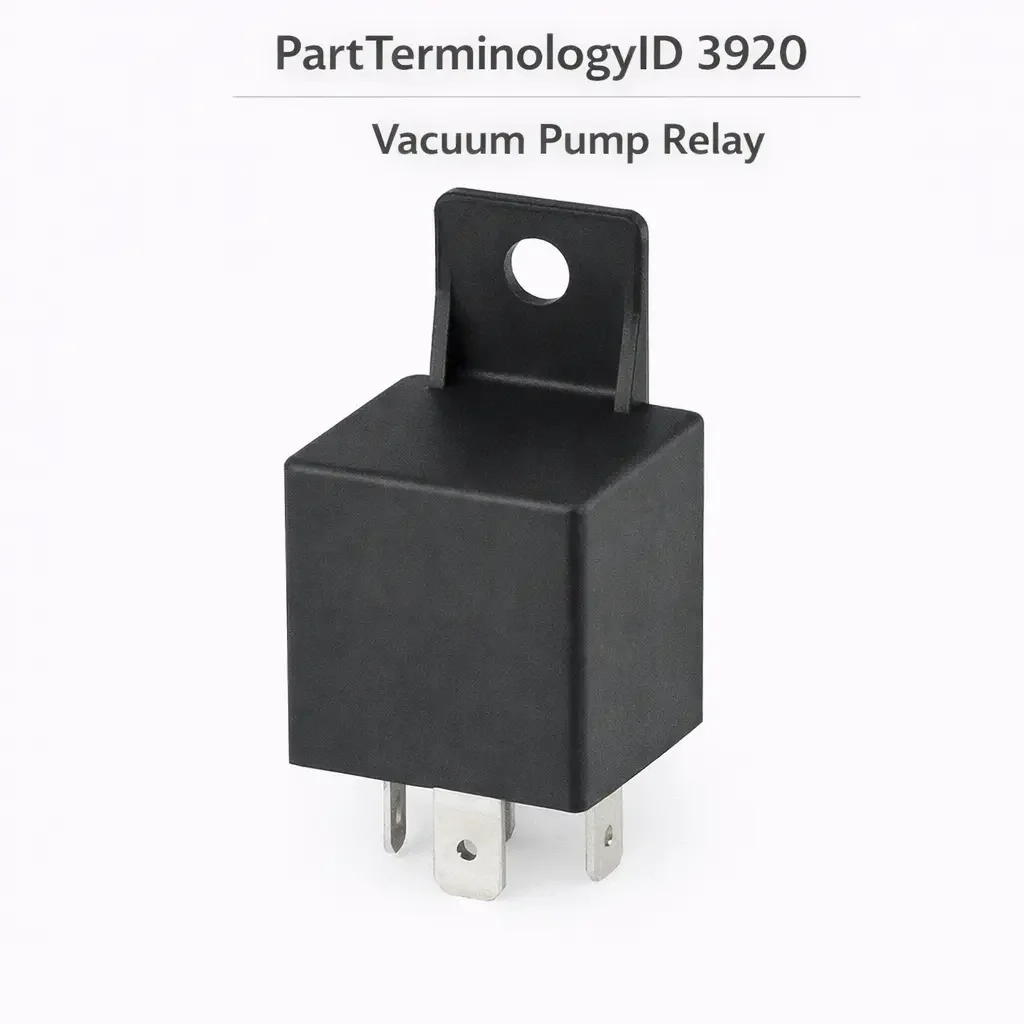
The Vacuum Pump Relay, cataloged under PartTerminologyID 3920, provides switched battery power to the electric vacuum pump that supplies vacuum to the brake booster on vehicles whose engines cannot generate sufficient intake manifold vacuum through normal operation. Turbocharged gasoline engines, diesel engines, engines with cylinder deactivation, and certain stop-start systems all produce conditions where manifold vacuum is too low or absent to reliably operate a vacuum-type brake booster. On these applications, a dedicated electric vacuum pump driven by a DC motor maintains booster vacuum independently of the engine's intake state. The relay delivers the motor's current supply when commanded by the ECM or a dedicated brake booster control module, completing the high-current motor circuit that the ECM's internal output driver cannot carry directly.
The ECM controls the relay's coil ground side, energizing the relay coil when the booster pressure sensor reports vacuum below target, or when a calculated pressure model based on engine speed, load, throttle position, and brake pedal switch state predicts that booster vacuum is insufficient. On pressure-sensor-equipped systems, the pump cycles on and off to maintain the booster within a narrow vacuum window. On model-based systems without a discrete sensor, the ECM uses its intake manifold pressure map to infer booster vacuum and commands the pump accordingly. Either way, the relay is the current delivery component between the fused battery supply and the pump motor. It does not make the activation decision; the ECM does. But without a functioning relay the ECM's activation command produces no motor current and the pump does not run.
A relay that fails to deliver current to the pump motor eliminates the electric vacuum source for the brake booster. Booster vacuum depletes through normal brake pedal applications and the pedal becomes progressively harder to depress as vacuum falls. Under emergency braking this degradation is immediate and safety-critical. This makes the vacuum pump relay one of the few relay PartTerminologyIDs where failure has a direct, safety-consequential effect on vehicle control.
Status in New Databases PartTerminologyID 3920, Vacuum Pump Relay PIES 8.0 / PCdb 2.0: No change.
What the Relay Does
Power Delivery to the Pump Motor
The relay's output contacts carry the full current load of the electric vacuum pump motor, typically between 8 and 20 amperes depending on pump design and motor condition. The relay coil is supplied from the ignition circuit or engine run circuit, and the ECM completes the coil ground to energize the relay and close the motor supply contacts. When the ECM removes the coil ground, the relay opens and the motor stops. This ECM-controlled cycling pattern repeats continuously during engine operation as booster vacuum rises and falls through normal use.
Because the relay carries motor current directly, it is subject to contact arcing each time the relay opens against the motor's inductive load. Over time this arc erosion degrades the contact surface and increases contact resistance, which can produce symptoms of intermittent pump activation before the relay fails entirely. A relay that has failed due to contact welding produces the opposite symptom: the pump runs continuously regardless of ECM command, drawing sustained motor current and potentially overheating the motor.
ECM Ground Control and Relay Coil Circuit
The relay coil supply is typically connected to the ignition circuit at a constant level when the ignition is on. The ECM provides or removes the coil ground to switch the relay. On some applications the ECM supplies both the coil voltage and the coil ground through its relay driver circuit. On others, a separate brake booster control module acts as the intermediary between the pressure sensor and the relay coil, commanding the relay based on its own booster vacuum logic rather than the main ECM.
The distinction matters for diagnosis: on applications with a dedicated brake booster control module, a module fault produces no relay activation even though the relay coil circuit wiring, the relay itself, and the pump motor are all intact. A relay that clicks when commanded in a bidirectional control test from a scan tool but does not click during normal driving indicates either that the ECM or control module is not generating the activation command, or that the booster pressure sensor is reporting adequate vacuum when it is not. Neither of these is a relay fault.
Safe Failure Direction and Pump-First Diagnostic Priority
A relay that fails open produces no pump motor current and results in progressive booster vacuum depletion. This is the safety-critical failure mode. A relay that fails with contacts stuck closed produces continuous pump operation, which is functionally safe from a braking standpoint but runs the motor continuously and can cause motor burnout if the pump cannot maintain adequate booster vacuum against a vacuum system leak.
Because hard brake pedal is the primary symptom for this PartTerminologyID, and because hard brake pedal is also produced by pump failure, pressure sensor failure, vacuum system leaks, check valve failure, and booster diaphragm failure, the relay is one among several possible fault locations. The relay is not the first-priority replacement target when the pump was recently serviced or known to be in good condition, but it becomes the primary target after pump function is confirmed and the relay's coil signal from the ECM is confirmed present.
Top Return Scenarios
Blown Fuse Upstream of Relay Is the Actual Fault
The most common no-improvement return for this PartTerminologyID is a buyer whose relay is intact but whose upstream fuse has blown, typically because the vacuum pump motor seized and drew excess current before the fuse opened. The relay in this scenario clicks normally (the coil circuit and the output contacts are functional) but the relay's output delivers no voltage to the pump because the fuse protecting the motor supply circuit has opened.
The diagnosis is confirmed by testing for battery voltage at the relay's supply input terminal with the ignition on. If voltage is absent at the supply input, the fuse is open or the wiring between fuse and relay is broken. The relay is not the fault. Replacing the relay without restoring the fuse supply delivers no improvement. Additionally, if the fuse blew because the pump motor seized, installing a new pump and relay without confirming the pump turns freely will blow the new fuse immediately.
The inspection sequence for hard brake pedal on a relay-equipped vacuum pump system must begin with fuse integrity, then relay coil signal, then relay output voltage, in that order before any component replacement.
Pump Motor Has Failed: Relay Is Not the Cause
A pump motor that has failed mechanically or electrically draws no current or draws excessive locked-rotor current when the relay closes. In either case the pump does not generate vacuum. The relay is functioning correctly in both scenarios: it closes when commanded and delivers supply voltage to the motor. The fault is in the motor or pump mechanism, not in the relay.
Confirming pump function requires testing motor current draw when the relay is energized and the pump is commanded on. Normal running current within the specified range confirms the pump motor is turning. Zero current with relay contacts confirmed closed indicates an open motor winding or a disconnected motor harness. Locked-rotor current above the rated range indicates a seized pump. A buyer who replaces the relay in response to a hard brake pedal complaint without confirming pump operation will not improve the symptom if the pump is the fault.
Pressure Sensor Fault: Pump Never Commanded On
A brake booster pressure sensor that has failed or drifted out of calibration can report adequate vacuum to the ECM even when actual booster vacuum is depleted. The ECM, seeing a satisfactory pressure reading, never commands the relay to close and the pump never runs. The relay is never energized, the pump never activates, and booster vacuum depletes through normal use. The driver experiences a progressively hard pedal, particularly after multiple braking applications, and the relay appears non-functional because it never receives a ground command.
This fault is confirmed by commanding the pump on directly through a scan tool's bidirectional control function while monitoring pump output vacuum with a gauge. If the pump creates vacuum when commanded directly but the ECM never commands it during normal operation, the pressure sensor is reporting incorrectly. The relay is not the fault.
Relay Contacts Stuck Closed: Pump Runs Continuously
A relay with welded output contacts delivers continuous supply voltage to the pump motor regardless of ECM command. The pump runs from ignition-on to ignition-off without cycling. This is audible as a continuous motor noise from the pump location and produces elevated motor temperature. The ECM may log a fault indicating the pump is running outside of commanded duty cycle on applications where the ECM monitors the relay output circuit state.
This failure produces no hard brake pedal symptom and is identified through the continuous motor noise or through a fault code related to pump circuit state disagreement. The relay is confirmed as the fault by confirming the ECM is not commanding the relay coil during the period when the motor is running. If the coil ground is absent but the motor is still running, the relay output contacts are welded.
Hard Pedal After Pump Replacement: Relay Damaged by Seized Pump
A pump that seized and drew locked-rotor current before failing can damage the relay's output contacts through sustained high-current arcing at the moment of coil de-energization and through elevated contact temperature during the overload period. A new pump installed after a seizure event may fail to run if the relay output contacts were damaged by the same event that destroyed the pump. The relay should be replaced concurrently with the pump when the pump is confirmed to have seized, as the relay has likely sustained contact damage from the overload event.
Listing Requirements
Every listing for PartTerminologyID 3920 should include:
ACES fitment data confirmed for applications with an ECM-controlled electric vacuum pump relay in the brake booster circuit; must exclude applications where vacuum is supplied by a mechanically driven pump (camshaft or belt driven) which does not use an electric relay, and applications where the brake booster uses hydraulic boost rather than vacuum
A clear description of the safety consequence of relay failure: loss of electric vacuum source produces a progressively hard brake pedal as booster vacuum depletes
A note that a blown upstream fuse is more common than relay failure as the cause of a no-pump condition, particularly following pump seizure, and that fuse integrity must be confirmed before relay replacement
A note that pump function must be confirmed independently: the relay delivers current, but if the pump motor is seized or failed, relay replacement does not restore brake boost
A note that a pressure sensor fault producing an always-satisfied vacuum reading to the ECM will prevent relay activation without any relay fault being present
A note that when replacing a seized pump, the relay should be inspected and replaced concurrently due to likely contact damage from the overload event
Frequently Asked Questions
My brake pedal is hard. Is the vacuum pump relay the problem?
A hard brake pedal on a vacuum pump equipped vehicle is a safety concern that warrants immediate diagnosis before driving. The vacuum pump relay is one of several possible causes. Before replacing the relay, confirm the upstream fuse protecting the pump motor supply circuit is intact. If the fuse is blown, determine whether the pump motor seized before replacing the fuse and relay. If the fuse is good, confirm the ECM is generating the relay coil ground command using a scan tool's live data or bidirectional control function. If the coil is being commanded and the relay contacts are not closing, the relay has failed. If the coil is not being commanded, the fault is in the ECM, the booster pressure sensor, or the booster control module rather than in the relay.
The relay clicks when I activate the pump through the scan tool but the pump does not run. What is wrong?
Relay clicking confirms the relay coil and contacts are functioning. If the pump does not run when the relay closes, test for battery voltage at the pump motor connector when the relay is activated. If voltage is present at the motor but the pump does not run, the pump motor has failed or the pump mechanism has seized. If voltage is not present at the motor despite the relay clicking, a wiring fault exists between the relay output and the pump connector.
My vacuum pump runs continuously and never shuts off. Is the relay stuck?
Continuous pump operation indicates either that the relay output contacts have welded closed, that the ECM is commanding the relay continuously because the pressure sensor is reporting inadequate vacuum at all times, or that there is a wiring short delivering constant supply to the pump. Confirm whether the ECM is generating a continuous coil ground command. If the coil ground is absent but the pump continues to run, the relay contacts are welded and the relay must be replaced. If the coil ground is continuously present, the ECM is commanding continuous operation, likely because the pressure sensor is reporting persistent low vacuum.
I replaced the pump because it seized. Should I also replace the relay?
Yes. A seized pump draws locked-rotor current through the relay contacts until the upstream fuse opens or the pump frees. This overload event accelerates contact arcing and surface erosion. The relay may continue to function temporarily but has reduced contact life. Replacing the relay concurrently with a seized pump avoids a secondary relay failure shortly after the pump repair.
My vehicle has a cam-driven or belt-driven vacuum pump, not an electric one. Does this relay apply?
No. Mechanically driven vacuum pumps are driven directly by the engine and do not use an electric relay. PartTerminologyID 3920 applies only to applications with an electric vacuum pump motor that is switched by a relay. Confirm from the factory service documentation whether your application has an electric pump before purchasing.
What Sellers Get Wrong
Not flagging the fuse as the mandatory first check
The upstream fuse is destroyed by pump seizure before the relay, and the relay clicks normally in the aftermath. A listing that positions the relay as the first replacement target for a no-pump condition, without directing buyers to confirm fuse integrity first, consistently converts fuse buyers into relay buyers who return the part after finding the new relay clicks but the pump still does not run because the fuse is still open.
Not distinguishing electric pump relay from mechanical pump applications
Cam-driven and belt-driven vacuum pumps are common on diesel engines and some gasoline applications and produce identical hard-brake-pedal symptoms when they fail. Neither type uses an electric relay. A buyer on a mechanically-driven pump application who orders this relay based on the hard pedal symptom will find no relay socket associated with the pump and return the part. ACES data that includes mechanically-driven-pump applications is the primary source of this no-find return.
Not addressing the concurrent pump-and-relay replacement recommendation
A listing that addresses only relay failure without noting that pump seizure damages the relay creates a predictable scenario: the technician replaces the seized pump, the relay fails shortly after from accumulated contact damage, and the customer returns with the same hard pedal complaint within days of the pump repair. Noting the concurrent replacement recommendation sets the correct expectation and prevents this specific callback pattern.
Not noting that continuous pump operation points to a stuck-closed relay or sensor fault
Buyers with a continuously running pump are identifiable by the symptom pattern and represent a distinct fault mode from the no-pump buyer. A listing that only addresses the no-pump scenario does not serve this buyer or help them correctly identify whether the fault is relay contacts, ECM command, or pressure sensor. Including the continuous-run failure mode in the listing captures this buyer accurately.
Cross-Sell Logic
Brake booster vacuum pump (the motor and pump assembly that the relay supplies; a seized or failed pump is the most common co-fault and mandatory pre-check before relay replacement; when the pump seized and blew the fuse, the pump replacement is the primary repair and the relay is a concurrent replacement)
Brake booster pressure sensor (the vacuum feedback sensor that signals the ECM when to activate the relay; a failed sensor reporting adequate vacuum prevents relay activation and results in hard pedal identical to relay failure; distinct from the relay and should be tested when the ECM is not commanding the relay during a hard pedal complaint)
Fuse for the vacuum pump motor circuit (the zero-cost mandatory pre-check; blown by pump seizure before relay failure; must be confirmed intact before any relay or pump diagnosis)
Check valve in the vacuum line (the one-way valve between the pump and booster that maintains booster vacuum when the pump is off; a failed check valve allows booster vacuum to bleed back through the pump, causing the pump to cycle excessively or fail to maintain vacuum even with a functioning pump and relay)
Brake booster (the diaphragm assembly that uses vacuum to amplify brake pedal force; a ruptured booster diaphragm introduces a leak that the pump cannot overcome regardless of relay and pump condition; the booster is the fault location when the pump runs continuously, pulls strong vacuum at the pump outlet, but the booster still depletes rapidly)
Final Take
PartTerminologyID 3920 carries the highest safety consequence of any relay in the brake system category. A relay failure that prevents pump activation results in a progressively hard brake pedal, and on vehicles with this system the driver has no manual override. The safety urgency of the symptom drives buyers to replace components rapidly, which increases the risk of incorrect component selection before diagnosis is complete.
The three most predictable incorrect purchases are: the relay when the fuse is the actual fault, the relay when the pump motor has seized, and the relay when the pressure sensor is reporting false vacuum adequacy to the ECM. All three produce the same hard pedal symptom and all three can be distinguished from a relay fault through a sequence of tests that takes less than ten minutes with a multimeter and scan tool access. A listing that communicates this sequence clearly converts the correctly diagnosed buyer and directs the incorrectly diagnosed buyer to the right component before they purchase.
The concurrent relay replacement recommendation for seized pump repairs is a practical note that prevents a specific callback pattern rather than a theoretical possibility, and its inclusion in the listing reflects the contact damage mechanism that pump seizure imposes on the relay.
Disclaimer
This guide is intended for catalog research, parts listing, and diagnostic reference. Vacuum pump relay circuit architecture, ECM control logic, pressure sensor integration, and pump motor specifications vary by manufacturer, model, and model year. Always confirm application data against factory wiring diagrams and OEM service documentation before finalizing a listing or parts recommendation. PartsAdvisory and its contributors are not responsible for fitment errors arising from catalog data that has not been independently verified against official OEM sources.