
Manual Transmission Upshift Relay (PartTerminologyID 3916): Diagnosis, Return Prevention and Listing Guide
Written by Arthur Simitian | PartsAdvisory
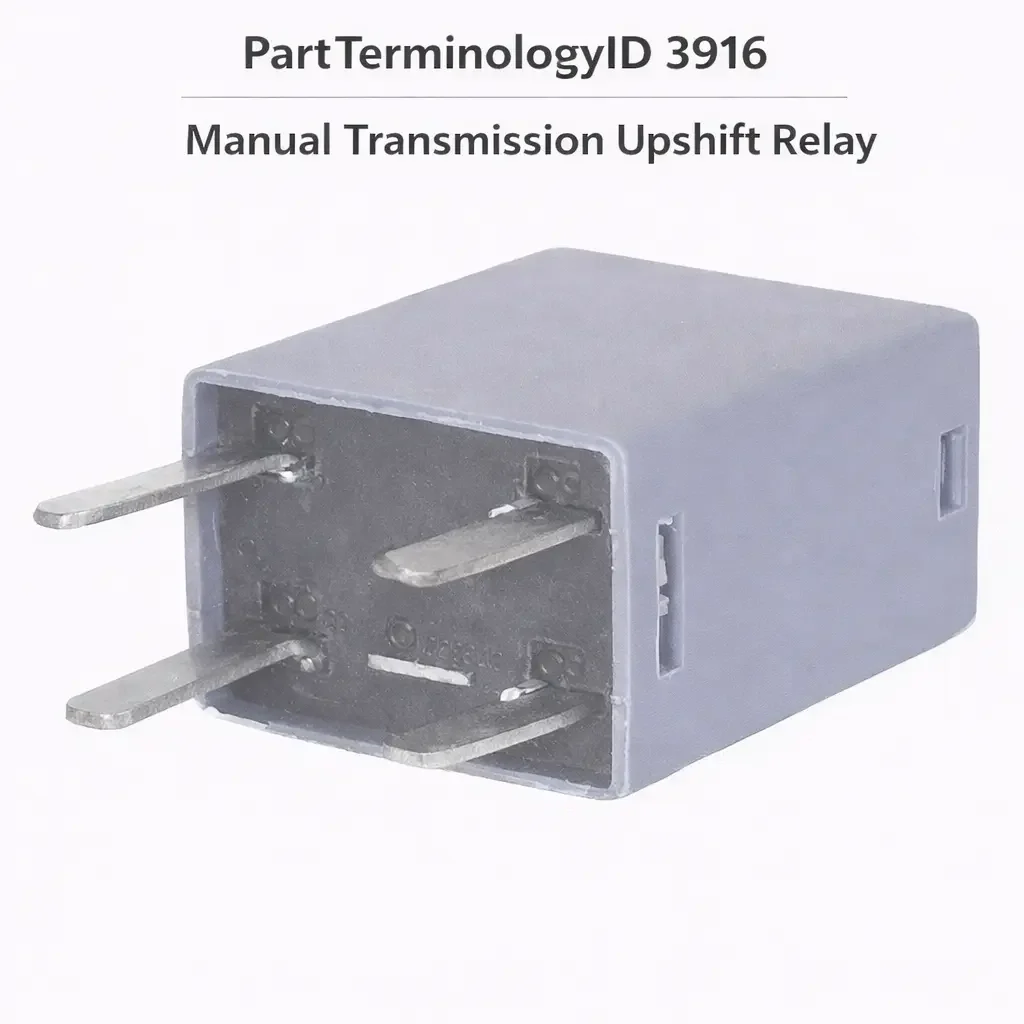
The Manual Transmission Upshift Relay, cataloged under PartTerminologyID 3916, is a control relay module that manages the upshift indicator light system on manual transmission vehicles from the early 1980s through the late 1980s where this system was installed as standard equipment. Its function is to monitor engine operating conditions - primarily manifold vacuum, engine speed, and on some applications a transmission gear position input - and illuminate a dashboard indicator light recommending that the driver shift to the next higher gear when doing so would improve fuel economy. The relay module processes the sensor inputs and controls a ground path to the indicator bulb, completing the light's circuit when the upshift condition is met.
The system's origin is regulatory. Beginning in the early 1980s, EPA fuel economy testing rules required that vehicles equipped with upshift indicator lights follow those indicators during the official test cycle. Manufacturers calibrated their upshift indicators for the RPM and load conditions that produced the best fuel economy figures during the EPA test procedure, which typically meant recommending upshifts at relatively low engine speeds and light throttle conditions, often lower than what most experienced drivers would choose for performance or smoothness. Because following the indicator light during the EPA test cycle produced measurable fuel economy gains on paper, the system was installed on a range of manual transmission vehicles intended for the US market during the period when these test rules applied.
The upshift relay and the indicator light it controls have no effect on engine operation, transmission function, clutch engagement, ignition timing, fuel delivery, or any other powertrain system. A failed upshift relay produces an indicator light that does not illuminate, or that illuminates incorrectly, and nothing else. The vehicle drives, shifts, and performs identically whether the relay and its indicator are functional or not. This is the defining characteristic of this PartTerminologyID for both listing and diagnostic purposes: it is an informational system only, and its failure has no operational consequence beyond the loss of the shift recommendation display.
Status in New Databases PartTerminologyID 3916, Manual Transmission Upshift Relay PIES 8.0 / PCdb 2.0: No change.
What the Relay Does
The Upshift Indicator Circuit Architecture
On Volkswagen Golf, Jetta, and Cabriolet applications from approximately 1983 through 1987, the upshift relay is identified as Relay 4 in the under-dash fuse and relay panel. The relay module receives inputs from two separate sensors: a vacuum switch in the intake manifold vacuum circuit that closes when manifold vacuum reaches a threshold indicating light-load, fuel-economy-appropriate conditions, and a reverse light and gear position switch on the transmission that provides a signal when the transmission is in fifth gear, indicating that no further upshift is available and the indicator should be suppressed. The relay compares these inputs and completes or interrupts the ground circuit to the upshift indicator bulb accordingly. The indicator illuminates when the engine is under light load at an RPM where an upshift would reduce engine speed and improve economy, and extinguishes when vacuum indicates high load, when the transmission is already in its highest gear, or when the vacuum switch threshold is not met.
On Chrysler-platform vehicles with the 2.5L four-cylinder and manual transmission, including various Jeep YJ and XJ applications from the mid-1980s through the early 1990s, the upshift indicator system operates through the ECM rather than through a discrete relay in the conventional sense. The ECM monitors manifold absolute pressure sensor data and engine speed simultaneously, applies its upshift algorithm, and controls the ground path to the indicator bulb through an internal output circuit. On these platforms, the transmission incorporates a physical upshift switch on the AX5 gearbox that opens the circuit when the transmission is in fifth gear, preventing the indicator from illuminating when no further upshift is possible. On AX15 applications, the fifth-gear suppression is achieved through vehicle speed and RPM calculation rather than a physical transmission switch. The relay referenced in PartTerminologyID 3916 for these applications is the discrete relay component in the indicator circuit where one exists, or the ECM output circuit on platforms where the ECM handles the function directly.
On other early 1980s US-market manual transmission vehicles from GM, Ford, AMC, and other manufacturers, the upshift indicator system architecture varies between discrete relay modules, ECM-integrated outputs, and combinations of vacuum switches and speed-sensing devices. The specific input signals, ground control architecture, and relay module location must be confirmed from the factory service documentation for the specific vehicle.
What the Relay Controls and What It Does Not Control
The relay's output is the ground circuit to the upshift indicator bulb on the instrument cluster. When the relay closes the ground path, the bulb illuminates and the driver sees the shift recommendation. When the relay opens the ground path, the bulb extinguishes. This is the complete extent of the relay's function. The relay does not control any aspect of fuel injection, ignition timing, transmission hydraulics, clutch engagement, or any other engine or drivetrain system. On Jeep applications, the service manual explicitly confirms that MAP sensor adjustments affect the upshift indicator light timing, but this is because the MAP sensor is also an input to ignition and fuel control systems and the relay's threshold is based on the same MAP data, not because the relay influences those other systems.
A vehicle with a failed upshift relay will experience no change in engine power, fuel economy, shift smoothness, or any other drivability characteristic. The only difference is the absence of the indicator light's shift recommendations. Buyers experiencing drivability complaints and ordering the upshift relay in expectation of restoring lost performance have misidentified the fault location, because this relay has no pathway to produce a drivability effect.
The No-Consequence Failure Mode
Because the upshift relay controls only a dashboard indicator light, the most common response to its failure in the field is driver indifference or deliberate disablement. A significant proportion of owners on affected vehicles have removed the indicator bulb, pulled the relay from its socket, or disconnected the vacuum switch input specifically to silence an indicator they found intrusive or inaccurate. On VW Rabbit/Golf applications, pulling Relay 4 from the relay panel eliminates the upshift indicator entirely without affecting any other system. The reverse light switch on VW applications also serves as the fifth-gear suppression input for the upshift circuit, and a worn switch in that position causes the indicator to illuminate permanently in fifth gear, which is another reason many owners disable the system rather than diagnose it.
Top Return Scenarios
Upshift Light On Continuously or On in Highest Gear: Gear Position Switch Is the Fault
The most common symptom that generates a relay replacement purchase for this system is the upshift indicator illuminating permanently or illuminating in the highest gear where no further upshift is available. On VW applications, this is caused by a failed reverse light and gear position switch rather than a failed relay. The reverse light switch on these transmissions incorporates a fifth-gear detection function that opens the indicator circuit when fifth gear is selected. When this switch wears, the fifth-gear detection contact fails to open, and the indicator remains grounded through the relay even in fifth gear.
A buyer who orders the upshift relay in response to a permanently illuminated indicator light on a VW application, without testing the gear position switch, is likely ordering the incorrect component. Confirming whether the indicator extinguishes when the transmission is in neutral and the ignition is on isolates whether the relay's input sensing circuit is responsible: if the indicator extinguishes in neutral, the relay is receiving correct neutral-state input and the fault is in the gear position switch or the vacuum switch rather than in the relay's output circuit.
Upshift Light Never Comes On: Multiple Possible Causes
A dashboard indicator that never illuminates regardless of engine speed, load, or gear position could indicate a failed relay that no longer closes the ground circuit, a burned-out indicator bulb, a blown fuse protecting the indicator bulb supply circuit, an open wiring fault between the relay output and the bulb, or a vacuum switch that is stuck open and never closes to satisfy the relay's activation condition.
The bulb and fuse are the correct first checks because they are zero-cost or near-zero-cost diagnostic steps. Confirming the bulb is intact by applying direct voltage to the bulb connector confirms it can illuminate. Confirming fuse integrity eliminates supply voltage loss as the cause. If the bulb and fuse are confirmed good and the indicator still does not illuminate, testing the vacuum switch by applying manifold vacuum directly and confirming it closes confirms or eliminates the vacuum switch. If the vacuum switch tests correctly and the relay still does not close the indicator's ground path under the appropriate input conditions, the relay has failed.
Relay Ordered in Response to Drivability Complaint
A subset of buyers on early 1980s VW and Jeep manual transmission vehicles with poorly understood electrical systems order the upshift relay in response to drivability issues including rough idle, poor fuel economy, stumbling under acceleration, and cold-start problems. These complaints have no causal relationship to the upshift relay, which controls only the indicator light and has no connection to any engine management function. On VW CIS-injected applications, the relay panel position adjacent to the upshift relay is shared with other relay positions that do affect fuel system function, and buyers who identify a relay panel position as the source of a complaint without confirming which relay function corresponds to that position may order the upshift relay when the actual fault is in the fuel pump relay, the oxygen sensor relay, or another relay in the same panel.
A listing that clearly describes the upshift relay as controlling only the indicator light, with no effect on any engine or transmission function, prevents this buyer category from converting to an incorrect purchase.
Relay Ordered as Part of a Restoration: Compatibility Verification Required
A meaningful share of buyers for this PartTerminologyID are restoring vehicles to factory-correct condition and need the upshift indicator system to function as originally equipped. These buyers are correctly motivated but need to verify that the specific relay part number matches the relay panel position and connector configuration for their exact model year and market, because relay panel layouts changed between model years on VW applications and connector pinouts differ between applications. The VW Cabriolet, Golf, Jetta, and Rabbit share platform architecture but have year-specific relay assignments that differ from each other in some model years, and the Bentley service manual has documented errors in its relay position assignments for certain year ranges that require verification against the actual relay part number stamped on the relay.
Listing Requirements
Every listing for PartTerminologyID 3916 should include:
ACES fitment data confirmed from factory service documentation for manual transmission applications equipped with the upshift indicator system; this was a US-market-specific feature tied to EPA fuel economy testing requirements and was not installed on the same vehicles sold in other markets; it also was not installed on all manual transmission vehicles of the applicable years, being engine-size-specific on some platforms
A clear statement that the relay controls only the upshift indicator dashboard light and has no effect on engine operation, transmission function, or any drivability characteristic
A clear description of the relay's input circuit: the vacuum switch that detects light-load conditions and the gear position switch that suppresses the indicator in the highest gear
A note that on VW applications, the gear position switch function is incorporated in the reverse light switch, and that a worn reverse light switch is the more common cause of a permanently illuminated indicator than a failed relay
A note that on Jeep AX5 applications, the upshift switch is a separate transmission-mounted component, and on AX15 applications the function is handled through ECM logic rather than a physical switch
A note that removal of the relay from its panel socket is a common owner modification that eliminates the indicator without affecting any other system, and that many vehicles of these model years may have had the relay removed by a prior owner
Frequently Asked Questions
My upshift indicator light never turns off. Does that mean the relay is bad?
On VW Rabbit/Golf/Jetta applications, a permanently illuminated upshift indicator is most likely caused by a worn reverse light switch that has lost its fifth-gear detection function, not by a failed relay. The switch is mounted on the transmission and serves both as the backup light switch and as the indicator suppression switch for fifth gear. Confirm whether the indicator extinguishes in neutral with the ignition on. If it does not extinguish in neutral, test the relay's ground output circuit directly. If it extinguishes in neutral but illuminates in all forward gears including fifth, the gear position switch contact has failed and the switch is the replacement target, not the relay.
My upshift indicator never comes on at all. Could the relay be the problem?
Before testing the relay, confirm the indicator bulb is intact and the circuit fuse is not blown. These are more common and less expensive failure causes than the relay. If the bulb and fuse are confirmed good and the indicator still does not illuminate under light-load conditions in any gear below the highest, apply direct manifold vacuum to the vacuum switch and confirm it closes. If the switch does not close, it is the fault. If the switch closes correctly and the relay still does not illuminate the indicator, the relay has failed or there is a wiring fault between the relay and the bulb.
Will replacing the upshift relay fix my rough idle or poor fuel economy?
No. The upshift relay controls only the dashboard indicator light and has no connection to any fuel injection, ignition, or engine management function. Rough idle and poor fuel economy on early 1980s manual transmission vehicles are caused by fuel system faults, ignition system faults, vacuum leaks, sensor failures, and other issues that the upshift relay cannot influence. If a relay in the same relay panel position is suspected of affecting engine behavior, confirm which relay function corresponds to that panel position from the factory wiring documentation before ordering.
I pulled the upshift relay from the panel. Will anything else stop working?
On VW Rabbit/Golf/Cabriolet applications, removing Relay 4 (the upshift relay) eliminates the upshift indicator light and has no effect on any other system. The relay controls only the indicator ground circuit. No fuel system, ignition, lighting, or other function is dependent on this relay. Many owners remove it permanently to silence the indicator. On other applications, confirm from the factory service documentation that the relay position in question serves only the upshift indicator function before removing it.
My vehicle has a manual transmission from the correct era but I do not see an upshift indicator light on the dash. Does it have the relay?
The upshift indicator system was not installed on all manual transmission vehicles of the applicable years. On some platforms it was specific to certain engine families, such as the 2.5L four-cylinder on Jeep applications and specific displacement four-cylinders on VW applications. On VW vehicles it was discontinued after approximately 1987. Confirm from the factory service documentation or the vehicle's option content whether the upshift indicator was part of the original equipment specification for the specific engine and transmission combination before searching for the relay.
What Sellers Get Wrong
Not stating that the relay has no drivability function
The most important single statement a listing for this PartTerminologyID can make is that the relay controls only the dashboard indicator light and has no effect on any engine or transmission function. Without this statement, buyers experiencing drivability complaints who arrive at the relay through an incorrect diagnostic path will convert to a purchase that cannot resolve their fault. The no-drivability-effect statement is the most effective return-prevention copy element for this PartTerminologyID.
Not noting the gear position switch as the primary cause of a permanently illuminated indicator on VW applications
On VW Rabbit/Golf/Jetta applications, the reverse light switch's fifth-gear detection function is more likely to be the cause of a permanently illuminated upshift indicator than the relay itself. A listing that directs buyers to replace the relay in response to a permanently illuminated indicator, without identifying the gear position switch as the primary suspect, will systematically convert gear-switch buyers into relay buyers who return the part without improvement.
Including non-US-market applications or all-manual-transmission applications without confirming system presence
The upshift indicator system was a US-market-specific feature tied to EPA testing requirements, and its installation was engine-size-specific on some platforms. ACES data that includes all manual transmission vehicles of an eligible model year, without filtering for the specific engine and market combination that received the system, will generate no-find returns from buyers whose vehicle has no indicator light and no relay socket for this function.
Not acknowledging that the relay may have been removed by a prior owner
The trivial consequence of removing the upshift relay, combined with the common driver frustration with an indicator that recommends upshifts at lower RPM than many drivers prefer, means that a significant proportion of vehicles in the applicable model year range have had their upshift relay removed by a prior owner. A buyer who purchases a replacement relay for an otherwise functioning vehicle is likely doing so for a restoration or OEM-correct repair, and the listing should acknowledge this buyer context rather than presenting the relay exclusively as a fault-resolution component.
Cross-Sell Logic
Vacuum switch for upshift indicator (the manifold vacuum input component that detects light-load conditions and signals the relay to illuminate the indicator; a stuck-open vacuum switch prevents the indicator from ever illuminating; sometimes called the upshift vacuum switch or the economy vacuum switch depending on the application)
Reverse light switch and gear position switch (on VW Rabbit/Golf/Jetta applications, the same switch that operates the backup lights also provides the fifth-gear suppression input for the upshift circuit; a worn switch that fails to open the suppression contact causes the indicator to illuminate permanently in fifth gear and is the primary differential diagnosis for a stuck-on indicator; more commonly needed than the relay on high-mileage VW manual transmission applications)
Upshift switch on AX5 transmission (on Jeep YJ and XJ applications with the AX5 gearbox, a separate transmission-mounted switch opens the upshift circuit when the transmission is in fifth gear; distinct from the reverse light switch; the correct replacement when the Jeep upshift indicator remains on in fifth gear with the AX5)
Indicator bulb for upshift light (the zero-cost-to-diagnose first check when the indicator never illuminates; must be confirmed intact before relay diagnosis proceeds)
Final Take
PartTerminologyID 3916 is defined by two facts that must appear in every listing: it controls only a dashboard indicator light, and its failure has no operational consequence for the vehicle's driving behavior. These two facts together determine the return risk profile almost entirely. A buyer who understands that the relay controls only the indicator will not purchase it to resolve a drivability complaint. A buyer who understands that the gear position switch is more likely than the relay to cause a permanently illuminated indicator will not order the relay as the first response to that symptom.
The application scope is narrow - US-market manual transmission vehicles from approximately 1983 through 1987 on the primary VW and Jeep applications - and the system was discontinued or superseded on most platforms by the late 1980s as EPA test procedure rules changed and ECM integration replaced discrete relay modules for the indicator function. ACES data that extends beyond the confirmed application range generates no-find returns on vehicles that were never equipped with the system.
Within the correct scope, the restoration buyer and the owner maintaining a functioning system are the primary legitimate buyers, and the listing serves them best by providing accurate diagnostic guidance that distinguishes the relay fault from the more common gear position switch fault on VW applications and the transmission upshift switch fault on Jeep applications.
Disclaimer
This guide is intended for catalog research, parts listing, and diagnostic reference. Upshift indicator system architecture, relay location, vacuum switch configuration, and gear position switch integration vary by manufacturer, engine, and model year. Always confirm application data against factory service documentation before finalizing a listing or parts recommendation. PartsAdvisory and its contributors are not responsible for fitment errors arising from catalog data that has not been independently verified against official OEM sources.