
Turbocharger Boost Control Relay (PartTerminologyID 3896): Diagnosis, Return Prevention and Listing Guide
Written by Arthur Simitian | PartsAdvisory
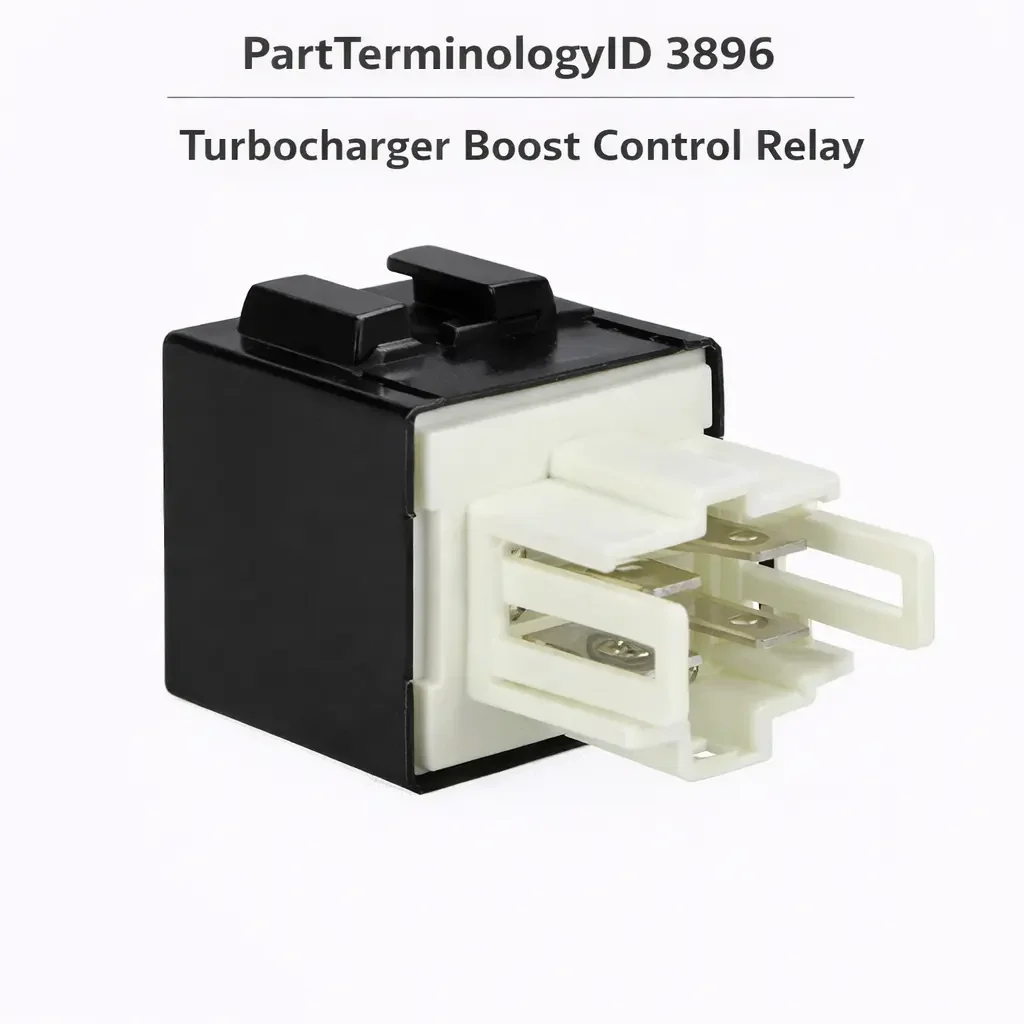
The Turbocharger Boost Control Relay, cataloged under PartTerminologyID 3896, is a relay that provides the power supply to the boost control solenoid in a turbocharged engine's wastegate control circuit. The boost control solenoid is the component that modulates how much pressure signal reaches the wastegate actuator, which in turn determines how far the wastegate opens and therefore how much exhaust gas bypasses the turbine. The relay is the power delivery component in this circuit; the solenoid is the pneumatic metering component. On platforms that use a discrete boost control relay, the ECM commands the relay coil to close and provide battery voltage to the solenoid, then controls boost pressure by varying the PWM duty cycle signal sent to the solenoid's control side.
The distinction between the relay and the solenoid is the first and most important element of any listing or diagnosis work for this PartTerminologyID. On most modern turbocharged platforms, the ECM drives the boost control solenoid directly without an intermediate relay. The ECM supplies both the voltage and the PWM control signal to the solenoid through an internal driver circuit. On these platforms, PartTerminologyID 3896 does not apply because no discrete relay exists in the solenoid power circuit. Including these applications in the ACES fitment data generates no-find returns from buyers whose vehicle has no separate relay to locate or replace.
On platforms that do use a discrete relay, its failure eliminates power delivery to the solenoid entirely. Without supply voltage, the solenoid cannot be modulated by the ECM regardless of how correctly the ECM's driver circuit is operating. The result from the driver's perspective is a boost control system that has dropped into its mechanical default state, governed only by the wastegate actuator's spring pressure rather than by closed-loop ECM control.
The safe failure design principle for boost control solenoids specifies that when the solenoid loses power, it must default to directing full pressure to the wastegate reference port rather than bleeding pressure away from it. This ensures the wastegate opens at spring pressure and boost is held to the lowest calibrated level, protecting the engine from an uncontrolled overboost condition. A relay failure that removes solenoid power should therefore produce underboost and reduced power rather than overboost and engine damage. This is the intended failure mode design. An overboost condition after a relay-related fault points to a stuck-closed solenoid or a mechanical wastegate fault rather than to a relay that has simply lost supply voltage.
Status in New Databases PartTerminologyID 3896, Turbocharger Boost Control Relay PIES 8.0 / PCdb 2.0: No change.
What the Relay Does
Wastegate Operation and the Role of the Boost Control Circuit
The wastegate is a valve in the turbocharger's exhaust housing that bypasses exhaust gas around the turbine wheel. When the wastegate is closed, all exhaust gas drives the turbine and boost pressure rises. When the wastegate opens, some exhaust gas is diverted away from the turbine, slowing the compressor and limiting further boost increase. In the absence of any electronic boost control, the wastegate actuator spring holds the wastegate closed until boost pressure at the actuator reference port equals the spring's calibrated opening pressure, then allows the wastegate to open and hold boost at that spring pressure.
The boost control solenoid modifies what pressure the wastegate actuator sees at its reference port. By bleeding some of the boost pressure signal away from the actuator reference line, the solenoid allows the ECM to hold the wastegate closed longer than the spring pressure alone would permit, building boost above the spring's nominal setpoint. Conversely, by passing more pressure to the actuator, the solenoid can open the wastegate earlier and hold boost below the spring setpoint when conditions require it. The ECM varies the solenoid's open-time fraction through PWM signals to achieve precise closed-loop boost pressure control across all engine operating conditions.
On a platform with a discrete relay in this circuit, the relay provides the constant supply voltage to the solenoid that makes PWM modulation possible. The ECM cannot vary the solenoid's duty cycle without a supply voltage present at the solenoid. A relay that fails open removes this supply and eliminates ECM boost control entirely. The wastegate actuator defaults to its spring pressure, boost is limited to the spring's nominal setpoint, and the engine loses the additional boost that the ECM would normally provide above spring pressure.
ECM Power Circuit vs. Direct ECM Drive
The distinction between relay-supplied and directly ECM-driven solenoids matters for diagnostic interpretation. On relay-supplied platforms, the relay coil is typically energized by the ignition supply or the engine run relay, and the relay output provides battery voltage to the solenoid's supply terminal. The ECM modulates boost by varying the duty cycle of its PWM ground signal on the solenoid's control terminal. The relay is not part of the modulation; it is simply the power source. A relay fault eliminates the supply but does not produce an ECM driver fault code in the same way that a shorted or open solenoid coil does.
On directly ECM-driven platforms, the ECM supplies both the voltage rail and the modulation control to the solenoid through internal driver circuits. A fault in this circuit produces OBD-II codes P0243 through P0246, which describe the solenoid circuit condition from the ECM's monitoring perspective. These codes point to the solenoid, its wiring, and the ECM driver, not to a discrete relay, because no relay exists in the circuit on these platforms. A buyer who receives one of these codes on a directly driven platform and searches for a boost control relay based on the code description may order a component their vehicle does not have. The listing must make clear that these codes are generated by the solenoid circuit, not the relay circuit, and that the relay is a separate upstream power component present only on specific platforms.
Safe Failure Mode and Default Boost State
The design requirement that a de-energized boost control solenoid defaults to full pressure delivery to the wastegate actuator is the central safety principle of this circuit. When the relay fails and removes solenoid supply voltage, the solenoid spring returns its plunger to the position that passes maximum pressure to the wastegate reference port. The wastegate opens at spring pressure and holds boost to the spring setpoint. On most OEM applications this produces an underboost condition relative to the ECM's target boost map, because the ECM normally maintains boost above the spring setpoint through solenoid modulation.
This default-underboost failure mode is how the circuit was designed to fail. An overboost condition after a relay or solenoid fault is not the expected result of a simple power loss to the solenoid. Overboost following a boost control fault points to a wastegate actuator diaphragm rupture, a stuck-closed wastegate valve, a mechanical fault in the wastegate linkage, or a solenoid that has failed with its plunger stuck in the pressure-bleed position. These are mechanical faults on the output side of the solenoid, not electrical faults in the relay or solenoid coil circuit.
Top Return Scenarios
Underboost and Power Loss: Relay Failure Is One of Several Causes
The most common complaint associated with a boost control relay fault is reduced power from underboost. With the relay failed and the solenoid de-energized, the engine operates on spring-pressure boost only, which is typically lower than the ECM's target boost level. The driver experiences a flat, limited power feeling under acceleration, particularly at higher engine loads where the ECM would normally be commanding above-spring boost levels.
This symptom is shared by a large number of possible faults: a failed solenoid coil, a disconnected or corroded solenoid connector, a cracked or disconnected vacuum line between the solenoid and the wastegate actuator, a ruptured wastegate actuator diaphragm, stuck variable geometry vanes on VGT applications, a faulty boost pressure sensor delivering incorrect feedback to the ECM, and a blown fuse in the relay or solenoid supply circuit. The relay is one node among many that can produce this symptom.
Confirming the relay is the fault requires confirming that battery voltage is not present at the solenoid supply terminal when the engine is running. If supply voltage is absent at the solenoid and present at the relay output terminal, the wiring between relay and solenoid is the fault. If supply voltage is absent at both the solenoid and relay output but present at the relay input, the relay contacts have failed open. If supply voltage is absent at the relay input, the fault is in the relay coil supply circuit or the coil is not being energized. Each of these outcomes points to a different fault location and a different replacement need.
Limp Mode Activation With or Without Boost-Related Codes
Many turbocharged platforms activate a reduced-power limp mode when the ECM detects that it cannot maintain closed-loop boost control within its target range. Limp mode is a protective response to detected abnormal boost behavior, not a direct readout of which component has failed. A relay failure that eliminates solenoid control and drops boost to spring pressure can trigger underboost limp mode on platforms where spring pressure is significantly below the ECM's minimum target boost. The associated code, most commonly P0299 for underboost or P0045 for boost control circuit open, identifies the circuit condition rather than the specific failed component.
P0243 and its variants specifically indicate that the ECM detects an open or short in the solenoid circuit as seen from its driver output. On relay-supplied platforms, a relay failure that removes supply voltage from the solenoid may or may not produce a P0243 variant, depending on whether the ECM monitors the solenoid supply voltage independently or only monitors its own output driver circuit. On some platforms the ECM detects solenoid supply absence and sets a code; on others the loss of supply looks like a solenoid open circuit to the ECM's driver monitor and sets P0243 directly. The factory service manual for the specific application determines which codes are expected from a relay fault versus a solenoid fault.
Relay Coil Not Energized Due to Upstream Fault
The relay coil in the boost control relay circuit is typically supplied from the engine run relay or from a fused ignition circuit that is active whenever the engine is running. A blown fuse in this supply, a failed engine run relay, or a wiring fault between the fuse and the relay coil input prevents the relay coil from being energized. The relay output contacts remain open and the boost solenoid receives no supply regardless of the relay's own internal condition.
This upstream fault produces the same symptoms as a relay coil open circuit and is confirmed by testing for voltage at the relay coil input terminal with the engine running. If no voltage is present at the coil input, the fault is upstream of the relay. If voltage is present at the coil input but the relay output contacts do not close, the relay coil or contacts have failed internally. A blown fuse is a zero-cost diagnostic step that must be confirmed before a relay replacement is purchased.
Vacuum Line Fault Produces Boost Symptoms Without Electrical Fault
On vacuum-actuated wastegate platforms, the boost control solenoid's output is a vacuum or pressure signal carried by small-diameter rubber hoses to the wastegate actuator. These hoses age, crack, and develop leaks that alter the pressure signal reaching the actuator independently of whether the solenoid or relay is functioning correctly. A cracked vacuum line between the solenoid and the wastegate actuator produces erratic or limited boost control that mimics a solenoid or relay fault in symptom but has no electrical fault code.
A buyer who identifies underboost or erratic boost without an electrical code, who correctly identifies that the boost solenoid is receiving supply voltage and the ECM's duty cycle output is present and correct, should trace the vacuum hose circuit before ordering a relay or solenoid. On heat-exposed underhood locations, these hoses are among the first components to degrade with age and are far less expensive to replace than either the relay or solenoid.
Overboost: Not a Relay Fault, But Buyers Order the Relay Anyway
A small but consistent subset of buyers order the boost control relay in response to an overboost condition or an overboost-related code. As described above, a relay that has simply lost power or failed with open contacts produces underboost, not overboost, because the safe failure design of the solenoid defaults the wastegate to its spring pressure. Overboost requires that something is actively preventing the wastegate from opening: a stuck wastegate valve, a ruptured actuator diaphragm that can no longer move the wastegate, a solenoid whose plunger is stuck in the pressure-bleed position and is continuously reducing the wastegate actuator signal, or a VGT actuator fault that holds the variable vanes in a position that generates excessive boost.
A relay replacement will not resolve an overboost condition caused by any of these mechanical faults. A listing that does not distinguish relay-fault underboost from solenoid or mechanical overboost will attract buyers whose symptom is overboost and return them after installation produces no improvement.
Listing Requirements
Every listing for PartTerminologyID 3896 should include:
ACES fitment data confirmed from factory wiring documentation for turbocharged applications that use a discrete, externally mounted relay to supply power to the boost control solenoid; must exclude all applications where the ECM directly drives the solenoid without a relay in the supply circuit
A clear description of the relay's role: it provides supply voltage to the boost control solenoid; it is not the modulation component and does not vary duty cycle
A clear statement that relay failure produces underboost through loss of solenoid supply, not overboost, because the solenoid defaults to directing pressure to the wastegate on loss of power
A note that P0243, P0245, and P0246 are solenoid circuit codes generated from the ECM driver side; their presence does not confirm that a relay exists in the circuit on a given application
A note that fuse integrity in the relay coil supply circuit is a required pre-check before relay replacement
A note that vacuum line integrity between the solenoid and wastegate actuator must be confirmed as part of any boost control diagnosis, as line faults produce boost symptoms without electrical codes
Frequently Asked Questions
My turbocharged car has reduced power and I was told the boost control relay is bad. How do I confirm this?
With the engine running, use a multimeter to test for battery voltage at the boost control solenoid's supply terminal. If voltage is absent, trace the circuit back toward the relay output terminal, then the relay input, then the fuse. Voltage absent at the solenoid and relay output but present at the relay input means the relay contacts have failed open. Voltage absent at the relay input means the fuse or the wiring supplying the relay coil is the fault. Confirming which node in the circuit is missing voltage identifies whether the relay itself is the fault or whether an upstream component is preventing it from being energized.
I have a P0243 or P0245 code. Does that mean the boost control relay is bad?
P0243 through P0246 are codes set by the ECM when it detects an abnormal condition in the boost control solenoid circuit as measured from its own driver output. On platforms where the ECM drives the solenoid directly without a relay, these codes point to the solenoid, its wiring, and the ECM driver circuit. On relay-supplied platforms, a relay fault that removes supply from the solenoid may produce one of these codes on some applications if the ECM monitors the solenoid's circuit state. The factory wiring diagram for the specific application determines whether a relay exists in the circuit and which fault the code is indicating. Ordering a relay based on a P0243 code alone, without confirming the application has a relay in the solenoid supply circuit, risks ordering a component the vehicle does not have.
Can a faulty boost control relay cause overboost?
A relay that has failed with its contacts in the open position removes power from the solenoid and causes the solenoid to default to its safe state, which directs pressure to the wastegate actuator and holds boost at spring pressure. This produces underboost. Overboost requires something actively preventing the wastegate from opening at its target pressure. The relay is not the cause of an overboost condition. If a relay failure is suspected and overboost is the symptom, the fault is in the wastegate actuator, the wastegate valve mechanism, the vacuum lines, or the solenoid's mechanical plunger position rather than in the relay's power circuit.
What happens to engine power when the boost control relay fails?
When the relay fails and removes supply from the boost control solenoid, the solenoid defaults to directing full pressure to the wastegate actuator. The wastegate opens at its spring pressure setpoint and holds boost to that level. On most applications the spring setpoint is lower than the ECM's target boost level, so the engine produces less power than normal. The reduction is most noticeable at high engine loads where the ECM's target boost significantly exceeds the spring setpoint. At light throttle, where target boost is near or below spring pressure, the power reduction may be imperceptible. Limp mode may or may not be activated depending on how far the actual boost deviates from the ECM's target range.
My car has a boost control solenoid code and I cannot find a separate boost control relay. Does the relay exist on my vehicle?
Many turbocharged platforms drive the boost control solenoid directly from the ECM without a discrete relay. If the factory wiring diagram for your vehicle shows the solenoid connected directly to ECM output pins with no relay in between, PartTerminologyID 3896 does not apply to your vehicle. The relay is an additional component only on specific applications that use it to supply battery voltage to the solenoid while the ECM provides only the modulation ground signal. Confirm from the factory service documentation before purchasing.
What Sellers Get Wrong
Including direct-ECM-drive applications in the ACES fitment data
The most consequential error for this PartTerminologyID is listing it for applications where the ECM drives the solenoid directly and no relay exists in the circuit. A buyer on these applications will receive a relay, search for it on their vehicle, and return it because it has no installation location. The no-find return is entirely a function of incorrect ACES data. Factory wiring diagram confirmation for each application is the only reliable basis for inclusion.
Conflating the relay with the boost control solenoid
The boost control solenoid is a significantly more commonly replaced component than the relay and attracts a much larger buyer audience. A listing that uses solenoid language to describe the relay, or that does not clearly distinguish the relay's power-supply function from the solenoid's pneumatic metering function, will attract solenoid buyers who discover after purchase that the relay is not the component with the two pneumatic ports they were looking for. The relay and solenoid are both in the boost control circuit but occupy completely different functional positions within it and mount in completely different locations.
Not addressing the safe failure mode direction
A listing that does not state whether relay failure produces overboost or underboost leaves the buyer without the single most important diagnostic distinction for their symptom. A buyer with overboost should not be ordering this relay. A buyer with underboost who has confirmed solenoid supply voltage is absent is the correct buyer. The failure direction, underboost from power loss to the solenoid, is a property of the system design that every listing for this part should make explicit.
Not distinguishing this relay from the ECM's solenoid driver fault codes
P0243 and related boost solenoid codes are among the most commonly encountered turbocharger-related OBD-II codes and generate significant parts search traffic. A listing that appears in these searches without clarifying that these codes are solenoid circuit codes, not relay codes, will attract buyers whose fault is the solenoid and who have no discrete relay to replace. Including a clear note that these codes identify the solenoid circuit from the ECM driver's perspective, and that a relay in the supply circuit is a separate upstream component that may or may not exist on a given application, is the correct handling for this traffic source.
Not flagging vacuum line integrity as a prerequisite to boost control diagnosis
Boost symptoms on vacuum-actuated wastegate platforms are as likely to originate from cracked or disconnected vacuum lines as from electrical faults in the relay or solenoid. A listing that does not mention vacuum line inspection as a pre-replacement step will occasionally convert buyers whose fault is a two-dollar rubber hose. These are easy returns to prevent with a single line of copy.
Cross-Sell Logic
Boost control solenoid, also called the wastegate control solenoid, N75 valve, or turbocharger bypass valve depending on application (the pneumatic metering component that the relay supplies; the output device that the ECM modulates via PWM; the correct replacement for solenoid coil faults, stuck plunger, and P0243 through P0246 circuit codes on direct-drive applications)
Wastegate actuator (the pneumatic diaphragm assembly that translates boost pressure into wastegate position; a ruptured diaphragm produces boost control loss independent of relay or solenoid condition; the correct replacement for boost control loss that persists after relay and solenoid are confirmed functional)
Boost pressure sensor, also called the MAP sensor or boost pressure transducer (the feedback sensor that reports actual boost pressure to the ECM for closed-loop control; a faulty sensor delivering incorrect boost readings causes the ECM to under-command or over-command the solenoid even if the relay and solenoid are working correctly; P0299 underboost codes may originate at this sensor rather than in the actuator circuit)
Fuse for the boost control relay circuit (a zero-cost pre-check that must be confirmed before relay or solenoid replacement; a blown fuse removes supply from the relay coil or the solenoid supply and produces the same symptoms as a failed relay or solenoid)
Engine run relay or main relay (on platforms where the boost control relay coil is supplied from the engine run relay output, a failed engine run relay removes the boost control relay coil supply and produces the same underboost symptoms as a failed boost control relay; the engine run relay must be confirmed functional as part of the coil supply circuit trace)
Vacuum lines for the boost control circuit (the small-diameter hoses between the solenoid and the wastegate actuator; cracked or disconnected lines produce erratic or absent boost control without any electrical fault code; least expensive diagnostic and repair item in the boost control system)
Final Take
PartTerminologyID 3896 requires more ACES scope discipline than almost any other relay in the forced induction category, because the majority of turbocharged platforms do not use it. Direct ECM drive of the boost solenoid is the norm in modern applications, and the relay is a characteristic of specific older or architecturally distinct platforms. An ACES entry that extends beyond these platforms generates no-find returns at a high rate because buyers on direct-drive applications will search for the relay and not find it on their vehicle.
Within the correct application scope, the diagnostic logic is clean: relay failure removes solenoid supply, solenoid defaults to safe state, wastegate opens at spring pressure, boost drops to spring setpoint, driver experiences underboost. The failure direction is the single most useful piece of information for a buyer trying to determine whether the relay is even a candidate for their symptom. Overboost buyers should not be purchasing this relay; underboost buyers with confirmed absent solenoid supply voltage are the correct audience.
The solenoid, the vacuum lines, the wastegate actuator, and the boost pressure sensor are each capable of producing the same underboost symptom independently of the relay, and each should be systematically eliminated before the relay replacement decision is made. A listing that communicates this sequence keeps the correct buyers and routes the incorrect ones away from a purchase that will not resolve their fault.
Disclaimer
This guide is intended for catalog research, parts listing, and diagnostic reference. Boost control circuit architecture, relay location and function, solenoid operating parameters, and wastegate actuator design vary by manufacturer, engine, and model year. Always confirm application data against factory wiring diagrams and OEM service documentation before finalizing a listing or parts recommendation. PartsAdvisory and its contributors are not responsible for fitment errors arising from catalog data that has not been independently verified against official OEM sources.