
Written by Arthur Simitian | PartsAdvisory
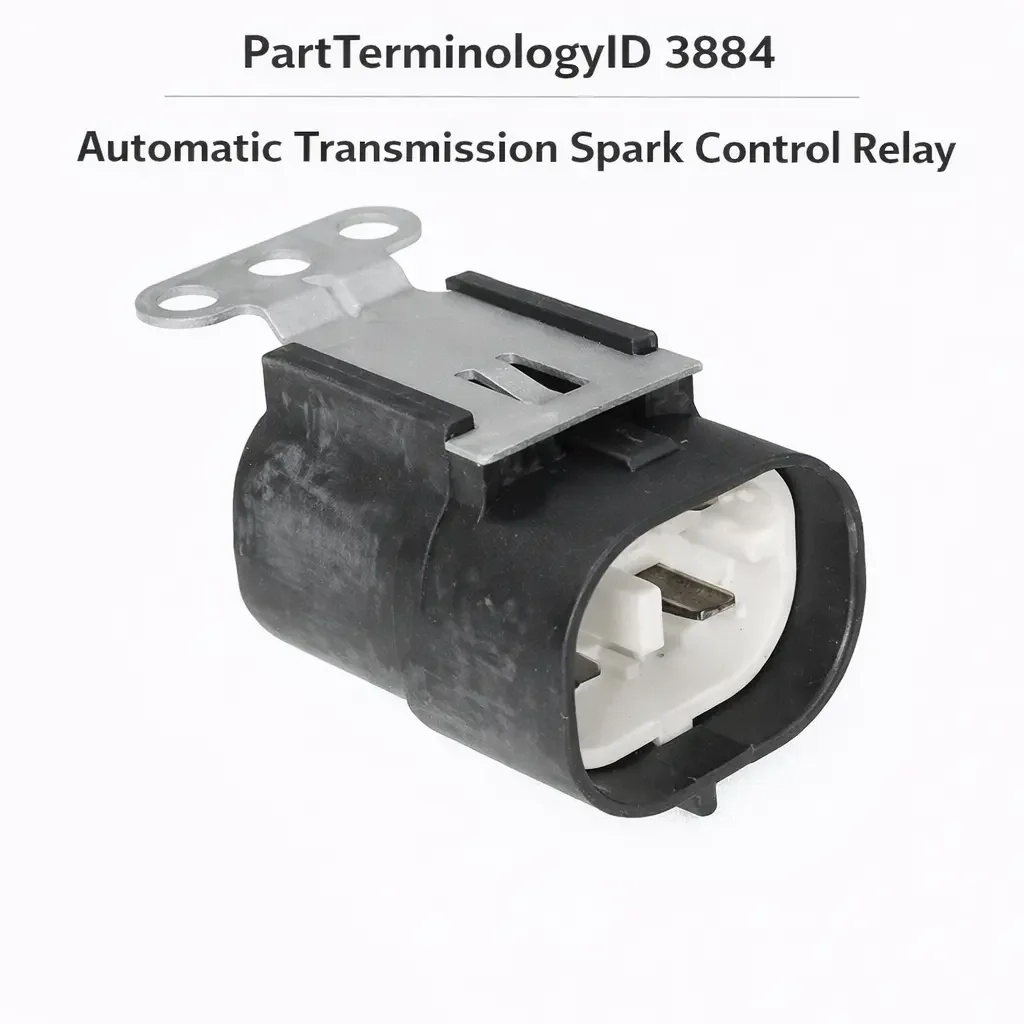
The Automatic Transmission Spark Control Relay, cataloged under PartTerminologyID 3884, is a relay that forms part of the Transmission Controlled Spark system, commonly abbreviated TCS. The TCS system was an emission control strategy introduced on GM vehicles beginning with the 1970 model year and used through the mid-1970s on a range of V8 and six-cylinder applications. Its purpose was to reduce hydrocarbon and nitrogen oxide emissions by blocking distributor vacuum advance in the lower forward gear ranges, allowing vacuum advance only when the transmission was in high gear and the engine was at operating temperature.
The relay's specific function within this system is as a time delay device. When the ignition is turned to the On position, the relay closes and holds the TCS vacuum solenoid in its energized state for a fixed interval of approximately 15 to 20 seconds, depending on the specific model year and application. During this interval, the distributor receives full vacuum advance regardless of which gear the transmission is in. After the delay interval expires, the relay opens and returns control of the vacuum solenoid to the transmission gear switch and the coolant temperature override switch, which then govern whether vacuum advance is permitted based on gear position and engine temperature.
The purpose of this cold-start delay is to prevent stalling. An engine that has just been started at idle needs vacuum advance to maintain stable combustion. Removing vacuum advance immediately on startup, before the engine has come off the starting enrichment condition and before the driver has moved the transmission out of Park or Neutral, would produce erratic idle and potential stalling in some engine and carburetor combinations. The time delay relay provides a brief window of unconditional vacuum advance to allow the engine to stabilize before the TCS gear-based restriction takes effect.
This PartTerminologyID applies exclusively to distributor-equipped, carburetor-or-throttle-body-era vehicles that include a discrete TCS relay in their emission control wiring. It has no application to any vehicle equipped with electronic fuel injection or a distributorless ignition system, where ignition timing is managed entirely by the engine control module and no discrete vacuum advance relay exists in the circuit. The application scope is restricted to a defined set of GM platforms from approximately 1970 through 1974, after which the TCS system was phased out or replaced with temperature-only spark timing control systems that do not use a transmission gear switch or a time delay relay.
Status in New Databases PartTerminologyID 3884, Automatic Transmission Spark Control Relay PIES 8.0 / PCdb 2.0: No change.
What the Relay Does
The TCS System and Its Components
The Transmission Controlled Spark system on automatic transmission applications uses four primary components working in series: a transmission gear switch located in the transmission valve body, a solenoid vacuum valve mounted near the ignition coil bracket or intake manifold, a coolant temperature override switch, and the time delay relay. The relay is the fourth component, positioned in the circuit to provide the cold-start delay function.
The transmission gear switch is an oil pressure switch that opens when the transmission is in high gear and closes in all lower gear ranges. In lower gears, the closed switch provides a ground path that energizes the solenoid vacuum valve. When energized, the solenoid blocks carburetor vacuum from reaching the distributor vacuum advance diaphragm and vents the distributor advance port to atmosphere. The result is zero vacuum advance in low and intermediate gears under normal warm operating conditions. In high gear, the transmission switch opens, the solenoid loses its ground, and the solenoid plunger extends to uncover the vacuum port. Carburetor vacuum reaches the distributor and vacuum advance operates normally for fuel economy and drivability at cruise.
The coolant temperature override switch provides an additional input: when coolant temperature is below its calibrated threshold, it overrides the transmission gear switch and allows vacuum advance in all gears regardless of gear position. This prevents the drivability penalty of eliminated vacuum advance during cold-engine operation. When the engine reaches operating temperature, the temperature switch removes its override and the transmission gear switch regains control.
The Time Delay Relay's Specific Role
The time delay relay is wired to hold the vacuum solenoid in its de-energized state, allowing vacuum advance, for a fixed period after ignition-on. During the delay interval, the solenoid is not under the control of the transmission switch. The relay maintains the solenoid in the de-energized position regardless of which gear the transmission is in, providing unconditional vacuum advance for the duration of the delay. When the delay expires, the relay opens and returns the solenoid circuit to the control of the transmission switch.
On the 1970 GM TCS system, the delay interval is approximately 15 seconds. On the 1971 system using the Combination Emission Control solenoid, the delay is approximately 20 seconds. The specific interval varies by application year and must be confirmed from the factory service manual for the vehicle being diagnosed or listed. A relay that provides a delay significantly shorter than specified allows the TCS system to begin blocking vacuum advance before the engine has fully stabilized, producing rough idle or stalling after starting. A relay that provides no delay at all removes the cold-start grace period entirely and puts the TCS restriction in effect immediately on ignition-on.
The relay is not involved in the ongoing gear-based vacuum control during normal warm driving. Once the delay has expired and the relay has opened, the relay plays no further role until the next ignition cycle. All subsequent vacuum advance behavior is governed by the transmission switch and temperature override switch.
Relationship to Solenoid Valve Operation
The vacuum solenoid in the TCS system reverses its default state between the 1970 and 1971 model year implementations on GM vehicles, and this distinction matters for diagnosis. In the 1970 system, the solenoid is normally open to allow vacuum advance and is energized to block it. In the 1971 system using the CEC solenoid, the default state reverses: the solenoid is normally closed to block vacuum advance and is energized to allow it. The relay's role and the system behavior are inverted between these two architectures, and diagnosing a 1971 system with the 1970 logic, or vice versa, produces incorrect conclusions about whether the system is functioning or failed.
A technician who connects a vacuum gauge to the distributor hose on a 1970 application and finds vacuum at idle in Neutral is seeing normal behavior, because the solenoid is normally open in that architecture. Finding no vacuum in that condition would indicate a stuck-closed or energized solenoid fault. On a 1971 application, the same observation, vacuum present at idle in Neutral, would indicate a fault, because the normally-closed 1971 solenoid should be blocking vacuum in lower gears at operating temperature. Confirming the model year and solenoid architecture from the factory service manual is the mandatory first step in any TCS diagnosis.
Top Return Scenarios
Poor Idle or Stalling Immediately After Cold Start
The most direct symptom of a failed time delay relay is stalling or severe rough idle immediately after the ignition is turned on. If the relay fails to provide its delay interval, the TCS vacuum solenoid comes under the immediate control of the transmission switch on the first ignition cycle. With the transmission in Park or Neutral and a cold engine, the solenoid may block vacuum advance before the engine has stabilized, causing the idle quality problem.
This symptom is also produced by a number of unrelated causes including carburetor choke maladjustment, an idle mixture screw that is set incorrectly, a vacuum leak elsewhere in the intake circuit, or a faulty coolant temperature override switch that is not providing its cold-engine vacuum advance override. The time delay relay is one of several possible causes and should be confirmed as the fault by testing the delay interval directly before replacement.
The relay test procedure is straightforward: with a vacuum gauge connected between the solenoid and the distributor, turn the ignition on and observe whether vacuum advance is present for the specified delay interval and then drops away when the relay opens. If the delay interval is absent or significantly shorter than specification, the relay is the fault. If the delay interval is present and correct but cold-start stalling still occurs, the fault is elsewhere in the system or in the carburetor calibration.
Permanently Retarded Timing in All Gears With Engine at Temperature
A relay that has failed with its contacts stuck closed holds the TCS solenoid circuit in the relay-controlled de-energized state permanently, effectively bypassing the transmission gear switch. On a 1970-architecture normally-open solenoid system, stuck-closed relay contacts keep the solenoid de-energized and allow vacuum advance in all gears regardless of gear position. This is the opposite of the system's intended function but produces better drivability than normal TCS operation, and many owners on these platforms do not notice or report this as a problem.
On a 1971-architecture normally-closed solenoid system, the analysis is reversed and must be traced through the specific circuit diagram for the application. The solenoid architecture inversion means the relay failure effect differs between model years, and the listing must be clear that the buyer confirm which solenoid architecture applies to their vehicle before concluding the relay is the fault.
Permanently Blocked Vacuum Advance: Flat Power and Poor Economy
A relay that fails open immediately after ignition-on, or that fails to maintain its contacts closed during the delay interval, removes the cold-start delay entirely and puts vacuum advance control under the transmission switch immediately. If the transmission switch is functioning correctly and the engine is cold, the coolant temperature override switch may compensate and allow vacuum advance during the warmup phase. If the coolant temperature override switch has also failed or is out of calibration, the TCS system blocks vacuum advance in all lower gears from the moment the engine starts, producing a flat power feeling, reduced fuel economy, and potential overheating from the retarded timing increasing combustion temperature and exhaust heat.
This failure pattern, permanently retarded timing from a combination of a relay fault and a temperature switch fault, is a common condition on vehicles of this era that have been sitting unused for extended periods. Both components are electrically simple and fail from age, heat cycling, and connector corrosion. A buyer who is restoring or returning a TCS-equipped vehicle to correct factory operation may need both the relay and the temperature switch to restore proper system function, and the listing should cross-reference both components.
Relay Replaced but System Still Malfunctions: Transmission Switch or Solenoid Is the Fault
The TCS system is a series circuit with four components, and any single component failure can produce a system malfunction. A buyer who replaced the relay and finds the system is still not functioning correctly has confirmed the relay is not the sole fault. The transmission gear switch, which is located in the transmission valve body and operates from hydraulic oil pressure, is susceptible to corrosion and contamination from old transmission fluid and may not be switching correctly between gear positions. The vacuum solenoid may have stuck plunger or a failed coil. The coolant temperature switch may be stuck in its override position.
The vacuum gauge test procedure traces the system step by step and identifies which component in the series is not contributing correctly to the overall behavior. A buyer who performs this test before and after relay replacement can confirm whether relay replacement resolved the fault or whether another component requires attention.
Listing Requirements
Every listing for PartTerminologyID 3884 should include:
ACES fitment data confirmed from factory service documentation for TCS-equipped automatic transmission applications; this applies exclusively to distributor-equipped, carburetor-era vehicles and must exclude all EFI and distributorless ignition applications
A clear statement that the relay provides a cold-start time delay of approximately 15 to 20 seconds after ignition-on, after which the TCS solenoid reverts to control by the transmission gear switch
A note that the solenoid architecture differs between 1970 and 1971 model years: the 1970 system uses a normally-open solenoid that is energized to block vacuum, while the 1971 system reverses this architecture; the buyer must confirm which architecture applies before performing any diagnosis based on solenoid default state
A note that the relay governs only the cold-start delay interval and has no involvement in the ongoing gear-based vacuum control once the delay has expired
A note that a complete TCS system diagnosis includes the transmission gear switch, the vacuum solenoid, and the coolant temperature override switch in addition to the relay, and that relay replacement without confirming the other components may not resolve the system malfunction
A note that this PartTerminologyID has no application on any fuel-injected or distributorless ignition vehicle
Frequently Asked Questions
My car stalls or idles rough immediately after starting. Is the spark control relay the cause?
A failed time delay relay that provides no cold-start delay can contribute to stalling after starting by allowing the TCS solenoid to block vacuum advance before the engine stabilizes. However, this symptom has many possible causes including carburetor choke problems, incorrect idle mixture, vacuum leaks, and a failed coolant temperature override switch. Testing the delay interval with a vacuum gauge connected between the TCS solenoid and the distributor is the correct first diagnostic step. If vacuum advance is present for the specified interval after ignition-on and then drops away, the relay is functioning correctly and the fault is elsewhere.
My car has no vacuum advance at any time in any gear. Is the relay causing this?
Permanent absence of vacuum advance at all times and in all gears is most likely caused by a vacuum solenoid that is permanently energized, a stuck solenoid plunger, or a vacuum hose fault rather than by the relay alone. The relay's role is only to provide a brief delay interval after ignition-on. Permanent vacuum advance absence across all gears and ignition cycles points to the solenoid, its supply circuit, or the transmission switch rather than to the time delay relay. Vacuum gauge testing at the solenoid inlet and outlet while the engine is running traces which component in the circuit is blocking the vacuum path.
What year vehicles use this relay?
The TCS system with a discrete time delay relay was used on GM automatic transmission applications from approximately 1970 through 1974, with the relay present in the 1970 through early 1970s implementations. The system was phased out or modified in later years, and the 1980 and later Spark Timing Control system that replaced TCS operates from coolant temperature alone without a transmission gear switch or time delay relay. Confirming whether a specific vehicle uses the TCS relay requires checking the factory service manual or the vehicle's original emission control label, which lists the applicable system components.
Can I test the relay without removing it?
The relay can be evaluated in place using a vacuum gauge connected between the TCS solenoid and the distributor vacuum advance diaphragm. With the ignition on, vacuum should be present for the specified delay interval, then drop away as the relay opens and the transmission switch takes control. If the delay interval is absent or shorter than specified, the relay is not providing its timed function. If the delay is present but other system behavior is incorrect after the delay, the fault is in the transmission switch, solenoid, or temperature switch rather than in the relay.
Is this relay required for the engine to run?
The engine will run without the relay, and the TCS system is an emission control system rather than an engine operation system. However, the cold-start delay the relay provides helps prevent stalling in certain cold-start conditions. Removing or bypassing the relay on a vehicle that is being operated with the TCS system intact will eliminate the cold-start delay and may produce stalling immediately after startup if the carburetor and idle settings require the vacuum advance during the starting warm-up phase.
What Sellers Get Wrong
Including EFI and distributorless ignition applications in the ACES data
The most significant fitment error for PartTerminologyID 3884 is applying it to any vehicle that does not use a distributor with a vacuum advance diaphragm. The TCS system is a vacuum-advance-based emission control strategy. It has no analog and no application on any vehicle with electronic fuel injection, electronic spark timing, or a distributorless ignition system. These vehicles manage ignition timing entirely within the engine control module and have no discrete spark control relay in any circuit. An ACES entry that extends this PartTerminologyID beyond the 1970 to mid-1970s TCS-equipped GM applications will generate no-find returns from buyers who cannot locate the relay on their vehicle.
Not explaining the solenoid architecture difference between 1970 and 1971
The inversion of the solenoid's default state between the 1970 and 1971 system architectures is the most technically critical distinction in TCS diagnosis, and it directly affects how a buyer interprets their diagnostic observations. A listing that describes only one architecture, or that does not acknowledge the inversion, will generate incorrect diagnoses from buyers whose vehicle uses the opposite architecture. The correct default state for the solenoid must be confirmed from the factory service manual for the specific model year before any fault conclusion is reached.
Positioning this as a performance or economy upgrade rather than an emission control restoration component
The TCS system is an OEM emission control system designed to reduce exhaust emissions by restricting vacuum advance in lower gears. It produces a measurable drivability and fuel economy penalty compared to operation with full vacuum advance in all gears, which is why many owners of these vehicles disconnect or bypass the TCS system rather than maintain it. A listing that positions this relay as a performance improvement or fuel economy enhancement misrepresents its function. Buyers purchasing this relay are most likely restoring a vehicle to factory-correct emission system function, returning a vehicle to compliance with its original certification, or troubleshooting a stalling complaint on a vehicle where the TCS system is still intact.
Not noting the relay's limited role in the overall system
A buyer who understands that the relay controls only the cold-start delay interval, and has no role in the ongoing gear-based vacuum control once the delay expires, can interpret their diagnostic observations correctly and identify whether the relay or another system component is the fault. A listing that describes the relay as controlling the TCS system generally, without specifying that its function ends after the delay interval, leads buyers to attribute all TCS malfunctions to the relay and to miss transmission switch and solenoid faults that occur after the delay has expired.
Cross-Sell Logic
TCS vacuum solenoid, also called the transmission controlled spark solenoid or CEC solenoid (the solenoid valve that controls whether carburetor vacuum reaches the distributor; the series component most directly responsible for the ongoing gear-based vacuum advance behavior; a stuck plunger or failed coil produces permanent vacuum advance loss or permanent vacuum advance regardless of gear position)
Transmission gear switch, also called the TCS switch or 3-4 switch (the oil pressure switch in the transmission valve body that opens in high gear to allow vacuum advance; a failed or corroded switch that does not open in high gear keeps the solenoid energized in all gears and permanently blocks vacuum advance at operating temperature)
Coolant temperature override switch (the thermal switch that bypasses the transmission gear switch during cold-engine operation to allow vacuum advance in all gears; a switch stuck in the override position permanently allows vacuum advance regardless of gear, defeating the emission control function; a switch that does not provide override below its calibrated temperature threshold produces the TCS restriction even on a cold engine)
Distributor vacuum advance unit (the diaphragm assembly in the distributor that advances ignition timing in response to vacuum; a ruptured or stuck advance diaphragm produces no vacuum advance response regardless of whether the TCS solenoid is functioning correctly; confirming the advance unit responds to direct vacuum application eliminates this component as a co-fault before TCS system diagnosis)
Final Take
PartTerminologyID 3884 is among the most historically specific relay PartTerminologyIDs in the automatic transmission catalog. Its application is bounded by a particular emissions regulatory era, a particular engine management architecture, and a particular group of platforms. Outside those boundaries, the part does not exist on the vehicle. The ACES scope is therefore the first and most important discipline: if a buyer's vehicle is not a TCS-equipped GM application from approximately 1970 through the mid-1970s with a distributor and vacuum advance unit, this PartTerminologyID has no application there.
Within the correct application scope, the relay's function is precise and its failure symptoms are specific: absence of the cold-start delay interval, confirmed with a vacuum gauge, is the relay's diagnostic signature. All other TCS system behavior, the gear-based vacuum control during normal warm driving, the temperature override function, the solenoid's default state, is controlled by other series components and is not attributable to the relay once the ignition-on delay has expired.
The solenoid architecture inversion between 1970 and 1971 is the technical detail most likely to be omitted in generic listings and most likely to produce incorrect diagnosis when it is. A listing that explicitly identifies this distinction and directs buyers to confirm the architecture for their specific model year before interpreting diagnostic observations provides the technical grounding that buyers on these restoration and compliance-driven applications need.
Disclaimer
This guide is intended for catalog research, parts listing, and diagnostic reference. TCS system architecture, relay timing intervals, solenoid operating logic, and component locations vary by manufacturer, engine, and model year. Always confirm application data against factory service documentation and the vehicle's original emission control label before finalizing a listing or parts recommendation. PartsAdvisory and its contributors are not responsible for fitment errors arising from catalog data that has not been independently verified against official OEM sources.