
Written by Arthur Simitian | PartsAdvisory
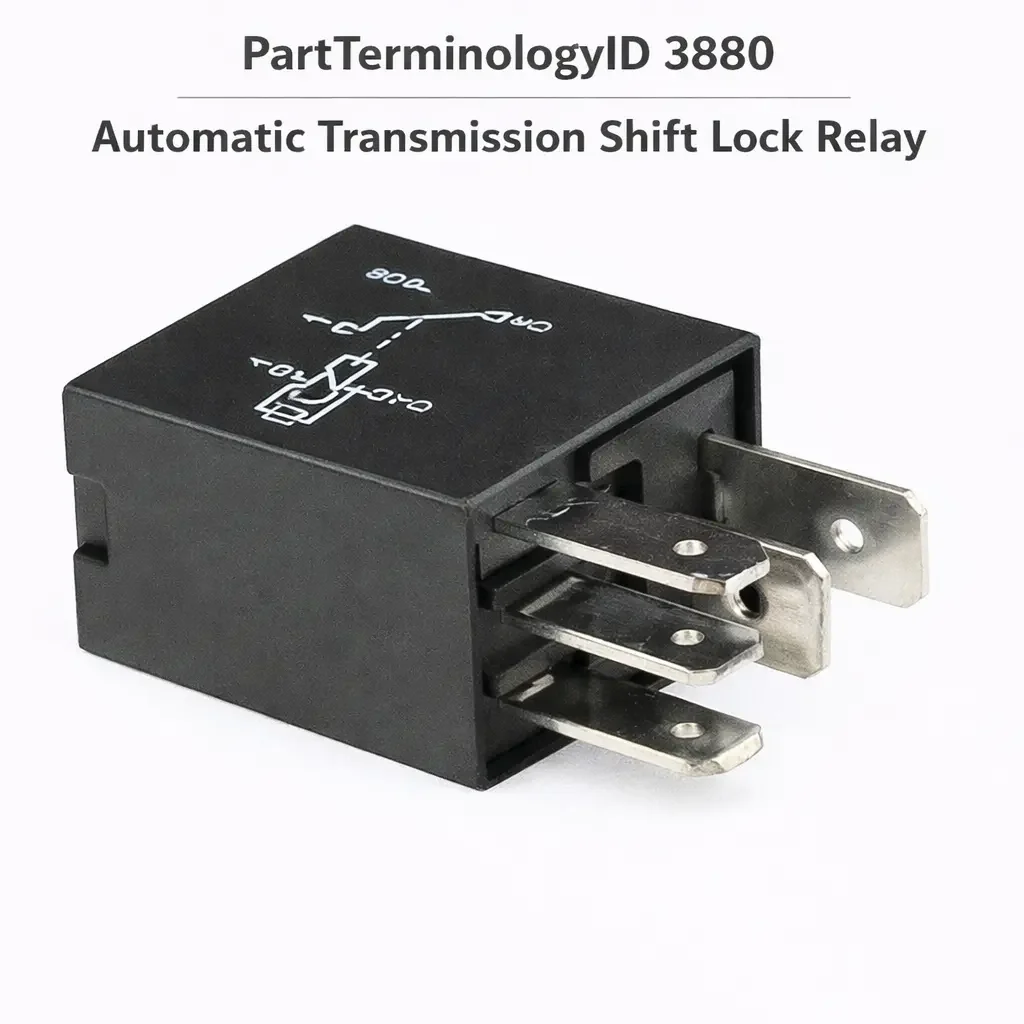
The Automatic Transmission Shift Lock Relay, cataloged under PartTerminologyID 3880, is a relay that forms part of the Brake Transmission Shift Interlock system, commonly abbreviated BTSI. Its function is to carry the activation signal from the brake light switch circuit to the shift interlock solenoid in the shifter assembly, enabling the solenoid to retract its locking plunger and release the shift lever from the Park position when the brake pedal is depressed and the ignition is in the Run position. On platforms that use a discrete relay in this path, the relay sits between the brake switch output and the solenoid supply, amplifying or routing the signal in a way that the brake switch circuit alone cannot directly drive.
The BTSI system is a federally mandated safety feature on automatic transmission vehicles sold in the United States, with broad applicability requirements extending across virtually all domestic-market automatic transmission vehicles. Its purpose is to prevent the vehicle from being shifted out of Park accidentally, particularly by children in an unattended vehicle and by drivers who begin to move the vehicle before the brake pedal is fully depressed. The system requires two simultaneous conditions for the shift lever to be released: the ignition switch must be in the Run or Start position, and the brake pedal must be depressed to at least a defined minimum travel. When both conditions are met, the interlock solenoid receives its supply signal and retracts, allowing the shift button and lever to move. When either condition is absent, the solenoid plunger remains extended and mechanically blocks the shift lever in Park.
The relay is one node in a series circuit that includes the ignition switch or body control module, the brake light switch, the relay itself, the shift interlock solenoid, and in some implementations a park position switch that feeds back to the ignition key interlock. The dominant diagnostic reality for this PartTerminologyID is that the brake light switch is the most common single component to fail in this circuit and produces an identical symptom to a failed relay: the shift lever is stuck in Park despite the brake pedal being depressed. A buyer who replaces the relay without first confirming that the brake light switch is delivering voltage to the relay coil input has a high probability of no-improvement return because they have replaced the downstream component while the upstream cause remains in place.
Status in New Databases PartTerminologyID 3880, Automatic Transmission Shift Lock Relay PIES 8.0 / PCdb 2.0: No change.
What the Relay Does
The BTSI Circuit and the Relay's Position Within It
On platforms that implement the BTSI function through a discrete relay, the relay coil receives its energization signal from the brake light switch circuit when the brake pedal is depressed and the ignition is in the Run position. When the coil is energized, the relay's output contacts close and deliver supply voltage to the shift interlock solenoid. The solenoid coil generates a magnetic field that retracts its iron plunger from the blocking position, releasing the shift lever's detent mechanism and allowing the lever to be moved from Park.
When the brake pedal is not depressed, the brake light switch is open and delivers no voltage to the relay coil. The relay coil is not energized, the output contacts remain open, the solenoid receives no supply, and the solenoid plunger remains extended under spring pressure in the blocking position. The shift lever cannot be moved regardless of how far the shift button is pressed.
The relay is inherently a safety component. Its default state, with no coil energization, is the locked state. This means that any failure in the relay or in the circuit supplying its coil defaults to the safe condition: the shift lever cannot be moved out of Park. A relay that has failed in this direction, with its output contacts stuck open or its coil open-circuited, produces a shift lever that is permanently locked in Park. This is the more common failure mode because it aligns with the default physics of an unenergized relay.
Distinction Between the Relay, the Solenoid, and the BTSI Controller
On some platforms, the BTSI function is implemented without a discrete external relay. The body control module or a dedicated BTSI controller directly drives the shift interlock solenoid through an internal transistor output, using the brake switch signal and ignition state as inputs to its logic. On these platforms, PartTerminologyID 3880 does not apply because no discrete relay component exists in the solenoid supply circuit. Including these applications in the fitment data for this PartTerminologyID generates no-find returns from buyers whose vehicle has no relay to replace.
On platforms that do use a discrete relay, the relay is distinct from the shift interlock solenoid itself. The relay closes or opens the solenoid supply circuit; the solenoid uses that supply to mechanically retract the locking plunger. Both components are in series and either can fail independently. A relay that functions correctly but whose solenoid has failed produces a locked shift lever because the plunger does not retract even though supply voltage is reaching the solenoid. A relay that has failed with its output contacts stuck open produces a locked shift lever because supply voltage never reaches the solenoid even though the solenoid is capable of operating. The symptom is identical from the driver's perspective.
Park Position Switch and Key Interlock Interaction
Many BTSI implementations include a bidirectional safety architecture: not only must the brake be depressed to shift out of Park, but the shift lever must be in Park before the ignition key can be removed. A park position switch or microswitch in the shifter assembly signals the key interlock mechanism when the lever is in the Park detent. If the park position switch fails, the key cannot be removed from the ignition even when the lever is correctly placed in Park, or in some failure modes the key can be removed while the lever is out of Park, which represents a safety risk. The park position switch is a separate component from the shift lock relay and solenoid, but its failure can produce complaints that are attributed to the relay in initial diagnosis because both relate to the overall BTSI system behavior.
Top Return Scenarios
Shift Lever Stuck in Park, Brake Light Switch Is the Actual Fault
The single highest-return scenario for this PartTerminologyID is a buyer whose shift lever is stuck in Park because the brake light switch has failed in the open position, preventing any voltage from reaching the relay coil, while the relay itself is intact. The brake light switch is a mechanically actuated switch mounted near the brake pedal pivot. It sustains physical wear from the pedal contact on every brake application and fails from contact erosion over time. When it fails in the open position, it delivers no voltage to the brake lights and no voltage to the relay coil. The shift lever is permanently locked.
The diagnostic confirmation that distinguishes a relay fault from a brake light switch fault takes less than thirty seconds with a test light: with the ignition in the Run position, depress the brake pedal and probe the relay coil input terminal. If voltage is present at the coil input and the relay does not close its output contacts, the relay is the fault. If no voltage is present at the coil input, the fault is upstream of the relay, most commonly the brake light switch or its fuse. A buyer who performs this test before purchasing confirms the correct component. A listing that does not direct buyers to perform this test first will convert buyers whose fault is the switch, who will return the relay unused.
The brake light confirmation is the fastest triage: if the brake lights do not illuminate when the pedal is depressed, the brake light switch is the primary diagnostic target before any relay diagnosis.
Shift Lever Stuck in Park With Functioning Brake Lights
When the brake lights illuminate correctly and the shift lever remains stuck in Park, the brake light switch is supplying voltage to its output circuit but the shift release mechanism is still not activating. This symptom pattern points to the relay coil not being energized, the relay output contacts not closing, the solenoid not receiving supply voltage, or the solenoid plunger not retracting mechanically. In order, the diagnostic steps are: confirm voltage at the relay coil input with ignition in Run and brake depressed, confirm output contact closure by testing voltage at the solenoid supply wire, and if both relay tests pass, apply direct voltage to the solenoid to confirm the solenoid retracts and releases the lever.
A buyer who has confirmed brake lights are working, confirmed voltage at the relay coil input, and still finds no output from the relay has confirmed a relay fault. This is the correctly qualified buyer for PartTerminologyID 3880. A buyer who skips the coil input voltage test and orders based on the stuck-in-park symptom alone has about a fifty-fifty chance of having identified the correct component, given that the brake light switch accounts for a roughly equal share of stuck-in-park complaints on BTSI-equipped vehicles.
Emergency Shift Lock Release Used Successfully: Relay May Not Be the Fault
All vehicles equipped with a BTSI system include an emergency shift lock release, typically a small slot or button near the base of the shift lever or accessible through the center console bezel. When a small tool is inserted into this slot and pressed, it mechanically overrides the solenoid blocking position and allows the shift lever to be moved regardless of electrical system state. This bypass is designed for emergency use when the system has failed or when the battery is dead.
A buyer who has successfully used the emergency release to shift out of Park, and whose vehicle otherwise operates normally once shifted, has confirmed that the mechanical blocking mechanism is functioning correctly and the solenoid plunger is capable of being moved. The fault is electrical: either the brake light switch, the relay, the solenoid, or a wiring fault is preventing the solenoid from being energized electrically. The relay is one of these candidates, and the coil input voltage test is the determinant.
A buyer who attempted the emergency release and it did not allow the lever to move has a mechanical fault in the shifter assembly, not an electrical fault in the relay circuit. The emergency release bypasses the electrical circuit entirely. If bypassing the electrical circuit does not release the lever, the lever is mechanically stuck independent of the BTSI system. This is most commonly caused by a broken release mechanism inside the shifter assembly, a parking pawl fault, or a vehicle parked on an incline without the parking brake set that has loaded the pawl beyond the shifter's mechanical release capability.
Relay Contacts Stuck Closed: Shift Lever Releases Without Brake Pedal
A relay that has failed with its output contacts stuck closed provides permanent supply voltage to the shift interlock solenoid regardless of brake pedal state. The solenoid plunger remains retracted at all times, and the shift lever can be moved out of Park without depressing the brake pedal. The BTSI safety function is absent.
This failure mode produces no stuck-in-park complaint and is therefore unlikely to generate a replacement purchase driven by a symptom. It is most likely to be identified during a pre-purchase inspection, during a safety system check, or when the vehicle fails a safety inspection that includes verification of BTSI function. A buyer who identifies this failure mode has done so through intentional testing rather than through a driving complaint, and their replacement need is specific and confirmed. The listing should acknowledge this failure mode to ensure these buyers can identify the correct part.
Fuse Fault Produces Same Symptom as Relay Fault
The relay coil circuit and the solenoid supply circuit are both protected by fuses in the vehicle fuse box, typically shared with the brake light circuit or the ignition supply circuit depending on the application. A blown fuse upstream of the relay produces no voltage at the relay coil input, which produces the same stuck-in-park symptom as a relay coil open circuit. Confirming fuse integrity in both the relay coil supply circuit and the solenoid supply circuit is a required step before relay replacement. A buyer who replaces the relay with an intact fuse box and finds the fault persists has either confirmed a relay fault by elimination or has a wiring fault between the fuse and the relay.
Listing Requirements
Every listing for PartTerminologyID 3880 should include:
ACES fitment data confirmed from factory service documentation for platforms with a discrete, externally mounted shift lock relay in the BTSI solenoid supply circuit; must exclude platforms where the BTSI logic is implemented through the BCM or a dedicated BTSI controller that directly drives the solenoid without a discrete relay
A clear description of the relay's position in the BTSI circuit: between the brake light switch output and the shift interlock solenoid supply
A prominent note that the brake light switch is the most common upstream cause of a stuck-in-park complaint, and that confirming brake light function and voltage at the relay coil input must precede relay replacement
A note that the emergency shift lock release slot or button is present on all BTSI-equipped vehicles and provides a method to confirm whether the fault is electrical or mechanical before any component replacement
A note that relay contacts stuck closed eliminate BTSI function without producing a stuck-in-park symptom, and that this failure mode is identified only through active testing rather than through a driving complaint
A note that fuse integrity in the relay coil supply circuit must be confirmed before relay replacement
Frequently Asked Questions
My gear shift is stuck in Park. Are my brake lights on when I press the pedal?
This is the most important diagnostic question before any component replacement. If the brake lights do not illuminate when the brake pedal is depressed, the brake light switch is the primary fault, not the relay. The relay can only be energized by a signal from the brake light switch circuit. A switch that is not closing delivers no signal to the relay and no signal to the brake lights simultaneously. Replace the brake light switch before any relay diagnosis when both the brake lights and the shift release have failed together.
My brake lights work but the shift lever is still stuck in Park. Is the relay the fault?
Functioning brake lights with a stuck shift lever confirms the brake light switch is closing and delivering voltage to the lighting circuit. The BTSI relay coil supply may share this circuit or may be a separate signal from the switch. With the ignition in the Run position and the brake pedal depressed, probe the relay coil input terminal for voltage. If voltage is present and the relay output does not close, the relay is the fault. If no voltage is present at the coil input despite the brake lights working, the relay supply circuit is routed differently from the lamp circuit on this application and the wiring between the brake switch and relay coil input must be traced.
I used the emergency release slot and shifted the car. Does that mean the relay is definitely bad?
Using the emergency shift lock release slot to move the lever out of Park confirms the fault is in the BTSI electrical circuit, not in the mechanical shifter assembly. The relay, the brake light switch, the solenoid, and wiring faults are all equally possible as the electrical cause. Circuit testing to isolate the fault to the relay specifically is the correct next step before purchasing a replacement.
Can I drive with a relay that is stuck closed and releases the shift lever without pressing the brake?
A relay with stuck-closed contacts eliminates the BTSI safety function. The vehicle can be shifted out of Park without the brake pedal being depressed. This is a safety issue and should be repaired. In most jurisdictions, BTSI functionality is required on all automatic transmission vehicles as originally equipped, and disabling or bypassing it is not compliant with the original safety specification.
The shift lever releases fine on its own but I cannot remove the key unless I use the emergency release. Is this a relay problem?
The inability to remove the ignition key when the lever is in Park is associated with the park position switch or the key interlock solenoid, both of which are components separate from the shift lock relay. The shift lock relay controls whether the lever can move out of Park. The key interlock circuit controls whether the key can be removed when the lever is in Park. A fault preventing key removal points to the park position switch or the key interlock solenoid rather than to this PartTerminologyID.
What Sellers Get Wrong
Listing this relay as the default stuck-in-park replacement without brake switch caveat
The most consequential listing error for PartTerminologyID 3880 is allowing the stuck-in-park symptom to drive relay purchases without a prominent upstream check instruction. The brake light switch accounts for a large share of BTSI-related stuck-in-park complaints and costs a fraction of the relay. A listing that positions the relay as the primary replacement response to a stuck-in-park complaint will attract and convert brake-light-switch buyers who return the relay intact after installation produces no improvement. The brake light check must be the first item in any description of how to diagnose this part.
Not distinguishing the relay from the shift interlock solenoid
The shift lock relay and the shift interlock solenoid are separate components in the same circuit. The solenoid is in the shifter assembly at the shift lever. The relay is in the underhood relay box or behind the instrument panel. Both can produce a stuck-in-park symptom when failed. A listing that describes only the relay without acknowledging the solenoid as a co-fault possibility will generate returns from buyers whose solenoid is the fault and who ordered the relay because they could not find the solenoid description separately. Referring buyers to a circuit test that distinguishes relay output from solenoid response keeps both faults correctly identified.
Not covering the emergency release bypass as a pre-replacement diagnostic step
The emergency shift lock release is the simplest tool available for distinguishing an electrical BTSI fault from a mechanical shifter fault. A listing that does not mention the emergency release forces buyers who have a mechanically stuck shifter into an electrical component replacement sequence that cannot resolve their fault. Mechanical faults in the shift assembly, including broken release mechanisms and parking pawl issues, are confirmed when the emergency release does not allow the lever to move. This single check eliminates mechanical causes and confirms the fault is electrical before the buyer spends money on a relay.
Not addressing the fuse as a required pre-check
A blown fuse in the relay coil supply circuit produces the same symptom as an open-circuit relay coil and is resolved at zero component cost. A listing that does not instruct buyers to confirm fuse integrity before purchasing will convert a subset of buyers whose fuse is the fault. Fuse replacement costs under a dollar. Relay replacement costs many times more. A buyer who could have solved their problem with a fuse and instead received a relay they did not need is a return and a dissatisfied customer.
Not flagging BCM-integrated applications in the ACES exclusion
The subset of applications where the BCM or a dedicated BTSI control module directly drives the solenoid without a discrete relay is the most damaging fitment inclusion error for this PartTerminologyID. A buyer who searches for this relay on a BCM-integrated platform, finds it in the listing, purchases it, and then cannot locate it on their vehicle has a no-find return and a damaged confidence in the catalog. Factory wiring diagram confirmation for each application is the only reliable basis for this listing's ACES data.
Cross-Sell Logic
Brake light switch, also called the stoplight switch (the upstream input that signals the relay when the brake pedal is depressed; the most common single cause of stuck-in-park complaints on BTSI-equipped vehicles; confirming brake light function is the mandatory first diagnostic step; replacement is required when the relay coil receives no supply voltage despite the brake pedal being depressed)
Shift interlock solenoid, also called the BTSI solenoid (the downstream output component that the relay supplies; when relay output contact closure is confirmed but the shift lever remains locked, the solenoid is the next fault location; bench test with direct voltage confirms solenoid plunger retraction)
Park position switch (the component in the shifter assembly that signals the ignition key interlock when the lever is in Park; a failed park position switch prevents key removal when in Park, or in some failure modes allows key removal when not in Park; separate fault from the shift lock relay)
Ignition switch (an input to some BTSI implementations that must be in the Run position for the interlock to release; a faulty ignition switch that does not correctly signal the Run position can hold the BTSI in its locked state independently of brake pedal input)
Fuse for the BTSI circuit (a zero-cost diagnostic and repair item that must be confirmed intact before any relay replacement; blown fuse produces the same symptom as relay coil open circuit)
Body control module (the control unit that manages BTSI logic on platforms where a discrete relay is not used; a BCM fault affecting the BTSI output produces stuck-in-park behavior on BCM-integrated platforms; this is the correct fault location on those platforms rather than a relay)
Final Take
PartTerminologyID 3880 is the safety interlock relay most likely to be purchased by a buyer whose actual fault is not in the relay at all. The brake light switch accounts for a share of stuck-in-park complaints that rivals or exceeds the relay's own failure rate, and both produce identical driver-observable symptoms. The listing that leads with the brake light check converts the buyers who genuinely need the relay while redirecting brake-switch buyers before they make an incorrect purchase. The listing that does not lead with this check converts both groups and returns the second.
The emergency shift lock release procedure is the second critical element. It is a built-in diagnostic tool that every buyer has access to without any additional equipment. A buyer who has attempted the emergency release and found it releases the lever has confirmed an electrical fault. A buyer who found the emergency release does not release the lever has confirmed a mechanical fault and should not be purchasing electrical components. Including this procedure in the listing prevents the mechanical-fault buyer from ordering the relay.
The ACES fitment scope is the third discipline. On BCM-integrated platforms, no relay exists. A buyer who cannot find the relay on their vehicle and returns the part is the direct result of an ACES entry that was built from symptom matching rather than from factory wiring diagram confirmation.
Disclaimer
This guide is intended for catalog research, parts listing, and diagnostic reference. BTSI circuit architecture, relay location, and solenoid control logic vary by manufacturer, model year, and platform. Always confirm application data against factory wiring diagrams and OEM service documentation before finalizing a listing or parts recommendation. PartsAdvisory and its contributors are not responsible for fitment errors arising from catalog data that has not been independently verified against official OEM sources.