
Written by Arthur Simitian | PartsAdvisory
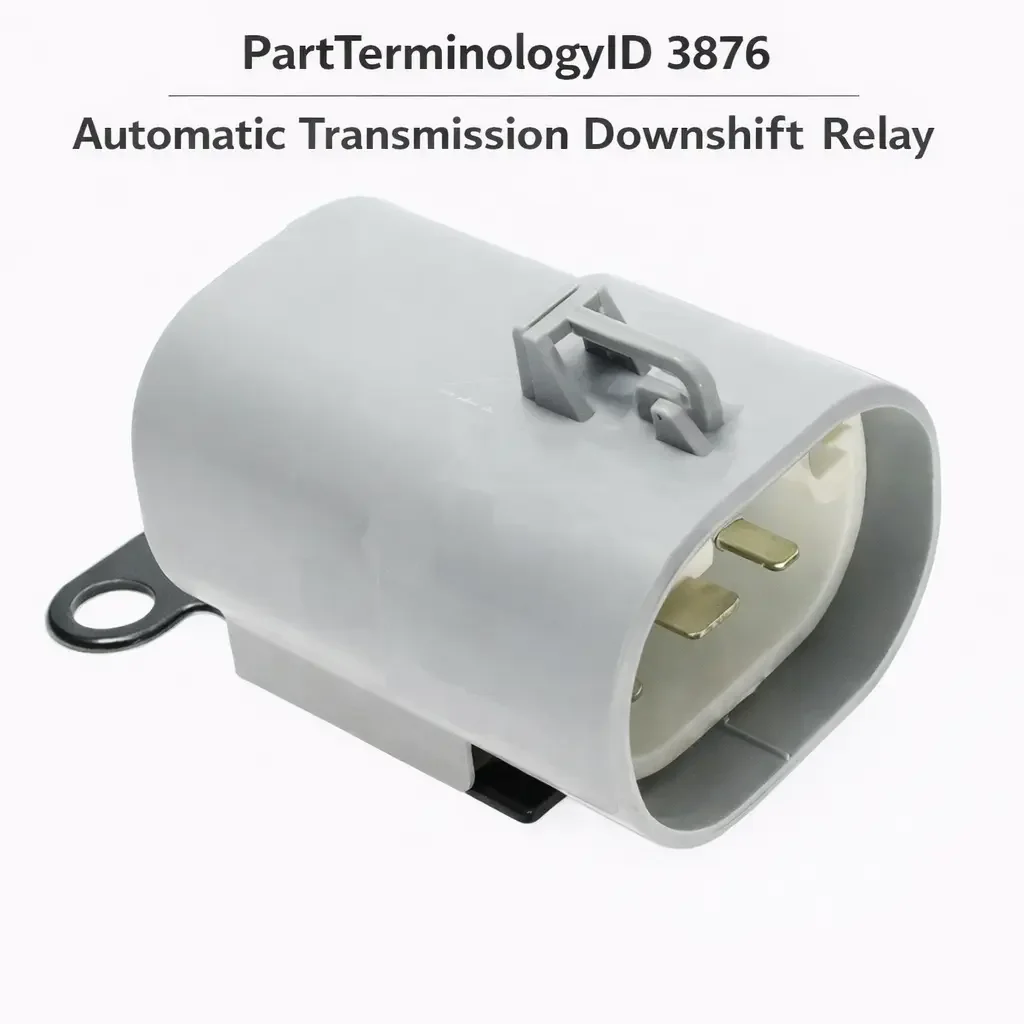
The Automatic Transmission Downshift Relay, cataloged under PartTerminologyID 3876, is a relay that sits in the electrical circuit between the wide-open-throttle kickdown switch and the kickdown solenoid in the transmission valve body. When the driver presses the accelerator pedal to the floor, the kickdown switch closes and signals the transmission to downshift to the lowest gear available at the current vehicle speed, producing maximum acceleration. The relay's role is to carry or interrupt that signal between the switch and the solenoid, amplifying it in applications where the switch current is insufficient to directly drive the solenoid, or modifying the circuit based on additional control inputs such as engine RPM or vehicle speed that determine whether a full-throttle downshift is appropriate at the current operating condition.
The circuit architecture of this relay is not uniform across applications and is frequently the opposite of what a buyer expects. On most relay applications a relay closes its output contacts to complete a circuit. On many downshift relay applications the relay uses normally-closed contacts that are already closed at rest, so the kickdown solenoid circuit is live by default and the relay's job is to open those contacts under specific conditions, such as when engine RPM reaches a defined threshold, to break the kickdown solenoid supply and force an instantaneous shift. This inverted logic means that a relay that has failed open-circuit produces a symptom of no kickdown response even though no kickdown was being blocked, because the normally-closed contacts that were supposed to be carrying the solenoid supply are now open permanently. A relay that has failed contacts-stuck-closed in a normally-open application produces the opposite: permanent full-throttle shift programming regardless of actual throttle position.
Understanding which architecture a specific application uses, and therefore what both failure modes look like, is the prerequisite for any diagnostic or listing work on this PartTerminologyID. The normally-closed relay architecture is specifically documented on Porsche 928 and related applications where the relay receives a tachometer-derived RPM signal at a defined engine speed threshold, opens its normally-closed contacts to break the kickdown solenoid circuit, and forces the transmission to upshift instantly rather than allowing the solenoid to hold the lower gear past redline. On these platforms the relay is not activated by the kickdown switch; it is activated by the RPM circuit as an override that limits the downshift duration.
This is a relay associated primarily with older and transitional-generation automatic transmission platforms. Modern electronically controlled transmissions integrate downshift logic entirely within the transmission control module software, which monitors throttle position sensor data and commands downshift solenoids directly without a discrete relay in the signal path. The application scope for PartTerminologyID 3876 is restricted to platforms confirmed to have a discrete, externally mounted downshift relay in the kickdown circuit.
Status in New Databases PartTerminologyID 3876, Automatic Transmission Downshift Relay PIES 8.0 / PCdb 2.0: No change.
What the Relay Does
Signal Amplification Between Kickdown Switch and Solenoid
On applications where the relay functions as a simple amplifier, the kickdown switch at the throttle body or accelerator pedal assembly closes a low-current circuit when full throttle is applied. This low-current signal energizes the relay coil, which closes the relay's output contacts and delivers the higher current required to activate the kickdown solenoid in the valve body. The relay allows the kickdown switch to be a small, lightly-built component in the pedal or throttle linkage while the heavier current load is carried by the relay's output contacts and associated wiring rather than through the switch itself.
On these amplifier-only applications, the relay is normally open. It is de-energized at rest, the solenoid is not powered, and the transmission uses its standard shift programming. When full throttle is applied and the switch closes, the relay energizes, the solenoid activates, and the transmission downshifts. When the driver releases the pedal, the switch opens, the relay de-energizes, and the solenoid returns to its unactivated state.
Redline Override and the Normally-Closed Architecture
On applications where the relay incorporates a redline or RPM-based override, the circuit operates in reverse. The kickdown solenoid is powered directly through the relay's normally-closed contacts. As long as engine speed is below the defined threshold, the relay coil is not energized, the contacts remain closed, and the solenoid receives supply whenever the kickdown switch is activated. When engine speed reaches the RPM threshold, the relay coil is energized by a tachometer or ignition-pulse-derived signal, and the normally-closed contacts open, breaking the solenoid supply. This forces the transmission to upshift even if the driver's foot is still at full throttle, preventing the engine from exceeding its safe operating speed in the lower gear.
On these applications, the relay is not activated by the kickdown switch at all. It is activated by the RPM signal. The kickdown switch powers the solenoid directly through the relay's resting closed contacts. The relay's only active function is to interrupt that path at redline. This architecture produces a counterintuitive failure mode: a relay whose coil has developed an open circuit and cannot be energized by the RPM signal cannot open its normally-closed contacts at redline. The solenoid remains active, the downshift is not released at redline, and the engine can be driven past its intended RPM limit in the lower gear. The driver notices no loss of kickdown function because the solenoid is working normally below redline. The failure is the absence of the redline protection, which is invisible until the engine is pushed to its limit.
Interaction with Valve Body Hydraulics
The kickdown solenoid in the transmission valve body operates a detent valve that changes the hydraulic pressure governing shift points when activated. When the solenoid is energized, the detent valve raises line pressure and modifies the shift point thresholds so that the transmission holds lower gears to higher speeds and engine RPM than it would under normal partial-throttle driving. When the solenoid is de-energized, the transmission returns to its standard partial-throttle shift programming. The relay controls whether the solenoid is energized or not. A relay that cannot activate the solenoid means the transmission never enters the detent state. A relay that cannot de-activate the solenoid means the transmission is permanently in the detent state.
Permanent detent-active operation from a contacts-stuck-closed relay failure produces a transmission that shifts aggressively at all throttle positions, holds gears to near-redline during normal driving, and exhibits harsh kickdown-style behavior regardless of how lightly the driver presses the accelerator. This symptom can be confused with a stuck-open throttle position sensor or a calibration fault in a PCM-controlled transmission, because the shift behavior resembles what a faulty WOT signal would produce.
Top Return Scenarios
No Kickdown Response at Full Throttle
The most common buyer symptom is the absence of a kickdown downshift when the accelerator is pressed to the floor. The engine reaches its power band but the transmission does not downshift to the next lower gear, and acceleration from the current gear is less responsive than expected. In normal operation, full-throttle application produces a noticeable change in engine RPM and a corresponding surge in acceleration as the transmission drops to a lower gear ratio.
This symptom is also produced by a failed kickdown switch that is not closing when the pedal reaches full travel, a faulty kickdown solenoid that is not responding to its supply signal, a broken or disconnected wire between any of these components, or a low-current fault in the relay coil circuit. The relay is one node in a series circuit. Before replacing the relay, confirming that the kickdown switch closes at full throttle and delivers voltage to the relay coil terminal, and confirming that the relay output contacts deliver voltage to the solenoid when the coil is energized, isolates whether the relay is the fault. A relay that tests correct in both respects with the fault persisting elsewhere in the circuit produces a no-improvement return.
Transmission Always in Kickdown Mode: Harsh Shifts at All Throttle Positions
A relay that has failed with its output contacts stuck closed in a normally-open application, or a relay whose coil circuit is permanently completed rather than switched, delivers continuous supply to the kickdown solenoid regardless of throttle position. The transmission behaves as though the driver is always at full throttle: shift points are high, upshifts are delayed, and the shift quality during light-throttle or normal driving is harsh. This is the contacts-stuck-closed failure mode described above, and it produces a complaint pattern that leads buyers to diagnose the transmission control system or the throttle position sensor before arriving at the relay.
Confirming this failure mode requires testing whether the kickdown solenoid is receiving supply voltage with the pedal not applied. If solenoid supply voltage is present at rest with no switch activation, the relay contacts are stuck closed or the wiring has a permanent short to supply. Replacing the relay resolves the fault if the relay is the stuck contact. A permanent wiring fault requires wiring repair before relay replacement is appropriate.
Relay Ordered After Kickdown Switch Replacement Failed to Restore Function
A common diagnostic sequence for a no-kickdown complaint begins with the kickdown switch, which is the more accessible and less expensive component. When switch replacement does not restore kickdown function, the relay is the natural next diagnostic step. A buyer in this scenario has already confirmed the switch side of the circuit and has narrowed the fault to the relay or the solenoid. This is the most qualified buyer for this PartTerminologyID: they have performed partial diagnosis and identified the relay as a probable fault location.
The return risk in this scenario is from buyers who replaced the switch and relay sequentially but whose solenoid is the actual fault. Confirming solenoid activation by applying the correct voltage directly to the solenoid terminals after the relay is confirmed functioning eliminates the solenoid as a co-fault before the relay replacement purchase is made.
Redline Protection Failure: No Immediate Symptom Until Limit Is Approached
On normally-closed relay applications with a redline RPM override, a relay whose coil has failed open prevents the normally-closed contacts from opening at the RPM threshold. The relay cannot be energized by the RPM signal, the contacts stay closed, and the solenoid stays active during a full-throttle run that approaches the engine's redline. Under normal street driving, most drivers never reach the speed at which the redline protection activates, and the relay failure produces no observable symptom.
This failure mode is invisible in diagnosis and therefore produces a high rate of no-fault-found returns when the relay is replaced proactively rather than in response to a symptom. A relay that tests correct bench behavior, with normally-closed contacts resting closed and opening when the coil is energized with 12 volts, confirms that the relay is not suffering coil failure. Confirming the relay coil opens the contacts within the RPM threshold specified in the factory service manual for the specific application completes the diagnostic confirmation.
Wrong Architecture Ordered: Normally Open vs. Normally Closed
A buyer who identifies the relay by socket location and orders a replacement based on pin count and housing dimensions may receive a relay with the wrong contact architecture if the listing does not specify whether the application requires normally-open or normally-closed output contacts. Installing a normally-open relay in a normally-closed application leaves the solenoid without supply at rest: the kickdown switch activates but there are no contacts to close. Installing a normally-closed relay in a normally-open application puts the solenoid in permanent supply: the transmission is always in kickdown mode.
The listing must specify the contact architecture required for each application. A generic relay description that omits normally-open or normally-closed classification will generate returns from buyers who installed the incorrect architecture.
Listing Requirements
Every listing for PartTerminologyID 3876 should include:
ACES fitment data confirmed from factory service documentation for platforms with a discrete, externally mounted downshift relay in the kickdown solenoid supply circuit; must exclude platforms where the downshift function is managed entirely within the transmission control module software
A clear statement of whether the application uses a normally-open relay architecture, where the relay completes the solenoid circuit when energized, or a normally-closed relay architecture, where the relay breaks the solenoid circuit when energized by an RPM signal
A description of both failure modes for the specific architecture: stuck-open contacts producing no kickdown response, and stuck-closed contacts producing permanent kickdown-mode behavior
A note that the kickdown switch and kickdown solenoid are series circuit components that must be confirmed before relay replacement is appropriate; a relay that tests functioning at the bench but produces no improvement after installation indicates a fault at one of these other nodes
A note that on normally-closed redline-override applications, coil failure produces no immediately observable driving symptom and is confirmed by bench-testing whether the relay coil opens the contacts within the application-specific RPM threshold
Frequently Asked Questions
My car won't downshift when I floor the accelerator. Is the relay the cause?
A failed downshift relay is one possible cause of no kickdown response. Before replacing the relay, confirm that the kickdown switch at the pedal or throttle body closes and delivers voltage to the relay coil terminal when the pedal is at full travel. If the switch is not delivering voltage to the coil, the switch is the fault. If the switch delivers voltage to the coil and the relay coil does not energize and close its contacts, the relay is the fault. If the relay contacts close and deliver voltage to the solenoid but the transmission still does not downshift, the solenoid is the fault.
My transmission shifts very aggressively at all throttle positions, even light acceleration. Could the relay be causing this?
Aggressive shift behavior at all throttle positions, with the transmission holding gears longer than normal and upshifting later than expected, is consistent with the kickdown solenoid being permanently activated. This is produced by a relay whose output contacts are stuck closed, a wiring short that permanently supplies the solenoid, or in some cases a kickdown switch that is stuck in the closed position. Confirm whether the solenoid is receiving supply voltage with no pedal input before diagnosing the relay as the fault.
What is a normally-closed relay and why does it matter for this part?
A normally-closed relay has its output contacts closed at rest with no coil voltage applied. Power flows through the contacts by default. When the relay coil is energized, the contacts open and break the circuit. Some downshift relay applications, particularly those incorporating a redline RPM override, use this architecture so the kickdown solenoid is powered by default through the relay's resting contacts, and the relay's active role is to interrupt that supply at a defined engine speed threshold. A normally-open relay installed in a normally-closed application, or vice versa, produces the wrong default circuit state and will cause incorrect transmission behavior regardless of whether the relay itself is functioning correctly.
My relay bench tests correctly but the kickdown still does not work after installation. What should I check?
A relay that tests correctly at the bench and still produces no kickdown response after installation indicates a fault at another node in the circuit: either the kickdown switch is not delivering the activation signal to the relay coil, the wiring between the relay output and the solenoid is broken, or the solenoid itself is not responding to its supply. Test each circuit segment individually using the factory wiring diagram before concluding that another relay replacement is needed.
What Sellers Get Wrong
Not specifying the relay contact architecture
The most consequential listing error for PartTerminologyID 3876 is omitting whether the application requires normally-open or normally-closed output contacts. A buyer who installs the wrong architecture will experience transmission behavior that is the inverse of what they were trying to correct, and the new relay will appear to have made the problem worse rather than better. The contact architecture must be identified for each application from the factory service documentation, not inferred from general relay descriptions.
Treating the relay as the first diagnostic step for no-kickdown complaints
No-kickdown complaints have multiple possible causes in the same circuit, and the relay is not the most accessible or most likely single cause. The kickdown switch, being a mechanical component at the accelerator pedal that sustains physical wear and contact fatigue, is as likely or more likely to be the fault than the relay on high-mileage vehicles. A listing that positions the relay as the first replacement action on a no-kickdown complaint will generate returns from buyers whose switch is the fault, or whose solenoid is the fault, and who replaced the relay without improving the circuit behavior. Directing buyers to a systematic circuit test before relay replacement reduces this return category.
Not addressing the normally-closed redline-override architecture and its failure mode
The most technically counterintuitive aspect of this PartTerminologyID is the normally-closed redline-override application, where the relay's failure mode produces no observable driving symptom under most conditions. A listing that only describes the no-kickdown symptom pattern will not capture buyers whose relay has failed in the coil-open mode on a normally-closed redline-override platform, because those buyers have no symptom to respond to. It will also fail to inform buyers on those platforms that their relay requires a bench test confirming coil actuation rather than just contact continuity testing.
Not distinguishing this relay from the transmission main relay
Many automatic transmissions equipped with electronic controls use a separate transmission main relay or transmission control relay that provides the primary power supply to the transmission control module and its solenoid pack. This relay is a distinct component from the downshift relay and controls a different circuit. A buyer who has a transmission in limp mode or a total loss of electronic transmission control has a transmission main relay fault, not a downshift relay fault. A listing that does not distinguish these two relay types will attract buyers with limp-mode complaints who install the downshift relay and find no change in behavior.
Cross-Sell Logic
Kickdown switch, also called the full-throttle switch or WOT switch (the input-side component that signals the relay when full throttle is applied; a failed or maladjusted switch produces the same no-kickdown symptom as a failed relay and is the correct first diagnostic target before the relay)
Transmission kickdown solenoid (the output-side component that the relay supplies; when relay function is confirmed and no kickdown response occurs, the solenoid is the next fault location; bench-testing with direct voltage application confirms solenoid responsiveness before relay replacement)
Throttle valve cable, also called the TV cable or kickdown cable (on non-electronic transmissions that use a mechanical TV cable rather than an electrical solenoid for shift point control, the cable rather than the relay and solenoid is the downshift mechanism; confirming whether the application uses electrical or mechanical downshift actuation is a prerequisite for correct part identification)
Transmission main relay or transmission control relay (the power supply relay for the transmission control module and solenoid pack; distinct from the downshift relay; the correct replacement for limp-mode or total electronic transmission control loss)
Accelerator pedal position sensor or throttle position sensor (on modern platforms where downshift logic is TCM-integrated, a faulty TPS or APPS delivering an incorrect WOT signal to the TCM produces aggressive or absent downshift behavior without any relay being involved; confirming the application uses a discrete relay before purchasing this PartTerminologyID)
Final Take
PartTerminologyID 3876 is defined by its circuit architecture ambiguity more than any other relay in the transmission catalog. A normally-open relay and a normally-closed relay that are externally identical can occupy the same socket on different applications and produce entirely opposite default circuit states. The listing that identifies the correct architecture for each application, and explains both failure modes for each architecture, converts buyers accurately and returns them rarely. The listing that describes only one architecture or omits the contact specification will generate misapplication returns from a predictable subset of buyers.
The redline-override normally-closed architecture is the most technically precise element of this PartTerminologyID and the least likely to be correctly handled in generic relay listings. On those applications, the relay's primary protective function is invisible in normal driving, the failure mode produces no complaint, and the correct bench test evaluates coil actuation against an RPM threshold rather than simply testing contact continuity. A listing that communicates this accurately differentiates itself from generic relay copy and serves the technically literate buyer on these applications.
Disclaimer
This guide is intended for catalog research, parts listing, and diagnostic reference. Relay contact architecture, kickdown circuit configuration, and solenoid control logic vary by manufacturer, transmission model, and model year. Always confirm application data against factory wiring diagrams and OEM service documentation before finalizing a listing or parts recommendation. PartsAdvisory and its contributors are not responsible for fitment errors arising from catalog data that has not been independently verified against official OEM sources.