
Written by Arthur Simitian | PartsAdvisory
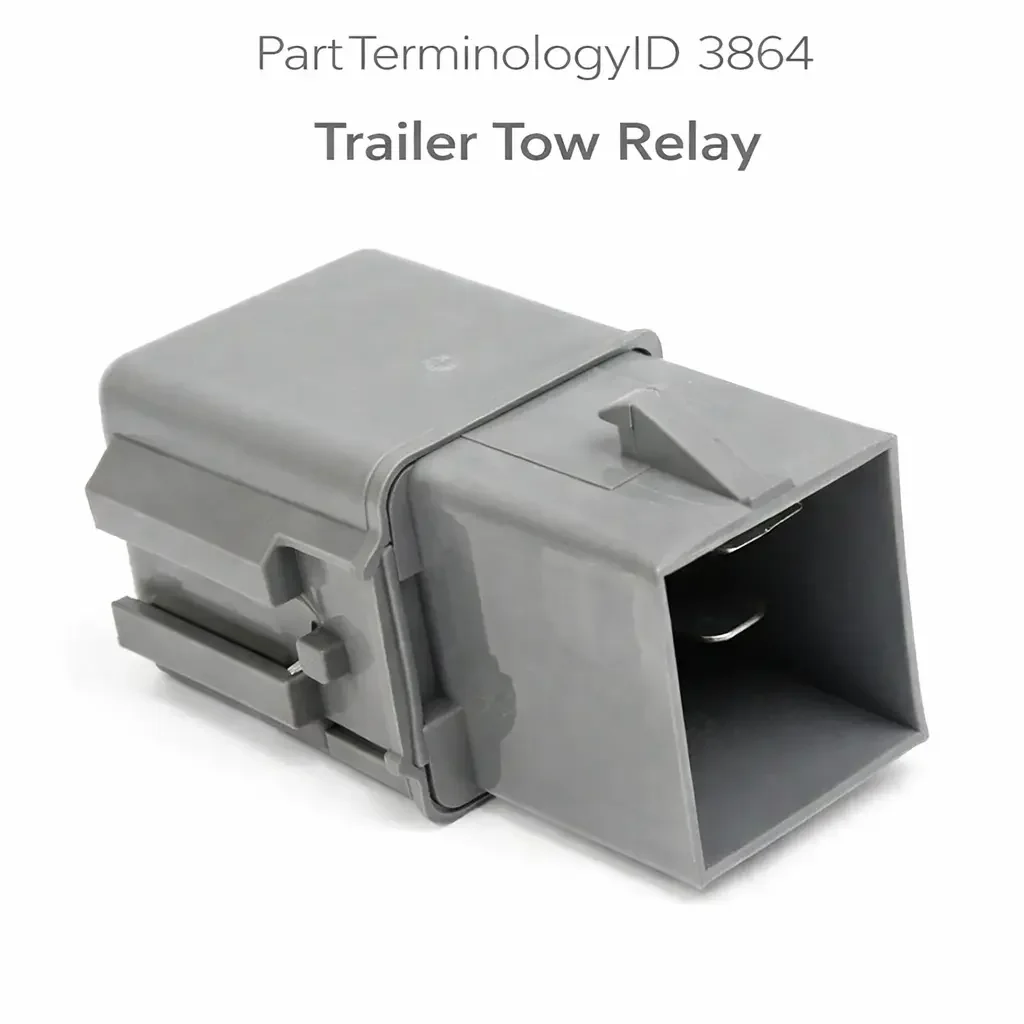
The Trailer Tow Relay, cataloged under PartTerminologyID 3864, is a relay that controls the high-current auxiliary power circuit feeding the battery charge pin of the trailer connector, typically the orange wire in a seven-way blade connector. Its function is to connect the tow vehicle's electrical system to the trailer's auxiliary power circuit only when the vehicle is running, preventing the trailer battery or trailer-powered accessories from discharging the tow vehicle's starting battery when the engine is off. It is a normally-open relay: its output contacts are open at rest, and it closes when its coil is energized by an ignition-switched supply. When the engine starts and the ignition circuit rises to the run position, the relay closes and connects battery voltage to the trailer charge pin. When the ignition is switched off, the relay opens and isolates the trailer circuit from the vehicle battery.
The relay is functionally simple. Its purpose is a single switching action keyed to ignition state. What makes it complex in a catalog context is the variety of circuit implementations across manufacturers and model years, the frequency with which it is absent from vehicles that have tow packages but were not built with the battery charge circuit populated, and the number of diagnostics that begin as no-twelve-volt complaints at the trailer connector and end with an incorrect part number because the technician replaced the relay without confirming it was present and correctly connected in the first place.
On some platforms, the relay is a standard five-pin mini relay in a shared relay box. On others it occupies a dedicated socket in a separate trailer tow relay block in the engine compartment. On a number of Ford Super Duty and F-Series applications, the relay and associated fuse were supplied in a bag in the glove box rather than installed at the factory, requiring the owner or dealer to install them before the battery charge circuit functioned. A buyer who has no twelve volts at the trailer connector on one of these platforms may not have a failed relay at all. They may have a relay socket that was never populated. A listing that does not acknowledge this situation drives a sale that the buyer immediately returns when they discover the socket is empty.
What the Relay Does
Ignition-Switched Battery Charge Circuit
The seven-way trailer connector includes a dedicated twelve-volt battery charge pin that provides power to the trailer's auxiliary battery, onboard converter, or powered accessories while the tow vehicle is operating. This pin is protected by a high-current fuse, typically twenty-five to thirty amps, and its supply runs through the trailer tow relay. The relay coil is energized by an ignition-switched circuit so that the auxiliary power output is only live when the engine is running.
The ignition-switched control accomplishes two things. First, it prevents the trailer battery or trailer accessories from drawing current from the tow vehicle's battery when the vehicle is parked, which would deplete the starting battery overnight or over a period of days. Second, it ensures that the trailer auxiliary circuit is not live during the cranking event, when the starting battery's voltage is at its lowest and should not be burdened with additional loads.
On some platforms, the relay's coil circuit includes an additional logic condition beyond the ignition-switched supply. Certain Ford applications from the late 2000s and 2010s incorporated a voltage monitoring function that prevented the relay from closing until the vehicle battery had recovered to a minimum charge level after engine start, ensuring that the starting battery was not immediately burdened with a trailer charge demand before the alternator had restored its charge. This additional logic was implemented in the powertrain control module rather than in the relay itself, but its effect was that the twelve-volt trailer circuit did not become live immediately upon ignition engagement, and drivers unfamiliar with this behavior reported it as a relay fault.
Circuit Protection Boundary
The trailer tow relay also functions as a protection boundary between the tow vehicle's main electrical system and the trailer's auxiliary circuit. A short circuit or overload in the trailer's battery circuit can generate a high-current fault that, without the relay in the circuit, could reach the tow vehicle's wiring directly through the charge pin. The relay's fuse protects the wire gauge of the charge circuit from overload, but the relay itself provides the switching boundary that allows the fuse to do its job cleanly. A relay that is bypassed or replaced with a direct wire eliminates this switching boundary and increases the risk that a trailer-side fault affects the tow vehicle's electrical system beyond what the fuse alone can protect.
Relationship to Trailer Lighting Relays
On many platforms, the trailer tow package includes more than one relay. A separate relay, or set of relays, handles the trailer lighting circuits: running lights, turn signals, brake lights, and reverse lights. These lighting relays are distinct from the trailer tow relay of PartTerminologyID 3864. The trailer tow relay controls only the battery charge and auxiliary power circuit. A complaint about trailer lights not functioning is a lighting relay fault, not a trailer tow relay fault. A complaint about no twelve volts at the auxiliary power pin while all trailer lights function normally is the symptom pattern associated with this relay.
A listing that does not clearly identify which circuit this relay controls, and which circuits it does not control, will generate returns from buyers who installed the relay and found that it did not resolve a trailer lighting complaint. It will also generate returns from buyers whose trailer lighting relay failed and who ordered this relay based on a generic relay description without confirming which relay in their tow package controls which circuit.
Top Return Scenarios
No Twelve Volts at Trailer Connector, Socket Was Never Populated
The most common no-twelve-volt complaint at the trailer battery charge pin on Ford F-Series and Super Duty trucks from roughly 2000 through 2015 is an unpopulated relay socket rather than a failed relay. Ford supplied the trailer battery charge relay and its associated fuse as a loose item in the glove box on a significant portion of these trucks when equipped with the base tow wiring package, expecting the owner or dealer to install them when needed. A truck that has never had a relay in this socket has no twelve volts at the charge pin regardless of what relay is installed elsewhere in the relay box.
A buyer who orders this relay, installs it in a socket that is already populated with a functioning relay, and then finds the circuit still does not work has replaced a working relay and not addressed the actual fault, which may be the fuse, a broken wire between the relay output and the trailer connector, or the relay socket itself. A buyer who orders this relay and cannot find any relay socket matching the description in their vehicle has encountered the unpopulated socket scenario. Both return the relay.
The listing must note that the relay may be absent from the factory installation on certain applications and that socket presence must be confirmed before replacement is ordered. The factory service manual or relay box diagram for the specific vehicle is the authoritative reference.
Relay Present and Functional, Fuse Is Blown
The relay controls a high-current circuit protected by a separately mounted fuse, typically in the engine compartment fuse and relay box. A blown fuse on the power input side of the relay leaves no output voltage at the trailer connector despite the relay functioning correctly. The symptom is identical to a failed relay from the driver's perspective: no twelve volts at the charge pin. A buyer who replaces the relay without checking the associated fuse will return the relay intact.
The fuse and relay should be confirmed together in any no-twelve-volt diagnosis on this circuit. The fuse location is application-specific and must be identified from the factory relay box diagram before either component is replaced. On some platforms the fuse is a maxi fuse; on others it is a standard blade fuse in the power distribution box. A listing that mentions fuse confirmation as a pre-replacement check reduces this return scenario.
No-Voltage Complaint After Aftermarket Brake Controller Installation
An aftermarket brake controller installation frequently requires access to the wiring in the vicinity of the trailer tow relay and its associated fuse. Installations that were performed without following the factory wiring diagram correctly sometimes result in the relay being removed, bypassed, or reconnected to the wrong terminals. A buyer who has no twelve volts at the trailer connector and recently had an aftermarket brake controller installed should confirm the relay is present, correctly seated, and not bypassed before ordering a replacement.
A relay that has been bypassed by a direct wire connection from the battery to the charge pin circuit eliminates the ignition-switched protection and leaves the trailer circuit permanently live. This is a wiring fault that replacement of the relay does not correct unless the bypass is also identified and removed.
Relay Present, Functioning, Delayed Closure Due to PCM Logic
On Ford applications with PCM-controlled delay logic in the trailer charge circuit, the twelve-volt output at the trailer connector does not appear immediately upon ignition engagement. The PCM delays closing the relay coil circuit until the vehicle battery has recovered to a minimum charge threshold after the cranking event. A driver who checks for twelve volts at the connector immediately after starting a cold vehicle may not find it for several seconds to a minute, depending on battery state and alternator output. This is correct system behavior, not a relay fault.
This behavior also appears on vehicles where the PCM requires a brake pedal input or a trailer connected signal before enabling the charge circuit, depending on the specific software calibration. A buyer who tests for twelve volts without the engine running, or immediately after a cold start on a vehicle with this logic, and finds nothing, may conclude the relay has failed when the system is functioning exactly as designed. The listing should note that delayed activation after engine start is normal on certain applications and does not indicate relay failure.
Relay Failed Contacts-Closed: Charge Pin Live With Ignition Off
A relay that has failed with its output contacts stuck closed provides permanent twelve-volt supply to the trailer charge pin regardless of ignition state. The trailer battery or trailer accessories draw current from the tow vehicle's starting battery whenever connected, even with the vehicle parked and the ignition off. A driver who returns from a trip and finds a dead tow vehicle battery the next morning, after leaving the trailer connected, has the symptom pattern associated with this failure mode.
This symptom is shared with a wiring fault that has bypassed the relay entirely, making it important to confirm the relay itself has failed contacts-closed before replacement. Testing the relay in-circuit with the ignition off by measuring voltage at the trailer charge pin is the most direct confirmation: if twelve volts is present with the key out and no apparent wiring bypass, the relay contacts are stuck closed.
Listing Requirements
Every listing for PartTerminologyID 3864 should include:
ACES fitment data confirmed from factory service documentation for platforms with a discrete, socketed trailer tow relay in the battery charge circuit; must identify applications where the relay was supplied as a loose item rather than factory-installed, as this creates a distinct buyer scenario
A clear statement that this relay controls the battery charge and auxiliary power circuit at the trailer connector, not the trailer lighting circuits
A note that on certain Ford applications the relay may not be installed from the factory and that socket presence must be confirmed before replacement is ordered
A note that the associated high-current fuse must be confirmed intact before relay replacement, as a blown fuse produces the same no-voltage symptom
A note that delayed charge pin activation after engine start is normal behavior on applications with PCM-controlled charge circuit logic and does not indicate relay failure
A note that the trailer must be disconnected and the circuit checked with ignition off to confirm contacts-stuck-closed failure mode when investigating unexpected battery drain
Frequently Asked Questions
I have no twelve volts at the orange wire in my trailer connector. Is the relay the cause?
No twelve volts at the battery charge pin can result from a blown high-current fuse, an absent or unpopulated relay socket, a failed relay, a broken wire between the relay output and the connector, or PCM logic that has not yet enabled the circuit after engine start. Confirm the relay is present and correctly seated in its socket, confirm the associated fuse is intact, confirm the vehicle is running with the ignition in the run position, and allow a brief period after engine start on applications with PCM-monitored charge logic before concluding the relay has failed.
My trailer was connected overnight and my truck battery was dead in the morning. Is this relay the cause?
A dead truck battery after an overnight trailer connection is consistent with a relay that has failed with its output contacts stuck closed, which leaves the trailer circuit permanently live and allows the trailer battery or accessories to draw from the truck battery. Confirm twelve-volt presence at the trailer charge pin with the ignition off and the truck not running. If voltage is present in that state, the relay contacts are stuck closed and replacement is appropriate after confirming no bypass wiring is present.
My brake controller was installed last month and now I have no power at the trailer charge pin. Could the relay be the cause?
Aftermarket brake controller installations that required relay box access sometimes result in the trailer tow relay being removed, bypassed, or misconnected. Confirm the relay is present in its socket and correctly seated before ordering a replacement. If the socket is empty, the relay may have been removed during the controller installation and not reinstalled.
The twelve volts at my trailer connector comes on a few seconds after I start the engine rather than immediately. Is this normal?
On Ford applications with PCM-monitored charge circuit logic, delayed activation of the trailer charge circuit after engine start is normal behavior. The PCM delays closing the relay coil circuit until the vehicle battery has recovered to a minimum threshold after the cranking event. A delay of several seconds to approximately one minute depending on battery state is not a relay fault on these applications.
Do I need this relay if my truck already has the factory tow package?
The factory tow package on many trucks includes the wiring harness and connector but does not always include the trailer battery charge relay and its fuse as installed components. On a number of Ford F-Series and Super Duty trucks, these items were supplied loose and required owner installation. Confirm whether the relay socket in your relay box is populated before ordering a replacement. If the socket is empty, you need the relay for initial installation, not replacement.
What Sellers Get Wrong
Not distinguishing this relay from trailer lighting relays
The most consequential listing error for PartTerminologyID 3864 is failing to clearly identify which trailer circuit this relay controls. A tow package typically includes multiple relays, some for lighting circuits and one for the battery charge circuit. A buyer with no trailer lights and a buyer with no twelve volts at the charge pin have entirely different faults requiring entirely different relays. A listing that describes this relay generically as a trailer tow relay without specifying that it controls the battery charge and auxiliary power circuit will attract buyers with trailer lighting complaints who install the relay and find it does not resolve their symptom.
Not flagging applications where the relay was never factory-installed
The subset of Ford F-Series and Super Duty applications where the trailer battery charge relay was supplied loose rather than installed at the factory is the source of a disproportionate share of no-improvement returns for this PartTerminologyID. A buyer who orders the relay, installs it in the correct socket, and still has no twelve volts at the charge pin has either a blown fuse or a wiring fault that predated the missing relay. A buyer who cannot find the relay socket at all has a different truck model or configuration than the listing describes. Both return the relay. Identifying the loose-supply applications in the listing notes reduces this return rate and sets correct buyer expectations.
Not warning about the associated fuse as a co-diagnosis item
The high-current fuse in the trailer charge circuit is in series with the relay output. A blown fuse produces the same no-voltage symptom as a failed relay. A buyer who replaces the relay without checking the fuse will return the relay when the circuit remains dead. The fuse and relay are a diagnostic pair on any no-twelve-volt complaint, and the listing must make this explicit. The fuse is often in a separate location from the relay, which is why buyers miss it.
Not addressing battery drain as a relay failure symptom
Most relay listings for tow applications focus on the no-voltage complaint because that is the higher-volume return driver. The contacts-stuck-closed failure mode, which produces unexpected battery drain rather than no voltage, is underrepresented in listing copy for this PartTerminologyID. A buyer who is investigating unexpected battery drain with a trailer connected is investigating the correct part, but a listing that only describes no-voltage symptoms may not convert that buyer or may convert them without the correct diagnostic information to confirm their specific failure mode.
Omitting socket condition and wiring check guidance
Relay socket corrosion and loose terminal connections in the trailer tow relay socket are disproportionate causes of intermittent or no-voltage complaints on trucks that operate in outdoor environments and are subject to engine compartment moisture over time. A buyer who replaces the relay without inspecting and cleaning the socket terminals may find the new relay produces the same intermittent symptom. Including socket inspection and terminal cleaning as installation steps reduces repeat returns from this cause.
Cross-Sell Logic
High-current trailer charge fuse (in-series fuse on the relay output circuit; a blown fuse produces the same no-voltage symptom as a failed relay and must be confirmed intact before relay replacement; sold separately from the relay on most applications)
Trailer lighting relay (the relay or set of relays controlling the running lights, turn signals, brake lights, and reverse circuit at the trailer connector; an entirely separate component from the trailer tow relay; a no-lights complaint requires the lighting relay, not this relay)
Seven-way trailer connector and wiring harness (when the relay is confirmed functioning and no twelve volts is present at the connector, the fault may be in the wiring between the relay output and the connector terminal; the connector itself is inspected for corrosion and damaged pins as part of a complete no-voltage diagnosis)
Trailer brake controller (an aftermarket brake controller installation is a common event preceding a trailer charge circuit complaint; the listing should note that recent controller installations may have disturbed the relay or its wiring)
Battery and charging system components (unexpected battery drain with trailer connected is the primary symptom of contacts-stuck-closed failure; confirming tow vehicle battery condition and alternator output before attributing the drain to the relay eliminates the battery and charging system as independent causes of the drain)
Relay socket and terminal repair kit (socket corrosion is a disproportionate cause of intermittent relay faults on trucks in outdoor service; terminal repair components allow socket restoration without full wiring harness replacement)
Final Take
PartTerminologyID 3864 is one of the more straightforward relay functions in the tow vehicle catalog in terms of circuit architecture: a single normally-open contact set, an ignition-switched coil, a high-current output to the trailer charge pin. The complexity in the catalog comes entirely from the installation and fitment side rather than from the relay's internal design.
The unpopulated socket scenario on certain Ford platforms is the single most important fact for this listing to communicate, because it drives more misaligned sales than any relay failure mode. A buyer who has never had twelve volts at the trailer charge pin on an older Ford truck does not have a failed relay. They have an absent relay. They are the correct buyer for this product, but only if the listing correctly identifies their situation as initial installation rather than replacement and confirms that the associated fuse must also be installed. A listing that treats every no-voltage buyer as a replacement buyer will convert accurately on the applications where the relay was factory-installed and has failed, and will generate returns from the applications where it was never there.
Disclaimer
This guide is intended for catalog research, parts listing, and diagnostic reference. Trailer charge circuit architecture, relay socket locations, and PCM control logic vary by manufacturer, model year, and equipment package. Always confirm application data against factory wiring diagrams and OEM service documentation before finalizing a listing or parts recommendation. PartsAdvisory and its contributors are not responsible for fitment errors arising from catalog data that has not been independently verified against official OEM sources.