
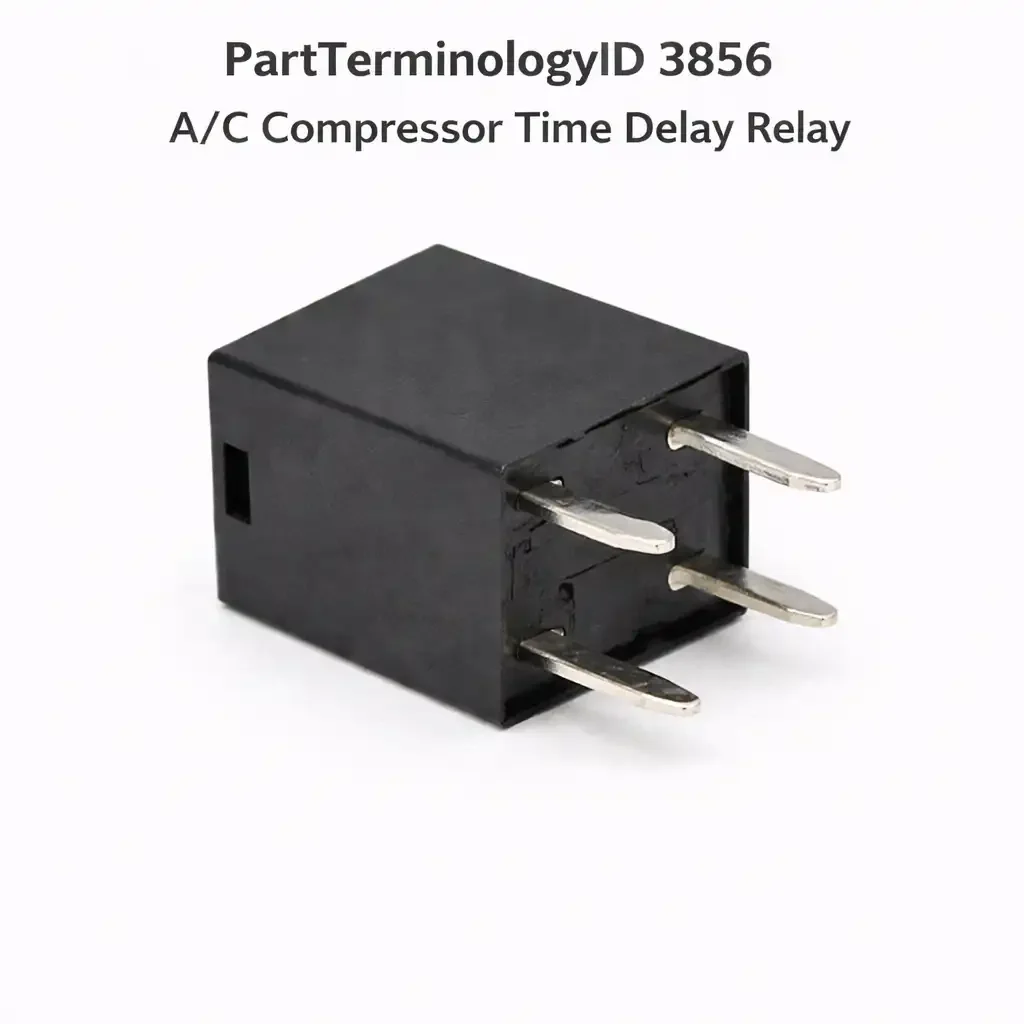
The A/C Compressor Time Delay Relay, cataloged under PartTerminologyID 3856, is a relay that incorporates an internal timing circuit to impose a deliberate hold-off period before allowing the A/C compressor clutch to engage. It is functionally and physically distinct from the standard A/C clutch relay, which closes its contacts immediately when commanded. The time delay relay holds its output contacts open for a fixed interval, typically three to thirty seconds depending on the application, before completing the circuit to the compressor clutch. This delay is the component's defining characteristic and its reason for existing.
The timing period serves two separate protective purposes depending on how it is implemented in a given application. On some platforms it is an engine-start delay: the relay prevents the compressor from engaging for a brief window after engine start, reducing the electrical and mechanical load on the starter circuit, battery, and drive belt during the period when system voltage is lowest and belt tension is most critical. On other platforms it is a short-cycle protection delay: the relay prevents the compressor from restarting immediately after it has shut off, whether because the driver cycled the A/C switch, because a pressure switch tripped and reset, or because the engine was briefly shut down and restarted. On some applications, the relay performs both functions through the same timing mechanism.
The distinction between this relay and the standard A/C clutch relay is not always visible from the exterior. Both may occupy similar underhood relay sockets and carry similar part number formats. The difference is internal: the time delay relay contains an RC timing network or solid-state timer circuit that delays contact closure, while the standard clutch relay has no internal timing and closes immediately. A time delay relay that fails with its contacts stuck closed will function mechanically as a standard clutch relay, delivering immediate compressor engagement without any hold-off. The A/C will appear to work normally. The protection the relay was installed to provide no longer exists, but no immediate symptom points to the relay as the cause of its own failure.
What the Relay Does
Engine-Start Load Protection
When an engine starts cold, the alternator is not yet producing its full output voltage, the battery has just supplied the high-current demand of the starter motor, and the drive belt is under transient load as all belt-driven accessories begin spinning. Adding the compressor clutch engagement load to this window increases the inrush current demand and can cause a brief voltage drop that affects ignition timing and idle stability on some platforms. The time delay relay prevents this by holding the compressor clutch circuit open for a fixed period after the ignition signal rises. During this window, the A/C system is powered and the blower is running, but the clutch remains disengaged. After the delay elapses, the timer circuit closes the output contacts and the compressor engages normally.
On these platforms, the delay is typically short, in the range of three to ten seconds. A driver who switches the A/C on before starting the engine and then cranks the engine will notice a brief pause before the compressor engages and cool air arrives. This is normal behavior on time-delay-relay-equipped platforms. A driver unfamiliar with this behavior may interpret the pause as an A/C malfunction and begin diagnosing a compressor or refrigerant fault when the system is operating exactly as designed.
Short-Cycle Compressor Protection
When a compressor shuts off, refrigerant pressure in the high-side circuit does not equalize immediately with the low-side circuit. The compressor is designed to start against its normal operating pressure differential, not against the peak high-side pressure that exists immediately after shutdown. A restart event that occurs within seconds of shutdown subjects the compressor to this elevated head pressure differential, which demands higher starting torque and causes higher motor winding temperature spikes from the locked rotor current. Repeated short-cycle restarts accumulate thermal stress in the motor windings and mechanical stress in the valve assembly.
The time delay relay prevents this by holding the output contacts open for a fixed period after the compressor shuts off. During this window, even if the A/C switch is cycled back on, or a pressure switch that tripped and caused the shutdown resets, the clutch cannot re-engage until the timer has run its course. On short-cycle protection applications the delay is longer, typically three to five minutes in residential HVAC context, but automotive implementations commonly use delays in the range of fifteen to sixty seconds, which is sufficient to allow high-side pressure to partially equalize through system equilibration.
Interaction with Pressure Switches and PCM Logic
On many modern vehicles, the time delay function has been integrated into the PCM's software logic, eliminating the need for a discrete time delay relay. The PCM includes minimum-off-time logic that prevents it from re-energizing the A/C clutch relay output within a defined window after the last shutoff. These platforms do not use PartTerminologyID 3856 because the function is not performed by a discrete relay component. Application data for this PartTerminologyID must be restricted to platforms confirmed to have a discrete time delay relay module in the A/C compressor clutch circuit, not platforms where the PCM handles the delay function internally.
On platforms where a discrete time delay relay is used alongside pressure switches in the compressor control circuit, the relay must be confirmed as the correct diagnosis before replacement. A pressure switch that is cycling rapidly due to refrigerant undercharge or an overcharge condition can produce a pattern that mimics short-cycle protection behavior even when the relay is functioning correctly. If the system is genuinely short-cycling because of a refrigerant or system pressure fault, replacing the time delay relay does not resolve the underlying cause.
Top Return Scenarios
No-Symptom Failure: Contacts Stuck Closed
A time delay relay whose internal timing circuit has failed while the output contacts remain in the closed position delivers immediate compressor clutch engagement without any delay. From the driver's perspective, the A/C functions normally: the compressor engages promptly when the system calls for cooling and produces cold air. No warning light appears. No code is stored. The relay's mechanical switching function is intact; only the timing protection has been lost.
A buyer who replaces this relay in response to an A/C complaint will not find any A/C problem to solve, because there is none. A buyer who is replacing the relay proactively as part of a compressor replacement procedure is the most likely correct buyer for this failure mode. A relay confirmed to have failed contacts-stuck-closed by direct contact continuity measurement while the coil is unenergized is the correct diagnostic identification. Measurement reveals that the output contacts are closed even with no coil supply voltage, which a normally functioning time delay relay should not allow during its timing period.
Unusually Long Engagement Delay After Engine Start
A timing circuit that has drifted from its design value can extend the hold-off period beyond the intended window. An engine-start delay relay that was designed for a five-second hold-off may develop a timing period of thirty seconds or more as the RC timing components age. The driver experiences cold air arriving with an unusual delay after engine start and A/C activation. This symptom is frequently attributed to refrigerant charge level or a failing compressor before the relay's timing circuit drift is considered.
Confirming this fault requires measuring the actual delay period against the specification in the factory service manual. A relay that consistently delays engagement for substantially longer than its rated period should be replaced. A buyer who is experiencing this symptom and has already confirmed refrigerant charge is adequate is investigating the correct part for this PartTerminologyID.
A/C Inoperative After Pressure Switch Trip and Reset
On platforms where the time delay relay provides short-cycle protection, a pressure switch event that causes compressor shutdown followed by a rapid reset can leave the driver with an apparently non-functional A/C for the duration of the relay's timing window. If the timing window is fifteen to sixty seconds, the driver presses the A/C button, the compressor does not engage for a period that feels much longer than normal, and then engagement occurs. If the timing window has extended due to aging components, the apparent no-A/C period becomes long enough that the driver concludes the system is not functioning.
This is correct relay operation in the case of a genuine pressure switch event, and is normal behavior the listing must acknowledge. A buyer who is investigating the relay after observing a delayed re-engagement after a visible pressure switch event may be observing a functioning relay performing its designed role. The diagnostic question is whether the delay duration is within the specification for the application, not whether a delay occurred.
Refrigerant System Fault Misattributed to Relay
The most common cause of a compressor clutch that does not engage on any modern vehicle is a low refrigerant charge that has caused the low-pressure switch to hold the clutch circuit open. The low-pressure switch is a normally-closed switch in series with the compressor clutch supply. When system pressure drops below the switch threshold due to a refrigerant leak, the switch opens and breaks the clutch circuit regardless of relay state. The relay may be functioning perfectly, but the compressor will not engage because the switch upstream has opened.
This fault is frequently attributed to the relay before system pressure is verified because the symptom, no compressor engagement, is identical from the driver's perspective whether the switch is open or the relay has failed. Any diagnosis of the A/C Compressor Time Delay Relay must confirm system pressure is within the normal operating range and that the low-pressure switch is closed before relay replacement is appropriate. A buyer who replaces the relay with normal system pressure and finds the compressor still does not engage has a fault upstream of the relay that the relay cannot resolve.
Wrong Part Ordered: Standard Clutch Relay vs. Time Delay Relay
A buyer who has identified the A/C clutch relay by its location in the relay box and ordered a standard A/C clutch relay may receive a relay that installs correctly in the socket but has no internal timing circuit. Immediate compressor engagement after engine start or after a brief shutdown will occur, which is the exact condition the time delay relay was installed to prevent. The buyer may not notice any immediate problem because the A/C produces cold air. The return, if it occurs, arrives from a buyer who noticed that the new relay does not produce the brief hold-off period they observed with the original, or from a buyer who installed the replacement and experienced compressor noise attributable to a high-pressure restart event.
The listing must clearly describe the time delay characteristic of the relay as its defining feature and distinguish it from standard clutch relays. Part number confirmation against the factory relay box diagram is the correct identification method, because a time delay relay and a standard clutch relay may have identical external dimensions and pin counts.
Listing Requirements
Every listing for PartTerminologyID 3856 should include:
ACES fitment data confirmed from factory service documentation for platforms with a discrete, socketed A/C compressor time delay relay; must exclude platforms where the delay function is implemented in PCM software logic with a standard clutch relay as the output device
A clear description of the time delay function and how it differs from a standard A/C clutch relay
A note that the delay produces normal behavior on applicable platforms: brief compressor engagement delay after engine start or after A/C cycling is not a system fault on these vehicles
A note that refrigerant pressure must be confirmed within specification before relay replacement is appropriate; low pressure that is holding the low-pressure switch open produces the same no-engagement symptom as a failed relay
Part number confirmation instructions directing buyers to the factory relay box diagram to distinguish the time delay relay from adjacent standard relays in the same relay center
Frequently Asked Questions
My A/C takes about five seconds to start blowing cold air after I start the engine. Is the relay failing or is this normal?
On vehicles equipped with an A/C compressor time delay relay for engine-start protection, a brief delay after engine start before the compressor engages is designed behavior, not a fault. The relay holds the clutch circuit open for a fixed period to protect the belt, battery, and starting system during the post-start window. If the delay is consistently within the normal range for the application, the relay is functioning as designed. If the delay has grown noticeably longer than it used to be, the timing circuit may have drifted and relay replacement is appropriate. Confirm the normal delay specification for the application from the factory service manual before concluding the relay needs replacement.
My A/C stops cooling for about thirty seconds after I cycle the button off and back on quickly. Is this a relay fault?
On platforms with short-cycle protection implemented through this relay, a re-engagement delay after rapid A/C cycling is the relay functioning as intended. The relay holds the clutch circuit open after the compressor shuts off to prevent immediate restart against elevated head pressure. If the delay is within the specification for the application, no repair is needed. If the delay has become long enough to be disruptive, thirty seconds may be within specification on some applications but abnormally long on others depending on the design. The factory service manual specification for the timing period is the reference.
I replaced the A/C compressor because it was short-cycling. The new compressor is also short-cycling. Could the time delay relay be the problem?
Short-cycling of a new compressor after replacement is almost always a refrigerant system issue, not a relay issue. The most common causes are refrigerant undercharge, an overcharge from improper recharge, a restricted orifice tube or expansion valve, or a low-pressure switch that is cycling at the threshold due to an operating pressure near its trip point. A time delay relay that has failed with contacts stuck closed eliminates the hold-off period, which can allow compressor restarts that are more stressful than they would be with the relay intact, but a failed relay does not cause the underlying pressure condition that triggers the shutdown and restart cycle. Confirm refrigerant charge and system pressures before attributing continuing short-cycling to the relay.
How do I confirm whether the relay in my vehicle is a time delay type or a standard clutch relay?
The most reliable method is the factory relay box diagram, which identifies each relay socket by part number and function. The OEM part number on the relay itself can be cross-referenced to the factory parts catalog to confirm whether it is a time delay variant. A physical test can also confirm timing behavior: with the relay removed from the vehicle and a 12V supply applied to the coil terminals, the output contacts on a time delay relay remain open for the rated timing period before closing, which can be measured with a multimeter and a watch. A standard clutch relay closes its output contacts immediately when the coil is energized. Do not substitute a standard clutch relay for a confirmed time delay relay application, as the engine-start protection or short-cycle protection the original relay was providing will be absent with the standard unit.
What Sellers Get Wrong
Not distinguishing the time delay function from the standard clutch relay
The most consequential listing error for this PartTerminologyID is treating the A/C Compressor Time Delay Relay as functionally equivalent to the standard A/C clutch relay and allowing fitment data to be shared between the two PartTerminologyIDs on the same platforms. A buyer who needs a standard clutch relay and receives a time delay relay will observe a delay before compressor engagement that was not present before. A buyer who needs a time delay relay and receives a standard clutch relay loses the protection function without any immediately obvious symptom. Both incorrect substitutions generate returns and, in the second case, potential downstream compressor damage complaints. The listing must be explicit that this relay contains an internal timing circuit that is not present in the standard A/C clutch relay.
Not warning about the normal delay behavior on applicable platforms
A listing that does not acknowledge that a brief compressor engagement delay is normal and designed behavior on time-delay-relay-equipped vehicles will generate diagnostic confusion. Buyers who install a new time delay relay and then observe a delay before cold air arrives will conclude the replacement relay has the same fault as the original and return it. The listing must clearly state that a few seconds of delay after engine start or after A/C cycling is the relay functioning correctly, not a symptom of failure. This is the single most counterintuitive aspect of this PartTerminologyID from a buyer perspective.
Attributing no-engagement symptoms directly to the relay without refrigerant check
A/C systems on all platforms have upstream protection circuits, most commonly a low-pressure switch, that prevent the clutch from engaging when refrigerant charge is insufficient. No-engagement of the compressor clutch is more commonly caused by a low-pressure switch holding the circuit open due to refrigerant loss than by a failed relay. A listing that directs buyers to the relay as the first diagnostic step without mentioning the refrigerant pressure check will generate a high rate of no-improvement returns from buyers whose actual fault is a slow refrigerant leak and an open pressure switch.
Not covering the contacts-stuck-closed failure mode
A time delay relay that has lost its timing function while maintaining closed output contacts is invisible from the symptom perspective: the A/C works. This failure mode is only relevant when performing proactive maintenance during a compressor replacement, during a detailed relay function test, or when investigating why a recently replaced compressor is showing early signs of short-cycle stress despite appearing to function normally. A listing that only describes the relay in the context of a no-cooling complaint misses the buyers who are replacing the relay as part of a compressor replacement protocol and need to understand why a functionally open relay and a contacts-stuck-closed relay produce entirely different symptom presentations.
Cross-Sell Logic
A/C compressor clutch assembly (the load component the time delay relay supplies; when relay function is confirmed normal but the compressor still does not engage, the clutch coil resistance, air gap, and clutch plate condition are the next diagnostic targets)
Low-pressure switch (the safety switch in series with the compressor clutch circuit that opens when refrigerant charge is insufficient; the most common non-relay cause of no clutch engagement; confirming the switch is closed under normal system pressure is the prerequisite check before relay diagnosis)
A/C clutch relay (the standard, non-time-delay variant of the compressor clutch relay; on platforms where the delay function has been moved into PCM software logic, the discrete output relay in the clutch circuit is a standard clutch relay rather than a time delay unit; the two are not interchangeable on platforms that require the time delay variant)
Refrigerant recharge kit or refrigerant (low refrigerant charge is the dominant cause of A/C no-engagement on all platforms; confirming charge level before any relay diagnosis eliminates the most common non-relay cause)
A/C compressor (when the time delay relay is replaced as part of a compressor replacement procedure, both components should be replaced together to ensure the compressor is protected by a functioning delay from its first operation cycle)
High-pressure switch (a system overcharge or condenser cooling failure raises high-side pressure to the point where the high-pressure switch opens the clutch circuit; a system that was recently recharged and now shows no clutch engagement may have been overcharged rather than having a relay fault)
Final Take
PartTerminologyID 3856 occupies a specialized position in the A/C relay catalog because its defining feature, the internal timing circuit, is its sole differentiator from the standard A/C clutch relay and is simultaneously the source of its most counterintuitive symptom: a functioning relay that delays compressor engagement. Every other relay in the catalog either works or does not. This relay can work correctly and still appear, to an unfamiliar buyer, to be malfunctioning during its intentional hold-off period.
The listing that explains this behavior clearly converts buyers who are confused by normal operation and eliminates their returns. The listing that does not explain it generates returns from buyers who installed the relay, observed a delay, concluded the relay was defective, and sent it back. The delay is the product. Buyers need to understand that before they install it.
Platform coverage requires careful separation from the standard A/C clutch relay catalog. Modern vehicles with PCM-integrated delay logic have no discrete time delay relay in the clutch circuit and should not appear in this listing's ACES data. Applications confirmed to have a discrete timing relay module as an independent component in the compressor clutch supply circuit are the correct fitment scope. The factory relay box diagram, not general symptom matching between platforms, is the correct basis for confirming whether a given application requires this PartTerminologyID.