
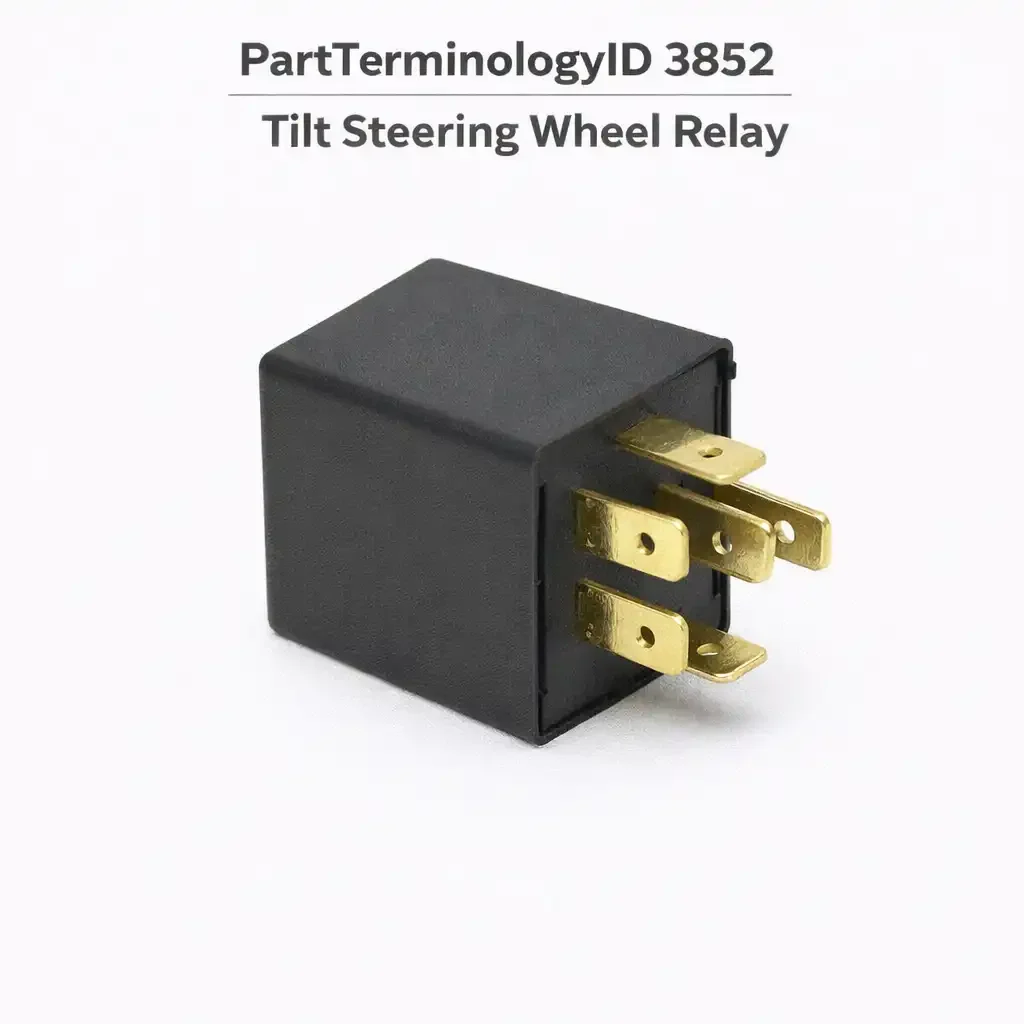
The Tilt Steering Wheel Relay, cataloged under PartTerminologyID 3852, is the polarity-reversing relay circuit that supplies and directs current to the power tilt motor on steering columns equipped with electric tilt adjustment. When the driver presses the tilt switch up or down, the relay circuit delivers battery voltage to the tilt motor with the polarity orientation that produces the commanded direction of column movement. When the opposite direction is commanded, the relay circuit reverses the polarity to spin the motor the other way. The relay does not determine column position or travel limits; it only gates and directs the motor supply current. Travel limits and end-of-travel shutoff are managed by a tilt position sensor and a controller module that deactivates the relay when the column reaches the commanded or limit position.
On platforms with the auto-tilt feature, the controller also uses the relay to automatically drive the column to its highest position when the ignition key is removed and to return it to the stored driver position when the key is reinserted. In this auto mode, the relay activates without any switch input; the controller initiates the movement based on the key-in or key-out signal. This automatic operation is the most common context in which tilt steering fails on the Mazda Millenia, the primary real-world application for this PartTerminologyID, because the auto function can be inadvertently enabled, producing wheel movement the driver did not command and eventually a stuck column when the motor, gear, or relay reaches a failure state.
Mazda issued Technical Service Bulletin 06-001/01R1 in October 2001, superseded by a revised version in November 2001, addressing tilt steering wheel inoperative conditions on all 1997 through 2002 Millenia models. The bulletin's repair procedure begins with verifying the auto button on the tilt switch is engaged, then disconnecting any aftermarket accessories that may interfere with tilt operation, before proceeding to relay inspection per the Workshop Manual section 06-15. The sequence in the bulletin reflects the documented reality that a significant portion of tilt steering complaints on these vehicles resolve to something other than a failed relay.
What the Relay Does
Polarity Reversal for Bidirectional Tilt Motor Control
The tilt motor is a bidirectional direct-current motor. Like any DC motor, its direction of rotation is determined by which of its two terminals receives battery positive and which receives ground. The Tilt Steering Wheel Relay circuit contains two relays in a common module or housing: one relay for the up direction and one for the down direction. When the up relay closes, battery positive is routed to the motor's up-direction terminal and ground is applied to the other terminal; the motor drives the column upward. When the down relay closes, the connections are reversed and the motor drives the column down. Only one relay can be energized at a time.
When neither relay is energized, both motor terminals are connected to ground through the normally-closed relay contacts. This provides a passive braking effect that prevents the column from coasting or drifting after the switch is released. The column stops promptly because the motor is effectively short-circuited through the relay ground connections.
The Tilt Controller and Position Sensor
The relay does not operate in isolation. On Mazda Millenia and similar applications, a tilt controller module receives inputs from the tilt switch, the tilt position sensor on the steering shaft, and the ignition key-in signal. The controller processes these inputs and commands the appropriate relay to close. The position sensor provides feedback so the controller knows when the column has reached the target position and can deactivate the relay to stop motor travel. The controller also enforces end-of-travel limits to prevent the motor from driving the column past its mechanical stops.
This architecture means the relay can only activate if the controller is commanding it. If the controller is not receiving its inputs correctly, or if the controller itself has failed, the relay will not activate regardless of its own condition. A tilt system with no relay click and no motor sound when the switch is pressed can indicate a failed relay, but it can equally indicate a failed controller, a failed position sensor that has confused the controller about the column's current location, or an input signal fault that is preventing the controller from issuing a relay command.
Relay Location
On Mazda Millenia applications, the tilt relay is located under the left side of the dashboard near the steering column and in proximity to the brake switch. On Toyota and Lexus applications with power tilt and telescoping columns, the relay or relay module is typically located in the instrument panel junction box or in a dedicated column control module near the steering column assembly. On Dodge and Ram truck applications with the Memory Seat Module controlling the tilt column, the relay function is integrated into the Memory Seat Module rather than being a discrete standalone relay.
Top Return Scenarios
Motor Clicks But Column Does Not Move: Gear or Motor Fault, Not Relay
On Mazda Millenia, technicians and owners have established a reliable field diagnostic rule: if pressing the tilt switch produces an audible click from the relay, the relay is receiving its activation signal and closing its contacts. Power is reaching the motor. If the column does not move despite the click, the fault is downstream of the relay. On these vehicles, the most common downstream fault is not the motor itself but a cracked or stripped plastic drive gear inside the steering column assembly. This gear translates motor rotation into column tilt movement, and the plastic material used does not tolerate the repetitive stress of years of tilt cycling. The gear cracks, loses its teeth, and the motor spins freely without moving the column.
A relay replaced in response to a click-but-no-movement complaint does not resolve a broken gear. The buyer who receives the relay and hears the same click with no movement will return it. Confirming whether the column produces any motion at all in response to a click, even slight or partial motion, separates a relay fault from a gear fault. A completely immobile column with a healthy relay click points toward the gear or a jammed mechanism as the correct diagnosis.
No Click, No Movement: Auto Function Inadvertently Enabled
The auto-tilt feature on Mazda Millenia causes the column to automatically move to the top position when the ignition key is removed. An owner who engages this feature without understanding it, drives normally, parks, and removes the key will find the steering wheel at an unexpected elevated position on the next entry. If the column then fails to return to the normal driving position on restart, the owner may conclude the tilt system is broken. In some cases the column is genuinely stuck; in others the auto return function has been disabled by the auto button, or the system is waiting for a key-in signal that is not arriving correctly.
Before any relay or part is ordered on a Millenia tilt complaint, confirming the state of the auto button on the tilt switch is the first check. If the auto function is active and the system is waiting for a correct key-in signal, aftermarket accessories that tap into the ignition circuit are a documented cause of the signal not arriving at the tilt controller. The Mazda TSB explicitly lists disconnecting aftermarket installed accessories as a diagnostic step. A buyer who installs a new relay on a car with an aftermarket remote starter interfering with the key-in signal will find no improvement.
Aftermarket Accessories Blocking the Key-In Signal
Remote starters, aftermarket alarms, and keyless entry systems that intercept or duplicate the ignition signal can prevent the tilt controller from correctly detecting the key-in or key-out transition. The tilt controller uses this signal to initiate automatic column movement. If the signal arrives at the wrong time, is inverted, or is absent, the controller may not issue a relay command even though the relay and motor are fully functional. On the Mazda Millenia, this is significant enough to appear as step two in the Mazda factory TSB diagnostic procedure: disconnect aftermarket accessories before performing further relay or component testing.
A vehicle that had normal tilt function before an aftermarket remote starter was installed and developed tilt problems afterward is a strong indicator of accessory interference. The relay is not the fault in this scenario. Replacing it does not restore normal operation. The accessory must be disconnected and the tilt system retested before any component replacement is appropriate.
Cracked Plastic Gear Producing Stuck Column
Beyond the click-but-no-movement scenario, a cracked plastic gear can produce a column that is stuck at an extreme position rather than midway through travel. On Mazda Millenia, the auto feature drives the column to the top position on key removal. If the gear cracks in that state, the motor cannot drive the column back down on key insertion because the gear has lost its ability to transmit motor torque to the column mechanism. The column is stuck at the top. The relay clicks. The motor hums. Nothing moves.
Mazda did not historically sell the plastic drive gear as a standalone service part, making this failure particularly frustrating for owners who correctly diagnosed the gear as the fault. The correct repair on these vehicles required either a used steering column from a salvage vehicle or a complete new column assembly. Aftermarket gear reproductions have become available from specialty suppliers over time. A listing that names the cracked gear as a possible cause of the stuck-in-top-position symptom alongside the relay directs buyers toward the correct diagnosis rather than toward an unsuccessful relay replacement.
Low System Voltage Causing Intermittent Tilt Operation
Power tilt systems on complex vehicles share electrical system voltage with all other loads. When battery voltage drops to approximately 10 volts or below, steering column tilt and telescoping control modules on some platforms cannot operate their motors reliably. A battery that is marginal during cold morning starts can produce intermittent tilt failure that resolves once the alternator brings the system voltage up. The relay and motor are both functional; the system simply lacks sufficient voltage for normal motor operation.
Intermittent tilt failure that occurs primarily on cold starts or after the vehicle has sat for an extended period is a battery capacity indicator before it is a relay indicator. Confirming battery health under load is a prerequisite check for any intermittent tilt complaint, particularly on vehicles where the tilt system shares the column control module with memory seat and mirror functions.
Listing Requirements
Every listing for PartTerminologyID 3852 should include:
ACES fitment data confirmed from factory service documentation for platforms with a discrete, serviceable Tilt Steering Wheel Relay; must exclude platforms where the relay function is integrated into a non-serviceable column control module or Memory Seat Module assembly
A description of the click diagnostic test specific to Mazda Millenia: click present indicates relay is activating and motor or mechanism is the fault; no click indicates relay, controller, fuse, or switch input fault
A note on the cracked plastic drive gear as a common Mazda Millenia failure that produces identical symptoms to a relay fault when the column is stuck at the top position
A note on the auto-tilt function and aftermarket accessory interference as documented non-relay causes of tilt inoperative per the Mazda factory TSB
Frequently Asked Questions
I press the tilt switch on my Millenia and hear a click but the steering wheel does not move. Is this the relay?
No. An audible click when the tilt switch is pressed on a Mazda Millenia confirms the relay is receiving its activation signal and closing its contacts. The relay is operating correctly. The fault is downstream, in the motor or in the mechanical drive mechanism. On Millenias, the most common cause of a click-with-no-movement condition is a cracked or stripped plastic drive gear inside the steering column assembly. The gear transmits motor rotation to the column tilt mechanism, and it fails frequently on older examples. A motor that hums without producing column movement when directly jumpered also points to a stripped gear rather than a failed motor. Replacing the relay in this situation does not resolve the fault because the relay is not the problem.
My Millenia steering wheel is stuck in the highest position. It moved there automatically when I removed the key. What should I check before ordering a relay?
This is the standard presentation of the auto-tilt feature driving the column to its top position on key removal, followed by a failure to return on key reinsertion. Check in this order. First, confirm the auto button on the tilt switch is pushed in and the auto function is enabled. Second, disconnect any aftermarket alarm, remote starter, or keyless entry system that was installed after the vehicle was purchased; these accessories can block the key-in signal the controller needs to command the return movement. Third, confirm the relay clicks when you press the tilt switch manually; if it does, the relay is not the fault. Fourth, with the relay confirmed clicking and the column still stuck, suspect a cracked plastic gear in the column mechanism rather than a relay fault.
My tilt system has no click at all when I press the switch. The relay is in the fuse box location but swapping it with a same-type relay from another position does nothing. What else could prevent the relay from clicking?
No click means the relay coil is not receiving its activation signal from the tilt controller. The controller is not issuing a command. Check the following: confirm the tilt system fuse is intact; confirm the controller is receiving power and ground; confirm the tilt position sensor is connected and its resistance value is within specification per the factory service manual; confirm no aftermarket accessories are present that could be interfering with the ignition key signal. If the controller is receiving power and ground and the switch input is confirmed correct but the controller is still not commanding the relay, the controller itself may have failed. On Mazda Millenia, the controller is part of the column assembly and is accessed under the lower steering column cover.
Can I just disable the auto tilt feature so the column stays at a fixed position and avoid relay and gear issues entirely?
Yes, on Mazda Millenia the auto function can be disabled by pressing the auto button on the tilt switch to deactivate it. With the auto function off, the column only moves when the manual tilt switch is actively pressed and held, and it stops in that position without returning automatically on key events. Many owners of high-mileage Millenias with marginal tilt systems disable the auto function as a practical measure that extends the service life of the motor and gear mechanism indefinitely by dramatically reducing the number of full-travel cycles the system performs. On Toyota and Lexus platforms, disabling the auto retract and memory return functions typically requires a dealer-level diagnostic tool to change the configuration in the column control module.
What Sellers Get Wrong
Presenting the click test backward
The relay click diagnostic is the most important single piece of information for a tilt steering wheel relay buyer on Mazda Millenia platforms, and it is commonly presented backward in listings and parts documentation. The correct interpretation is: a click confirms the relay is working, and the fault is in the motor or mechanism. No click means the relay may be failing or may not be receiving its activation signal. A listing that tells buyers to order the relay if they hear a click will generate a high rate of no-improvement returns from buyers who have a gear or motor fault. The click test must be presented correctly: click present means look elsewhere; no click is the indicator to investigate the relay.
Not naming the cracked gear
The cracked plastic drive gear inside the Mazda Millenia steering column is the most common cause of power tilt failure on this platform once the vehicle exceeds 100,000 miles. It is not a relay. It is not a motor. It is a gear that Mazda did not historically sell separately, which makes it an invisible failure mode to parts buyers who are searching for a relay or motor without knowing the gear exists. A listing that does not name the gear as a cause of click-with-no-movement symptoms does a disservice to buyers who need to understand that their correct repair requires a gear, not a relay. The listing that explains all three failure modes, relay, motor, and gear, and gives buyers a test to distinguish between them, earns trust and reduces returns.
Not warning about aftermarket accessory interference
The Mazda factory TSB for tilt steering inoperative on 1997-2002 Millenia explicitly identifies aftermarket accessories as a cause of the failure to address. This is not a minor footnote; it is the second step in the official repair procedure before relay inspection even begins. A listing that does not mention this will generate returns from buyers on Millenia examples with remote starters or aftermarket alarms, because those buyers will replace the relay and find no improvement because the root cause is an accessory tapping into the ignition circuit that is never identified.
Overlooking the auto button state
The auto-tilt function on the Mazda Millenia is enabled and disabled by a single button on the tilt switch assembly. A wheel that moves unexpectedly to the top position on key removal is not a failed system; it is the auto function operating as designed. Buyers who experience this for the first time and do not understand the feature will diagnose a malfunction where there is none, or will diagnose a relay fault because the column is stuck in an unexpected position. Listing content that explains the auto function, its button location, and the most common symptom it produces when it is active but not understood prevents a return from a buyer who would otherwise have disengaged the auto button for free.
Cross-Sell Logic
Tilt motor assembly (the bidirectional motor whose supply the relay controls; when the relay clicks but the column does not move, the motor should be confirmed with a direct-battery jump test before the gear is condemned; a motor that does not spin when directly powered is the fault rather than the gear)
Steering column drive gear or tilt gear assembly (the plastic gear inside the Mazda Millenia steering column that transmits motor rotation to the column tilt mechanism; the most common cause of click-with-no-movement and stuck-at-top symptoms on high-mileage examples; not historically available as a standalone OEM part but now available from specialty aftermarket suppliers)
Tilt position sensor (the sensor on the steering shaft that provides column position feedback to the tilt controller; a failed or out-of-adjustment tilt sensor can prevent the controller from commanding the relay because the controller cannot confirm the column's current position; on Mazda Millenia, factory diagnostic procedures include tilt sensor voltage and resistance checks as part of the no-operation diagnosis)
Tilt controller or column CPU assembly (the module that processes the switch input, key-in signal, and tilt sensor data and commands the relay; a controller that is not issuing relay commands despite correct inputs is the fault when the relay coil is confirmed to be receiving no activation signal; on Mazda Millenia, the controller is accessed under the lower steering column cover)
Column switch assembly (the switch whose input the controller reads to determine the desired tilt direction; a switch with worn contacts or a broken internal trace produces a no-operation symptom identical to a relay fault but resolves with switch replacement; the switch should be tested for output signal before the relay is condemned)
Battery (insufficient voltage during cold starts can prevent the tilt controller from activating the motor circuit reliably; intermittent tilt failure that resolves when the engine warms and alternator voltage rises indicates a marginal battery before it indicates a relay fault)
Final Take
PartTerminologyID 3852 serves a narrow category of vehicles, with Mazda Millenia representing the most well-documented real-world application. The platform has a defined and documented failure ecology: the relay fails, the motor fails, the plastic drive gear cracks, aftermarket accessories interfere with controller inputs, and the auto-tilt feature causes owner confusion. The Mazda factory TSB confirms this complexity by providing a multi-step procedure that addresses non-relay causes before arriving at relay inspection.
The click test is the defining diagnostic tool for this category and must be presented correctly. A listing that teaches buyers to use the click to separate relay faults from motor and gear faults will reduce returns more than any other single piece of content. The buyer who hears a click, correctly understands it means the relay is activating, and orders a gear rather than a relay is a satisfied buyer. The buyer who hears a click, is told to order the relay, installs it, hears the same click, and still has a stuck column is a return.
Platform coverage for ACES fitment data on this PartTerminologyID requires careful attention to the distinction between platforms with a discrete, serviceable relay and platforms where the relay function is integrated into a column control module, Memory Seat Module, or column assembly that has no individually replaceable relay component. Applications where the relay is not discrete produce no viable product return path for the buyer, generate returns on all sales to those applications, and should be excluded from the listing.