
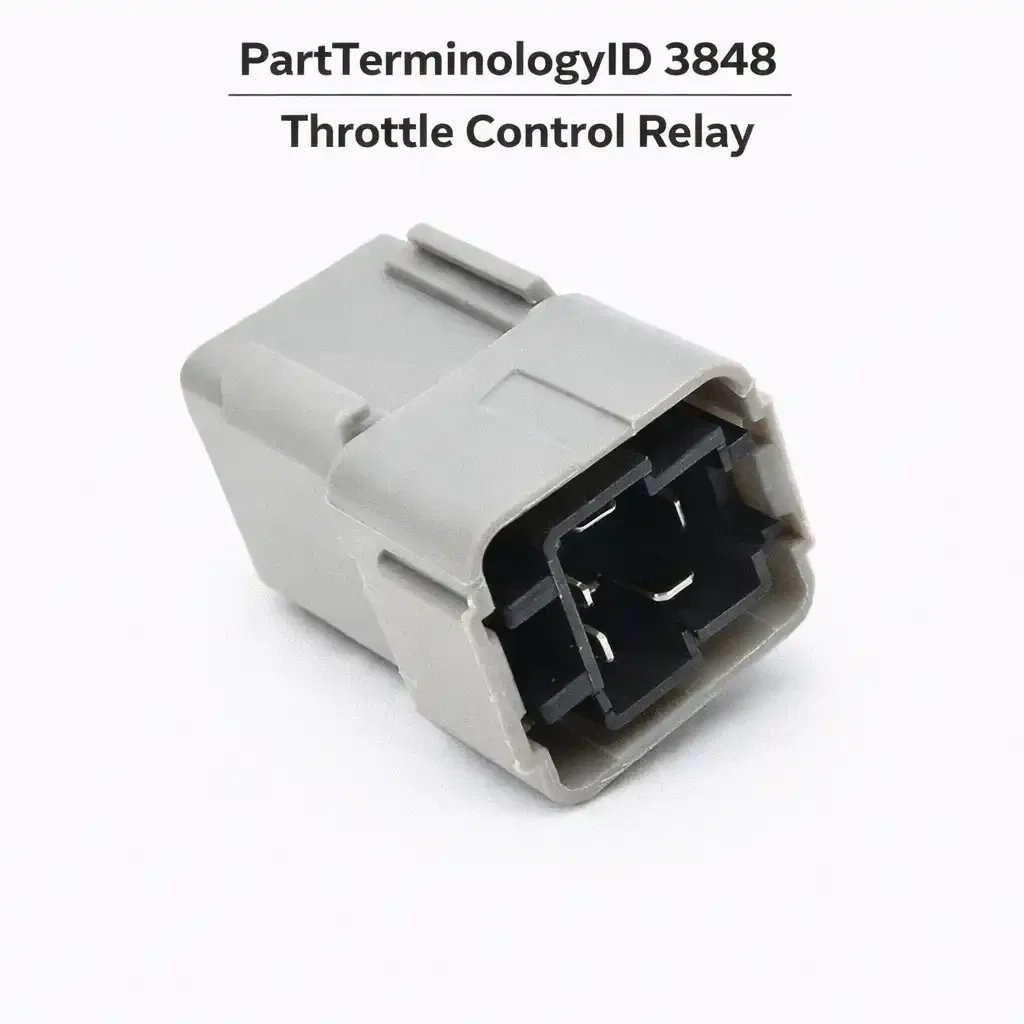
The Throttle Control Relay, cataloged under PartTerminologyID 3848, is the relay that supplies battery voltage to the electronic throttle control system motor circuit when the ignition is switched to the run or on position. On platforms equipped with drive-by-wire throttle control, the throttle body contains an electric motor that physically moves the throttle plate in response to commands from the powertrain control module. That motor requires a dedicated, relay-protected supply circuit that is separate from the PCM power relay and the main fuel injection relay. The Throttle Control Relay closes at key-on, delivers voltage to the throttle actuator motor circuit, and the PCM monitors that supply voltage as confirmation that the throttle system is powered and ready for operation.
On Honda and Acura platforms, this relay is called the ETCS Control Relay or Electronic Throttle Control System Control Relay. Its failure generates DTC P1659, defined as ETCS Control Relay OFF Malfunction, which describes the specific PCM detection logic: the PCM expects to see supply voltage at its ETCS monitor terminal within a set time window after commanding the relay on. If that voltage does not appear within the window, the code is stored and the engine management system limits throttle operation or enters a limp-mode condition. On Toyota and Lexus platforms a functionally equivalent relay serves the Throttle Actuator Control circuit. On certain GM platforms the TAC relay performs the same role in the electronic throttle supply circuit.
The safety intent of this relay architecture is deliberate. An electronic throttle system that cannot confirm the throttle motor is powered will not allow the PCM to command throttle plate movement in normal operating mode. A relay failure that leaves the throttle motor without supply voltage means the throttle plate stays at the default return-spring position rather than being commanded open, which produces a limp or no-power condition. The relay is therefore a gating component for one of the most safety-critical driver-input circuits on a modern powertrain.
What the Relay Does
Powering the Throttle Actuator Motor Circuit
When the ignition is switched to the run position, the PCM or engine control module commands the Throttle Control Relay coil to energize. The relay contacts close and deliver battery voltage through a fused circuit to the throttle body's motor drive terminals. The PCM's internal H-bridge driver circuit then modulates this supply voltage as a PWM signal to move the throttle plate to the commanded position. The relay itself does not determine throttle position; it only gates whether the throttle motor circuit has supply voltage available. Throttle positioning is entirely under PCM control through the H-bridge output.
The PCM monitors the supply voltage on its ETCS terminal as a confirmation signal. This monitoring is continuous during operation: if the relay drops out while the engine is running, the PCM detects the voltage loss, stores a fault code, and reduces or eliminates throttle actuator commands. The monitoring also occurs during the initialization sequence at key-on before the engine starts. A relay that fails to energize during this initialization window sets the code before the engine ever fires.
Relationship to Limp Mode
When P1659 or an equivalent throttle relay fault code is stored, the powertrain management system enters a reduced-capability operating mode. The specific behavior varies by platform, but common presentations include: throttle response limited to a fixed partial opening regardless of accelerator pedal position, engine speed limited to a fixed idle or near-idle RPM, cruise control disabled, and traction control and stability control functions suspended because they depend on throttle modulation capability. The vehicle may still move under its own power but acceleration is severely limited.
Limp mode is a safety design. A system that cannot confirm its throttle motor is powered will not allow unrestricted throttle commands. The limp mode is not resolved by clearing the code without repairing the root cause: if the relay or its circuit is still faulty, the PCM will re-enter limp mode within the first few seconds of the next ignition-on cycle and re-store the code.
Relay Location by Platform
On Honda Civic applications, the ETCS relay location varies by generation. On some models it is in the interior relay box under the dashboard on the driver's side; on others it is in the underhood fuse and relay box. On 2018 and newer Honda Accord applications, the throttle motor is controlled through the PGM-FI Sub-Relay, which is part of a relay circuit board inside the fuse and relay box rather than a discrete plug-in relay. Factory service manual relay box diagrams are the correct source for relay location on any specific year and model, because the location has changed across generations.
On Toyota applications, the TAC relay or throttle actuator relay is typically in the underhood relay center or the instrument panel junction box depending on the specific model year and engine application. On GM platforms, the TAC relay is typically in the underhood fuse and relay center adjacent to the ECM main relay and fuel pump relay.
Top Return Scenarios
P1659 Set by Wiring Fault Rather Than Relay Failure
DTC P1659 on Honda platforms and equivalent throttle relay fault codes on other platforms have multiple possible causes besides a failed relay. The Honda factory service manual diagnostic flow chart for P1659 lists as possible causes: ETCS control relay failure, throttle actuator fuse failure, open circuit in the ETCS control relay voltage supply line, open circuit in the relay control signal line from the PCM, and PCM failure. A buyer who replaces the relay without verifying that the activation signal from the PCM is reaching the relay coil, and without verifying that the supply fuse is intact and the wiring has continuity, may find no improvement if the fault is in the wiring or the PCM rather than the relay contact set.
The relay is the correct replacement when the relay coil activation signal is confirmed present at the relay coil terminal and the relay still does not close, or when relay contact continuity is confirmed open during coil energization. A relay ordered because P1659 appeared without the diagnostic flow chart being followed has a high probability of resolving nothing if the root cause is upstream of the relay.
Throttle Body Connector Disconnected After Engine Work
One of the most common causes of a sudden P1659 or equivalent throttle relay fault code on a vehicle that was recently serviced is a disconnected or improperly seated throttle body connector. When the throttle body connector is pulled for any engine work and not fully reseated, the PCM loses its communication with the throttle position sensors and the actuator motor. The PCM may interpret this as a throttle relay fault because the expected supply voltage confirmation is absent at the throttle motor circuit. The code is set immediately on the next key-on event.
This is the first physical check after any throttle relay fault code appears following recent engine work: confirm the throttle body four-wire or six-wire connector is fully seated and locked. A connector that clicks but has a terminal pushed back or corroded will also produce this condition without visible separation at the connector body. Replacing the relay does not resolve a connector fault.
Counterfeit or Failing Spark Plugs Causing Ignition Interference
In documented cases on Honda TSX and Civic platforms running modified ECU calibrations, counterfeit NGK spark plugs caused ignition interference severe enough to produce intermittent P1659 codes during cold starts. The interference disrupted the immobilizer circuit during cranking, causing the ECM to temporarily cut power to the drive-by-wire system, which generated the ETCS relay fault code as a secondary symptom. The code did not represent a failed relay; it represented an upstream power interruption triggered by ignition noise.
This scenario represents a category of P1659 causes that have nothing to do with the relay itself: any condition that transiently interrupts the ETCS supply circuit or the PCM's ability to confirm the supply, including a failing main relay, weak battery voltage during cranking, or ignition system interference, can produce the code. A relay replaced in response to this symptom does not resolve the underlying cause.
Limp Mode Persists After Relay Replacement
A relay that was genuinely faulty and has been replaced correctly should resolve a P1659 fault in most cases after the code is cleared and the system is restarted. However, limp mode that persists after relay replacement indicates that either the code has not been cleared with a scan tool after repair, the original code set a secondary fault in another module that must also be addressed, or the relay was not the actual fault and the root cause remains active. On Honda platforms, when the relay and throttle body have both been replaced and P1659 still returns on restart, the diagnostic flow chart directs the technician to substitute a known-good ECM to determine whether PCM failure is responsible.
Buyers who follow the relay replacement path without having the code cleared and the system re-initialized after repair will sometimes return the relay because limp mode continues, when the actual issue is that the stored code was never cleared. The relay replacement procedure must include a code clear and a confirmatory key-on cycle before the repair is evaluated.
Wrong Relay Ordered Based on Relay Box Labeling
The Throttle Control Relay on Honda platforms is sometimes labeled PGM-FI, ETCS, or ETC in different service documents and on different relay box lids, and the specific relay that supplies the ETCS circuit is not always the one labeled most prominently. On some applications, the relay that controls the ETCS supply is a smaller relay on the relay circuit board rather than a discrete plug-in relay. A buyer who opens the relay box, looks for any relay labeled in a way that sounds throttle-related, and pulls the first candidate they find may remove the wrong relay. The factory service manual relay box diagram with the specific relay identified by its designation code is the only reliable source for relay identification on Honda and Acura applications.
Listing Requirements
Every listing for PartTerminologyID 3848 should include:
ACES fitment data confirmed from factory service documentation for platforms with a discrete, socketed Throttle Control Relay; must exclude platforms where the throttle actuator is powered directly through an ECM-internal circuit or through a relay circuit board where the relay is not individually serviceable
The associated DTC for the applicable platforms: P1659 on Honda and Acura applications; equivalent TAC relay codes on Toyota and GM applications
A note that P1659 and equivalent codes have multiple possible causes including wiring faults and PCM failure, and that the relay should be confirmed as the fault location through the diagnostic flow chart before ordering
A note that code clearing and system re-initialization after relay replacement are required before the repair can be evaluated
A note that recently disturbed throttle body connectors are a common non-relay cause of sudden throttle relay fault codes
Frequently Asked Questions
I have a P1659 code on my Honda and the car is in limp mode. Is this the relay?
P1659 is an ETCS Control Relay fault code, but the relay itself is only one of several possible root causes. Before ordering the relay, confirm the following: the throttle actuator fuse in the relay and fuse box is intact, the throttle body connector is fully seated and all terminals are making contact, and no recent engine work could have disturbed the ETCS circuit. If these checks are clear, the next step is to probe the relay coil activation terminal with the ignition switched on to confirm the PCM is sending its activation signal to the relay. If the signal is present and the relay does not close, the relay is the fault. If the signal is absent, the fault is in the PCM output circuit or its wiring to the relay coil. The factory service manual P1659 diagnostic flow chart provides the complete pin-by-pin test sequence.
I replaced the ETCS relay and cleared the code, but P1659 came back immediately on the next key-on. What does this mean?
A code that returns immediately after a relay replacement and code clear means one of two things: the relay was not the root cause and the actual fault is still present, or the relay installed is incorrect for the application. On Honda platforms, if the relay and fuse have been confirmed good and P1659 still returns, the diagnostic flow chart directs testing the wiring continuity in the ETCS supply circuit and, if wiring is intact, substituting a known-good PCM to determine whether PCM failure is responsible. P1659 codes that persist through relay, fuse, throttle body, and wiring replacement on Honda platforms typically resolve to PCM failure.
My car ran fine and then I had some engine work done and now I have a throttle control relay code. Did the relay fail?
Sudden throttle relay fault codes following engine work are most commonly caused by a disconnected or poorly seated throttle body connector or by a disturbed wiring harness in the engine compartment. The throttle body connector should be the first physical inspection before any part is ordered. Confirm the connector is fully seated, all lock tabs are engaged, and pulling gently on each wire in the connector does not reveal a pushed-back terminal. Also confirm that no wiring near the throttle body or the relay box was pinched or disconnected during the service work. A relay that was operating correctly before the service work is unlikely to have failed coincidentally during the same timeframe.
Does the Throttle Control Relay have to be the same relay type as the OEM unit, or can any equivalent relay be used?
The relay coil and contact ratings must match the OEM specification. The coil voltage is 12V in all cases, but the coil resistance and contact current rating must match the application. On platforms where the relay is part of a relay circuit board rather than a discrete socket-mount unit, the board-mounted relay component must match the PCB footprint and pin assignment of the original. Using a relay with a lower contact current rating than the original risks contact damage from the throttle motor inrush current. Using an incorrect coil resistance can cause the PCM's relay drive output to overheat if the coil draws more current than the output circuit is designed to supply.
What Sellers Get Wrong
Treating P1659 as a confirmed relay failure
P1659 is a relay circuit malfunction code, not a relay confirmed-failed code. The code indicates that the PCM did not see the expected voltage at its ETCS monitor terminal within the required time window. That can mean the relay failed, but it can also mean the relay coil activation signal never arrived, the fuse is blown, the wiring has an open, the throttle body connector is not seated, the battery voltage dropped too low during cranking to keep the relay energized, or the PCM's relay drive output has failed. A listing that treats P1659 as conclusive relay diagnosis and directs buyers to order the relay as the first step will generate a high rate of no-improvement returns from buyers whose root cause was in the wiring, the connector, or the PCM.
Not explaining the need to clear codes and re-test after replacement
A buyer who installs a new relay and immediately drives the vehicle without clearing the stored P1659 code will still see the check engine light and still experience limp mode because the stored code has not been reset. Some buyers interpret this as the relay not having resolved the issue and return the part. The code must be cleared with a scan tool after relay replacement. The system must then be restarted and the initialization sequence completed before the outcome of the repair can be evaluated. Listing content that does not explain this step will receive returns from buyers who correctly repaired the relay but drew the wrong conclusion because they did not clear the stored code.
Not warning about the relay circuit board format on newer Honda applications
On 2018 and newer Honda Accord and related platforms, the throttle motor is supplied through the PGM-FI Sub-Relay on a relay circuit board inside the fuse and relay box. This is not a discrete plug-in relay. A buyer on one of these platforms who receives a discrete relay will find no socket to install it in. Application data that extends to relay-circuit-board platforms based on symptom or DTC match rather than relay format confirmation generates uninstallable-part returns. The format of the relay on the specific application must be confirmed before the application is included in the listing.
Overlooking the throttle body relearn procedure
On many platforms with electronic throttle control, the PCM stores learned values for the throttle plate rest position, the fully closed position sensor reading, and the idle control baseline. When the throttle body is replaced or the battery is disconnected for an extended period, these learned values are cleared. After relay or throttle body service, many platforms require a throttle body relearn or initialization procedure before normal idle quality and throttle response are restored. A buyer who replaces the relay, clears the code, and finds the idle is erratic or the throttle response is sluggish has not failed in the repair; the system needs to relearn its baseline positions. Not addressing the relearn procedure in listing guidance generates unnecessary concern calls and return inquiries from buyers who have completed a correct repair.
Cross-Sell Logic
PCM relay or engine control module main relay (the supply relay for the PCM itself, which is upstream of the throttle control relay; a failing PCM relay can produce throttle control fault codes as secondary symptoms when the PCM supply voltage is intermittent)
Throttle body assembly (the component whose internal motor the relay powers; when relay confirmation testing shows the relay is closing and delivering voltage to the throttle body, but the throttle plate does not move, the throttle body motor winding or the throttle position sensor is the fault)
Accelerator pedal position sensor (APP sensor) (a fault in the pedal position input to the PCM can cause the PCM to reduce or eliminate throttle actuator commands, producing limp mode with or without a relay code; APP sensor faults and throttle relay faults sometimes set together and must be diagnosed in the correct sequence)
Throttle body connector or wiring pigtail (on platforms where the throttle body connector is frequently disturbed during engine work, a replacement pigtail resolves terminal damage or push-back that produces the relay fault code without any relay fault being present)
Battery (a battery that cannot sustain sufficient voltage during cranking can cause the throttle control relay to drop out during start, setting P1659 or equivalent codes as transient faults that clear on the next start when the battery voltage is adequate; battery confirmation is a prerequisite check when throttle relay codes appear intermittently or only during cold starts)
Underhood fuse and relay box (on platforms where water intrusion in the engine compartment has reached the relay box and corroded the relay socket terminals, cleaning or replacing the socket resolves intermittent relay contact issues that cannot be fixed by replacing the relay alone)
Final Take
PartTerminologyID 3848 is among the most diagnostically demanding relay categories in the catalog because the fault code it generates, P1659 on Honda platforms and equivalents on other makes, has a well-documented list of non-relay causes that collectively outnumber genuine relay failures in field experience. A buyer who arrives at this listing having read that P1659 means replace the ETCS relay has done research that is partially correct but incomplete. The listing that teaches the diagnostic confirmation steps converts buyers who have a genuine relay fault and deflects buyers whose root cause is in the wiring, the connector, the fuse, or the PCM before they place an order that will not resolve their problem.
The limp mode condition that accompanies throttle relay faults amplifies the urgency that buyers bring to this repair. A vehicle that will not accelerate beyond a slow crawl creates pressure to order parts before diagnosis is complete. The listing that provides a clear, sequenced diagnostic path reduces panic-ordering and returns in equal measure. A buyer who follows the diagnostic steps, confirms the relay coil activation signal is present and the relay is not closing, and then orders the relay will install it correctly, clear the code, complete the relearn if required, and confirm the repair in one session.
Platform coverage requires specific attention to the relay format distinction between discrete socketed relays and relay circuit board components on newer Honda applications, and between applications where the throttle control relay is separately serviceable and those where the function is integrated into the ECM's internal driver circuits. The latter produce no relay return path for the buyer because there is no relay socket to find.