
Tailgate Window Relay (PartTerminologyID 3844): Diagnosis, Return Prevention and Listing Guide
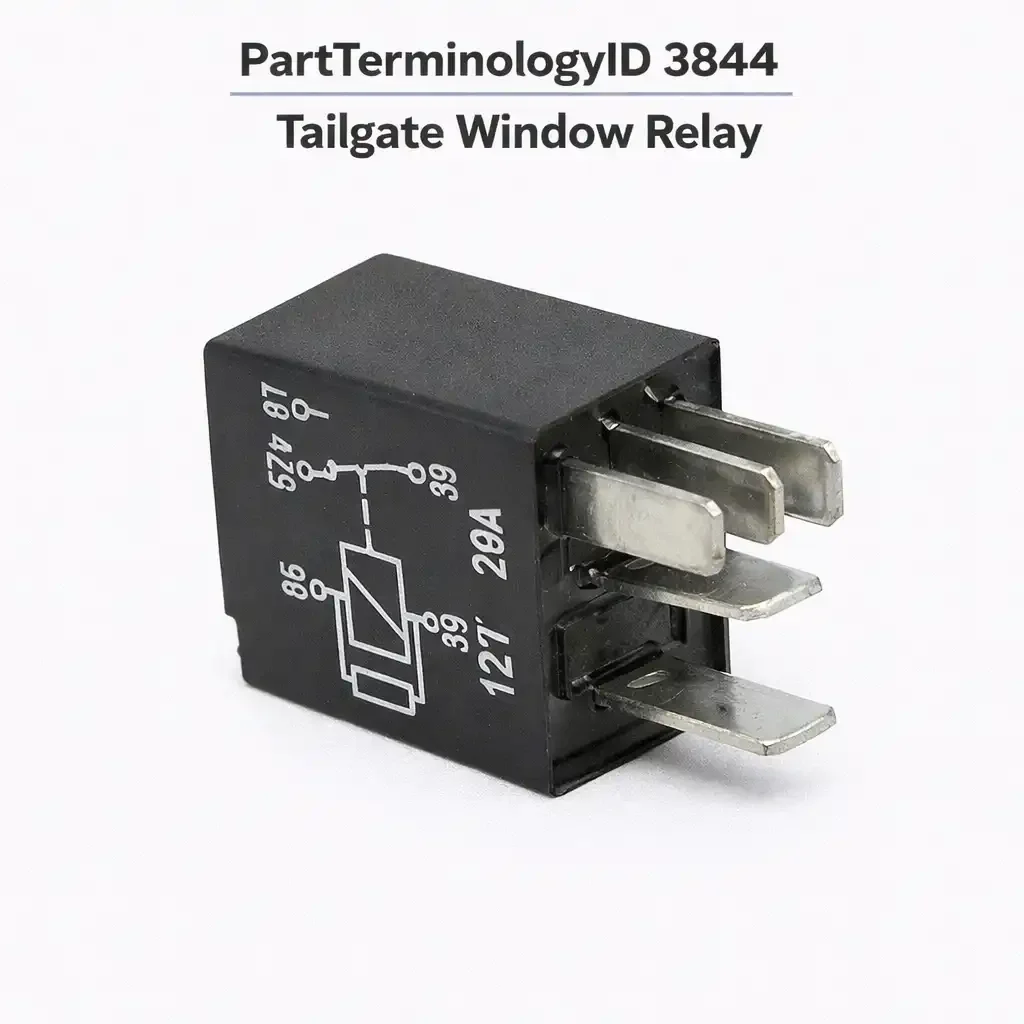
The Tailgate Window Relay, cataloged under PartTerminologyID 3844, is the polarity-reversing relay circuit that controls the tailgate rear glass motor on SUVs, wagons, and pickup trucks equipped with a power drop glass in the tailgate. When the driver commands the glass up or down via the console switch, the tailgate key switch, or the key fob on systems that support it, one of two relays in the circuit closes to supply battery positive to one motor terminal and ground to the other. Commanding the opposite direction activates the second relay, which reverses the polarity connection to spin the motor in the opposite direction and drive the glass the other way. The relay function is what makes bidirectional control possible with a single two-terminal motor.
On most platforms that use this relay, the two directional relays are not discrete plug-in ISO format relays in the underdash fuse box. They are PCB-mounted components inside a dedicated tailgate window control module or relay box, typically located in the rear cargo area of the vehicle: on the driver's side behind the quarter panel trim on Toyota 4Runner applications, inside the tailgate panel itself on Ford Bronco applications, and in comparable protected positions on other platforms. The module integrates the relays, the interlock signal processing, and sometimes additional switching logic for the rear wiper circuit into a single enclosure. On these platforms, the replaceable unit is the module assembly rather than an individual socketed relay, and the diagnostic target is the relay contacts within the module circuit board.
Not every platform with a power tailgate rear window uses this relay architecture. On some platforms the switch routes current directly through the tailgate key switch and console switch to the motor without a relay in the circuit, relying instead on the switch contacts to carry the full motor load. On BCM-controlled modern SUVs, the rear glass motor may be commanded through the body control module with no discrete relay module in the circuit. ACES fitment data for this PartTerminologyID must be built from factory service documentation confirming the presence of a discrete relay module in the tailgate window motor circuit on the specific application.
What the Relay Does
Polarity Reversal for Bidirectional Motor Control
A direct-current motor reverses direction when the polarity of its supply is reversed. The tailgate window motor has two terminals; when terminal A is positive and terminal B is ground, the motor drives the glass in one direction. When terminal A is ground and terminal B is positive, the motor runs the other way. A single switch cannot reverse polarity on its own without a relay or H-bridge circuit between it and the motor. The Tailgate Window Relay module contains two relays to accomplish this: the up relay, when energized, supplies positive to the up terminal and ground to the down terminal; the down relay, when energized, reverses the connection. The switch activates one relay at a time depending on the direction commanded.
When both relays are de-energized, both motor terminals are connected to ground through the normally-closed relay contacts, and no current flows. This provides a passive brake condition that prevents the motor from coasting when the switch is released. The glass stops promptly when the switch returns to neutral because the motor is effectively short-circuited through the relay ground connections.
The Control Module and Interlock Architecture
On Toyota 4Runner and similar platforms, the relay module also processes several interlock inputs before permitting the relays to activate. The tailgate closed sensor, which detects whether the tailgate door is fully latched, inhibits window operation when the tailgate is open. The rear wiper park position switch, which monitors whether the wiper is seated in its rest position, inhibits window operation when the wiper is not parked. On first-generation 4Runners, the cargo area cover interlock also contributes: a pair of bolts that engage a switch at the top of the tailgate opening must be present and seated for the module to permit window movement.
These interlock signals arrive at the module as switch inputs. If any interlock is not satisfied, the module withholds the relay activation signal regardless of what the console switch or tailgate key switch is commanding. A tailgate window that does not respond to any input command is most often a failed interlock condition rather than a failed relay. The most frequent interlock failure is the rear wiper not seated in its park position, which happens when the wiper arm is moved manually or the wiper blade falls out of the park holder on the tailgate. Seating the wiper correctly is the first diagnostic step on all platforms that use wiper interlock logic.
Underdimensioned Relays and Contact Wear
On Toyota 4Runner platforms, factory documentation and community repair records indicate that the original relay specification used in the window control module was undersized relative to the motor's actual current demand under load. The glass traveling upward works against gravity and draws more current than the downward direction, which is assisted by gravity. Contact wear from this current mismatch produces a failure pattern specific to this relay application: the window descends normally or quickly but travels up slowly, stops before reaching the top, or fails to travel up at all. The window may complete the upward travel when the engine is running at higher RPM because the higher system voltage reduces motor current demand slightly, but fails to complete the travel at idle.
This symptom pattern, fast down and slow or absent up, is diagnostic of worn relay contacts with elevated resistance in the up relay. It is not a motor fault. Confirming motor condition by direct-jumping the motor terminals with a battery source reveals a motor that operates normally in both directions under direct power. The fault is in the relay contacts limiting current delivery to the motor under the higher gravitational load of the upward direction.
Top Return Scenarios
Rear Wiper Not Seated Producing Complete Window Lockout
On Toyota 4Runner and any platform using wiper park position as a window operation interlock, a wiper arm that is not correctly seated in its park holder on the tailgate produces a complete tailgate window lockout. The window does not respond to the console switch, the tailgate key switch, or any other input. The relay module is receiving its power supply and is capable of operation, but the wiper park interlock signal is not satisfied and the module holds the relays open. Buyers who experience this symptom and research the relay as the cause are ordering against a condition that resolves without any parts replacement.
Confirming wiper seating takes under thirty seconds and requires no tools. The wiper arm should rest in the holder bracket at the bottom of the rear glass when parked. If the arm has been knocked loose, lifting the wiper away from the glass and reseating it in the park bracket restores window operation. Any listing that does not name the wiper interlock check as the first diagnostic step on applicable platforms will generate returns from buyers who have resolved their fault before the relay arrives.
Fast Down, No Up: Worn Contact Set in the Up Relay
The asymmetric failure pattern of smooth downward travel with absent or slow upward travel is the primary relay fault presentation on Toyota 4Runner and Full-Size Jeep platforms. The up relay contacts have degraded to the point where their contact resistance is too high to deliver sufficient current for the motor to overcome the glass weight. The down relay remains functional because the lower current demand in the gravity-assisted direction does not stress the contacts enough to produce the same failure.
This symptom is frequently attributed to the motor, especially after the buyer has replaced the motor and found no improvement. Motor replacement does not resolve a relay contact fault. The confirmation test is to jump the motor directly with a battery source: both directions work with full power. The relay is the fault. On Toyota platforms, the relay contacts are soldered into the module circuit board. The repair is either desoldering and replacing the individual relay components on the board with higher-rated replacements, or replacing the module assembly.
Tailgate Not Closed Producing Window Lockout on Tailgate-Open Interlock Platforms
The tailgate closed interlock prevents the rear window from traveling down while the tailgate door is open, which would allow the glass to contact the ground when the tailgate swings. A tailgate closed sensor that has failed in the open position, or a tailgate that does not fully latch due to a misaligned striker or debris in the latch mechanism, reports to the module that the tailgate is open even when it is physically closed. The module holds both relays open and the window does not respond to any switch input.
Testing the interlock is straightforward: confirm whether the relay module is receiving the closed signal from the tailgate sensor by probing the sensor input terminal at the module connector. If the signal is absent despite the tailgate being fully closed, the sensor or its wiring is the fault. Some owners bypass the tailgate closed interlock with a jumper wire after confirming it is not needed for their application, but this is a modification that bypasses a design safety feature.
Harness Break Between Body and Tailgate
The wiring harness that carries the motor supply, switch inputs, and ground from the body-side wiring to the tailgate-mounted components crosses the tailgate hinge point inside a rubber boot or grommet. On vehicles that have had the tailgate opened and closed thousands of times, the individual wires inside this boot flex at the same point repeatedly and eventually fracture inside the insulation. A fractured wire in this location may produce intermittent window operation that worsens with cold temperatures and eventually becomes complete loss of tailgate electrical function.
A fractured wire at the body-tailgate junction produces total loss of all tailgate electrical functions simultaneously: window, wiper, and lock actuator all become inoperative because they share the harness boot. The fracture can be confirmed by flexing the harness manually at the boot junction while an assistant holds the console window switch: if window movement returns when the harness is pushed in a specific direction, the fracture location is identified. Replacing the harness section or the specific wire is the correct repair; a new relay module does not resolve a fractured harness.
Ground Path Degradation Producing Slow or Intermittent Operation
The tailgate window motor grounds through its mounting hardware to the tailgate structure, and the tailgate structure grounds to the vehicle body through the hinge connections or a dedicated ground strap. Corrosion at the tailgate hinge pivot points, at the ground strap connector, or at the motor mounting hardware increases resistance in the ground return path. Elevated ground resistance reduces the voltage available to the motor, which reduces motor torque. The same symptom results as from worn relay contacts: the window struggles or fails to travel upward because the upward direction demands more current and the voltage drop across the high-resistance ground path becomes significant.
Confirming a ground fault requires measuring the voltage drop across the ground path while the motor is under load: connect a voltmeter between the motor housing and a known clean chassis ground and observe the reading while commanding a window movement. Any reading substantially above zero confirms high ground resistance. Running a temporary jumper wire from the motor mounting point to a clean chassis ground and retesting resolves the symptom if the ground path is the fault. A new relay does not reduce ground path resistance.
Listing Requirements
Every listing for PartTerminologyID 3844 should include:
ACES fitment data confirmed from factory service documentation for platforms with a discrete relay module in the tailgate window motor circuit; must exclude platforms where the switch carries the motor load directly, or where the BCM commands the motor without a discrete relay module
A description of the relay module location for the applicable platforms: rear cargo area behind quarter panel trim, inside the tailgate panel, or equivalent
A note that fast-down-slow-up is the primary relay contact wear symptom and is not a motor fault
A note on wiper park interlock as the first check on Toyota and similar platforms before ordering any relay or module
A note on harness inspection at the body-tailgate flex point as a prerequisite check on pickup and SUV platforms
Frequently Asked Questions
My tailgate window goes down fine but will not go up or goes up very slowly. I replaced the motor and the problem persists. Is this the relay?
Yes, this is the characteristic symptom of worn up-relay contacts in the tailgate window control module. The motor replacement confirmed that the motor is capable of operation, and the asymmetric behavior eliminates motor winding failure as the cause. The up relay contacts have developed elevated resistance from wear, which limits current delivery to the motor in the direction that works against glass weight. On Toyota platforms, the fix is replacing the relay components on the module circuit board with higher-rated units, or replacing the module assembly. Confirm by jumping the motor directly with a battery source in both directions: both directions work with full power under direct supply.
My tailgate window does not respond to either the console switch or the tailgate key switch. Nothing happens at all. What should I check before ordering a relay?
Before ordering anything, check these items in order. First, confirm the rear wiper is seated in its park holder on the tailgate; a wiper arm that is knocked loose defeats the window interlock on applicable platforms and produces complete window lockout. Second, confirm the tailgate is fully and firmly closed; an incompletely closed tailgate triggers the door-open interlock. Third, check the tailgate window fuse. Fourth, inspect the harness at the body-tailgate boot for fractures by flexing it while a helper holds the window switch. Only after these checks have been performed and the interlock conditions confirmed does testing the relay module become the next step.
On my 4Runner, the window works with the key switch in the tailgate but not with the console switch. Is this a relay issue?
When the tailgate key switch activates the window but the console switch does not, the relay module is receiving its activation signal from one path and acting on it correctly. The relay and motor are both functional. The fault is in the console switch circuit: either the console switch contacts have failed, the window lock button on the console is engaged and disabling the console switch output, or the wiring between the console switch and the relay module has an open. Confirm the window lock button is in the off position first, then test the console switch output with a multimeter to confirm whether the switch is sending its signal to the module.
My 4Runner had slow window operation and I replaced the relays on the module circuit board, but now the window works in neither direction. What went wrong?
Relay replacement on the module circuit board requires correct relay orientation and good solder joints. A relay installed backward has a reversed coil polarity and will not activate when the correct trigger signal is applied. An incomplete solder joint at any of the five relay pins can produce no-activation or intermittent behavior. Inspect each solder joint under magnification before reassembling, and confirm relay orientation matches the markings on the board. It is also worth confirming that no adjacent trace or pad was accidentally bridged during soldering, as the module board is dense. If a relay was swapped between the up and down positions, the window may work in the reverse of the commanded directions, which confirms a transposed installation.
What Sellers Get Wrong
Not naming the wiper interlock check
On Toyota 4Runner platforms and any others using wiper park position as an interlock, the unseated wiper arm is the most common cause of complete window lockout. It is not a relay fault. A listing that does not explicitly name this check as the first diagnostic step, before the relay or any other part is considered, will reliably generate returns from buyers whose wiper was not parked. The check is free, takes under a minute, and requires no tools. There is no reason not to name it, and significant return-rate consequence for omitting it.
Attributing slow-up-fast-down to the motor
Many buyers on Toyota 4Runner and Full-Size Jeep platforms have replaced the window motor after receiving slow-up-fast-down symptoms, found no improvement, and concluded the diagnosis is unclear. The correct attribution is relay contact resistance in the up relay. A listing that clearly names this symptom pattern as relay contact wear, and states that motor replacement will not resolve it, converts buyers who have already proven their motor is not the fault and are now looking at the relay. It also prevents a buyer who has not yet replaced the motor from buying a motor unnecessarily before finding that the relay was the correct diagnosis.
Not explaining the module repair vs module replacement path
On Toyota 4Runner platforms, the relay contacts are PCB-mounted and the original factory module is no longer available new from the dealer at a reasonable price. Buyers face a choice between soldering replacement relay components onto the original board, purchasing an aftermarket module assembly, or sourcing a used OEM module. A listing that presents the relay without explaining this context for the platform leaves the buyer uncertain whether the listed relay is the module assembly or individual PCB components. The listing must clarify what format the sold relay takes, how it installs, and whether soldering or plug-in replacement is the installation method.
Not covering the ground path as a parallel cause of the slow-window symptom
Elevated ground resistance in the tailgate motor circuit produces the same slow-or-no-upward-travel symptom as worn relay contacts. A buyer who replaces the relay module and finds the window still moves slowly has a ground path problem. Listing content that describes the ground check as a companion step to relay diagnosis, rather than as an afterthought for non-response cases only, helps buyers who have both issues present simultaneously address them in the correct order without returning the relay.
Cross-Sell Logic
Tailgate window control module (the assembly-level replacement when individual relay component replacement on the PCB is not practical; on Toyota 4Runner, sourcing a used OEM module from a salvage vehicle is a common approach given the cost of new replacements)
Tailgate window motor (the bidirectional motor the relay supplies; confirmed as intact when direct-battery-jumper testing shows normal operation in both directions; should be tested before ordering the relay module on slow-or-no-travel complaints to separate motor and relay fault locations)
Rear wiper arm or wiper blade assembly (on Toyota platforms, confirming the wiper seats correctly in its park position is the prerequisite for all tailgate window diagnosis; a wiper arm with a broken park bracket or missing park clip defeats the window interlock regardless of relay condition)
Tailgate window switch or console switch (the input component whose failure can produce partial operation; distinguishing a switch fault from a relay fault requires confirming whether the relay module receives its activation signal during a switch command, which requires probing the module input terminals)
Tailgate wiring harness or body-to-tailgate pigtail (on all platforms, the harness flex point at the tailgate hinge is a common fracture location for the window supply and ground wires; replacing the harness section is the correct repair when complete tailgate electrical function loss is caused by fractured wires at the boot junction)
Tailgate ground strap or ground connector (elevated ground resistance in the motor return path produces the same slow-upward-travel symptom as worn relay contacts; confirming the ground path resistance under motor load is the diagnostic step that separates the two root causes)
Final Take
PartTerminologyID 3844 covers a relay function with a distinctive symptom fingerprint that makes it more diagnosable than most window circuit relays: the fast-down-slow-up pattern on affected platforms is specific enough to point to the up relay contacts before the motor is even considered. Listings that name this pattern clearly, and state explicitly that motor replacement will not resolve it, capture buyers who have already proven the motor is not the fault. Those buyers are the most motivated and most accurate relay customers in this category.
The interlock architecture on Toyota and similar platforms is the other differentiating feature of this PartTerminologyID. No other relay in the lighting or door category has a wiper park position as a circuit interlock. That specificity makes it an unusually strong source of non-relay returns if the listing does not name it. A buyer who reseats a wiper arm and finds the window operational does not need to complete their order; the listing that redirects them before they purchase is the one that avoids the return.
Platform coverage requires careful attention to the distinction between PCB-mounted relay components inside a module and discrete plug-in relay formats. These are not interchangeable in form factor or installation method. Application data and listing description must agree on which format the offered part represents, and the installation description must reflect whether the buyer is replacing a module assembly or reworking a circuit board. Mismatches between what the listing describes and what arrives in the buyer's hands generate returns that have nothing to do with the relay's functionality.