
Tailgate Relay (PartTerminologyID 3840): Diagnosis, Return Prevention and Listing Guide
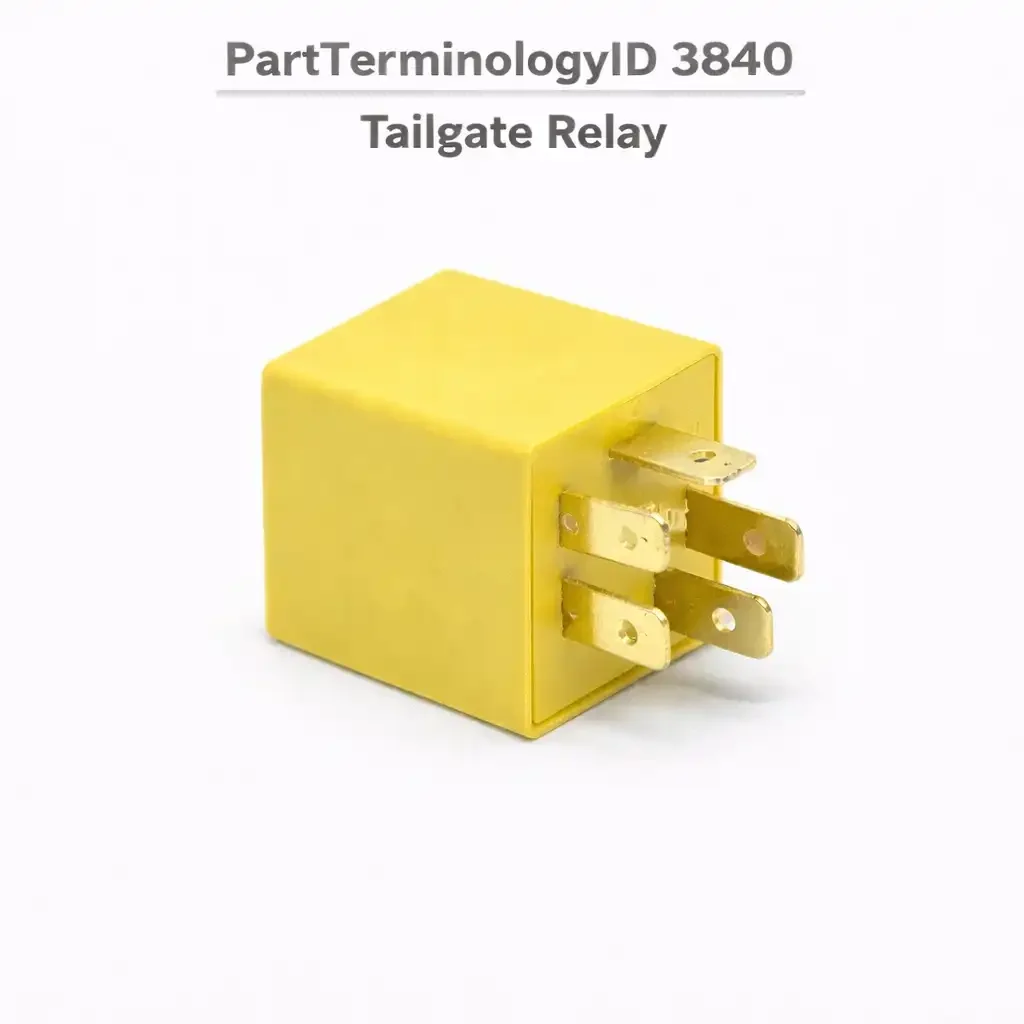
The Tailgate Relay, cataloged under PartTerminologyID 3840, is the relay that delivers momentary supply current to the tailgate latch actuator solenoid when the driver commands a lock, unlock, or release operation through the key fob, the interior door lock switch, the tailgate-mounted release button, or an exterior keypad. On platforms that use this relay, the BCM or door lock control module triggers the relay coil, the contacts close briefly, and current flows to the actuator solenoid to extend or retract the tailgate latch mechanism. The relay protects the BCM output from direct solenoid current load, provides a predictable switching point for the actuator circuit, and in some architectures handles the polarity reversal between the lock and unlock directions.
The tailgate latch actuator is a pulse-energized solenoid: it requires current only for the fraction of a second needed to mechanically shift the latch position, after which the relay de-energizes and the solenoid holds its position mechanically. This differs from a sustained-load relay like a cooling fan relay, which must remain energized throughout operation. A Tailgate Relay that fails in the open-contact state produces no actuator response at all; one that fails in the closed-contact state either holds the actuator energized continuously, which can damage the solenoid winding, or produces intermittent self-activation of the latch.
Not all platforms with power tailgate functions use a discrete, externally socketed relay for this function. On the Ford F-150 from certain generations, the BCM uses an internal relay described in service documentation as non-serviceable, and the BCM is the replacement unit if the relay function fails. On newer GM full-size trucks including the Silverado and Sierra, the tailgate latch is powered and controlled directly by the BCM with no discrete relay socket in the circuit. Listings for PartTerminologyID 3840 must be confined to applications confirmed by factory service documentation to have a discrete, externally accessible relay in the tailgate actuator circuit.
What the Relay Does
Supplying the Tailgate Latch Actuator
The tailgate latch actuator is a small electric motor or solenoid that shifts the latch mechanism between locked and unlocked states and, on release-capable systems, momentarily retracts the latch to allow the tailgate to swing open. When the driver activates any of the available inputs, the BCM or control module evaluates whether the unlock or release command is valid: whether the vehicle is in the correct state, whether any security inhibit is active, and whether the vehicle speed, if relevant, is within the permitted range. If the command is validated, the BCM grounds the relay coil terminal, the relay contacts close, and battery voltage reaches the actuator solenoid for the duration of the switching pulse. The relay then de-energizes and the solenoid holds its mechanical state until the next command.
On platforms with separate lock and unlock actuations, the relay supplies current in opposite polarities to the actuator motor to drive it in either direction. Two relays are typically used in this architecture: one for the lock direction and one for the unlock direction. Both relays must be functional for normal bidirectional operation. A single failed relay produces single-direction failure: the tailgate locks but does not unlock via the power circuit, or unlocks but does not lock.
Security and BCM Inhibit Logic
The BCM enforces several conditions before allowing the tailgate relay to activate. On most platforms the tailgate latch actuator is inhibited when the vehicle is above a defined speed threshold to prevent the tailgate from being released while driving. The BCM reads vehicle speed from the CAN bus and withholds the relay activation signal if speed exceeds the inhibit threshold. A buyer who observes the tailgate operating normally at rest but never while moving is not experiencing a relay fault; the BCM is functioning correctly.
On newer GM trucks, the BCM settings menu accessible through the infotainment system includes options for the tailgate unlock behavior. A BCM software update or inadvertent settings change can disable the tailgate button circuit while leaving key fob operation functional. A tailgate that responds to the fob but not the button is almost never a relay fault; it is a BCM setting, a failed tailgate button, or a wiring break in the button circuit, not the relay.
Tailgate Harness Flex Zone
On pickup truck platforms, the tailgate wiring harness must flex through a hinge or junction point every time the tailgate is lowered and raised. On the Ford F-150 and similar platforms, the harness exits the tailgate body through a sleeve or boot at the hinge connection point. Repeated flexing over years of use breaks individual wires inside the harness insulation at this flex point, producing intermittent or complete loss of tailgate electrical functions including the lock actuator, the rearview camera feed, the license plate lamps, and the tailgate release button circuit. The harness break produces a symptom identical to a relay fault: the tailgate does not respond to the button or fob command. Confirming that the harness flex point is intact before ordering a relay prevents a return that the relay cannot resolve.
Top Return Scenarios
Tailgate Responds to Fob but Not to Button
A tailgate that unlocks and releases when the key fob is used but does not respond to the tailgate-mounted exterior button or the interior lock switch is not a relay fault in the vast majority of cases. The fob signal passes through the BCM and triggers the relay from a different input path than the button circuit. If the relay were the fault, neither input method would produce a response. When the fob works and the button does not, the fault is in the button itself, the wiring from the button to the BCM input terminal, a connector in the tailgate harness, or a BCM setting that has been toggled off. Ordering a relay for this symptom generates a return.
The confirmation test is to use every available activation method: key fob, interior door lock switch set to unlock all, tailgate button, and exterior keypad if equipped. If any single input method produces a successful latch activation, the relay and actuator are both operational and the fault is in the specific input path that does not work.
Tailgate Harness Break at the Flex Point
On Ford F-150 and other pickup platforms where the harness flexes at the tailgate hinge, a fractured wire inside the harness sleeve produces complete loss of all tailgate electrical functions simultaneously: the button does not work, the camera feed may drop out, and the license plate lamp may fail. The symptom of total electrical failure on the tailgate including the button and the actuator appears to confirm a relay or fuse fault. However, with the harness break present, a new relay resolves nothing because the actuator signal cannot reach the actuator through the broken harness.
Visually inspecting the harness flex point on pickup platforms is mandatory before diagnosing either the relay or the actuator. On F-150 applications, the break typically occurs where the harness passes through the grommet at the driver's side tailgate hinge mount, visible when the tailgate is lowered. Physical flexing of the harness in this area while observing the license plate lamp for flicker or testing continuity in the circuit provides confirmation.
Failed Tailgate Ground Producing Total Tailgate Function Loss
On GM body-on-frame SUV platforms including the TrailBlazer, Envoy, and TrailBlazer EXT, the tailgate functions including the lock actuator, rear wiper, license plate lamps, and liftgate glass release share a common ground path that is routed through the liftgate or tailgate structure. Corrosion or a loose connection at this common ground point breaks the return path for all tailgate electrical circuits simultaneously. The BCM may be sending its relay activation signal correctly, the relay may be functioning, and the actuator may be intact, but no circuit function is restored until the ground is repaired.
A buyer on one of these platforms who installs a new relay without finding and repairing the ground fault will return the relay because the tailgate functions remain inoperative. The ground confirmation test is to run a jumper wire from the tailgate component ground bus to a known good chassis ground: if all tailgate functions return with the jumper in place, the ground path is the fault.
BCM Setting or Software Change Disabling Button Circuit
On 2019 and newer GM full-size trucks, the infotainment system settings menu includes tailgate unlock behavior options that can be toggled on or off, and BCM software updates pushed by the dealer or received over-the-air can alter these settings. A driver who takes a truck in for service and receives a software update may find afterward that the tailgate button no longer activates the latch while the key fob continues to work normally. This symptom generates relay orders from buyers who have researched the tailgate relay and found it as the standard fault for tailgate non-response.
The resolution requires accessing the BCM settings through the vehicle menu or a scan tool and confirming that the tailgate unlock option is enabled. No part is required. Listings that acknowledge BCM settings as a non-hardware cause of this symptom on these platforms prevent the return before it begins.
Actuator Failure Attributed to Relay
A relay that is confirmed operational — the coil activates on command and the contacts close delivering voltage to the actuator terminals — cannot resolve a failure in the actuator itself. A burned-out actuator solenoid winding, a seized actuator motor, or a broken mechanical linkage from the actuator to the latch presents as no latch movement despite all electrical commands registering correctly. Buyers who jump directly to the relay when the tailgate does not respond, without confirming that the actuator is receiving voltage and has a complete circuit, return the relay when it resolves nothing.
The actuator can be confirmed by probing its supply terminal during a release command with a test light or voltmeter: if voltage is present at the actuator terminal during the command pulse, the relay and its wiring are functional and the actuator is the fault. If no voltage appears during the command, the relay or its wiring is the fault.
BCM-Integrated Relay on Modern Platforms Generates Uninstallable Part
On Ford F-150 and newer GM truck platforms, the tailgate relay function is inside the BCM and is described explicitly in factory service documentation as non-serviceable. A buyer on these platforms who receives a discrete relay will find no relay socket in the circuit. The BCM is the only replaceable component if the internal relay function has failed, and BCM replacement on these platforms requires dealer-level programming.
Application data that includes BCM-integrated platforms is the primary driver of this return type. Factory service documentation must be consulted for each specific year and model to determine whether a discrete relay socket exists before any application is added to the ACES data.
Listing Requirements
Every listing for PartTerminologyID 3840 should include:
ACES fitment data confirmed for platforms with a discrete, externally socketed relay in the tailgate latch actuator circuit; must exclude platforms where the relay is internal to the BCM or door lock control module
A note that tailgate response to the key fob but not to the button is a button, wiring, or BCM settings fault rather than a relay fault
A note on tailgate harness inspection at the flex point on pickup truck applications before ordering
A note on tailgate ground path integrity on liftgate-style SUV platforms where a shared ground failure produces total tailgate function loss
A note that BCM settings or software updates on newer GM platforms can disable the tailgate button circuit without a hardware fault
Frequently Asked Questions
My tailgate opens with the key fob but not with the button on the tailgate or the interior switch. Is this the relay?
No. If the key fob successfully activates the tailgate latch, the relay and actuator are both confirmed functional because the fob command passes through the same relay to reach the same actuator. The fault is in the input path that does not work. The tailgate button has its own wiring from the button contacts to a BCM input terminal; if this wiring is broken, corroded at a connector, or the button contacts themselves have failed, the BCM never receives the button signal and cannot activate the relay in response. On newer GM trucks, the tailgate button circuit can also be disabled by a BCM setting that is accessible through the vehicle settings menu or can be altered by a software update. Check the BCM settings and the tailgate harness connectors before ordering any relay.
None of my tailgate functions work: the button, the fob command for the tailgate, and the interior switch all produce no response. Is this the relay?
Total tailgate function loss from all inputs is more consistent with a fuse, a broken harness, a failed ground, or a BCM fault than with a relay failure alone. Check the tailgate or power door lock fuse first. On pickup platforms, inspect the tailgate harness at the flex point near the hinge for a fractured wire. On GM SUV platforms, run a temporary ground jumper from the tailgate ground bus to chassis to confirm whether a ground fault is responsible. If the fuse is intact, the harness is undamaged, and the ground path is confirmed good, probing the relay output terminal during a command activation confirms whether the relay is supplying voltage to the actuator. If no voltage appears at the output terminal when the relay should be active, the relay or its coil activation path is the fault.
I can hear a click from the tailgate area when I press the button, but the tailgate does not open. Is this the relay?
An audible click during a button press typically means the actuator solenoid is receiving current and attempting to move the latch mechanism. This click is the actuator, not the relay. If the actuator is clicking but the tailgate is not releasing, the fault is mechanical: a frozen or binding latch mechanism, a broken actuator-to-latch rod or cable, or a misaligned latch that is preventing the actuator from completing its travel. A new relay does not resolve a mechanical latch fault.
My tailgate worked intermittently and then stopped completely. Is this the relay?
Intermittent tailgate operation that progresses to complete failure is a pattern consistent with a fractured tailgate harness wire at the flex point, a corroding connector in the tailgate circuit, or a relay contact set with increasing contact resistance. The harness flex point should be the first physical inspection on a pickup platform because the intermittent-to-complete failure progression is characteristic of a wire that is cracking from repeated flexing. After confirming the harness is intact, testing relay contact continuity with the relay removed from the socket confirms whether the contacts have degraded.
What Sellers Get Wrong
Not distinguishing fob-only-works from neither-method-works
These two symptom descriptions look similar in a search query but point to completely different fault locations. A buyer who can open the tailgate with the fob but not with the button has a functional relay; a buyer who cannot open the tailgate from any input may have a relay fault. Listing content that addresses both presentations separately, and explicitly routes the fob-works-but-button-does-not buyer to the switch circuit rather than the relay, prevents the single largest source of returns on this PartTerminologyID.
Not mentioning the harness flex point on pickup applications
The tailgate harness break at the hinge flex zone is the leading cause of total tailgate electrical failure on Ford F-150 and similar platforms, and it generates relay orders because the symptom matches a relay failure exactly. A listing that does not mention harness inspection will receive returns from buyers on these platforms regardless of how accurate the relay itself is. The harness is inspectable before any part is ordered and it requires no tools beyond visual examination of the flex zone with the tailgate lowered.
Ignoring the BCM integration issue on modern platforms
F-150 service documentation explicitly describes the tailgate relay as internal to the BCM and non-serviceable. GM service documentation for current Silverado and Sierra generations shows no discrete relay in the tailgate actuator circuit. A listing that extends application data to these platforms based on symptom matching rather than factory documentation will generate returns from buyers who have no relay socket. The BCM designation in the service documentation is the correct data source, not consumer-facing troubleshooting guides that reference a relay in general terms.
Not covering the ground fault scenario on GM SUV platforms
On the Chevrolet TrailBlazer, GMC Envoy, and related GMT360 platforms, a single ground path feeds the tailgate lock, rear wiper, license plate lamps, and other functions. Corrosion at the tailgate ground stud or the body-side ground connector produces a cluster of failures that buyers consistently attribute to the relay or BCM. The ground repair is a five-minute fix. A listing that does not acknowledge this failure mode will receive returns from buyers on these platforms who install the relay and find nothing improved.
Cross-Sell Logic
Tailgate latch actuator (the electromechanical component the relay supplies; an audible click during a button press with no latch movement confirms the actuator is receiving current but failing to move the mechanism; actuator replacement follows relay confirmation)
Tailgate release button or liftgate release switch (the input component whose failure most commonly mimics the relay fault; confirmed by testing whether the BCM is receiving the button signal during a press using a scan tool, or by confirming whether alternate input methods activate the latch successfully)
Tailgate wiring harness or tailgate harness pigtail (on pickup platforms subject to flex-point wire fracture, the harness repair or replacement is the most common repair for total tailgate electrical function loss; should be inspected before the relay is ordered and may be the required repair alongside or instead of the relay)
Power door lock fuse (the overcurrent protection shared between the tailgate lock circuit and the door lock circuits on many platforms; if neither the door locks nor the tailgate actuator respond to any input, the shared fuse is the first check)
BCM or door lock control module (on platforms where the relay is internal to the module; BCM replacement is the correct repair when the internal relay function has failed, and BCM replacement requires dealer programming on most current platforms)
Tailgate ground strap or ground connector (on GM SUV platforms with the shared tailgate ground path; the ground repair resolves total tailgate function loss more often than any relay or actuator replacement on these specific platforms)
Final Take
PartTerminologyID 3840 generates a disproportionate share of returns from buyers who have correctly identified that their tailgate does not work electrically, but have not performed the input-method test that separates a relay fault from a switch or wiring fault, or the harness inspection that separates a relay fault from a flex-point fracture. Both of these preliminary steps are free, require minimal tools, and take under five minutes. A listing that teaches these two steps before directing buyers to the relay will convert accurately on buyers who have a genuine relay fault and redirect everyone else before they order.
The modern platform challenge for this PartTerminologyID is significant. The BCM-internal relay on F-150 and the absence of a discrete relay on current GM trucks represent a large fraction of the full-size truck market, which is exactly the market searching for tailgate relay repairs. Application data precision is not a secondary concern on this catalog entry; it is the primary defense against the uninstallable-part return that arrives when a buyer on a BCM-controlled platform receives a discrete relay and finds nowhere to put it.