
Sunroof Relay (PartTerminologyID 3828): Diagnosis, Return Prevention and Listing Guide
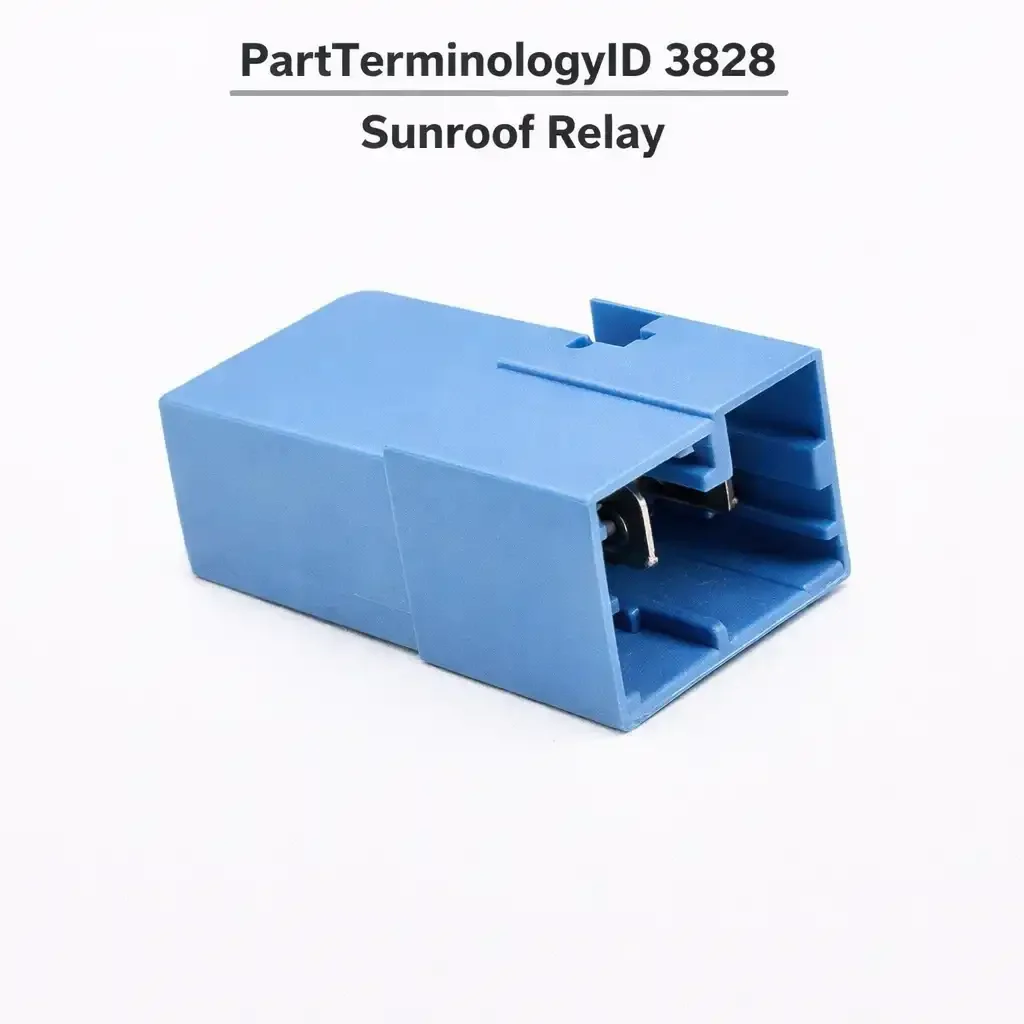
The Sunroof Relay, cataloged under PartTerminologyID 3828, is the relay that enables the ignition or accessory-switched supply voltage to reach the sunroof motor when the driver commands a tilt or slide operation. On the simplest system architectures, a single relay sits between the fused ignition supply and the sunroof switch, and the switch itself routes polarity to the motor to produce open or close movement. On more common two-relay architectures, a separate relay controls each direction of motor travel: one relay closes to supply the motor in the open direction, and a second relay closes to reverse motor polarity for the close direction. When the sunroof switch is depressed for open, the open relay is triggered; when the switch is depressed for close, the close relay is triggered. The relays prevent the full motor current from passing through the switch contacts directly, protecting the switch from arc erosion, and on some platforms they also interface with limit switches that halt motor travel at the fully open and fully closed positions.
On modern platforms, particularly those with a BCM or moonroof control unit managing the sunroof motor, the relay function may be integrated into the control module rather than offered as a discrete replaceable component. The motor assembly itself may contain the relay and direction-control logic as a sealed unit, making the motor assembly the replacement rather than an individual relay. Fitment data for this PartTerminologyID must be built from factory service documentation confirming that the platform uses a discrete, externally accessible relay rather than an integrated motor module. Listings that include modern BCM-integrated sunroof platforms will generate orders with no available installation point.
What the Relay Does
Enabling the Motor Supply Circuit
The sunroof motor draws significantly more current than the sunroof switch contacts are rated to handle directly. The relay accepts a low-current trigger signal from the switch or control module and closes its higher-current contact set to deliver motor supply voltage. On a platform with a single supply relay and a switch that handles direction internally, the relay's job is simply to gate the circuit: when the ignition or accessory circuit is active and the switch is pressed, the relay allows current to flow. When the ignition is off and the retained power window has expired, the relay is de-energized and the motor cannot run regardless of switch position.
On platforms with two directional relays, the relay function is extended to include polarity reversal. To run a DC motor in reverse, the polarity of the supply to the motor terminals must be swapped. Two relays accomplish this: the open relay supplies positive voltage to one motor terminal and ground to the other; the close relay supplies positive to the previously grounded terminal and ground to the previously positive terminal. The switch activates one relay or the other depending on the direction commanded, and the motor turns in the appropriate direction. A failure in one directional relay produces single-direction failure: the sunroof opens but refuses to close, or closes but refuses to open, depending on which relay has failed.
Retained Accessory Power Operation
Most sunroof systems operate on the ignition or accessory circuit, meaning the sunroof works when the key is in Run or Accessory. Many platforms extend this with a retained power window that keeps the accessory circuit active for a short period after the ignition is switched off, typically thirty to sixty seconds, allowing the driver to close the sunroof without restarting the vehicle. The Sunroof Relay is part of this retained power supply path: when the retained power window expires, the relay loses its coil supply and the motor circuit opens even if the switch is still being held.
Loss of retained power operation while normal ignition-on operation continues intact is a symptom that the retained power relay or its supply circuit is at fault rather than the Sunroof Relay itself. The distinction matters for diagnosis because replacing the Sunroof Relay does not restore retained power function if the fault is in the retained power supply.
Limit Switch Interaction
The Sunroof Relay on some platforms receives its coil ground path through the limit switches that are built into the sunroof mechanism. When the sunroof reaches its fully open or fully closed position, the limit switch opens the relay coil ground path and the relay de-energizes, stopping the motor. If a limit switch fails in the open position, the relay coil never has a ground path and the motor never runs at all despite the switch being pressed. If a limit switch fails in the closed position, the motor may run past the travel stop and damage the mechanism because the relay never de-energizes at the endpoint.
This limit switch interaction is a source of diagnostic confusion: a failed limit switch produces the same primary symptom as a failed relay coil, which is no motor movement when the switch is pressed. The distinction requires checking whether relay coil voltage is present and whether the coil ground path is complete before condemning the relay.
Top Return Scenarios
Relay Clicking Interpreted as Relay Functioning
The most common diagnostic error in sunroof circuit work is concluding that a relay is good because it clicks when the switch is pressed. The click confirms that the relay coil is energizing, which means the coil winding is intact and receiving its activation signal. It does not confirm that the contact set is closing and passing current. A relay with a failed contact set clicks normally but delivers no voltage to the motor. The relay swap test or a contact-side voltage test is the correct confirmation: probe the relay output terminal with the switch active to confirm that voltage appears on the load side when the relay clicks. Clicking without load-side voltage confirms a failed contact set despite an audible relay actuation.
Mechanical Bind or Track Obstruction Attributed to Relay Failure
When the sunroof panel moves partially and then stops, or starts moving and immediately reverses, the cause is almost always mechanical rather than electrical. Debris in the track, a stripped cable, seized slide blocks, or a dry track with insufficient lubrication all produce symptoms that buyers interpret as the motor or relay stopping the movement prematurely. The diagnostic test is to attempt a direct motor drive: with the motor confirmed receiving voltage through the relay, disconnect the motor from the drive mechanism and confirm the motor shaft turns freely. If the motor runs freely when disconnected from the mechanism but stalls under load, the fault is mechanical and relay replacement does not help.
The sunroof reversal behavior on systems with anti-pinch logic is also frequently misread as a relay fault. When the motor controller detects excessive current draw indicating an obstruction, it reverses direction or stops the panel. Buyers who see the panel reverse unexpectedly sometimes attribute the behavior to relay failure when the system is functioning exactly as designed in response to a binding track.
Water Intrusion Damaging the Relay or Connector Before the Relay Itself Fails
Clogged sunroof drain tubes are the most common root cause of sunroof electrical faults across all platforms. When the drains are blocked, standing water accumulates in the sunroof frame and runs into the headliner cavity where the relay, motor, and wiring connectors are located. Water in these connectors corrodes terminals, causes intermittent contact resistance, and eventually shorts circuits. A buyer who replaces the relay after water damage has corroded the connector terminals returns the relay when the symptom returns because the corroded connector was never addressed. Water damage to the connector and harness can also cause the relay to fail again shortly after replacement if the connector corrosion persists.
Before any electrical repair on a sunroof circuit, confirming that the drain tubes are clear and that no standing water is present in the sunroof frame is the necessary first step. On any vehicle where the relay is located in the headliner cavity near the motor, water damage to the connector should be assumed and inspected before the relay is replaced.
Motor Confirmed Good by Direct Test but System Still Inoperative
The direct motor confirmation test, bypassing the relay and switch by applying battery voltage directly to the motor terminals, confirms that the motor windings are intact and that the mechanical load does not exceed the motor's capability. This test is commonly performed when diagnosing a sunroof that does not respond to the switch, and finding the motor operational by direct test is useful. However, a motor that operates by direct test but not through the system circuit does not isolate the fault to the relay alone. The fault could be in the relay contact set, the wiring between the relay and the motor, the ground path for either the motor or the relay coil, or the ignition supply to the relay coil. Each of these must be evaluated before concluding the relay is the specific fault.
Control Module Initialization Required After Battery Disconnect
On platforms with a moonroof control unit or BCM-managed sunroof motor assembly, the position memory for the fully open and fully closed endpoints is stored in the control module. When the battery is disconnected, the module loses this stored position data. When battery power is restored, the module does not know where the panel is or where the travel limits are, and it will not operate the sunroof until an initialization procedure is performed. The initialization procedure typically involves holding the switch in a specific direction until the panel completes a full open-and-close cycle under motor control, which reestablishes the travel endpoints in the module's memory.
A buyer who disconnects the battery for unrelated service, then finds the sunroof inoperative, and orders a relay returns it when the initialization procedure resolves the problem in under two minutes. Listings that acknowledge the initialization requirement and direct buyers to their owner's manual or factory service information before ordering a relay save this return in its entirety.
One-Direction Failure on Two-Relay Systems
On platforms with separate open and close relays, a single relay failure produces a one-direction fault: the sunroof operates normally in one direction and is inoperative in the other. Buyers who experience this symptom often search for a sunroof relay and order a single relay, which resolves the fault in the failed direction but only if the correct relay is identified. On some platforms the open and close relays are different part numbers; on others they are identical and either position can be swapped with the other for confirmation. Listings must clarify whether the offered relay serves one specific direction or both, and whether the platform uses matched-pair relays or direction-specific units.
Listing Requirements
Every listing for PartTerminologyID 3828 should include:
ACES fitment data confirmed for platforms with a discrete, externally accessible Sunroof Relay; must exclude platforms where the relay function is integrated into the motor assembly or BCM
A description of whether the relay serves a supply function, a direction-control function, or both, and whether the platform uses one or two relays for sunroof operation
A note that relay clicking is not confirmation of relay function and that contact-side voltage testing is required before condemning or replacing the relay
A note on the control module initialization procedure required after battery disconnect on applicable platforms
A note on water intrusion as the dominant environmental threat to sunroof relay and connector condition, and the need to confirm drain tube clearance before electrical diagnosis
Frequently Asked Questions
When I press the sunroof switch I hear a click but the panel does not move. Is this the relay?
The click confirms that the relay coil is receiving its activation signal and energizing. It does not confirm that the relay contacts are closing and passing current to the motor. The correct next step is to probe the relay output terminal with the switch active to confirm whether motor supply voltage appears. If relay coil voltage is present on the input terminal but no voltage appears on the output terminal when the relay clicks, the contact set has failed and relay replacement is warranted. If output voltage is present but the motor does not run, the fault is at or downstream of the relay, in the motor wiring, motor ground, or motor itself.
My sunroof opens but will not close, or closes but will not open. Is this the relay?
Single-direction failure on a two-relay sunroof system is a strong indicator that the directional relay for the inoperative direction has failed. With the switch activated for the inoperative direction, probe the relay output terminal to confirm that no voltage appears despite the relay clicking. If the relay for that direction fails to pass voltage while the other direction operates normally, the directional relay for the failing direction is the fault. On platforms where both relays are identical, swapping the two relay positions is a valid confirmation test: if the failure direction changes after the swap, both relays are confirmed functional and the fault is elsewhere in the circuit.
My sunroof stopped working after I had the battery replaced or disconnected. Is this the relay?
Before ordering a relay, perform the sunroof initialization procedure for your vehicle. On platforms with a moonroof control unit, the position limits must be re-established after battery power is lost. The procedure is typically described in the owner's manual under moonroof or sunroof operation, or in the factory service manual under the sunroof control unit section. The procedure takes under two minutes and requires no tools. If the sunroof was operating normally before the battery disconnect and no other symptoms are present, initialization resolves the fault in the large majority of cases without any parts replacement.
The sunroof worked before but now nothing happens when I press the switch. No click, no movement. Is this the relay?
Complete silence when the switch is pressed, meaning no relay click at all, shifts the diagnostic focus away from the relay contact set and toward the relay coil supply, the fuse for the sunroof circuit, the ignition or accessory supply to the relay, and the switch output to the relay coil. Confirm the sunroof fuse is intact, then probe the relay coil supply terminal to verify ignition-switched or accessory voltage is present. If the supply is present but pressing the switch produces no click, the switch output to the relay coil is not completing the circuit, meaning either the switch is at fault or the wiring between switch and relay coil terminal is broken. A relay that has lost its supply voltage produces complete silence rather than a click.
What Sellers Get Wrong
Treating a relay click as relay confirmation
Listing content that describes relay replacement as the solution when the relay is clicking but the motor is not running reinforces the most common diagnostic error in sunroof circuit diagnosis. The relay click confirms coil function only. The contact set is the mechanical component most subject to failure in relay use, and it fails silently except for the absence of output voltage. Any listing or cross-sell logic that equates clicking with relay health will generate returns from buyers whose relays were clicking perfectly while their contact sets were open.
Not acknowledging the initialization requirement
The moonroof control unit initialization procedure is a free, tool-free repair that resolves a large percentage of post-battery-disconnect sunroof failures before any part needs to be ordered. A listing that does not acknowledge this procedure will reliably receive returns from buyers whose vehicles required initialization rather than a relay. The return is entirely preventable with a single sentence directing the buyer to check their owner's manual for the reset procedure before ordering.
Not distinguishing supply relay from directional relay in listing content
The terms sunroof relay and moonroof relay appear in listings that cover both single-supply relay architectures and two-directional-relay architectures without making the distinction clear. A buyer on a two-relay platform who orders a single relay for a one-direction fault installs it correctly and then wonders why the system still only works in one direction, before calling to ask whether a second relay is needed. A buyer on a single-relay platform who reads a listing describing two directional relays may over-order. Listing content that specifies which relay architecture the part applies to, and whether the buyer needs one or two units, prevents both outcomes.
Ignoring water damage as the cause of recurring relay failure
On platforms where the relay is located in the headliner cavity or in an area subject to water from clogged drains, a relay that fails and is replaced without addressing the drain tube condition or connector corrosion will fail again. A second return after replacement is almost always a water damage scenario on these platforms. Listing content that identifies drain tube maintenance as the first step in sunroof circuit diagnosis, and warns that a relay installed into a water-damaged connector will either fail immediately or produce intermittent symptoms, reduces the double-return pattern.
Cross-Sell Logic
Sunroof motor or moonroof motor assembly (the component the relay supplies; direct battery test of the motor before ordering the relay confirms whether the motor is capable of running the mechanism under its current mechanical load)
Sunroof switch or moonroof switch (the component that activates the relay coil; on two-relay systems, a switch contact that fails for one direction produces the same single-direction symptom as a failed directional relay; switch confirmation precedes relay ordering on one-direction faults)
Sunroof fuse or moonroof fuse (the overcurrent protection for the relay supply circuit; a blown fuse produces complete silence with no relay click; fuse confirmation is the correct first step before any relay or switch diagnosis)
Sunroof relay connector or wiring pigtail (on platforms subject to water intrusion, a corroded relay connector must be addressed alongside relay replacement to prevent recurrence; a new relay in a corroded socket will show the same symptom or fail prematurely)
Limit switches for the sunroof mechanism (on platforms where the relay coil ground path runs through the limit switches, a failed limit switch produces a no-click, no-movement symptom identical to a relay coil supply failure; limit switch continuity must be confirmed before the relay is replaced on these architectures)
Sunroof drain tube cleaning kit or drain tube grommet (clogged drain tubes are the most common root cause of sunroof electrical damage on all platforms; addressing the drain condition before or alongside the relay replacement is the only intervention that prevents recurrence)
Final Take
PartTerminologyID 3828 covers a circuit that combines mechanical complexity with electrical simplicity in a way that reliably produces misdiagnosis. The relay is one of the last components to fail in a sunroof circuit that is not exposed to water, because the switch, motor, limit switches, track mechanism, and drain system all have shorter service lives under typical use. A relay that is failing is usually doing so because water reached it, because the motor load has increased due to a dry or obstructed track putting excess current through the contacts, or because the limit switch ground path has degraded and the coil is running longer than intended on every cycle.
Listings that build the water-and-drain context into the diagnostic guidance, acknowledge the initialization procedure, and separate relay clicking from relay functioning will earn and retain orders from buyers who have a genuine relay fault. Buyers who have mechanical issues, initialization needs, switch faults, or water damage in the harness will be correctly redirected before they order, and that redirection is what keeps return rates manageable on a category that attracts a wide range of misdiagnosed complaints.