
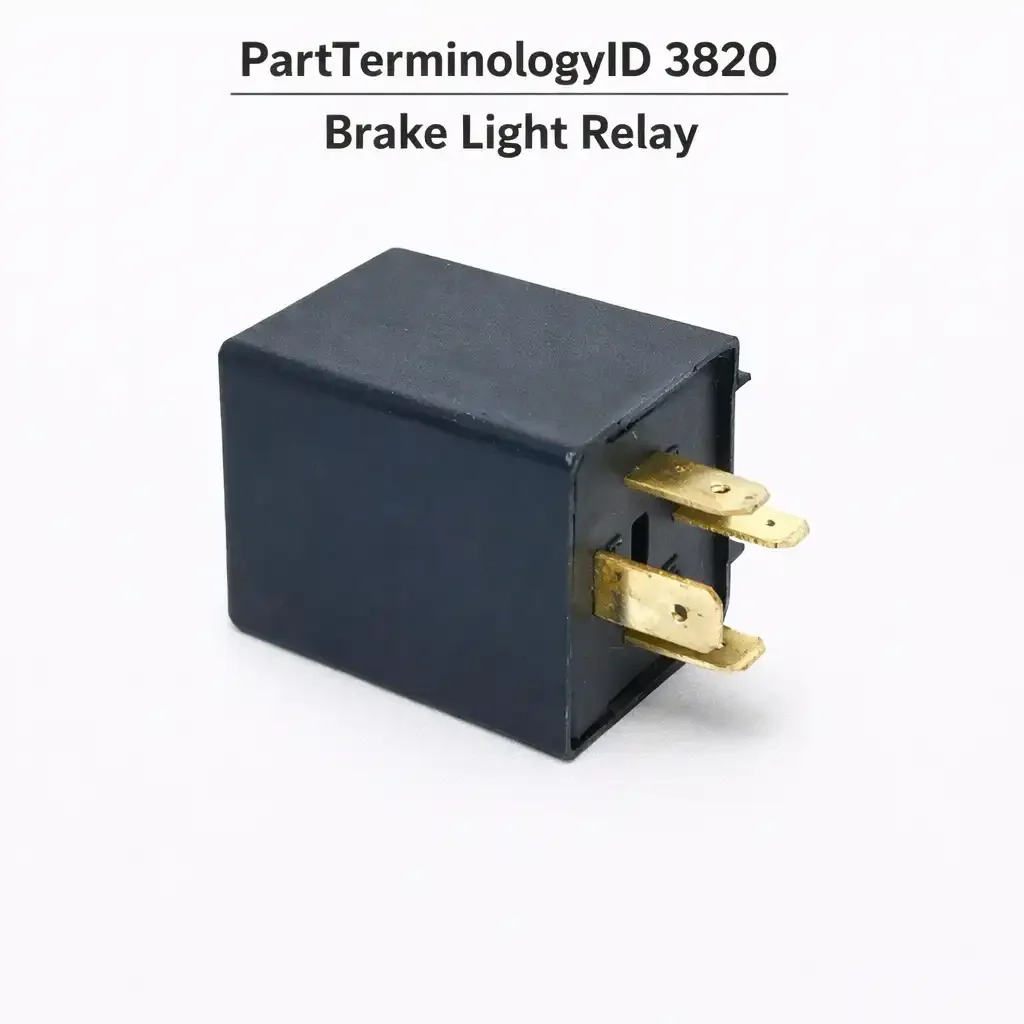
The Brake Light Relay, cataloged under PartTerminologyID 3820, is the relay that carries the full load current to the vehicle's stop lamps when the brake switch signals a pedal depression. On platforms that use this relay, the brake pedal switch does not feed the stop lamp bulbs directly. Instead, the switch supplies a low-current coil activation signal to the relay, and the relay's main contacts close to deliver battery voltage to the brake light circuit. This arrangement protects the brake switch contacts from the arc erosion caused by repeatedly switching the full current draw of three or more brake lamp bulbs on and off, and on modern platforms it also allows the ABS, ESC, and hill assist systems to monitor and interact with the brake lamp circuit through the relay rather than through the switch itself.
Not all platforms use a dedicated Brake Light Relay. On many vehicles, particularly older domestic designs and simpler current architectures, the brake switch feeds the stop lamp bulbs directly through a fuse with no relay in the path. A buyer on one of these platforms has no relay to replace regardless of what the brake light symptom is. The ACES fitment data for this PartTerminologyID must be built from factory service manual confirmation that the platform uses a discrete external relay in the brake lamp supply circuit. Including platforms without a dedicated stop lamp relay generates orders with no application.
What the Relay Does
Protecting the Brake Switch Contact Life
The brake pedal switch activates and deactivates every time the driver touches the pedal, which over the life of a vehicle can amount to tens of thousands of switching events. On a platform without a relay, the full current draw of the stop lamp circuit passes through the switch contacts at every actuation. Three standard incandescent stop lamp bulbs at 21 watts each represent a total load of roughly five amps, with a higher inrush current at the moment of contact closure due to the cold resistance of the filaments. That inrush causes arcing at the switch contacts, which gradually carbonizes and erodes the contact surfaces. A relay inserted between the switch and the lamp load reduces the current flowing through the switch to the small coil current of the relay, typically under 200 milliamps, eliminating virtually all contact arcing at the switch.
This protection function is the primary reason the relay exists on the platforms that use it. It is not strictly necessary for the brake lights to function in the short term, but it substantially extends the service life of the brake switch by keeping the switch contacts in the low-current control circuit rather than the high-current load circuit.
ABS, ESC, and Hill Assist Integration
On modern platforms, particularly Kia and Hyundai vehicles, the brake lamp relay serves a second function beyond load switching: it is part of the signal path that ABS, electronic stability control, and hill start assist systems use to detect brake pedal application. The stop lamp relay output is monitored by these control modules as a confirmation of brake engagement. A relay that fails in the open position does not just extinguish the stop lamps; it also deprives the ABS and ESC modules of their brake confirmation signal, which can illuminate the ABS warning lamp, the ESC/traction control warning lamp, or both simultaneously with the stop lamp failure. On these platforms, the relay failure has broader consequences than simple lamp loss.
On Kia and Hyundai platforms, the stop lamp relay is sometimes labeled in service documentation under a function name other than stop lamp relay. The HAC relay, standing for Hill Assist Control, supplies the stop lamp circuit on some Kia Optima, Sorento, and related platforms. Buyers whose service documentation lists an HAC relay in connection with stop lamp function are not looking at a separate relay; the HAC relay is the relay that powers the stop lamps on those applications, and it is located in the underhood fuse and relay box despite the stop lamp relay on other Kia/Hyundai models being located behind the instrument panel in the interior relay box.
Location Variability by Platform
The Brake Light Relay is not consistently located in the underhood fuse and relay center. On Kia and Hyundai platforms that use a dedicated stop lamp relay distinct from the HAC relay, the relay is typically located behind the instrument panel cluster or within the interior fuse and relay box on the driver's side, not under the hood. On Toyota platforms with a separate tail lamp or stop lamp relay, the location varies by model year and body style, with some placements in the driver's side kick panel area and others within the engine compartment fuse block. Buyers who look only in the underhood fuse center on platforms where the relay is interior-mounted will not find the relay and may incorrectly conclude it is absent from their vehicle when in fact it is in a different location entirely.
Top Return Scenarios
Brake Switch Failure Diagnosed as Relay Failure
The brake pedal switch is the most common cause of stop lamp failure on every platform that uses one. The brake switch governs not only the stop lamp circuit but also the shift interlock release on automatic transmission vehicles, the cruise control cancel function, the ABS and ESC module brake input, and on some platforms the PCM brake signal that affects shift scheduling and other functions. When the stop lamps fail, the brake switch can be confirmed or eliminated quickly: if the vehicle's cruise control also fails to cancel when the pedal is pressed, if the automatic transmission cannot be shifted out of Park, or if a scan tool shows the brake switch input as inactive when the pedal is depressed, the brake switch is the fault and the relay is not implicated.
On Kia and Hyundai platforms, a failed brake switch may also trigger ESC warning lamps and shift interlock faults simultaneously with stop lamp failure, creating a multi-system complaint that looks complex but traces to a single cheap switch. A buyer who replaces the relay without checking the brake switch and finds no improvement because the switch is the fault returns the relay and still has no working brake lights.
Relay Located in Wrong Fuse Box
On platforms where the stop lamp relay is in the interior relay box rather than the underhood fuse center, buyers frequently search the underhood fuse center, find no relay labeled STOP LAMP or BRAKE LIGHT, and either conclude the relay does not exist or order a relay assuming the part will tell them where to install it. Neither outcome is productive. The correct procedure is to consult the factory service manual or the underdash fuse box label for the specific model year and body style before concluding the relay is absent. Listings that describe the relay's general fuse box locations and note that location varies by platform reduce returns from buyers who installed the relay in the wrong location or ordered it without understanding where it goes.
HAC Relay Confusion on Kia Platforms
On Kia Optima, Sorento, and related models, owners who research stop lamp relay failures often encounter two different relay names in service documentation: the stop lamp relay behind the instrument panel and the HAC relay in the underhood fuse block, both of which appear in wiring diagrams associated with the stop lamp circuit. The HAC relay feeds the stop lamp circuit on some of these applications, meaning that a failed HAC relay produces a no-stop-lamp symptom. Buyers who replace the interior stop lamp relay without addressing the HAC relay, or vice versa, may not restore stop lamp function. Diagnosis requires tracing the specific circuit path on the specific model year rather than replacing relays by name.
Relay Contacts Welded Closed: Brake Lights On Continuously
A Brake Light Relay with welded contacts presents the opposite symptom: the stop lamps illuminate at all times regardless of brake pedal position. The correct first step is to confirm whether the brake switch itself is the fault by disconnecting the switch connector: if the lights remain on with the switch disconnected, the relay contacts are welded and the relay requires replacement. If the lights extinguish when the switch connector is removed, the brake switch is stuck in the closed position and is feeding continuous voltage to the relay coil. Both faults produce continuous stop lamp illumination, but the relay is only the correct repair in the first case.
Continuous stop lamp illumination also drains the battery over time if the vehicle is parked with ignition off on platforms where the brake lamp circuit has battery-direct supply. A buyer noticing unexpected battery drain alongside brake lights that appear to be on may have a welded relay in addition to or instead of the more obvious symptom.
All Brake Lights Out With Fuse and Switch Confirmed Good
When the stop lamp fuse is confirmed intact and the brake switch is confirmed delivering its output signal, but no stop lamps illuminate, the relay is the next candidate. The relay confirmation test is voltage at the relay load terminal when the brake pedal is depressed: if coil voltage is present but no load voltage appears on the output side, the relay contacts are not closing and the relay is confirmed faulty. If coil voltage is absent, the fault is between the brake switch and the relay coil terminal, either a wiring fault or a missing supply to the relay coil.
Listing Requirements
Every listing for PartTerminologyID 3820 should include:
ACES fitment data confirmed for platforms with a discrete external Brake Light Relay; must explicitly exclude platforms where the brake switch feeds the lamps directly without a relay
A description of the relay's function both as a load switch that protects the brake switch contacts and as a system relay that interfaces with ABS and ESC module inputs on modern platforms
A note that the brake pedal switch is the most common cause of stop lamp failure and must be confirmed before the relay is ordered, with specific reference to the shift interlock and cruise control cross-checks available before any wiring is touched
A note on location variability: the relay may be interior-mounted or underhood depending on platform, and the buyer must confirm location from factory documentation
A note on the HAC relay labeling used on some Kia platforms where the HAC relay serves the stop lamp function
Frequently Asked Questions
My brake lights don't work. I checked the fuse and it's fine. Is this the relay?
The brake pedal switch is the more common fault before the relay on virtually every platform. Before ordering the relay, perform these cross-checks with the ignition in the Run position: attempt to move the automatic transmission out of Park, which requires brake switch input to release the shift interlock; attempt to set cruise control and verify that pressing the brake pedal cancels it; and, if a scan tool is available, check whether the brake switch input PID shows active when the pedal is pressed. Any of these tests that fail to respond correctly to pedal depression confirms the brake switch as the fault. If all of these cross-checks confirm that the brake switch is producing its signal correctly and the stop lamps still do not illuminate, the relay becomes the primary diagnostic target.
The brake lights stay on all the time even when I am not pressing the pedal. Is this the relay?
Constant stop lamp illumination can be a welded relay or a brake switch stuck in the closed position. The quickest separation test is to disconnect the brake switch connector. If the lights go out when the switch is disconnected, the switch is stuck closed and is the fault. If the lights remain on with the switch disconnected, the relay contacts are welded and the relay requires replacement. On vehicles with a brake switch that has been recently adjusted, reinstalled, or bumped during other underdash work, a misadjusted switch that no longer releases fully when the pedal returns to rest is a common cause of constant illumination that mimics a welded relay.
I can not find a brake light relay in my fuse box. Does my car have one?
Not all vehicles have a dedicated Brake Light Relay. Many platforms feed the stop lamps directly from the brake switch through a fuse with no relay in the circuit. Confirm whether your platform uses a relay by consulting the factory service manual wiring diagram or the fuse/relay box label insert. On Kia and Hyundai platforms, the stop lamp relay may be located in the interior relay box behind the instrument panel rather than in the underhood fuse center. On some Kia models, the relay that feeds the stop lamp circuit is labeled HAC relay in the underhood box rather than stop lamp relay. If your factory documentation does not show a relay in the brake lamp circuit, your platform does not use one and relay replacement is not a valid repair path.
My ABS light came on at the same time my brake lights stopped working. Are these related?
On modern platforms with ABS and ESC systems that use the brake lamp relay output as a brake confirmation signal, a failed relay that opens the stop lamp circuit also removes the brake input signal that those modules depend on. The ABS and ESC warning lamps illuminating simultaneously with stop lamp failure on these platforms is a consequence of a single relay failure, not two separate faults. Replacing the relay restores both the stop lamp function and the ABS/ESC module brake input. If the ABS and ESC warning lamps remain after the relay is replaced and the stop lamps are restored, the modules may have set fault codes that require clearing with a scan tool before the lamps extinguish.
What Sellers Get Wrong
Not making the brake switch the first diagnostic step
The brake switch is a cheaper, more commonly failed component that produces exactly the same primary symptom as the Brake Light Relay: no stop lamp illumination. The listing that sends a buyer directly to relay replacement without making the brake switch the visible first check will see returns from buyers whose switch was the fault all along. The shift interlock test and the cruise control cancel test are both free, tool-free cross-checks that take under thirty seconds each and definitively separate brake switch failure from relay failure on any automatic transmission vehicle. These tests belong in the listing.
Ignoring location variability
A relay that ships to a buyer who does not know where to install it generates a return even when the relay is the correct part. The Brake Light Relay is one of the less predictably located relays in the aftermarket catalog: underhood on some platforms, behind the instrument panel on others, occasionally integrated into a multi-relay assembly that is not a standard ISO relay format. Listing content that describes relay location as simply being in the fuse box leaves buyers on interior-relay platforms searching in the wrong place, failing to find the relay socket, and returning the part.
Overlooking the HAC relay labeling on Kia platforms
Kia Optima, Sorento, Forte, and related models have generated substantial diagnostic confusion because the relay that feeds the stop lamp circuit on some applications is labeled HAC in the fuse box legend rather than STOP LAMP. Buyers who search the underhood and interior relay boxes for a position labeled STOP LAMP and find nothing labeled that way may give up or conclude the relay is absent. Listing content that acknowledges the HAC relay labeling on Kia platforms and notes that the stop lamp and HAC functions share a relay on some model years prevents this confusion from becoming a return.
Not addressing the welded contacts scenario
Brake Light Relay articles overwhelmingly focus on the no-illumination failure mode and rarely address the welded contacts scenario that causes constant illumination. A buyer with brake lights that stay on continuously reaches for a brake switch article rather than a relay article because the symptom intuitively points to the switch being stuck. But when the switch is confirmed released and the lights are still on, the relay is the candidate, and the buyer may not know to look there. Listing content that includes the constant illumination failure mode alongside the no-illumination failure mode captures buyers from both ends of the fault spectrum and reduces the probability that they return a part after misidentifying the root cause.
Cross-Sell Logic
Brake light switch (the component that activates the relay coil; failed on open produces no stop lamp illumination; failed closed produces constant illumination; must be confirmed before the relay is ordered on any all-lamps-out complaint)
Stop lamp bulbs (a burned high-intensity filament in any of the stop lamp positions reduces the brake circuit load; on platforms with no relay, bulb failure is the first check; should be confirmed alongside fuse and switch testing)
Brake light fuse (the overcurrent protection upstream of the relay load circuit; a blown fuse produces bilateral stop lamp loss identical to relay failure; confirmed by visual inspection or meter before the relay is ordered)
ABS control module or ESC module (on platforms where the brake lamp relay output feeds module brake input signals, a module that has logged faults due to relay failure may retain warning lamp illumination after the relay is replaced and require fault code clearing)
Interior fuse and relay box assembly (on platforms where the stop lamp relay is integrated into an interior relay box rather than installed as a discrete replaceable relay, the assembly itself may be the replacement unit rather than an individual relay)
Brake switch wiring harness pigtail (corrosion or damage at the brake switch connector produces intermittent brake switch signal loss that mimics relay failure; a pigtail repair may restore reliable switch operation without replacing either the switch or the relay)
Final Take
PartTerminologyID 3820 occupies a narrower application footprint than most brake-system relay categories because many platforms do not use a dedicated Brake Light Relay at all. The buyers who reach this relay correctly have already confirmed a functioning fuse and a functioning brake switch, or have a stop lamp system that stays on constantly with the switch eliminated from the circuit. Both of these buyer profiles are looking at the right part. The buyers who reach this relay incorrectly have a brake switch or a blown fuse, and listing content that makes those two checks mandatory before ordering prevents the majority of returns.
The platform-specific complexity of Kia and Hyundai stop lamp relay architecture, including interior relay placement and HAC relay labeling, represents the largest single source of confusion for buyers who have correctly identified a relay as their fault but cannot find or identify the right relay in their vehicle. Listing content that addresses both of these platform-specific issues directly converts researching buyers into correctly-ordering buyers rather than confused returners.