
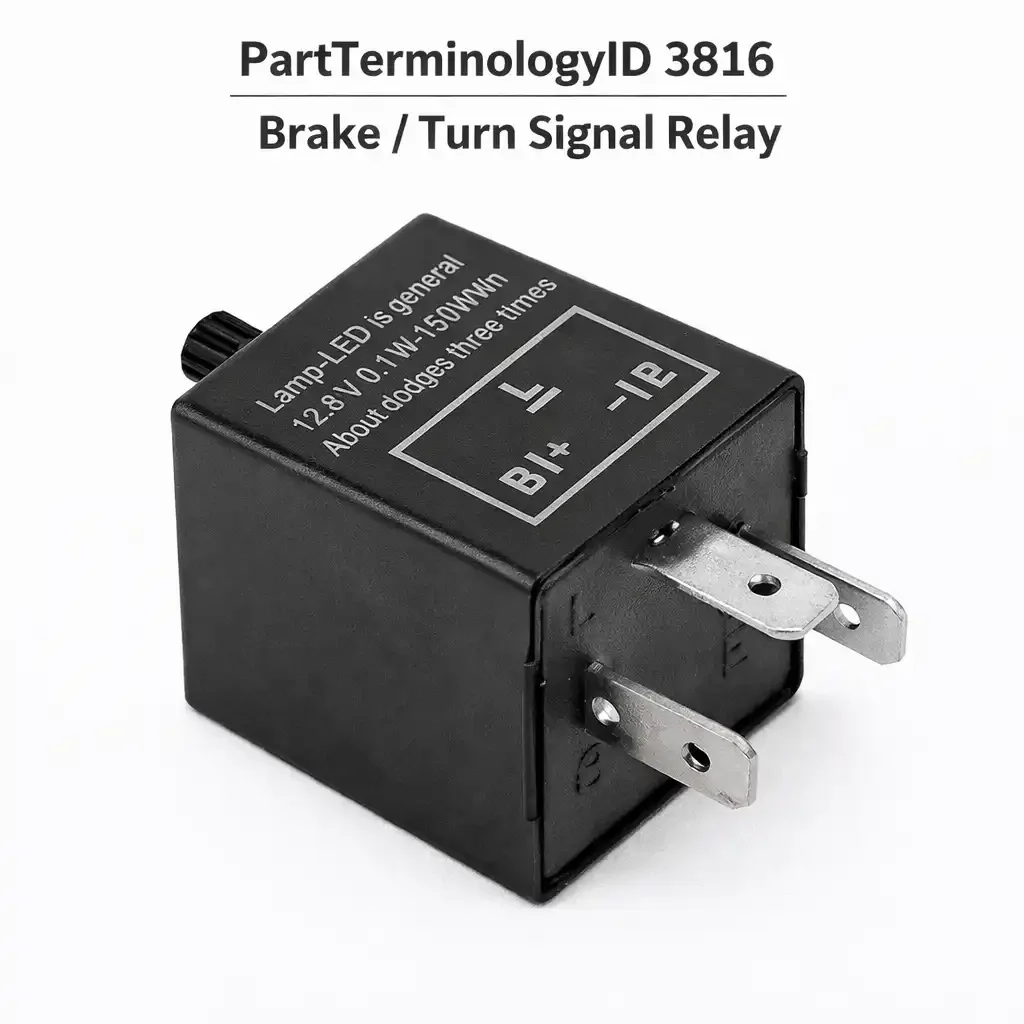
The Brake / Turn Signal Relay, cataloged under PartTerminologyID 3816, is the relay that manages the priority conflict between the brake light and turn signal functions when both are assigned to the same lamp filament. On vehicles that use dual-filament combined stop/turn bulbs, a single high-intensity filament serves as both the brake indicator and the turn signal. When only the brakes are applied, steady battery voltage from the brake light switch feeds both rear filaments and both illuminate solidly. When a turn signal is active, the flasher output must interrupt the steady brake voltage on the signaling side and replace it with pulsed voltage so the driver behind sees a flash rather than a solid light. The Brake / Turn Signal Relay is the component that performs that substitution: its normally-closed contacts carry the steady brake voltage when no signal is commanded, and when the turn signal switch activates the relay coil, the contacts open the brake path and the normally-open contacts deliver flasher output to the same filament.
This relay exists because of a circuit geometry problem. The brake light switch and the turn signal flasher output both want to feed the same wire to the same filament, and without arbitration, the steady brake voltage overpowers the flasher and the filament stays on rather than flashing. The relay solves that problem by ensuring only one source feeds the shared filament at any time, with the turn signal taking priority when both are simultaneously demanded. The relay is most commonly encountered on domestic American passenger cars and light trucks from roughly the late 1950s onward that used combined stop/turn lamp architecture, on motorcycles with a single rear lamp serving both functions, and on any vehicle or trailer that uses a single-filament or single-output rear lamp for both brake and turn indication.
What the Relay Does
The Shared-Filament Architecture
American automotive lighting design consolidated the stop and turn signal functions into a single dual-filament rear bulb for most of the second half of the twentieth century. The 1157 and its equivalents became the standard rear lamp across domestic passenger cars and trucks, with the low-intensity filament serving the tail light function and the high-intensity filament carrying both the brake and turn signal. The turn signal switch in the steering column was engineered to handle this priority conflict internally on many platforms: with signals off, brake switch voltage passes through the switch to the bulb; with a signal active on one side, the switch routes flasher output to that side's filament and the brake feed is interrupted on that side while the other side retains steady brake light operation.
The Brake / Turn Signal Relay provides the same arbitration function in circuit architectures where the column switch cannot perform it, or as a discrete component in the circuit where the factory wiring separates the brake and turn feeds before they reach the column switch. On motorcycles with a single rear lamp and no complex column switch, the relay is often the only way to manage simultaneous brake and turn demands without cross-feeding. On vehicles where the original steering column has been replaced, or where the wiring architecture does not route both signals through a combined switch, a discrete relay in the lighting circuit performs the priority management.
Normal Operation: Both Modes in Sequence
When neither the brakes nor the turn signal is active, the relay is de-energized and its normally-closed contacts are at rest. The brake light switch supplies voltage through the relay's normally-closed contact set and the filament illuminates as a brake light when the pedal is pressed. The turn signal switch supplies nothing to the relay coil, and the relay does not actuate.
When the turn signal is activated while the brakes are also applied, the turn signal switch energizes the relay coil. The normally-closed contacts open, interrupting the brake light supply path. Simultaneously, the normally-open contacts close and the flasher output reaches the filament, which begins to flash at the flasher's frequency. The driver behind sees the turn signal flashing on that side rather than a steady brake light. On the opposite side, the steady brake light remains active because the relay on that side was not triggered.
When the turn signal is active but the brakes are not, the relay still opens the normally-closed path, but since the brake switch is not supplying voltage to that path anyway, the only effect is that the flasher output reaches the filament through the normally-open contacts. The filament flashes normally.
Why This Relay Is Specific to Combined Stop/Turn Architecture
Vehicles with separate amber turn signal lamps and dedicated red stop lamps have no use for this relay. The two functions are on independent circuits with no shared hardware, and there is no conflict to arbitrate. The Brake / Turn Signal Relay is only relevant where the stop and turn signal share a single output, whether on a single filament, a single LED cluster output, or any other arrangement where one conductor must carry both signals at different times.
The ACES fitment data for this relay must be built from confirmation that the platform uses combined stop/turn output architecture for its rear lamps. A platform with separate amber rear turn signals has no application for this relay, and including it generates orders that have nowhere to be installed.
Top Return Scenarios
Burned Bulb Filament Diagnosed as Relay Failure
The most common return for this PartTerminologyID is a buyer whose combined stop/turn bulb has a failed high-intensity filament and who attributes the symptom to the relay. When the high filament fails in a combined stop/turn bulb, both the brake light and the turn signal are lost on that side. The symptom is single-side loss of both functions simultaneously, which matches relay failure. But the cause is a burned filament, not a relay fault. The diagnostic confirmation takes under two minutes: remove the bulb, inspect the filaments visually, or test continuity across the filament terminals. A burned high filament confirms bulb replacement as the repair. Ordering a relay before checking the bulb is the most common mis-step for this part.
Hyper-flash, where the turn signal blinks at approximately double its normal rate, almost always means a burned turn signal bulb on that side or circuit. The flasher's timing circuit responds to total circuit resistance, and a missing bulb reduces the resistance load, causing the flasher to cycle faster. Hyper-flash does not implicate the Brake / Turn Signal Relay.
Flasher Unit Failure Confused with Relay Failure
When neither turn signal on either side operates, and the hazard lights are also inactive, the flasher unit is the first candidate. A failed flasher produces complete bilateral turn signal loss, while a failed Brake / Turn Signal Relay produces a single-side fault on the side where the relay is installed. If both sides fail simultaneously and the hazard function is also lost, the relay is not the cause. Flasher units are separate components from the Brake / Turn Signal Relay and occupy different positions in the circuit. The relay manages priority between brake and turn signals; the flasher unit generates the pulsed output that the relay routes to the shared filament. Both must be functional for the system to work, but they fail independently and produce different symptom patterns.
LED Conversion Disrupting the Relay Circuit
LED replacement bulbs in combined stop/turn sockets introduce two complications for the Brake / Turn Signal Relay circuit. First, LED bulbs draw far less current than the incandescent bulbs the circuit was designed around, which affects the performance of thermal-style flasher units that rely on current draw to generate the pulse. A thermal flasher with LED loads either does not flash at all or hyper-flashes because the current draw is below its activation threshold. This symptom is not caused by the relay but is frequently investigated as a relay issue.
Second, LED bulbs with built-in current regulation can respond differently to the relay's switching behavior than incandescent bulbs did. The steady brake voltage on the normally-closed side and the pulsed turn signal voltage on the normally-open side may interact with the LED driver in unexpected ways, producing dim glow during the turn-signal-off phase or other anomalies that are not present with incandescent bulbs. These symptoms are circuit interactions, not relay failures. A buyer who converts to LED and then experiences anomalous lighting behavior and orders a new relay returns it when the behavior is unchanged.
Turn Signal Switch Fault Diagnosed as Relay Fault
On vehicles where the turn signal switch itself performs the brake/turn priority arbitration rather than a discrete relay, a failed switch contact produces the same symptom as a failed Brake / Turn Signal Relay: turn signal operates but does not override the brake on the active side, or turn signal does not illuminate on the active side. When the platform uses both a switch with internal arbitration and a discrete relay, both must be evaluated. A buyer who replaces the relay without confirming the switch contact condition finds no improvement if the switch is the fault.
The distinction is testable: if the turn signal activates the relay coil but the filament behavior is still incorrect, the relay is probably switching correctly and the fault is downstream. If the relay coil is not receiving the activation signal despite the turn signal switch being in the active position, the switch or the wiring between switch and relay is the fault.
Ground Path Degradation Causing Partial Loss
Combined stop/turn lamp sockets ground through the lamp housing on many older domestic vehicles. Corrosion at the housing-to-body contact point, at the ground strap connection, or at a corroded bulb socket base introduces resistance in the return path that affects both the brake and turn signal functions equally on that side. The symptom is dim illumination on both functions and potentially erratic flashing due to reduced current through the flasher. A buyer who attributes dim or erratic operation to the relay returns it when cleaning the ground contact resolves the symptom. Ground path verification using a multimeter to measure resistance between the bulb socket ground terminal and a known chassis ground is the correct first step when both functions on the same side are degraded rather than absent.
Listing Requirements
Every listing for PartTerminologyID 3816 should include:
ACES fitment data confirmed for platforms with combined stop/turn lamp architecture; must explicitly exclude platforms with separate amber rear turn signals
A description of the shared-filament priority problem the relay solves, making clear that the relay is not part of the flasher circuit itself but manages which source feeds the shared filament
A note that bulb inspection is the first diagnostic step for single-side loss of both brake and turn function
A note that hyper-flash and bilateral turn signal loss implicate the bulb and flasher unit respectively, not this relay
A note on LED conversion interaction with both the relay circuit and thermal flasher units
Frequently Asked Questions
My turn signal on one side works but the brake light on that side stays solid and does not flash when I brake and signal at the same time. Is this the relay?
This is the relay's failure mode when it fails to open the normally-closed contacts on command. When the relay coil is energized by the turn signal switch but the normally-closed contacts do not open, the brake light supply continues to reach the filament at the same time as the flasher output. The steady brake voltage overpowers the flasher pulse and the filament stays solid. Before replacing the relay, verify that the relay coil is receiving its activation signal from the turn signal switch by probing the coil terminals with the signal active. If the coil is receiving voltage and the contacts are not switching, the relay is confirmed faulty. If the coil is not receiving voltage, the turn signal switch or its wiring to the relay is the fault.
Both my rear turn signals stopped working at the same time but my brake lights still work fine. Is this the relay?
Simultaneous bilateral loss of turn signals with retained brake function almost always points to the flasher unit rather than the Brake / Turn Signal Relay. The relay manages which source reaches the shared filament on each side, but it does not generate the pulse. A failed flasher produces no output on either side, so neither turn signal functions. The relay on each side is only involved if the failure is single-side. Replace the flasher unit and test before investigating the relay.
I switched to LED bulbs and now my turn signals hyper-flash. Will a new relay fix this?
Hyper-flash after LED conversion is a flasher unit compatibility issue, not a relay issue. Thermal flasher units require a minimum current load to operate at the correct rate. LED bulbs draw substantially less current than incandescent bulbs, causing the flasher to cycle much faster than normal. The solution is an LED-compatible electronic flasher unit that does not rely on current draw for timing. The Brake / Turn Signal Relay does not govern flash rate and replacing it will not correct hyper-flash.
My brake lights work on both sides but the turn signal on one side does not flash, it just stays on when I signal. Could this be the relay?
A turn signal that illuminates solidly instead of flashing when the signal is active suggests that the flasher output is not reaching the relay's normally-open contacts, or that the flasher itself is not pulsing. If the flasher is confirmed working and pulsing on both sides, the relay's normally-open contacts on the affected side may be failing to close when the coil is energized. Test by probing the normally-open output terminal while the coil is activated: if no voltage pulse appears there despite the flasher pulsing on the input side, the relay contacts are not closing and the relay needs replacement.
What Sellers Get Wrong
Not separating relay failure from bulb failure in listing content
The most actionable return prevention for this PartTerminologyID is content that makes the bulb the first check, not the relay. Single-side loss of both brake and turn function is a burned high-intensity filament until proven otherwise. The listing that leads with bulb inspection before relay investigation will have a lower return rate than any listing that leads directly to relay replacement as the diagnosis. The inspection takes two minutes and costs nothing.
Not explaining the bilateral vs. single-side symptom pattern
Relay failure produces a single-side fault. Flasher failure produces bilateral turn signal loss. Ground fault produces reduced brightness on both functions for the same side. Bulb failure produces single-side loss of one or both functions. Listings that present a generic turn signal fault symptom without breaking down the pattern give buyers no way to self-triage and send relay orders to buyers who need flashers, bulbs, or ground repairs. The symptom patterns are distinctive enough to filter the vast majority of misdirected orders if they are explained clearly.
Ignoring LED conversion as a source of circuit interaction symptoms
A meaningful and growing fraction of combined stop/turn circuit anomalies are the result of LED bulb substitutions, either incompatible flasher units or LED driver interactions with the relay switching behavior. Listings that do not acknowledge LED conversion as a distinct diagnostic category will receive returns from buyers who installed LED bulbs, noticed anomalous behavior, and ordered a relay based on a generic turn signal fault article. The LED compatibility note needs to be visible in the listing, not buried in fine print.
Building application data without confirming combined stop/turn architecture
The Brake / Turn Signal Relay has no application on platforms with separate amber rear turn signals. Including these platforms in application data generates orders from buyers who have no circuit in which to install the relay. This is not a return-with-damage scenario; it is a return-because-there-is-nothing-to-replace scenario. Application data for this PartTerminologyID requires confirming the rear lamp architecture for each platform, not just the presence of turn signals.
Cross-Sell Logic
Combined stop/turn rear lamp bulb, 1157 or equivalent (the most common part ordered before or alongside this relay; a burned high-intensity filament in the combined bulb is the most frequent cause of the symptoms that lead buyers to this relay)
Flasher unit or turn signal flasher relay (the upstream component that generates the pulse the Brake / Turn Signal Relay routes to the shared filament; bilateral turn signal loss with functioning brake lights means a flasher unit, not this relay)
LED-compatible electronic flasher (specifically applicable when LED bulbs have been installed; thermal flashers do not function correctly with LED loads and require replacement with an electronic unit designed for low current draw)
Turn signal switch or multifunction switch (the component that activates the relay coil on each side; a failed switch contact that does not supply the coil activation signal produces the same symptom as a failed relay, and both must be evaluated in a single-side fault)
Bulb socket or pigtail connector (corrosion or damage at the socket often contributes to both brake and turn signal anomalies at the same time; a relay that has been replaced but continues to show the same symptom should prompt socket and connector inspection)
Trailer lighting converter (for vehicles towing trailers that use combined stop/turn format with a tow vehicle that has separate amber turn signals; the converter performs the same priority arbitration function across the tow vehicle / trailer interface)
Final Take
PartTerminologyID 3816 sits in a circuit whose failure symptoms overlap with three other much more commonly replaced components: the bulb, the flasher unit, and the turn signal switch. The relay is rarely the fault. When it is the fault, the symptom is specific: a single side that does not flash when both braking and signaling simultaneously, meaning the relay fails to open the brake path when the coil is activated. Any other symptom pattern, bilateral loss, hyper-flash, steady illumination on both functions, or dim operation across both functions on the same side, points somewhere else before it points to this relay.
Listings for this PartTerminologyID earn their keep by making that triage visible upfront. A buyer who walks through the bulb check, the bilateral-vs.-single-side distinction, and the flasher test before reaching for a relay order has been well-served and will receive a part that will actually solve the problem. The listing that produces that outcome is the one that builds credibility with the platforms where this relay lives.