
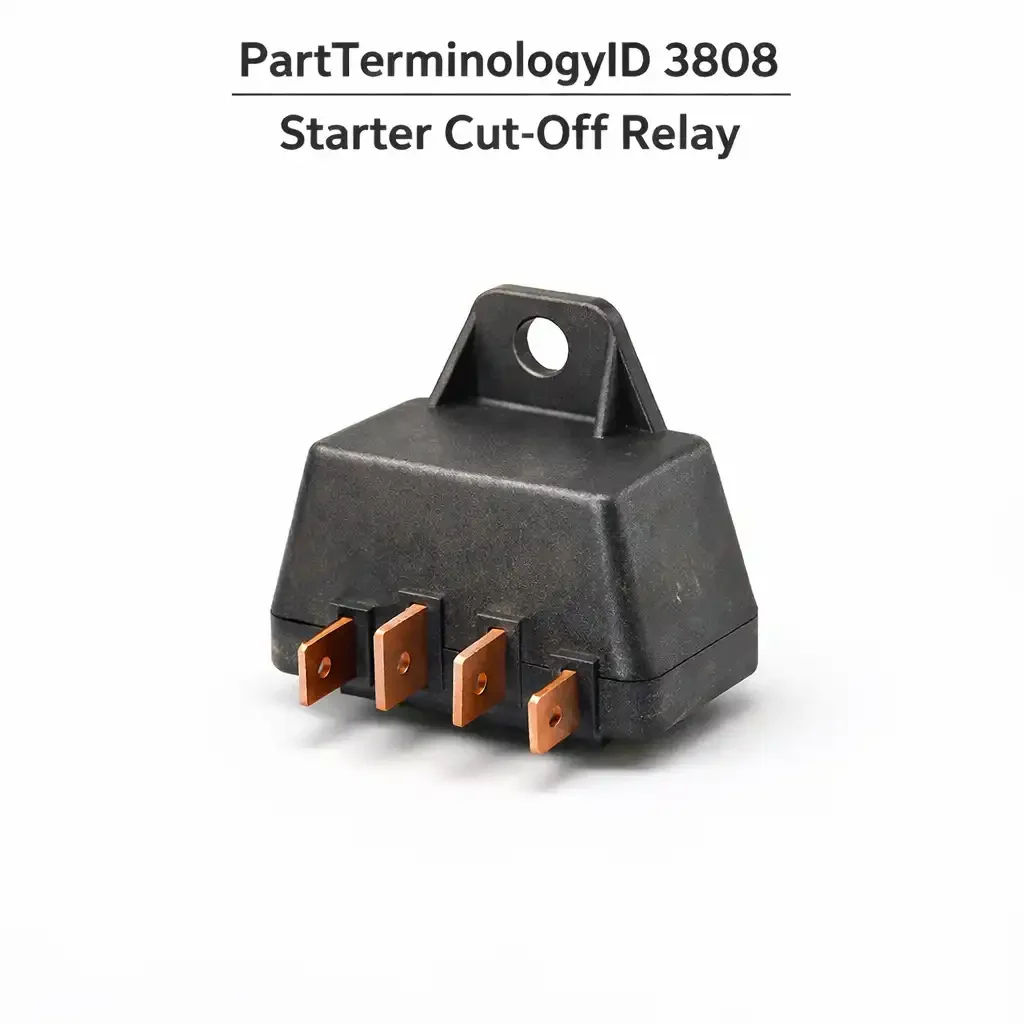
The Starter Cut-Off Relay, cataloged under PartTerminologyID 3808, is a normally-open relay wired in series with the starter control circuit whose contacts remain open unless the vehicle's security or immobilizer system authorizes an engine start. When the driver presents a valid transponder key, enters the correct security code, or disarms the factory alarm system, the security module closes the relay coil circuit, the relay contacts close, and the starter circuit is completed exactly as it would be on a vehicle with no security interruption. If the security system does not authorize a start because it has detected an unauthorized key, an alarm condition, or a fault in its own circuit, the relay remains open and the starter receives no control voltage regardless of what position the ignition switch is in. The relay is the hardware expression of the security system's veto over the starting circuit.
The Starter Cut-Off Relay is primarily associated with Honda and Acura factory security systems from the early 1990s onward, where it appears under the label "starter cut relay" in factory service manuals and wiring diagrams. The same function appears under different names across other manufacturers and in aftermarket alarm and immobilizer installations, but the Honda and Acura application is the most widely documented in the aftermarket catalog and the most common source of part inquiries. Understanding the relay's position in the security system architecture, and the multiple non-relay faults that produce an identical no-crank symptom on these platforms, is the foundation of accurate diagnosis and return prevention for this PartTerminologyID.
What the Relay Does
Position in the Starting and Security Circuit
On Honda and Acura platforms with the factory starter cut relay, the relay sits between the ignition switch start output and the starter solenoid control input, or between the park/neutral switch output and the solenoid input, depending on platform architecture. The relay coil receives its ground path through the security control module, or receives its power from the security module, with the exact wiring arrangement varying by model year and platform. The critical characteristic is that the security module must actively supply or complete the relay coil circuit for the relay to close. The relay is wired so that a de-energized coil means an open load circuit: the factory default state of the starting circuit on these platforms is non-functional unless the security system permits otherwise.
This architecture inverts the failure mode compared to a standard normally-open relay. A failed Starter Relay that loses its coil supply defaults the starting circuit to open, which is also a non-functional state, but the cause is a malfunction in the relay or its trigger circuit. A Starter Cut-Off Relay in a security-equipped vehicle that loses its coil supply may be doing exactly what it was designed to do: preventing an unauthorized start. Distinguishing between the relay failing to close because of a security system authorization failure and the relay failing to close because of a relay component failure requires observing the security system's indicator behavior before any relay is ordered.
The Security System Indicator as a Diagnostic Gate
On Honda and Acura platforms, the immobilizer indicator light, commonly shown as a green key symbol on the instrument cluster, provides the first and most important diagnostic information when a no-crank condition is encountered. When the driver inserts a recognized and valid transponder key and turns the ignition to on, the green key light illuminates briefly and then extinguishes, indicating that the immobilizer has recognized the key and will authorize engine starting. If the key is not recognized, the green key light flashes continuously or does not follow the normal illuminate-then-extinguish pattern, and the immobilizer is actively preventing the starter cut relay from closing. Replacing the relay in this state does nothing because the relay is functioning correctly.
A no-crank condition with the green key light following its normal pattern indicates that the immobilizer has authorized starting but the starting circuit has still not completed. This is the scenario where the starter cut relay, its wiring, the clutch or park/neutral switch, or other starting circuit components may be the fault. The green key indicator's behavior is the diagnostic gate that separates immobilizer system faults from relay and starting circuit faults.
Aftermarket Alarm System Interaction
A substantial share of no-crank complaints associated with the Starter Cut-Off Relay on Honda and Acura platforms involve aftermarket alarm or immobilizer systems that were installed into the factory starter cut relay circuit. Aftermarket systems commonly splice their immobilizer relay into the same circuit segment where the factory starter cut relay operates, inserting an additional interruption point that requires both the factory security authorization and the aftermarket system's authorization before the starting circuit is complete.
When an aftermarket alarm system fails, is incorrectly removed, or has wiring that develops an open circuit fault, the result is a permanent open in the starter circuit at the point where the aftermarket relay was spliced. The vehicle will not crank regardless of key validity or ignition switch position. The factory starter cut relay may be functioning correctly, and the immobilizer may have authorized starting, but the aftermarket circuit interruption prevents the solenoid from receiving any signal. A vehicle with a removed, disconnected, or failed aftermarket alarm system that suddenly presents a no-crank condition almost certainly has an open circuit where the aftermarket relay wiring was connected, not a failed factory relay.
Platform Breadth Beyond Honda and Acura
The Starter Cut-Off Relay function is not exclusive to Honda and Acura platforms. Factory security systems on Toyota and Lexus vehicles implement an equivalent starter disable relay in some applications. European manufacturers, including BMW and Mercedes-Benz, integrated starter cut functions into their factory immobilizer systems at various points in their model histories. The function also appears in factory alarm-equipped Japanese domestic market vehicles from the late 1980s onward that were imported as used vehicles. The ACES fitment data must be built from factory service manual confirmation of relay presence and circuit architecture for each platform, not extrapolated from the presence of a security system in general, since many security systems disable the fuel injection circuit or the ignition circuit rather than the starter circuit.
Top Return Scenarios
Security System Fault Misidentified as Relay Failure
The most common return scenario for this PartTerminologyID is a buyer whose security system has failed to authorize starting, who orders and installs a new starter cut relay, and finds the no-crank unchanged because the relay was never the problem. The relay was open because the security module did not supply the coil trigger, and a new relay that also receives no coil trigger remains open for the same reason.
On Honda and Acura platforms, this scenario is identifiable before any part is ordered by observing the green key immobilizer indicator. A flashing or abnormal green key pattern with ignition on confirms that the immobilizer is actively inhibiting start authorization and that no starting circuit component replacement will restore cranking until the immobilizer fault is resolved. The immobilizer fault may be a failed transponder chip in the key, a failed antenna ring around the ignition cylinder, a failed immobilizer control unit, or on later platforms, a communication fault between the immobilizer and the ECM or MICU. None of these faults are addressed by replacing the starter cut relay.
Failed or Removed Aftermarket Alarm Leaving Open Circuit
The second most common return scenario involves a vehicle where an aftermarket alarm system was previously installed into the starter circuit and has subsequently failed, been improperly removed, or developed an open in its wiring. The buyer experiences a sudden no-crank, identifies the starter cut relay in the circuit through forum research, orders the factory relay, installs it, and finds no change because the open circuit is in the aftermarket alarm wiring spliced adjacent to the factory relay socket, not in the relay itself.
Diagnosis requires tracing the starter control circuit through every point between the park/neutral switch or clutch switch output and the starter solenoid control input, including any junction points or splice locations where aftermarket wiring joins the factory circuit. Evidence of an aftermarket system, including non-factory wire splices in the dash or under-hood harness, surface-mounted LEDs on the dash or A-pillar, a flashing indicator that is not part of the factory instrument cluster, or an antenna module attached to the ignition cylinder, should be documented and the aftermarket circuit should be confirmed functional or removed before any factory relay is ordered.
Clutch Switch or Park/Neutral Switch Fault Misidentified as Relay Failure
On manual transmission Honda and Acura platforms, the clutch pedal switch must be fully depressed for the starting circuit to be authorized. The clutch switch is in series with the starter cut relay circuit on many of these platforms, meaning that a failed clutch switch produces exactly the same symptom as a failed starter cut relay: no-crank with no response. The clutch switch on high-mileage vehicles can fail at the switch itself, at the rubber bumper that contacts the switch plunger, or at the connector. On some platforms, the switch also activates the cruise control cancel function and the push-to-defog feature on vehicles so equipped, meaning a buyer can cross-check clutch switch function by observing whether those features respond to pedal actuation.
On automatic transmission platforms, the park/neutral switch or transmission range sensor performs the equivalent interlock function. A misadjusted or failed switch that does not confirm park or neutral position prevents the relay coil from being grounded and the relay from closing. The test is to shift between park and neutral while holding the key in the start position: if the engine cranks in one position but not the other, or cranks when the shifter is slightly off its detent, the switch or its adjustment is the fault.
Rare Relay Failure After Confirming All Upstream Authorizations
Genuine relay failure in the Starter Cut-Off Relay is less common than in the standard Starter Relay because the cut relay's coil is energized only briefly during each start event, rather than during cranking, and its contacts carry only the low-current starter control signal rather than any substantial load current. When all upstream authorizations have been confirmed, including valid key recognition confirmed by normal immobilizer indicator behavior, clutch or park/neutral switch confirmed functional, and aftermarket circuit interruption confirmed absent, a relay that does not close is a valid fault candidate. On Honda and Acura platforms, the relay swap test using a matching relay from another position in the fuse block is the fastest confirmation. The factory service manual identifies which relays in the underdash fuse block share the same format and rating as the starter cut relay.
Listing Requirements
Every listing for PartTerminologyID 3808 should include:
ACES fitment data built from factory service manual confirmation of relay presence and circuit architecture, not assumed from security system presence alone
A clear explanation that the relay is normally open and requires security system authorization to close, distinguishing it from the standard Starter Relay
A description of the immobilizer indicator behavior as the first diagnostic checkpoint on Honda and Acura platforms, with a specific note that abnormal indicator behavior confirms the relay is functioning correctly and the fault is in the immobilizer system
A note addressing aftermarket alarm system interaction and the diagnostic process when non-factory wiring is present in the circuit
A note that clutch switch and park/neutral switch faults produce an identical no-crank symptom and must be evaluated before the relay is ordered
Frequently Asked Questions
My car won't crank and the green key light on the dash is flashing. Is this the starter cut relay?
No. A flashing green key indicator on the instrument cluster means the immobilizer system has not recognized the key as valid and is actively preventing the starter circuit from operating. The starter cut relay is functioning correctly in this scenario: it is open because it is supposed to be open when an unauthorized key is presented. Replacing the relay will not restore cranking. The most common causes of an unrecognized key are a failed transponder chip inside the key, a failed antenna ring around the ignition cylinder that cannot read the transponder signal, heavy metal objects or other keys on the same key ring that interfere with the transponder reading, or a failed immobilizer control unit. Start by trying the spare key with no other keys or metal objects on the key ring.
My green key indicator looks normal, it comes on briefly and goes out, but the car still won't crank. Is this the relay?
Normal immobilizer indicator behavior confirms that the immobilizer has authorized starting, which is a necessary precondition for evaluating the starter cut relay. With immobilizer authorization confirmed, the next steps are: verify the clutch pedal switch on manual transmission vehicles by checking whether fully depressing the clutch produces any change in cranking response; verify the park/neutral switch on automatic vehicles by shifting between park and neutral while holding the key in start; and confirm that no aftermarket alarm wiring is introducing an open circuit in the starter control path. If all of these are confirmed normal, perform the relay swap test using a matching relay from another position in the fuse block.
I removed an aftermarket alarm from my car and now it won't crank. Is the starter cut relay bad?
Almost certainly not. When an aftermarket alarm system is removed, the wires it was spliced into must be reconnected to restore circuit continuity. An aftermarket immobilizer typically inserts itself into the starter circuit by cutting one of the starter control wires and connecting both cut ends to its relay output. When the alarm module is removed without reconnecting those wires, the circuit remains open at the splice points and no signal can reach the starter solenoid. Locate the splice points in the starter control wiring where the aftermarket system was connected, confirm that they are no longer bridged by any relay or module output, and bridge them with a direct connection to restore the original circuit. The factory starter cut relay may need to be reinstalled in its socket if it was removed during the alarm installation.
I have a Honda Civic from the mid-1990s and cannot find the starter cut relay at the parts store. Where is it and what is it called?
The starter cut relay on these platforms is located in the underdash fuse and relay box on the driver's side. Factory parts catalogs may list it by a Honda-specific part number rather than by the descriptor "starter cut relay." Because the relay shares its physical format with other relays in the same underdash fuse block, including the A/C condenser fan relay and A/C compressor relay on many applications, the relay swap test is available as a free first diagnostic step: pull the suspected relay and swap it with a matching relay from another position to determine whether the relay is the fault. If an aftermarket equivalent is being purchased, confirm that the terminal configuration, coil resistance, and contact rating match the original before ordering.
What Sellers Get Wrong
Not separating security system faults from relay faults
The Starter Cut-Off Relay and the security system that controls it produce the same external symptom when either fails: no-crank. A listing that does not explain the immobilizer indicator test as the primary diagnostic separator will attract orders from buyers whose security system is the actual fault. These buyers install a new relay into a circuit where the security module is still not supplying the coil trigger, find no change, and return the relay. The immobilizer indicator test is free, takes under thirty seconds, and conclusively separates these two fault categories. It must be described in the listing.
Not addressing aftermarket alarm interaction
A significant fraction of no-crank complaints on Honda and Acura platforms that involve research into the starter cut relay originate from vehicles with aftermarket alarm systems. These buyers are frequently in one of two situations: the aftermarket system is still present and has failed, leaving an open circuit in the relay path, or the aftermarket system was removed and the wiring splice was not restored. In both cases, the factory relay is not the fault. A listing that does not acknowledge the aftermarket alarm scenario misses the most common non-relay cause of Starter Cut-Off Relay research.
Treating this relay as equivalent to the standard Starter Relay
The Starter Cut-Off Relay and the standard Starter Relay occupy adjacent positions in the starting circuit and share the same no-crank symptom when they fail, but they fail for different reasons and require different diagnostic approaches. The standard Starter Relay fails when its coil trigger is absent due to ignition switch wear, neutral safety switch failure, or PCM command failure. The Starter Cut-Off Relay fails to close primarily when the security system does not authorize a start, not when the relay itself is faulty. Conflating the two in listing content or application data produces misdirected orders from buyers on standard Starter Relay platforms who order a Starter Cut-Off Relay, and from buyers on Starter Cut-Off Relay platforms who follow a standard Starter Relay diagnostic approach and miss the security system entirely.
Building application data from security system presence rather than starter cut relay presence
Not all vehicles with factory security systems implement that security through a discrete Starter Cut-Off Relay. Many factory security systems disable the fuel injection system, interrupt the ignition system, or communicate directly with the PCM to prevent starting without any discrete relay in the starter circuit. The ACES fitment data for this PartTerminologyID must be confirmed against factory wiring diagrams for each application. Including platforms where the security system does not use a discrete starter cut relay generates orders that cannot be filled with this component.
Cross-Sell Logic
Transponder key (the most common cause of an unauthorized key condition on Honda and Acura platforms; a failed transponder chip inside the key produces the immobilizer no-authorize symptom that leaves the relay correctly open; a new key requires programming to the vehicle's immobilizer system)
Ignition cylinder antenna ring or immobilizer receiver (the component that reads the transponder chip signal from the key; a failed antenna ring cannot communicate the key's identity to the immobilizer control unit and produces the same unauthorized key symptom as a failed transponder chip)
Clutch pedal switch on manual transmission applications (in series with the starter cut relay circuit on many Honda and Acura manual transmission platforms; a failed switch produces no-crank identical to a failed relay and should be confirmed functional before the relay is ordered)
Park/neutral switch or transmission range sensor on automatic transmission applications (the automatic transmission equivalent of the clutch switch in the relay authorization path; a misadjusted or failed switch prevents relay coil circuit completion)
Starter relay, PartTerminologyID 3804 (the relay immediately downstream in the starting circuit on some platform architectures; on platforms where both a starter cut relay and a starter relay are present, either can produce no-crank and both must be evaluated)
Factory alarm system control module (the security module that supplies the relay coil trigger; a failed module does not authorize starting regardless of key validity; replacement typically requires immobilizer system programming at a dealer or with manufacturer-specific diagnostic software)
Final Take
PartTerminologyID 3808 has a higher proportion of incorrect orders than almost any other relay category in the starting circuit, primarily because it is researched by buyers who have identified it in a Honda or Acura wiring diagram without first confirming whether the no-crank is caused by the security system or by a relay or wiring fault. The relay is doing its job correctly in the majority of cases where buyers reach this part number. The listing content that eliminates returns here is the content that makes the immobilizer indicator test the visible first step, before the part is ordered, and that explicitly names the aftermarket alarm open-circuit scenario as the second most common cause of research into this relay.
A buyer who has confirmed normal immobilizer indicator behavior, ruled out the clutch or park/neutral switch, confirmed no open-circuit legacy from an aftermarket alarm installation, and found no coil trigger reaching the relay socket during a start attempt has made a thorough diagnosis and is ordering the correct part. That buyer will have a successful repair. The listing that produces that outcome consistently is the listing that earns the platform's trust.