
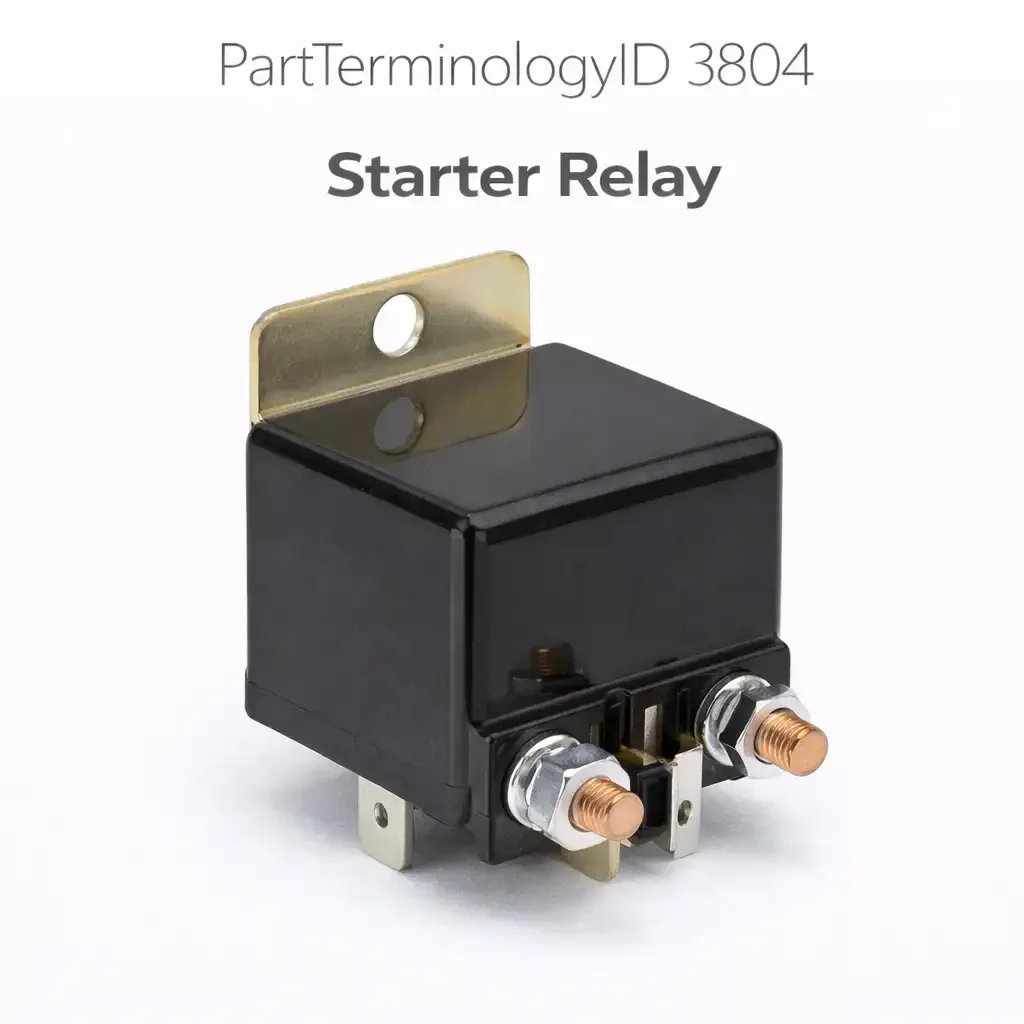
The Starter Relay, cataloged under PartTerminologyID 3804, is the electromechanical relay that closes the control circuit to the starter solenoid when the driver commands engine cranking. When the ignition key is turned to the start position, or when the start button is pressed on a push-button ignition vehicle, the relay coil receives a trigger signal, the relay contacts close, and voltage is delivered from the relay's load terminal to the starter solenoid's control input. The solenoid then closes the high-current main circuit between the battery and the starter motor while simultaneously engaging the pinion gear with the flywheel ring gear. The Starter Relay's job ends at the solenoid input: it delivers the trigger signal, and the solenoid does the mechanical and high-current work from that point forward.
The relay exists in the starting circuit for the same reason relays exist in any high-current automotive circuit: to allow a low-current switch, in this case the ignition switch or the PCM output, to control a load circuit that would otherwise require heavy-gauge wiring routed to the driver's position or would expose sensitive electronics to transient current spikes. A starter solenoid's control coil draws several amps to close. Routing that current through an ignition switch, a transmission range switch, a clutch switch, a brake switch interlock, and back through the PCM is practical only because the relay handles current amplification between the command side and the load side. The relay is small, inexpensive, and located in the underhood fuse block where it is exposed to heat cycles, vibration, and moisture over the vehicle's service life.
What the Relay Does
Circuit Position in the Starting System
The Starter Relay occupies the control-circuit layer of the starting system, positioned between the devices that authorize a crank event and the starter solenoid that executes it. On a simple early-generation circuit, the relay coil receives its trigger from the ignition switch start output, and the coil ground path runs through the neutral safety switch on automatic transmission vehicles or the clutch switch on manual transmission vehicles. If either interlock is open, the coil cannot complete its ground circuit and the relay does not close, regardless of the ignition switch position.
On modern vehicles, the circuit is more complex. The ignition switch sends a start-position signal to the Body Control Module. The BCM evaluates the signal and passes a crank request to the Powertrain Control Module. The PCM checks the transmission range sensor for a valid park or neutral indication, confirms the brake pedal or clutch pedal interlock is satisfied, checks for diagnostic trouble codes that would inhibit starting, and then supplies the ground or the voltage to the relay coil control circuit if all conditions are met. The relay closes, delivers voltage to the starter solenoid, and cranking begins. This architecture means that a no-crank condition on a modern vehicle may originate from a failed or miscommunicating module, a failed transmission range sensor, a brake pedal switch fault, or a diagnostic code that has placed the PCM in a crank-inhibit state, all upstream of the relay itself.
Relay Location and Format
On the vast majority of production vehicles from the mid-1980s onward, the Starter Relay is a standard ISO mini or micro format relay plugged into the underhood fuse and relay center. It occupies a labeled position in the fuse block, typically identified as STARTER, STRTR, CRANK, or ST in the fuse block legend. On some platforms, particularly older domestic vehicles, the starter relay is a fender-mounted unit with blade terminals rather than a fuse-block plug-in relay. The fender-mounted relay was common on Chrysler and Mopar applications through much of the 1980s before the fuse-block plug-in relay format became universal. The format distinction matters for application data because a fender-mounted relay and a fuse-block relay for the same circuit function are not interchangeable and represent different part numbers.
What the Relay Does Not Do
The Starter Relay does not engage the pinion gear with the flywheel. That is the mechanical function of the starter solenoid plunger. The Starter Relay does not close the main high-current circuit between the battery and the starter motor. That is the function of the starter solenoid's heavy contacts. The Starter Relay does not perform any engine management function after the crank event begins. Once cranking starts, the PCM or ignition module takes over firing the injectors and ignition, and the relay's role is complete until the next start event. A relay that is functioning correctly cannot compensate for a weak battery, corroded battery cables, a failed starter motor, a seized engine, or a starter solenoid with burned main contacts. All of those faults will produce a no-crank or slow-crank symptom regardless of relay condition.
Top Return Scenarios
Battery and Cable Faults Misidentified as Relay Failure
The single most common cause of Starter Relay returns is a battery or cable fault that was misidentified as a relay fault before the battery and cables were properly tested. A battery with marginal cranking reserve that drops below approximately 9.6 volts under load cannot supply adequate voltage to the starter solenoid even if the relay closes correctly. The relay closes, the solenoid receives its trigger, but if the battery cannot sustain voltage through the solenoid's coil, the solenoid chatters or fails to close fully, and the engine does not crank. The symptom is a rapid clicking from the solenoid or no response from the starter, identical to the symptom pattern of a failed relay.
The test that separates battery and cable failure from relay failure is voltage measurement at the relay's load output terminal during a crank attempt, not voltage measurement at the battery at rest. A battery that reads 12.4 volts at rest but collapses to 8 volts under load will allow the relay contacts to close but will not support the solenoid. If voltage at the relay output is present and within one volt of battery voltage during the crank attempt, the relay is delivering what the battery has available and the fault is the battery or its cables, not the relay. Battery load testing is the mandatory prerequisite for any starter relay diagnosis.
Starter Solenoid Failure Misidentified as Relay Failure
The next most common return scenario involves a failed starter solenoid that was misidentified as a failed relay. The starter solenoid and the Starter Relay are both in the starting circuit, but they occupy different positions and produce distinguishable symptoms when they fail. A failed relay produces silence: no click from the relay, no response from the solenoid, no crank attempt. A failed solenoid typically produces a single solid click from the starter area, or rapid clicking if the solenoid coil receives power but its main contacts are burned and cannot complete the high-current circuit.
The relay swap test is the fastest way to isolate relay failure from solenoid failure. If the Starter Relay occupies an ISO mini relay position shared by other relays of the same type in the fuse block, swapping the relay with an identified match from another circuit (such as the horn relay or the A/C compressor relay) costs nothing and takes under a minute. If the symptom changes when the swap is made, the original relay is the fault. If the symptom is unchanged, the relay is not the fault. A buyer who performs this test before ordering avoids the return if the relay is not the problem.
PCM or BCM Fault on Modern Vehicles Misidentified as Relay Failure
On modern vehicles where the PCM or BCM controls the relay coil ground or relay coil power, a no-crank condition can exist while the relay itself is functioning. The most reliable way to diagnose a modern starting circuit is with a scan tool that can read starter relay position under live data and display the BCM's interpretation of the ignition switch start position signal. If the scan tool shows that the PCM is not commanding the relay despite a valid start request, the fault is in the command side of the circuit: the ignition switch signal, the BCM communication, the transmission range sensor, or a DTC preventing engine start. Replacing the relay in this scenario does nothing because the relay is never triggered.
A buyer who identifies a no-crank condition on a modern vehicle, replaces the relay without scan tool diagnosis, finds the condition unchanged, and then diagnoses the actual fault as a failed transmission range sensor or a stuck BCM has purchased a relay they did not need. Listing content that directs buyers toward scan tool diagnosis before ordering on modern platforms prevents this return category.
Welded Relay Contacts Requiring Immediate Diagnosis
The opposite failure mode from a relay that will not close is a relay whose contacts have welded shut. A relay with welded contacts delivers constant voltage to the starter solenoid, causing the starter to remain engaged after the engine has started. The symptom is a grinding noise from the starter area as the pinion gear remains in mesh with the flywheel ring gear while the engine is running at idle speed. This condition causes rapid damage to the starter motor, the flywheel ring gear, and the pinion gear. It must be addressed immediately.
A welded relay is not always the cause of a starter that remains engaged after engine start. The ignition switch may be failing to return fully from start to run, maintaining the trigger signal to the relay. The transmission range switch can fail in a position that maintains the relay ground path. On PCM-controlled systems, a software fault can hold the relay command active. The relay should be removed first, as it is the most accessible component in the circuit, but the trigger circuit must be confirmed open before a new relay is installed if welded contacts are found.
Ignition Switch Failure Producing No Trigger to Relay Coil
The trigger voltage to the relay coil originates at the ignition switch start output. A worn ignition switch whose start position contacts have burned or corroded delivers no trigger to the relay, and the relay does not close regardless of its own condition. On vehicles where the starter motor, the battery, and the neutral safety switch or clutch switch have all been confirmed functional by other tests, an absent trigger voltage at the relay coil terminal during a crank attempt points to the ignition switch as the fault location.
A worn ignition switch start contact is a common failure on high-mileage vehicles, particularly on platforms known for ignition switch wear. The symptom is typically intermittent before it becomes consistent: the engine cranks on the first key turn sometimes, fails on others, and eventually stops cranking reliably. A buyer who orders a Starter Relay for this symptom pattern without first confirming trigger voltage at the relay coil will install the relay and find the intermittent no-crank unchanged.
Listing Requirements
Every listing for PartTerminologyID 3804 should include:
ACES fitment data that correctly distinguishes fender-mounted relay formats from fuse-block plug-in relay formats for platforms that used both across model years
A clear description of the relay's position in the starting circuit, distinguishing it from the starter solenoid and from the starter motor itself
A note that battery load testing and cable condition verification are mandatory prerequisites before any relay is ordered on a no-crank complaint
An explanation of the relay swap test for fuse-block applications, identifying it as a zero-cost first step before purchasing a replacement
A note that scan tool diagnosis is required for modern PCM-controlled starting circuits before any component is ordered
A note distinguishing the symptom of a failed relay that will not close (silence, no click at relay or solenoid) from a failed solenoid with burned contacts (single click from starter area, no crank)
Frequently Asked Questions
My engine makes a single click when I turn the key but won't crank. Is this the starter relay?
A single solid click from the starter area almost always indicates the starter solenoid is receiving the trigger signal and closing its coil but cannot close its main heavy-duty contacts, or the starter motor itself has an internal fault. If the Starter Relay had failed, the solenoid would receive no trigger and produce no click at all. The single-click symptom points toward the starter solenoid contacts, the starter motor brushes or armature, or a very weak battery that allows the solenoid coil to energize briefly but cannot sustain voltage through the main contacts. Check battery load capacity under crank conditions and inspect the large battery cables at both ends before replacing any component.
I hear rapid clicking from under the hood when I turn the key. Is the relay failing?
Rapid clicking from the underhood fuse block area may indicate a relay that is cycling on and off as the battery voltage collapses and recovers under the load of each crank attempt. This pattern is almost always a battery or cable fault rather than a relay fault. The battery's terminal voltage is dropping below the relay coil's minimum pull-in voltage with each crank attempt, the relay drops out, voltage briefly recovers, the relay closes again, and the cycle repeats. Battery load testing will confirm whether the battery can sustain voltage under cranking load. Rapid clicking from the starter area, rather than the fuse block, typically indicates a similar condition at the solenoid level.
How do I test the starter relay without a multimeter?
The relay swap test requires no tools and takes under one minute on most vehicles. Locate the Starter Relay in the underhood fuse block using the fuse block legend. Identify another relay in the same fuse block that matches the Starter Relay's terminal configuration and amperage rating, typically the horn relay or the A/C compressor relay. Pull the Starter Relay out of its socket and insert the other relay in its place, and insert the Starter Relay in the other relay's position. Attempt to start the vehicle. If the engine now cranks, the original Starter Relay is the fault. If the engine still does not crank, the relay is not the fault and the diagnosis should continue elsewhere. Return both relays to their original positions if the test does not implicate the relay.
My engine won't stop cranking after it starts. Is this the relay?
A starter that remains engaged after the engine fires is a serious condition that requires immediate attention to prevent damage to the starter and flywheel. The most likely causes in sequence are: a relay with welded contacts that cannot open when the trigger signal drops; an ignition switch that is not returning fully from start to run, maintaining the trigger signal; and on PCM-controlled systems, a software or sensor fault holding the relay command active. Pull the Starter Relay immediately if this symptom occurs. If removing the relay stops the starter, the relay's contacts are welded and the relay must be replaced. If removing the relay does not stop the starter, the solenoid itself has welded contacts and must be addressed separately from the relay.
What Sellers Get Wrong
Not separating relay failure symptoms from solenoid failure symptoms
The Starter Relay and the starter solenoid are both in the starting circuit and are frequently confused with each other. A listing that does not distinguish their symptom patterns will attract orders from buyers whose solenoid is the actual fault. Silence and no relay click point to the relay or its trigger circuit. A single click from the starter area with no crank points to the solenoid or the battery. This distinction is the foundation of correct diagnosis and must be present in the listing content.
Not addressing the relay swap test
For the majority of applications where the Starter Relay is a plug-in ISO format relay in the fuse block, the relay swap test is a free, tool-free, immediate diagnostic step. A listing that does not mention this test fails to give the buyer the most useful piece of diagnostic information available. A buyer who performs the relay swap test before ordering either confirms that the relay is the fault, in which case the purchase is correct, or discovers that the relay is not the fault, in which case the listing has saved itself a return.
Not addressing battery and cable prerequisites
The battery and its cables are implicated in a substantial fraction of no-crank complaints that result in relay returns. A listing that does not direct buyers to verify battery load capacity and cable integrity before ordering creates a return path for every buyer with a marginal battery who installs a new relay and finds the no-crank unchanged. Battery load testing is widely available at no cost at auto parts retail locations and is a reasonable prerequisite to communicate in any starting circuit listing.
Treating all model years identically without addressing PCM-controlled circuit complexity
A listing built around the simple ignition-switch-to-relay-to-solenoid circuit architecture of older vehicles fails buyers on modern platforms where the PCM mediates every crank event. On modern vehicles, relay replacement without scan tool diagnosis is a guess. A listing that acknowledges this distinction and directs modern-vehicle buyers toward scan tool diagnosis before ordering demonstrates an understanding of the actual diagnostic process and reduces returns from buyers on PCM-controlled platforms.
Cross-Sell Logic
Starter motor (the downstream load component that the relay ultimately supplies through the solenoid; worn brushes, failed armature windings, or seized bearings produce no-crank or slow-crank symptoms that survive correct relay operation; should be tested after relay and solenoid are confirmed functional)
Starter solenoid (the immediate downstream component that receives the relay's output; burned solenoid contacts produce a single-click no-crank symptom that is frequently confused with relay failure; on most modern vehicles the solenoid is integral to the starter assembly and is replaced as a unit)
Neutral safety switch or transmission range sensor (the interlock component that provides the relay coil ground path on older vehicles or supplies the PCM with park/neutral confirmation on modern vehicles; a failed or misadjusted switch prevents the relay from closing on every crank attempt regardless of relay condition)
Clutch switch or clutch pedal position sensor on manual transmission applications (the manual transmission equivalent of the neutral safety switch in the relay trigger path; a failed clutch switch prevents the relay coil circuit from completing)
Ignition switch (the source of the relay coil trigger signal; worn start-position contacts in the ignition switch produce the same absent-trigger symptom as a failed relay and must be tested when trigger voltage is absent at the relay coil terminal during a crank attempt)
Battery (the foundational prerequisite for any starting system diagnosis; a battery that cannot sustain cranking voltage produces symptoms that traverse the entire starting circuit and cannot be resolved by any relay, solenoid, or starter motor replacement)
Final Take
PartTerminologyID 3804 is the most widely applicable and most frequently over-ordered relay in the starting system. It is over-ordered because the no-crank symptom it is associated with has many causes, most of which are upstream or downstream of the relay, and because the relay is inexpensive enough that buyers often order it speculatively rather than diagnostically. The listing content that prevents returns here is the content that puts battery testing and the relay swap test in front of the buyer before the add-to-cart decision. Neither test requires tools beyond what most buyers already have or can access for free, and both tests deliver a definitive answer about whether the relay is the actual fault.
The modern PCM-controlled starting circuit is the second major return driver for this PartTerminologyID. On any vehicle built after roughly 2000, the relay is the last component that should be ordered without scan tool confirmation that the PCM is attempting to command it. A PCM that is not sending the relay trigger because of a transmission range sensor fault, a brake pedal switch input error, or a crank-inhibit diagnostic code will not begin commanding the relay after a new relay is installed. That buyer will return the relay and remain stranded until the correct diagnosis is made. The listing that redirects modern-platform buyers toward scan tool diagnosis before purchasing is the listing that earns that buyer's confidence regardless of which component turns out to be the actual fault.