
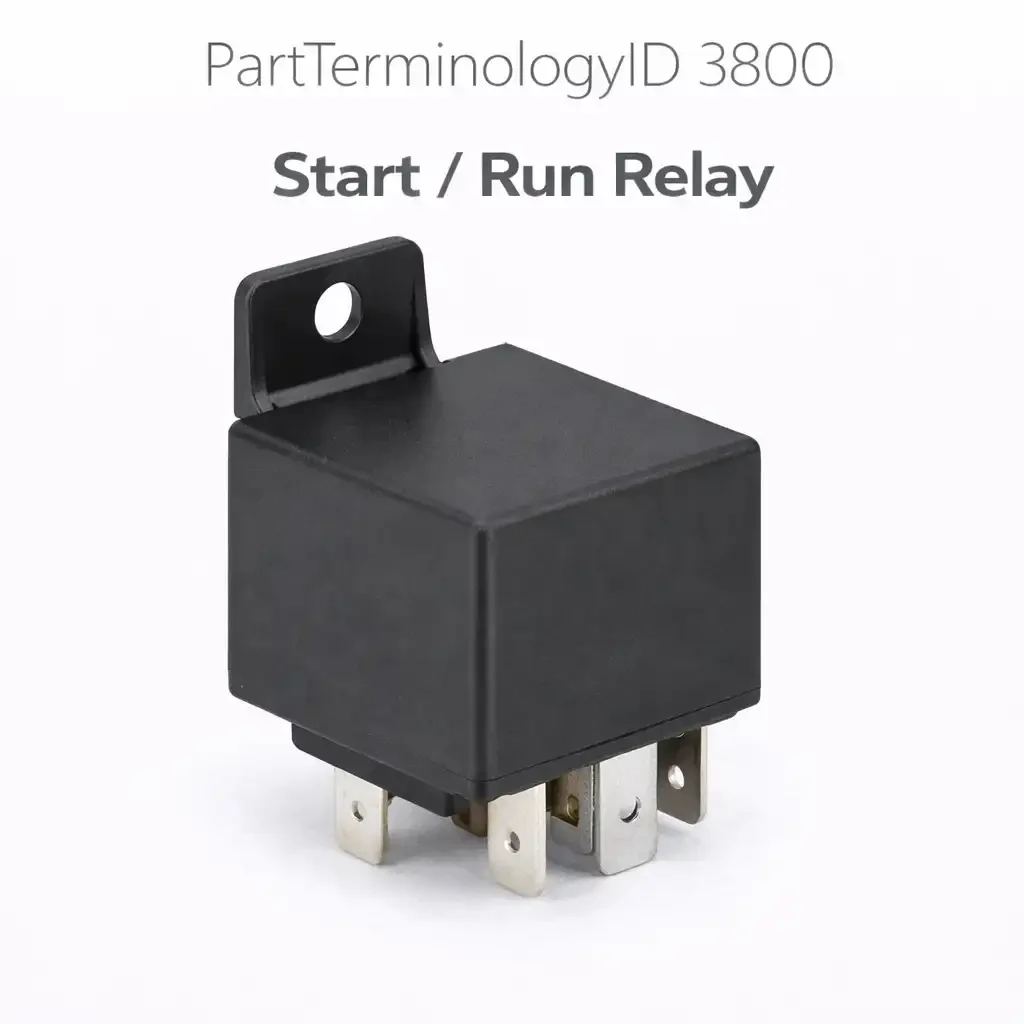
The Start / Run Relay, cataloged under PartTerminologyID 3800, is the relay that switches the ignition coil's primary supply voltage between two circuit states: during cranking, it delivers full battery voltage directly to the ignition coil positive terminal, bypassing the ballast resistor that limits coil voltage during normal run operation. Once the engine starts and the ignition key returns from the start position to the run position, the relay opens its bypass contact, and the coil operates through the ballast resistor at reduced voltage for the remainder of the drive cycle. The relay's function is to ensure the ignition coil produces the strongest possible spark during the period when it is needed most — cranking — when battery voltage is already depressed by the starter's massive current draw.
The Start / Run Relay addresses a fundamental voltage problem in the ballast-resistor ignition systems used on domestic vehicles from the mid-1950s through the early 1980s. Under normal cranking conditions, the starter motor draws several hundred amperes from the battery, collapsing the battery's terminal voltage from approximately 12.6 volts at rest to as low as 9 to 10 volts during cranking. An ignition coil operating through a ballast resistor under these conditions may receive only 4 to 6 volts at its primary terminal, which is insufficient to produce a reliable spark. The Start / Run Relay closes a direct path from the battery supply to the coil positive terminal during cranking, bypassing the ballast resistor and delivering the full available cranking voltage to the coil. The improvement in spark energy at the worst possible moment — a cold start, a flooded condition, or a weak battery — is significant enough that all major domestic manufacturers incorporated this bypass function into their ignition system designs, though the specific hardware implementing it varied between manufacturers and platforms.
What the Relay Does
The Ballast Resistor System Context
To understand the Start / Run Relay, it is necessary to understand the ignition system architecture it operates within. From the mid-1950s onward, domestic manufacturers used a ballast resistor wired in series between the ignition switch run output and the ignition coil positive terminal. The resistor, typically presenting one to two ohms of resistance, drops the coil's operating voltage from the charging system's 13.5 to 14.5 volts down to approximately 7 to 9 volts during normal run operation. This reduced voltage extends ignition coil life, protects the ignition module or breaker points from excessive current, and keeps the ignition system operating within its design parameters throughout the coil's service life.
The same resistor that protects the coil during run operation creates a problem during cranking. Cranking voltage at the battery may be only 9 to 10 volts under good conditions and as low as 7 to 8 volts on a marginal battery or in cold weather. Passing that already-reduced voltage through a 1 to 2 ohm ballast resistor under load may deliver as little as 4 to 6 volts to the coil positive terminal. A coil at 5 volts produces a substantially weaker spark than a coil at 9 volts, and a weak spark during cranking is the difference between an engine that starts readily and one that cranks for many seconds before catching, or does not start at all.
The Bypass Circuit Operation
The Start / Run Relay closes a direct path from a battery-voltage supply to the coil positive terminal while the ignition switch is in the start position. The relay coil receives its trigger from the ignition switch start output, the same signal that energizes the starter motor circuit. When the driver turns the key to start, the relay coil is energized, the relay contacts close, and the coil positive terminal receives battery voltage directly, bypassing the ballast resistor. The ballast resistor remains connected at its normal position in the run circuit but carries no meaningful current while the direct bypass path is closed.
When the key is released from start to run, the ignition switch start output drops to zero, the relay coil de-energizes, the bypass contacts open, and the coil is again supplied exclusively through the ballast resistor. The transition from start to run is momentary and occurs every time the engine is started. The driver does not interact with the relay directly at any point during normal operation.
Platform-Specific Bypass Implementations
The bypass function described above was implemented differently across manufacturers and chassis families, which creates significant complexity for application data. On Chrysler and Mopar platforms, the bypass function was built into the starter relay itself. The Mopar starter relay included an IGN2 terminal, connected to the ballast resistor's coil-side terminal through a brown wire, that received battery voltage whenever the relay contacts closed for cranking. No separate dedicated Start / Run Relay existed on these platforms; the bypass function was integral to the starter relay. On Ford platforms, the starter solenoid's "I" terminal provided the same function, supplying battery voltage back through a wire to the coil positive terminal during cranking through the solenoid's internal circuit. On GM platforms, the starter solenoid "R" terminal served the same role.
Dedicated external Start / Run Relays appear in several scenarios: on platforms where the OEM bypass circuit failed and a separate relay was added as a repair; on vehicles converted from points ignition to aftermarket electronic ignition where the installation instructions require a dedicated bypass relay for reliable cold starting; on later-model applications with separate ignition system architectures; and on some diesel applications where a start/run switching relay controls glow plug preheating circuits or other systems that must behave differently in start mode versus run mode. The ACES fitment data for PartTerminologyID 3800 must correctly distinguish between platforms where a discrete Start / Run Relay exists in the original circuit architecture and platforms where the bypass function is integrated into the starter relay or starter solenoid.
Symptom of Bypass Circuit Failure
The defining symptom of a failed Start / Run Relay or a failed bypass circuit is that the engine cranks but fires only weakly or not at all, or fires and immediately stalls when the key is released from start to run. The immediately-stall-on-key-release pattern is the most diagnostic symptom and deserves particular attention because it is highly specific. When the key is held in start, the bypass relay supplies full battery voltage to the coil, ignition fires, and the engine runs. The instant the key returns to run, the bypass relay opens and the coil supply is handed back to the ballast resistor. If the ballast resistor has also failed, or if the run-mode ignition supply wiring is open, the coil receives no voltage in run mode and the engine stalls immediately. A functioning engine that stalls every time the key leaves the start position points to a run-mode supply fault rather than a relay fault; a coil that receives insufficient voltage during cranking to fire reliably points to the bypass relay or bypass circuit as the fault.
Top Return Scenarios
Ballast Resistor Failure Misidentified as Relay Failure
The ballast resistor and the Start / Run Relay work in series at different points in the ignition primary circuit and can produce overlapping symptoms when they fail, but they fail in opposite directions and produce distinguishable patterns. A failed ballast resistor typically fails open, removing coil voltage in run mode and producing the starts-and-immediately-stalls-when-key-released symptom. The bypass relay is functioning correctly in this scenario, delivering full voltage during cranking, but the run-mode supply through the ballast resistor is absent, so the engine cannot continue running after the bypass closes.
A buyer who observes the starts-and-stalls symptom and attributes it to the relay rather than the ballast resistor will order the relay, install it, and find the symptom unchanged because the actual fault is the ballast resistor. The diagnostic separator is coil voltage measurement. Measure the voltage at the coil positive terminal with the ignition key in the run position and the engine not cranking. If voltage is near zero or well below the expected 6 to 9 volts for the application, the ballast resistor or the run-mode supply wiring is the fault. If voltage is in the correct range in run mode but the engine cranks weakly and starts poorly, the bypass relay is not delivering adequate voltage during cranking.
Ignition Switch Failure Producing Loss of Start Output
The relay coil trigger comes from the ignition switch's start output. A worn ignition switch with a degraded start position contact does not produce the trigger signal, and the relay never closes regardless of its condition. The symptom is identical to a failed relay: no bypass during cranking, reduced coil voltage, hard starting or no-start. On vehicles where the start output is also the trigger for the starter circuit, a failed ignition switch start contact typically produces no-crank as well as no relay trigger, making the starting system completely unresponsive. On platforms where the relay trigger comes from a separate ignition switch terminal than the starter circuit trigger, the starter may crank normally while the relay fails to close.
Measuring trigger voltage at the relay coil terminal while holding the ignition in start distinguishes between a failed switch output and a failed relay. If trigger voltage is present and the relay does not close, the relay is the fault. If trigger voltage is absent, the ignition switch, the wiring between the switch and the relay coil, or an interlock in the start circuit is the fault location.
Stale Ballast Bypass Wire Fault on Classic Platforms
On Chrysler platforms that implement the bypass through the starter relay's IGN2 terminal, the brown bypass wire running between the starter relay and the ballast resistor's coil-side terminal is a wiring run that has been in service for decades on surviving vehicles. This wire passes through the bulkhead connector and may develop corrosion or breaks at the bulkhead terminal, at the ballast resistor connector, or at intermediate splice points. A broken or high-resistance brown wire produces the same hard-starting symptom as a failed bypass relay and must be traced through continuity testing before any relay or ballast is ordered.
The same principle applies to the Ford "I" terminal wire and the GM "R" terminal wire, which are equally aged on surviving vehicles. A buyer who identifies a bypass circuit failure on a classic platform should trace the bypass wiring from the starter relay or solenoid to the coil positive terminal before concluding that any component needs replacement. Wire resistance, broken conductors, and corroded bulkhead terminals are a far more common cause of bypass circuit failure on aging platforms than failed relay contacts.
Electronic Ignition Conversion Wiring Error
A significant share of buyers in this category are working on vehicles where the original points ignition has been replaced with an aftermarket electronic ignition system. Aftermarket electronic ignition instructions vary in how clearly they address the bypass circuit requirement. Some installations connect the coil supply only to the ballast resistor run output, effectively removing the bypass function from the circuit. An engine with this wiring error will be difficult to start from cold, will require extended cranking, and may not start at all on a weak battery or in extreme cold, while running normally once started.
A buyer who orders a Start / Run Relay to correct an aftermarket electronic ignition hard-start complaint may or may not have the relay as the correct solution, depending on whether a relay socket already exists in the application. If the original vehicle had a dedicated bypass relay socket, restoring the relay to it corrects the installation error. If the original platform implemented the bypass through the starter relay or solenoid and no bypass wire was included in the aftermarket ignition installation, the correct repair is to add the bypass wire from the starter solenoid or relay to the coil positive terminal, rather than adding a new dedicated relay that the circuit was not originally designed to accommodate.
Low Battery or Starter Fault Producing Inadequate Cranking Voltage
A failing battery that collapses to 7 or 8 volts during cranking delivers that voltage through the bypass relay to the coil, but 7 volts is insufficient for reliable ignition even with the bypass active. The bypass relay may be functioning correctly while the coil still receives too little voltage to fire reliably because the battery cannot sustain cranking voltage above the coil's minimum operating threshold. This condition is frequently misidentified as a bypass relay fault because the symptom is hard starting that correlates with cold weather or extended vehicle storage periods, exactly when a marginal battery is most likely to struggle.
Battery voltage under cranking load, measured directly at the battery terminals, separates battery failure from relay failure. If cranking voltage at the battery terminals is below approximately 9.6 volts at room temperature, the battery is marginal and should be load-tested and replaced before any ignition circuit component is ordered. A relay cannot compensate for a battery that cannot sustain adequate cranking voltage.
Listing Requirements
Every listing for PartTerminologyID 3800 should include:
ACES fitment data restricted to vehicle makes, models, and model years with a discrete external Start / Run Relay in the circuit architecture, excluding platforms where the bypass function is integrated into the starter relay or starter solenoid through a dedicated terminal and wire
A clear description of the relay's function in the ballast resistor bypass circuit, including the distinction between the start-mode bypass path and the run-mode ballast resistor path
An explanation of the starts-and-stalls symptom and how it distinguishes a run-mode ballast resistor fault from a start-mode bypass relay fault
A note that coil voltage measurement in run mode is the first diagnostic checkpoint to separate ballast resistor failure from bypass relay failure
A note that battery condition must be verified before attributing hard starting to the bypass relay, since a marginal battery produces low cranking voltage that the relay cannot compensate for
Frequently Asked Questions
My engine cranks but barely fires and needs extensive cranking to start. Is the bypass relay the problem?
Possibly, but the battery must be checked first. A marginal battery that cannot sustain cranking voltage above approximately 9.6 volts produces exactly this symptom, and the bypass relay is delivering whatever voltage the battery can sustain to the coil — the relay cannot improve on the battery's available voltage. Have the battery load-tested before ordering any ignition component. If the battery is confirmed sound, measure coil voltage during cranking by briefly connecting a voltmeter to the coil positive terminal while cranking with the engine disabled from starting. If coil voltage during cranking is significantly below battery voltage, the bypass circuit is not delivering full battery voltage to the coil. Confirm the relay coil receives its trigger signal during cranking, then check the relay contacts for output voltage.
My engine starts and then immediately stalls when I release the key from start to run. Is this the bypass relay?
The immediately-stalls-on-key-release symptom is caused by a loss of coil supply voltage in run mode, not by a bypass relay failure. The bypass relay is closing correctly during cranking, supplying the coil and allowing the engine to fire. The problem is that the run-mode supply — through the ballast resistor — is absent, so when the bypass relay opens as the key returns to run, the coil receives no voltage. Check the ballast resistor for continuity and correct resistance, and verify that the ignition switch run output is present at the ballast resistor input with the key in run. The ballast resistor is the far more common fault in this symptom pattern.
My platform is a Mopar with the original Chrysler starter relay. Do I need a separate Start / Run Relay?
No. On original Chrysler and Mopar platforms, the bypass function is built into the starter relay through the brown wire connected to the IGN2 terminal. The relay contacts close during cranking, delivering battery voltage through the brown wire to the coil-side terminal of the ballast resistor, bypassing the resistor's voltage-dropping effect. There is no separate dedicated bypass relay socket on these platforms. If the bypass function has failed, trace the brown wire from the starter relay through the bulkhead connector to the ballast resistor for continuity and resistance before ordering any relay. The brown wire circuit, the bulkhead connector terminal, and the ballast resistor connector are the most common fault locations.
I installed an aftermarket electronic ignition system and now the engine is hard to start from cold. Could the bypass relay have failed?
The most likely cause is that the aftermarket ignition installation did not include the bypass circuit connection. Many aftermarket ignition installation instructions direct the user to connect the coil supply to the run-mode output of the ignition switch or to the run-side terminal of the ballast resistor, which provides the reduced run-mode voltage but not the full bypass voltage during cranking. Check the service voltage at the coil positive terminal with the ignition key in start position while cranking. If coil voltage during cranking equals coil voltage in run mode, the bypass circuit is not connected to the coil positive terminal and the installation must be corrected. On platforms with a dedicated bypass relay socket, reinstalling the relay connects the bypass. On platforms where the bypass is implemented through a starter solenoid terminal and wire, that wire must be connected to the coil positive terminal.
What Sellers Get Wrong
Not distinguishing the relay from the ballast resistor
The ballast resistor and the Start / Run Relay operate in the same ignition primary circuit and produce overlapping symptoms when they fail. A listing that does not explain the difference between a run-mode ballast resistor failure and a start-mode bypass relay failure will attract orders from buyers whose ballast resistor is the actual fault. These buyers install the relay, find the starts-and-stalls symptom unchanged, and return a functional relay. The coil voltage test that separates the two faults is straightforward and should be described in the listing content.
Including platforms where the bypass is built into the starter relay or solenoid
Chrysler/Mopar platforms with the original starter relay and Ford platforms with the original starter solenoid implement the bypass function through internal terminals and wiring rather than through a discrete external relay. Including these platforms in the fitment data generates orders from buyers who find no dedicated bypass relay socket in their vehicles. The application boundary must be established through platform-by-platform verification against the factory wiring diagram rather than by model year alone.
Not addressing battery condition as a prerequisite
Hard-starting complaints attributed to the bypass relay often have a marginal battery as the actual root cause. A listing that does not direct buyers to verify battery condition before ordering the relay will attract orders from buyers whose battery cannot sustain adequate cranking voltage, who install the relay, and find no improvement. Battery load test confirmation is a legitimate diagnostic prerequisite for this PartTerminologyID and should be noted in the listing.
Not addressing electronic ignition conversion context
A meaningful share of the buyer population for this relay is working on vehicles with aftermarket electronic ignition where the bypass circuit was not correctly connected during installation. A listing that does not acknowledge this context misses an opportunity to either confirm that the relay is the correct repair (for platforms with a relay socket) or redirect buyers to the correct repair (connecting the bypass wire) on platforms where no dedicated relay socket exists.
Cross-Sell Logic
Ballast resistor (the series component in the same ignition primary circuit; a failed ballast resistor produces the starts-and-stalls symptom that is most commonly confused with bypass relay failure; should be verified with a resistance check and a coil voltage measurement in run mode before any other component is ordered)
Ignition coil (the load component supplied by the bypass relay; a coil with degraded primary winding resistance may still fire but will produce a weaker spark than a coil within specification; relevant when the relay and ballast resistor test correctly but hard-starting persists)
Ignition switch (the source of the relay coil trigger in start position; worn start-position contacts in the ignition switch prevent the relay from receiving its trigger and produce the same no-bypass symptom as a failed relay; relevant when trigger voltage is absent at the relay coil terminal during cranking)
Electronic ignition module for applicable platforms (relevant when the vehicle has been converted from points to electronic ignition and the bypass circuit wiring needs to be verified or added; some aftermarket modules include bypass relay sockets in their mounting hardware)
Battery (the foundational prerequisite for any cranking voltage diagnosis; a battery that collapses below approximately 9.6 volts during cranking delivers inadequate voltage to the coil even with the bypass relay functioning correctly; should be load-tested before any ignition circuit component is ordered on a hard-start complaint)
Starter relay for applicable platforms (on Chrysler/Mopar platforms, the starter relay implements the bypass function internally; if the bypass has failed on a Mopar application, the starter relay and its brown IGN2 wire are the correct diagnostic path rather than a separate bypass relay)
Final Take
PartTerminologyID 3800 sits at the intersection of two diagnostic separations that must both be established before an order is correct. The first is the run-mode versus start-mode failure distinction: a ballast resistor failure that removes coil supply in run mode produces the starts-and-stalls symptom that many buyers attribute to the bypass relay, and the relay cannot be the fault when the engine runs normally during cranking but stalls when the key returns to run. The second is the platform architecture distinction: a large share of the applicable vehicle population implements the bypass function through the starter relay or solenoid terminals and wiring rather than through a dedicated external relay, and these platforms have no bypass relay socket to fill.
The listing content that prevents returns is the content that delivers both of these separations clearly to the buyer before the part is ordered. A buyer who has confirmed that coil voltage is low during cranking, that run-mode coil voltage is correct, that battery cranking voltage is adequate, and that a dedicated bypass relay socket exists in their vehicle's circuit has made the correct diagnosis and will be satisfied when the relay corrects the hard-starting complaint.