
ABS Control Relay (PartTerminologyID 3772): Diagnosis, Return Prevention and Listing Guide
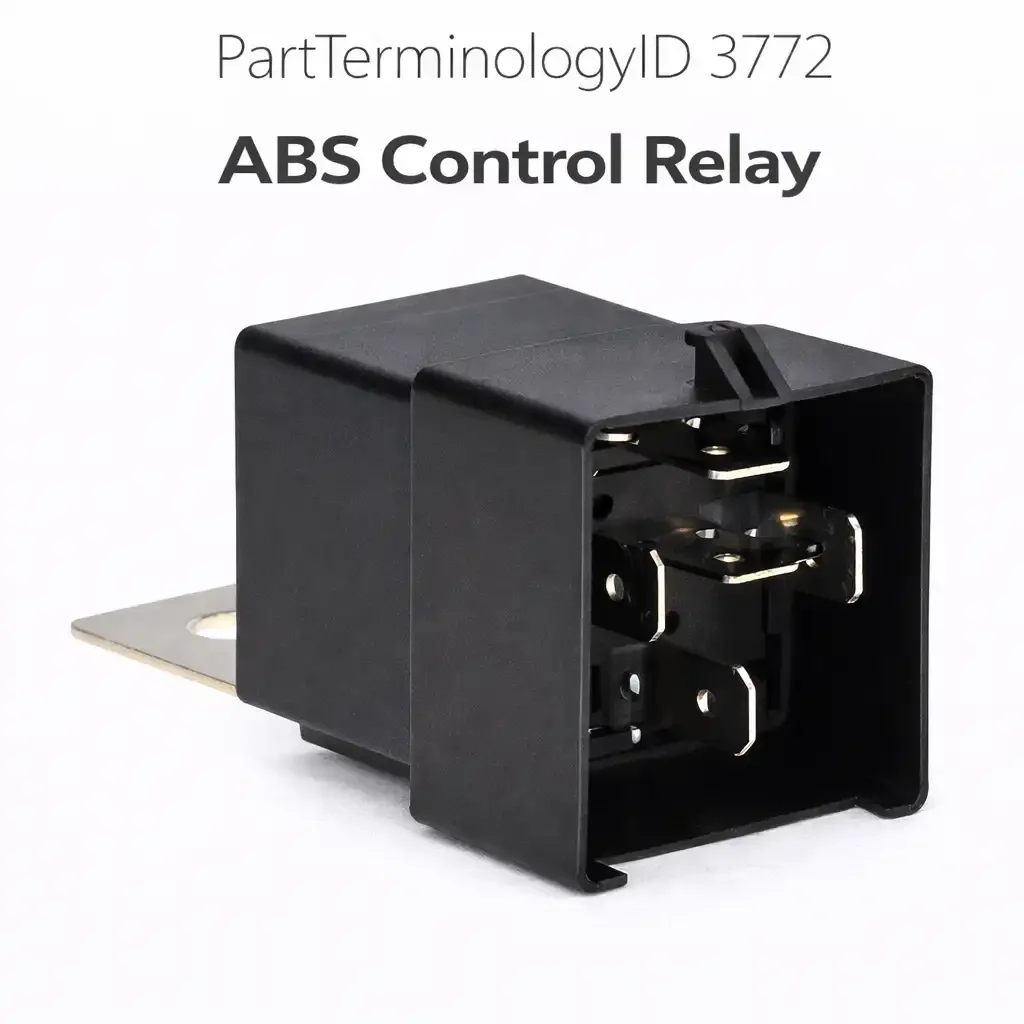
The ABS Control Relay, cataloged under PartTerminologyID 3772, is the main supply relay that delivers operating voltage to the anti-lock brake system's electronic control module and solenoid valve circuits. On applicable platforms, the relay closes when the ignition switch reaches the run or on position and supplies the ABS control module with the voltage it needs to initialize, monitor wheel speed sensors, execute self-test routines, and command the hydraulic control unit's solenoid valves during an ABS event. The relay remains closed throughout the ignition-on period. When the ignition is switched off, the ABS module completes its shutdown sequence and the relay opens, removing power from the ABS system.
The ABS Control Relay is distinct from the ABS pump motor relay, which is a separate component on most platforms and controls only the hydraulic pump motor during active brake pressure modulation. The control relay supplies the module's logic circuits and solenoid valve power rails; the pump motor relay supplies the high-current pump motor itself. Many platforms use both relays in parallel, each serving its portion of the ABS hydraulic control unit. On some platforms, particularly later-generation integrated ABS modules, one or both relay functions are handled by solid-state switching inside the EBCM or ABSCM rather than by discrete external relays. On these platforms, PartTerminologyID 3772 does not apply because there is no external relay to replace.
What the Relay Does
Module Initialization and Self-Test Supply
When the ignition reaches the run position, the ABS control relay receives its coil trigger from the ignition switch or from the body control module, closes its contacts, and supplies battery voltage to the ABS module's main supply terminal. The module initializes its internal processor, performs a self-test of the solenoid valve circuits, wheel speed sensor inputs, and internal relay driver circuits, and clears itself to operate. If the relay fails to close during this initialization sequence, the module receives no power, cannot complete its self-test, and sets a control relay fault code while illuminating the ABS warning lamp.
The module also monitors the relay circuit continuously during operation. It compares the supply voltage at its main supply terminal against a known threshold and monitors its own relay coil driver output. If it detects that the contact side of the relay is not delivering expected voltage when the coil is commanded closed, or if the coil driver circuit shows an open or short condition, it stores a system relay diagnostic trouble code and disables ABS function. This relay monitoring is why specific relay fault codes exist in the ABS DTC library: the module is reporting what it measured in the relay circuit, not what it inferred from system behavior.
Solenoid Valve Power Supply
On platforms where the control relay supplies the solenoid valve power rail, the relay's contact output also connects to the positive supply buss of the hydraulic control unit's solenoid valve block. The solenoid valves themselves are individually switched to ground by the ABS module's internal drivers, with the supply voltage held steady by the control relay. A failed control relay removes the solenoid valve supply rail voltage, which disables the ABS module's ability to modulate any of the individual brake circuits regardless of wheel speed sensor input.
On platforms where the control relay and pump motor relay functions are split, the solenoid valve supply may be provided by the control relay while the pump motor is supplied separately. This split architecture means a failed control relay silences the solenoid valves but does not necessarily prevent the pump motor from running, and a failed pump motor relay does not necessarily remove solenoid valve supply. The symptom of a failed control relay on a split-architecture platform is ABS warning lamp on with control relay fault codes and no ABS modulation capability, while the pump motor may or may not function depending on whether it shares its supply from the control relay or has its own.
ABS Warning Lamp Activation on Relay Failure
A failed ABS control relay produces an ABS warning lamp that illuminates at ignition-on and remains on throughout the drive cycle. The lamp does not extinguish after the self-test because the module either cannot initialize at all without supply voltage, or detects the relay circuit fault during its self-test and deliberately holds the lamp on to alert the driver. Normal braking function is maintained through the conventional brake circuit, but ABS modulation is disabled. The traction control and stability control systems, where equipped, are also typically disabled when the ABS module is non-functional, which may illuminate additional warning lamps for those systems alongside the ABS lamp.
Top Return Scenarios
Wheel Speed Sensor Codes Misidentified as Relay Faults
Wheel speed sensor faults are the most common cause of ABS warning lamp illumination and have no relationship to the control relay. Codes for left front wheel speed circuit malfunction, right rear excessive wheel speed variation, or any of the wheel speed circuit open or shorted codes indicate a fault in the sensor, its ring gear, the sensor harness, or the sensor connector, not in the relay. The relay's failure mode is a loss of supply voltage to the entire ABS module, which produces relay-specific codes: contact circuit open, contact circuit active, coil circuit open, or coil circuit short to ground or voltage.
A buyer who has an ABS warning lamp with one or more wheel speed sensor codes and no relay-specific codes does not have a relay fault. The relay can be confirmed functional in less than a minute by measuring supply voltage at the ABS module's main supply terminal with the ignition on. If supply voltage is present, the relay is closing normally and the fault is elsewhere in the system. Ordering the relay without this measurement based on an ABS warning lamp and wheel speed codes produces a no-correction return when the wheel speed sensor or its wiring is the actual fault.
Low Battery Voltage or Poor Ground Mimicking Relay Failure
A weak battery, a failing alternator, or a high-resistance main ground connection can produce ABS warning lamp illumination with low supply voltage codes (C1236, C0899, or platform equivalents) that superficially resemble a relay supply failure. The module requires a minimum supply voltage to initialize and operate. When the supply voltage drops below the module's minimum operating threshold, the module disables ABS function and sets a low voltage code. The cause is the charging system or battery condition rather than the relay, but the symptom is an ABS lamp with supply voltage codes that look to a buyer like the relay failed to deliver proper voltage.
The diagnostic separation is battery and charging system voltage measurement. Measure battery voltage with the engine running at idle. If charging system voltage is below approximately 13.5 volts, or if battery voltage with the engine off is below 12.4 volts, the charging system or battery is the primary fault and should be corrected before any ABS diagnosis proceeds. An ABS module that sets low voltage codes because the battery is at 11.8 volts at cold start does not have a relay fault, and replacing the relay while leaving the battery and charging system uncorrected will produce an immediate return of the same symptom.
ABS Pump Motor Relay Fault Misidentified as Control Relay
On platforms with separate ABS control and pump motor relays, a failed pump motor relay produces pump motor fault codes and disables the pump during ABS events, but does not necessarily remove supply voltage from the control module or solenoid valve circuits. A buyer who experiences ABS warning lamp with pump motor codes and orders the ABS control relay rather than the ABS pump motor relay will receive the wrong part. The code types are the separator: pump motor codes implicate the pump motor relay; control relay contact and coil codes implicate the control relay. On platforms where both relay positions are present in the fuse box, both the relay type and the socket location must be identified before ordering.
The PartTerminologyID distinction between the ABS Control Relay (3772) and the ABS pump motor relay (which may carry a different PartTerminologyID depending on platform) is meaningful and must be communicated in the listing. A buyer who does not know that these are separate components, each with its own relay socket and its own fault code set, cannot make an accurate part selection without guidance from the listing content.
Integrated EBCM Platform Without External Relay
Later-generation ABS systems on many platforms integrate the relay function into the EBCM's internal circuitry rather than using a discrete external relay. On these platforms, code C0265 (EBCM Relay Circuit) or similar relay-related codes indicate a fault inside the module itself rather than a failed external relay. A buyer with this code who searches for an ABS control relay and finds a fitment entry for their vehicle where no such entry should exist will order a relay, find no relay socket in their fuse box, and return the part.
An ABS warning lamp with a relay circuit code on a platform whose fuse box has no ABS control relay socket, or whose service information indicates that the relay function is internal to the EBCM, requires EBCM diagnosis or replacement rather than relay replacement. The listing's ACES fitment data must exclude these platforms. Including them generates a consistent stream of no-fit returns that are entirely preventable through application boundary verification.
Wiring Fault in the Relay Control Circuit
The relay coil circuit runs from the ignition switch or BCM output, through the relay coil, to the module's coil driver ground. A corroded connector at the relay socket, a broken wire in the coil trigger circuit, or a failed ignition switch contact produces a relay that never receives its coil trigger and never closes, even if the relay itself is functional. The symptom is identical to a failed relay: no supply voltage at the module, ABS lamp on, relay coil circuit codes stored.
Measuring coil trigger voltage at the relay socket before pulling the relay confirms whether the trigger is present. If trigger voltage is absent with the ignition on, the relay is not the fault. If trigger voltage is present and the relay contacts are not closing, the relay is the fault. This measurement takes less time than removing and substituting a relay and eliminates the wiring fault from consideration before a new relay is installed.
Listing Requirements
Every listing for PartTerminologyID 3772 should include:
ACES fitment data restricted to platforms with a discrete external ABS control relay, excluding platforms where the relay function is integrated into the EBCM, with application boundaries verified against the platform's factory wiring diagram and fuse box layout
A clear statement that wheel speed sensor codes do not implicate the relay, and that relay fault codes (contact circuit open, coil circuit open, coil circuit short) are the correct indicator for this part
A note distinguishing the ABS Control Relay from the ABS pump motor relay, including a description of which fault codes correspond to each component
A note that low battery voltage and charging system fault produce ABS warning lamp illumination and supply voltage codes that must be ruled out before the relay is ordered
A note that an ABS-capable scan tool is required to read the relay-specific codes that confirm this repair, as generic OBD-II scanners typically cannot read ABS chassis codes
Frequently Asked Questions
My ABS light is on. Is the control relay likely the problem?
An ABS warning lamp is consistent with a relay fault but is consistent with a much larger number of other faults, the most common of which are wheel speed sensor failures. The relay is confirmed as the fault when an ABS-capable scanner retrieves relay-specific codes rather than wheel speed sensor, solenoid valve, or pump motor codes. If the scanner returns codes pointing to wheel speed circuits, check the sensor, its tone ring, and the sensor harness before ordering any relay. If the scanner returns contact circuit or coil circuit codes specific to the system relay, the relay is the correct repair target. If no scanner is available, measure supply voltage at the ABS module's main supply terminal with the ignition on before ordering any component.
What codes specifically indicate this relay rather than other ABS components?
The relay-specific codes vary by platform but follow a consistent pattern. Generic codes C1214 (system relay contact circuit open), C1215 (system relay contact circuit active when it should be inactive), C1216 (system relay coil circuit open), C1217 (coil circuit short to ground), and C1218 (coil circuit short to voltage) directly reference the system relay. Code C0265 is used on some platforms for the EBCM relay circuit but on later-generation platforms indicates an internal module fault rather than an external relay. Wheel speed sensor codes in the C0035 through C0051 range and C1221 through C1235 range do not implicate the relay. Pump motor codes in the C0110 range and C1095 range implicate the pump motor relay rather than the control relay on split-relay platforms.
My vehicle has two ABS relays in the fuse box. Which one is the ABS control relay?
On platforms with two ABS relay positions, the control relay typically supplies the module logic and solenoid valve circuits, while the pump motor relay supplies the hydraulic pump motor. The relay positions are usually labeled in the fuse box diagram printed on the fuse box cover or in the owner's manual. The factory service information or wiring diagram will show which relay socket corresponds to which function. Relay fault codes from an ABS scan also identify which circuit is affected, which corresponds to a specific relay position on split-relay platforms. Do not substitute relays between the two positions based on appearance alone, as both positions often accept physically identical relay bodies.
Can I test the ABS control relay without a scan tool?
A basic functional test is possible. With the ignition on, measure voltage at the ABS module's main supply terminal with a multimeter. If battery voltage is present, the relay is closing normally. If voltage is absent, remove the relay and measure for coil trigger voltage at the relay socket's coil terminal with the ignition on. If trigger voltage is present and the relay contacts were not delivering output, substitute a known-good relay or bench-test the suspect relay by applying battery voltage to the coil terminals and confirming contact continuity with an ohmmeter. However, a scan tool with ABS code reading capability is the most efficient diagnostic path because relay fault codes confirm the relay as the specific fault before any components are removed.
Will a bad ABS control relay disable traction control and stability control?
Yes, on most platforms. Traction control and electronic stability control systems share the ABS wheel speed sensor inputs and hydraulic control unit with the ABS system. When the ABS module is disabled because the control relay has failed and the module cannot initialize, the traction control and stability control systems are also disabled as a consequence. Warning lamps for traction control off and stability control unavailable typically illuminate alongside the ABS warning lamp when the control relay has failed. These additional lamps extinguish when the relay fault is corrected and the ABS module initializes normally.
What Sellers Get Wrong
Listing the relay as a general ABS light repair without code context
The ABS warning lamp illuminates for a wide variety of reasons, the large majority of which have nothing to do with the control relay. Wheel speed sensor failures, tone ring damage, sensor harness faults, pump motor faults, solenoid valve faults, and low battery voltage all produce ABS warning lamp illumination. A listing that presents the control relay as a broad solution for ABS warning lamp complaints will attract the majority of buyers whose complaint has nothing to do with the relay, all of whom will return a functional relay after confirming through testing or scan tool that their actual fault is a wheel speed sensor or a worn tone ring.
Not distinguishing the control relay from the pump motor relay
Buyers who are unfamiliar with the two-relay ABS architecture do not know that their vehicle has separate relays for the module supply and the pump motor. A listing that does not explain this distinction, and does not describe the specific codes that implicate the control relay rather than the pump motor relay, will receive orders from buyers who have pump motor fault codes and need the pump motor relay. These buyers install the control relay, find the codes persist, and return it.
Not flagging EBCM-integrated platforms
The most damaging application error in this PartTerminologyID is including platforms where the relay is internal to the EBCM. Buyers on these platforms order the relay, cannot find the relay socket, and return it. Every platform-level application entry that has not been verified against a fuse box diagram is a potential no-fit return.
Not addressing the scan tool requirement
Generic OBD-II scanners commonly sold at auto parts stores do not read ABS chassis codes on most platforms. A buyer who checks for ABS codes with a generic scanner, gets no codes, and concludes the relay must have failed because nothing was found has not actually accessed the ABS code memory. The listing should note that ABS-specific codes require a scanner with ABS/chassis diagnostic capability, and that the presence or absence of relay-specific codes in that memory is the correct diagnostic gate before ordering this relay.
Cross-Sell Logic
ABS pump motor relay (the companion relay on split-relay platforms; pump motor fault codes implicate the pump motor relay rather than the control relay; buyers who are unsure which relay they need benefit from content that distinguishes the two by code type and fuse box position)
Wheel speed sensor for each corner (the highest-probability cause of ABS warning lamp illumination; wheel speed sensor codes occur far more often than relay codes; a buyer who has confirmed relay fault codes does not need a wheel speed sensor, but a buyer who has only wheel speed sensor codes should be directed here rather than to the relay)
ABS fuse for the control relay supply circuit (a blown control relay supply fuse produces a no-power condition at the relay contact terminal that presents identically to a failed relay; the fuse must be checked and replaced before any relay order, and a recurring blown fuse indicates a short circuit that will destroy the replacement relay)
Battery or battery terminal hardware (low supply voltage is a common source of ABS warning lamp and low voltage codes; a battery that cannot maintain adequate voltage at cold start produces ABS initialization failures that look like relay faults until charging system voltage is measured)
ABS control module or EBCM (relevant when relay-specific codes indicate a coil driver fault that traces to the module's internal driver rather than an external wiring or relay fault, or when the platform uses an integrated relay requiring module replacement)
Relay socket repair harness or relay socket connector (corroded relay sockets are a common cause of relay contact and coil circuit codes; socket terminal corrosion produces the same high-resistance symptoms as relay contact failure and should be inspected before the relay is condemned as the fault)
Final Take
PartTerminologyID 3772 sits at the intersection of two diagnostic filters that must both be applied before an order is correct. The first is the application boundary filter: only platforms with a discrete external ABS control relay have any use for this part, and integrated EBCM platforms where the relay function lives inside the module must be excluded from the fitment data. The second is the code specificity filter: the ABS warning lamp illuminates for a wide range of faults, most of which are wheel speed sensors, and only relay-specific trouble codes from an ABS-capable scanner distinguish this relay as the fault from the much larger population of sensor and wiring complaints.
Buyers who arrive at this relay with relay contact or coil circuit codes, who have confirmed supply voltage absent at the module terminal despite coil trigger voltage present at the relay socket, and who have verified battery and charging system voltage is adequate, have done the correct diagnostic work and will be satisfied with the repair. The listing content that prevents returns is the content that redirects every other buyer — the one with wheel speed sensor codes, the one with a low battery, the one with an integrated EBCM platform, and the one whose relay socket has corroded terminals that need replacement rather than a new relay sitting in degraded contacts.